While we were in Italy this summer, my wife and I did the usual tourist things in Rome, visiting the Roman Colliseum and Forum and the Vatican. I noticed something at St Peter’s which is reported first here at Climate Audit.
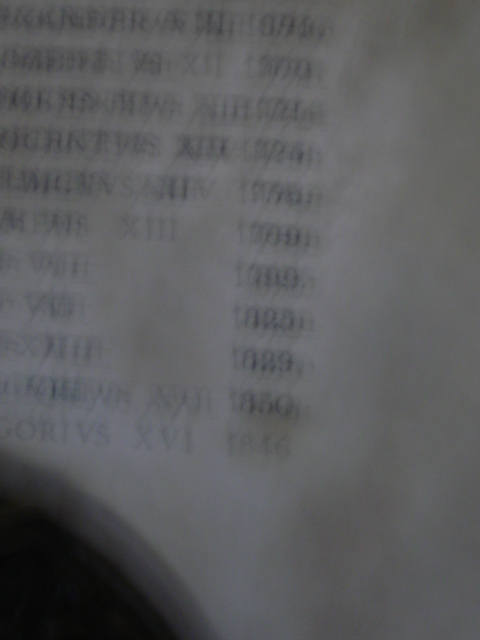
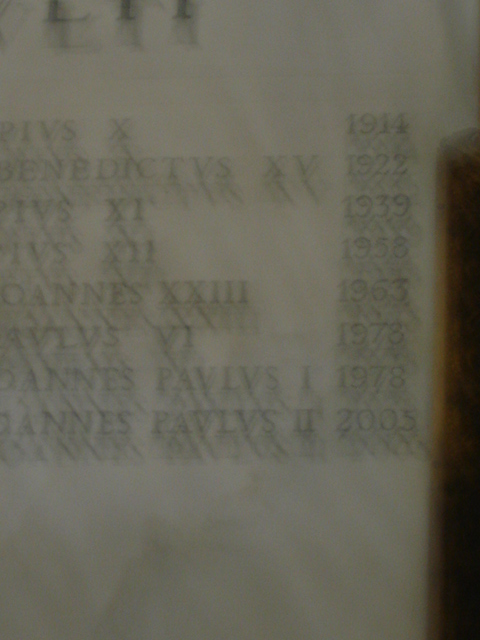
St. Peter’s was mostly built in the 1500s, with the architecture done around the time of Michelangelo in the early 1500s and opening in the early 1600s. Inside the basilica, there are many monuments to past popes, mostly in the 2nd millennium. On the left side of the nave, there is a plaque showing a list of popes from St Peter to John Paul II, which I show below. For some reason, I stopped and looked at the list of popes. I’m not sure why. I apologize for the poor quality of the photo. Better picture here (thanks to Bernd).

When I looked at this list, I found myself subconsciously looking at time series properties. There were notably more first millennium popes than second millennium popes. So I looked more closely at the centuries with the most and fewest popes.
The tenth century had the most popes. That was a period of turbulence within the church, when sometimes a pope was in office for only a day or two. But even if he was in office only a day or two, he’s on the list at St Peter’s. So that sort of made sense.
The 19th century had the fewest popes – remarkably few. I looked how long individual 19th century popes were in office. Gregory XVI is shown as dying in 1846, while the next one on the list (Pius X) is shown as dying in 1914. You can confirm this for yourself from the (poor quality) photographs here here which show the entry for Gregory XVI -1846 at the bottom of one column and Pius X – 1914 at the top of the next.
[At face value], this implied that Pius X was in office for an astounding 68 years, a couple of years longer than Ramesses II. While I suppose that someone could have become pope at 31 and died at 99, it seemed like the sort of thing that I would have heard about before. Anyway I was intrigued enough to document the plaque (my wife rolling her eyes and laughing, but she’s used to me.)
The actual order of 19th century popes here is:
Pius VIII (1829-30)
Gregory XVI (1831-46)
Blessed Pius IX (1846-78)
Leo XIII (1878-1903)
St. Pius X (1903-14)
What happened? The list at St Peter’s left out Blessed Pius IX (1846-78) and Leo XIII (1878-1903).
UPDATE: An alert reader points out below:
As the title of the plaque says in Latin, it lists all the popes who are entombed in St. Peter’s basilica. The two missing popes are not; Pius IX was transferred to San Lorenzo fuori le Mura, while Leo XIII is in San Giovanni in Laterano.
In response to this, I observed in a comment below that that Innocent III, a faous early pope, was also buried in San Giovanni in Laterano. The same reader observed that Innocent III is not on the list.:) In fact, there was about a 100-year gap in burials at St Peter’s in the 13th century. So the puzzle of the seeming 68-year reign is solved. Thanks, Bernd.
UPDATE 2: Demetris has sent in the following graphic of pope reigns – see below.





 Climate Audit

21 Comments
Perhaps they did not support the consensus and were therefore ‘eliminated’ from the record.
I bet they were troublemakers.
Steve: Nope. The list includes popes for a day in the 10th century. And one of the two left out was “Blessed” Pius IX, one of the few popes so honored.
High in the 10th century and low in the 19th century. I thought sure we had hockey stick coming. Of course there would have been a 20th century divergence, but hey, it team can snip and extend, I’m sure the RCC could too.
There are easy explanations: the transcriber thought the ‘Blessed’ was redundant to a Pius IX elsewhere and considered the Thirteenth Lion unlucky, so deleted them both, consciously or not.
======================================================
I’m rolling my eyes and laughing, too.
Good eye, Steve!
Sorry to burst your bubble, but the explanation is quite simple: As the title of the plaque says in Latin, it lists all the popes who are entombed in St. Peter’s basilica. The two missing popes are not; Pius IX was transferred to San Lorenzo fuori le Mura, while Leo XIII is in San Giovanni in Laterano.
Steve: CA readers are a resourceful lot. One should be careful about jumping to conclusions. Bernd, if all the popes for nearly 2 millennia, even the popes for a couple of weeks, were buried at St Peter’s, why weren’t these two popes?
snip (OT) – but the answer is that the sampling is non-destructive.
Bernd, I checked on Innocent III about whose tomb it says here:
That doesn’t sound like he’s buried in St Peter’s. I’ve withdrawn the assertion that two popes were “left out”. But having said that, are you sure that Innocent III are the other listed popes are buried there?
Steve: No, I’m not sure all the listed popes are buried there. Innocent III is apparently not, but his name is also not on the plaque 🙂 . I was certainly jumping to conclusions myself here, based on a rudimentary grasp of latin and the conviction that the Catholic church is much more diligent than the Curch of Global Warming. BTW, are clearer picture of the plaque can be found here: http://upload.wikimedia.org/wikipedia/commons/4/49/List_of_Popes.jpg
Cheers,
Bernd
Leo XIII is one of six popes buried at Laterano. It is the top cathedral of Rome, and thus the mother church of Roman Catholics. Why be buried there? I dunno. Popes do have favorite saints, churches, etc. that they choose to honor. Probably just a personal thing.
#9. 🙂 You’re right about Innocent III. In fact, it jumps nearly 100 years in the 13th century between buried popes. Problem solved.
What an interesting coincidence for me! It happened to be in Rome for a month and yesterday I visited the Vatican and St Peter with my wife. But this weekend the entrance was free (I think this happens once a year) and there were tens of thousands of people visiting the Vatican. In these crowded conditions, we could not observe any detail there. So thanks very much, Steve, for your post which complements my visit and also thanks for your smart observations which indicate the similarities of the succession of popes with climatic/natural time series.
It will be not a surprise if the series of popes exhibits some Hurst-Kolmogorov properties, i.e. fluctuations on several scales. Such behaviour could be induced by several types of reasons, including socio-political (turbulent vs. stable times), health (epidemics, changes of life duration) and even climate, all of which have some persistence.
Although an analysis of this series would require a setting different from a typical time series, I made a self-explanatory plot which shows a long-scale fluctuation. A first estimate of the Hurst coefficient is around 0.7.
When I visit Constantinople I may complete my analysis with Patriarchs. 🙂
Steve: Here’s Demetris’ graphic:
Re: Demetris Koutsoyiannis (#12),
It may also be related to if there is a particular age range that the electors tend to choose from during some era. If they choose younger popes that would probably reign longer than if they choose more senior ones.
Re: Demetris Koutsoyiannis (#12),
If you eyeball a continuation of the running average, there is an incipient but quite clear hockey-stick developing.
AFAIK the entrance to the Church is always free. The paid sections are the Apartments and the Basilica (mainly to control numbers). Funnily enough I also took a photo of the Pope list as I thought it looked interesting – never bothered to actually read it! The area where St Peter is supposed to be buried is the eeriest by far.
Could we use this list as a climate proxy?
Steve
Next time you’re inside a building, taking a photograph of something in detail – use the flash.
My wife and I were there this past August (low season) 8:30 in the morning the place was almost empty. We stayed at a small hotel (Palazo Cardinal Cesi) which is about 100M from the opening of St Peters Square. Best vacation I have ever had. The sculptures in the basilica just took my breath away, I am not Catholic (my wife is) but you really feel the devotion of the various artists.
I took many many pictures (where allowed), flash doesn’t help due to the vastness of the building. Set mine for low light shooting which didn’t help too much as I am not the most steady hand. While a picture may be worth a thousand words they still do not fully capture the awe. If ever you have the chance, go see it.
Life expectancy of ordinary people should be a good climatic proxy.
More heat, longer life (life “forcing” in IPCC speak) , what a catastrophe!
What about the periods when there were multiple Popes? 😉
Steve, to avoid other possible misunderstandings, let’s remember that Roman Catholic Church had a very troubled history until Napoleon.
Just to make an example, most of the Popes during XIVth century lived in Avignon, south-east France, where they were almost “prisoners” of the kings of France: http://en.wikipedia.org/wiki/Avignon_Papacy
Anyway, it would be interesting to know your opinions also the art, architecture, and other buildings and ruins in Rome, and also on that part of Italy and its inhabitants (just curiosity).