Polar Urals Spaghetti Graph

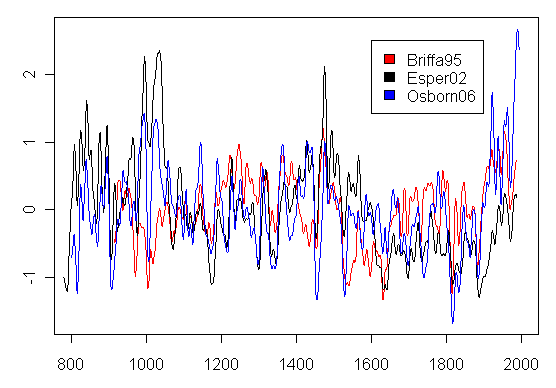
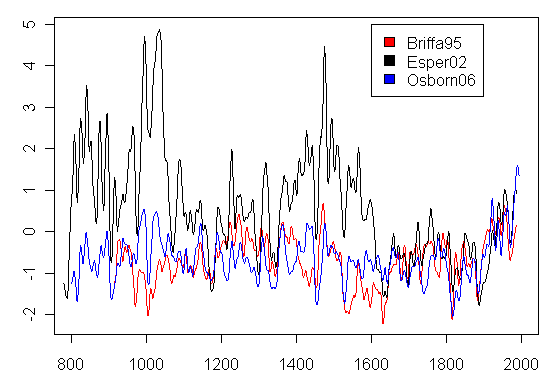
I’ve got to get back to the NAS presentation and this will be my last post on Polar Urals and Yamal for a while, but it is all quite delicious. Anyway, here is a spaghetti graph of 3 Polar Urals results – including the results from Esper et al [2002] just disclosed by Science, all standardized on 1902-1980 in standard Hockey Team fashion. Just put on your Hockey Team 3-D spectacles and you’ll be able to see that the spaghetti graph shows a remarkable similarity between the 3 reconstructions.

Figure. Spaghetti Graph of Polar Urals – Briffa et al [1995]; Esper et al [2002]; Osborn and Briffa [2006] using Briffa [2000].

Here’s what it looks like if it’s scaled on the full series.

Polar Urals: Briffa versus Esper

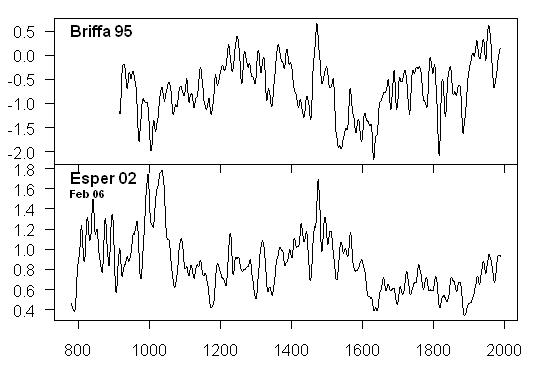
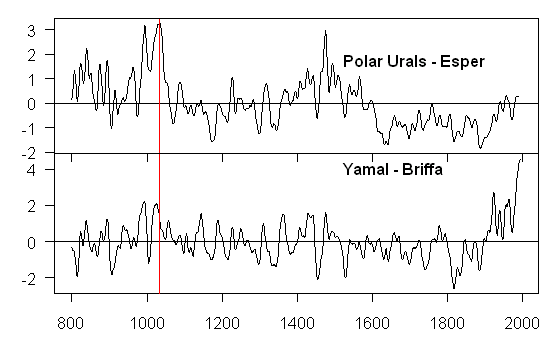
It’s interesting that the Hockey Team seems to be able to make spaghetti graphs of world temperature history when they can’t even arrive at a spaghetti graph for the Polar Urals. I posted up the difference between Briffa’s Yamal substitution and the updated Polar Urals ring widths. But before either one, there was Briffa’s Polar Urals temperature reconstruction – which I’ve discussed on many occasions (see Category – Jones et al 1998). Briffa’s Polar Urals reconstruction [Nature 1995] was widely applied in the multiproxy studies and even singled out in IPCC 1995. It stated that 1032 was the "coldest year of the millennium" and that the early 11th century was cold. It was instrumental in supporting the view that everything in the MWP was regional and inconsistent. So how does Briffa’s Polar Urals version compare with the recently disclosed version used in Esper et al [2002]?

Well, the early 11th century is obviously not especially cold – quite the opposite. The correlation between the series is 0.11 (and between the 40-year smoothed version shown below is 0.07). Spaghetti for two, anyone?


Figure 1. Polar Urals. Top – temperature reconstruction from Briffa et al [Nature 1995]; bottom – ring width chronology from Esper et al [2002], as provided in email from Science [Feb 2006].

Reply to Science

As noted a couple of days ago, I received a response from Science in respect to my request for data from Osborn and Briffa [2006]. They asked that the response be confidential, but pointed me to a file archived at WDCP on Feb. 9, 2006, which proved to contain, not original data, but smoothed versions of the 14 series used in the article.

In addition, they sent me time series for 13 of 14 sites in Esper et al [2002], but they did not remedy the missing measurement data for either article. I should mention that WDCP (www.ngdc.noaa.gov/paleo) contains measurement data sets for hundreds of tree ring sites – so it is not heavy lifting for these authors to archive tree ring measurements as used.

Anyway here’s my reply to Science: Continue reading

Moberg Corrigendum

If you look at the Category Moberg on the right frame, you’ll see discussion of frustration that I had in connection with replication of this article and, in particular, with the Lauritzen series. Yesterday, the following Corrigendum was issued:

The authorship of this Letter is amended to include Stein-Erik Lauritzen. Details of the SàƒÆ’à‚ⷹlegrotta Cave record (series 8 ), which should have been accredited to S.-E.L., were not supplied in the paper but are available from the corresponding author (A.M., anders.moberg@natgeo.su.se) on request. In addition, the tree-ring-width data from the Indigirka river region (series G) were inadvertently used without the proper permissions: although the series has been discussed in the literature 1, they are unpublished data that have not been made publicly available; they may, however, be obtained through A.M.

1. Sidorova, O. V., Naurzbaev, M. M. Response of Larix cajanderi to climatic changes at the Upper Timberline and in the Indigirka River Valley [in Russian]. Lesovedenie 2, 73—75 (2002).

I’ll write Moberg and see if I can finally get the data in question.

It’s interesting to see how Lauritzen played his hand in this – and maybe this sheds some light on why people are reluctant to archive data. If Lauritzen had simply archived his data in the first place, he would have got a footnote in the original article. Because Moberg had to clean up his supply of data, it appears to me as though Lauritzen had Moberg over a barrel and his price for data access was being added as an author in a Nature publication – coin of the realm in academia. Maybe there’s some other explanation – I hope that there is.

However, this raises another interesting question. There’s been a lot of criticism lately (e.g. in connection with Hwang) about including authors on the masthead of a paper who had nothing to do with the writing of the paper. I suspect that someone can even find some prononucements by Nature on the topic. Here’s a black-and-white example where Lauritzen obviously had nothing to do with the original paper – as evidenced by the fact that the original authors didn’t mention him (and the omission was not accidental.) Nature knew this and still permitted Lauritzen to be added as an author, even though he had nothing to do with the original paper. Does this seem inconsistent to anyone else?

Reference: Anders Moberg, Dmitry M. Sonechkin, Karin Holmgren, Nina M. Datsenko, Wibjörn Karlén and Stein-Erik Lauritzen, 2006. Corrigendum: Highly variable Northern Hemisphere temperatures reconstructed from low- and high-resolution proxy data. Nature 439, 1014(23 February 2006) | doi:10.1038/nature04575

Polar Urals “Grass Plot”

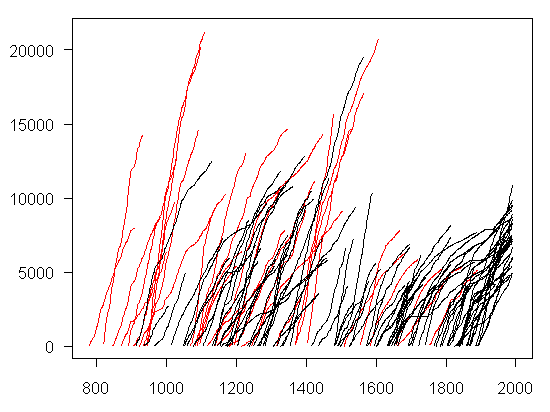
Here’s another look at Polar Urals using a “grass plot” showing cumulative ring width for individual trees against time. The trees plotted in black are from the original archive (russ021) and the ones plotted in red are form the 1998 update (russ176). This gives a little different viewpoint on variance stabilization issues. First, one of the resaons for the change in the update is simply the addition of several very large medieval trees – remember that Shiyatov said that the medieval period was especially favorable. Also you see the much increased relication in the eleventh century where I’ve argued that Briffa et al 1995 misdated 3 cores – and that their “cold” 11th century was an artifact of incorrect crossdating.

Variance Stabilization in Esper Chronologies

Yesterday, Science sent me 13 Esper site chronologies, all standardized using RCS methods, one of which is the updated Polar Urals site. It’s hard to think of a better testing ground for Rob’s argument that the variance of the Polar Urals series disqualified it and mandated the substitution of the hugely hockey-stick shaped Yamal series. See http://www.climateaudit.org/?p=541

In the spirit of spaghetti graphs, I have calculated 101-year moving variances for all 13 Esper sites, along the lines of Rob’s graph. I then scaled them all to have a mean of 0 and standard deviation of 1 . Here’s what I got, with the Polar Urals series shown in heavy black. Using the dendroclimatological statistical technique of "eyeballing", I do not observe any reason why the Polar Urals series is particularly problematic.

Figure 1. Spaghetti graph of 101-year moving standard deviations (scaled).

The red series caught my eye as it seemed to have a lot of similarity to the Polar Urals series in range. So I’ve plotted it and the Polar Urals series below. Guess what it was – the usual companion to Polar Urals: Tornetrask. So the variance at Polar Urals does not seem at all unusual relative to Tornetrask.


Figure 1. Non-spaghetti graph of 101-year moving standard deviations (scaled) for Polar Urals and Tornetrask.

An Open Letter to Science

An open letter has been sent to Science on archiving by Benny Peiser, Sir Colin Berry, Freeman Dyson, Chris de Freitas, Mick Fuller and Lord Taverne. Here it is:

22 February 2006
Science
R. Brooks Hanson
Managing Editor, Physical Sciences, Science
American Association for the Advancement of Science

Dear Dr Hanson

In early March, the National Research Council of The National Academies of the United States is convening a committee to study “Surface Temperature Reconstructions for the Past 1,000-2,000 Years”. According to the NAS announcement, “the committee will be asked to summarize the current scientific information on the temperature record over the past two millennia, describe the proxy records that have been used to reconstruct pre-instrumental climatic conditions, assess the methods employed to combine multiple proxy data over large spatial scales, evaluate the overall accuracy and precision of such reconstructions, and explain how central the debate over the paleoclimate temperature record is to the state of scientific knowledge on global climate change.”

In order for the NAS panel and the invited scientific experts to evaluate the overall accuracy and precision of temperature reconstructions based on multiple proxy data, it is essential that a complete archive of the data is made available. This is particularly relevant for a number of contentious papers published in Science that will feature prominently during the NAS assessment.

We understand that some authors of paleo-climate reconstructions published in Science (Osborn and Briffa, 2006; Thompson et al., 1989; 1997; Esper et al., 2002) have failed to provide complete data archives. We would like to ask Science to ensure that the NAS assessors and scientific experts will have full access to the data and that the authors in question provide a complete archive as required under Science policies.

Yours sincerely

Benny Peiser, Liverpool John Moores University, UK
Sir Colin Berry, Queen Mary, University of London, UK
Freeman Dyson, Institute for Advanced Study, Princeton, USA
Chris de Freitas, The University of Auckland, New Zealand
Mick Fuller, University of Plymouth, UK
Lord Taverne, House of Lords, UK

Liverpool, 22 February 2006
Wilson on Yamal Substitution

Rob Wilson has written in sharply criticizing me (Yamal Substitution #3) for a lack of a balanced presentation on the Yamal substitution, and, in particular, for not acknowledging the "clear statistical reasons (related to variance changes through time)" that he had provided me offline for why D’Arrigo et al 2006 made the Yamal substitution.
Also see here here here here

Continue reading

Yamal Substitution #3

There’s some very important new information related to the “Yamal Substitution” – which sounds like a Ludlum novel title – in the Esper site chronologies which Science provided today. Also see here here here.

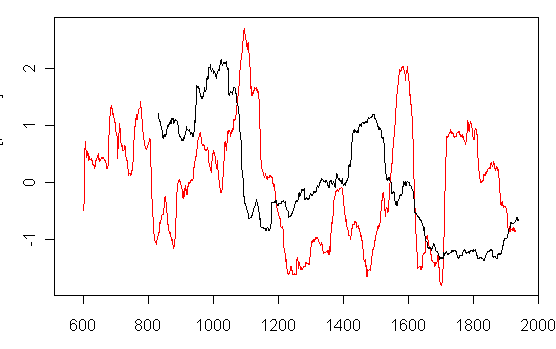
Here’s a plot of a 40-year smooth of the Esper site chronology for Polar Urals and Briffa’s archived version of the Yamal substitution (which is in the same general area).
Continue reading

A Reply from Science

A couple of days ago, I posted up a copy of a letter that I sent to Science on archiving or non-archiving in connection with Osborn and Briffa 2006, Esper et al [2002] and Thompson et al 1989 (Dunde); 1997 (Guliya).

I received a reply from Science today, which they stated was not for “public posting”. I don’t understand the idea of official organizations purporting to deal with formal complaints on an off-the-record basis.

Since relevant information was provided in the email, I presume that it’s OK to transmit the sense of the email.
Continue reading