This post was written in 2018 but not published. I noticed it the other day (Sept 30, 2026) and am posting it up.
Al Gore’s Inconvenient Truth prominently featured Dr Thompson’s Thermometer as supposed support for Mann’s hockey stick (see here). Dr Thompson’s “thermometer” included three Himalayan ice cores (Dunde, Dasuopo and Guliya) and three Andean ice cores (Quelccaya, Sajama and Husacaran.)
Dunde was Thompson’s first core. Thompson dated the basal portion of the Dunde core to the Last Glacial period – with values as old as 40000 BP. Thompson only archived d18O data for the most recent 1000 years, only showing earlier values in the bizarre figure shown below. Note that the rightmost quarter of this figure covers 145 years, while the leftmost quarter covers approximately 36,000 years and that there is a possible gap at about 1000 years ago. But it’s not a log scale. The histogram is from a sort of long-term mean, but it’s not clear how the mean was calculated. Overall, the diagram is a mess and the archiving is worse.
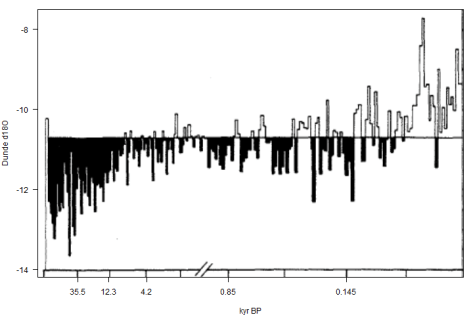
In polar regions, d18O values are depleted in glacial periods. At Dunde ( a rather short core), Thompson interpreted the relatively depleted d18O in the basal 10 meters, dated by Thompson to the Last Glacial period, as evidence of cold and more recent less depleted d18O values as evidence of warmth. This is the basis of “Dr Thompson’s Thermometer”.
A few years ago (December 14, 2014), I commented on the possibility that Thompson totally screwed up the dating as follows:
The Dulan area of China is desert or near-desert. Curiously it is relatively near Thompson’s original Dunde ice core.
There is very interesting speleothem d18O data from China covering very long periods in high resolution, a set of data that ought (in my opinion) to have been specifically noted up in the IPCC assessment, as opposed to so much focus on more reworking of bristlecones etc. I’ve been meaning to write up the Chinese data for a long time.
In the Holocene optimum, the Chinese monsoon was very strong and resulted in very depleted O18 values in speleothems and undepleted values in the LGM. This raises a very interesting question for the interpretation of Lonnie Thompson’s Dunde ice core, which does not (as interpreted) contain the prominent Holocene Optimum of the nearby speleothems, but does contain very depleted O18 values downhole, which Thompson interpreted as LGM.
If the d18O values in Dunde ice core tracked the d18O values in nearby speleothems, the very negative (depleted) basal values should be dated to the warm and humid Early-to-Mid Holocene (10000-6000 BP), almost 30000 (!) years after Thompson’s dating. The important corollary: if highly negative d18O values are associated with warmth, rather than the Last Glacial, Dr Thompson’s thermometer, as shown in the Al Gore movie, was upside down.
Chinese Speleothems – High-resolution d18O through the Holocene
Over the past 15 years (though almost entirely ignored by the PAGES2K crowd), China has been a remarkable source of high-resolution accurately-dated speleothem records which, on the one hand, come to the present day, and, on the other hand, reach back to the mid-Holocene or even the LGM.
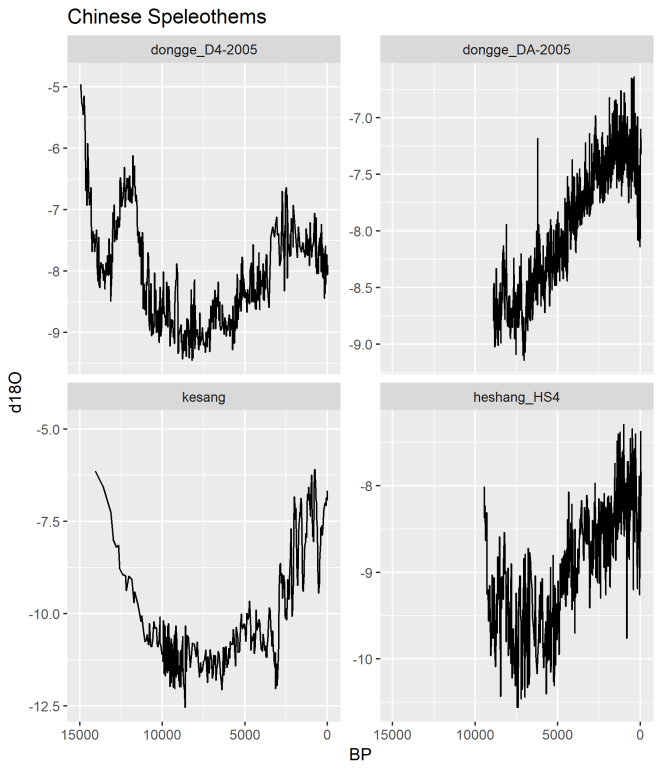
From these many records, I’ve illustrated four records which (1) reach back to the Early Holocene, and, preferably, also to the Last Glacial Maximum; (2) reach forward to at least the last half of the 20th century and, preferably, to AD2000; (3) decadal or, at worst, 20-year resolution. Vertical scales shown here vary from speleothem to speleothem. Unlike the frustratingly inconsistent squiggles of he inconsistent tree ring records promoted by Mann and PAGES2K, there are important consistencies in these records: d18O values were depleted (highly negative) in the early-to-mid Holocene (~10000-5000 BP), increasing to the late Holocene, leveling off or with a hint of slight reversal in the most recent millennium. In the other direction, d18O values become less negative in the LGM. These features are characteristic of all Chinese speleothems, not just the ones shown here. The overall behavior of d18O in Chinese speleothems is the exact opposite of Thompson’s thermometer: more negative in the warm and humid Early Holocene; less negative in the Last Glacial.
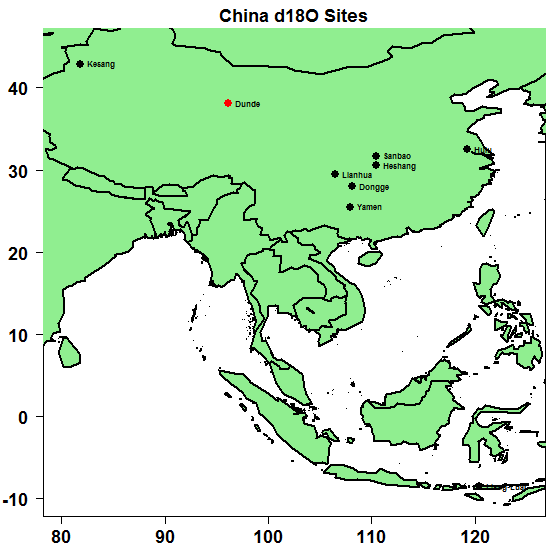
The location of Thompson’s Dunde ice core is bracketed by the speleothems shown above. Dunde is located in west-central China, more or less half-way between Dongge, Heshang and other sites to the east of Dunde and Kesang in the far west, as shown below. The depletion maximum in the early-mid Holocene at such distant speleothem sites strongly supports the expectation of a similar pattern in the Dunde ice core.
The inconsistency between Dunde and Kesang, used here as an example, is shown in the next figure, vividly showing Kesang d18O becoming less depleted in the Last Glacial, while Dunde (according to Thompson) becomes less depleted.
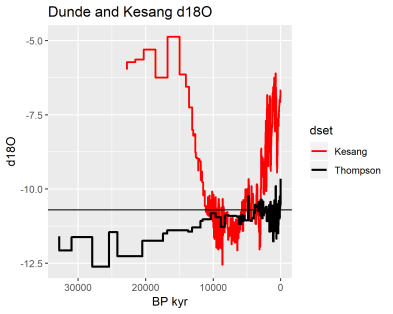
The most obvious reconciliation of the discrepancy is that Thompson’s ice core is radically misdated. I’ve long been suspicious of the dating of Thompson’s ice cores as being dated far too early. One of the very few of my AR4 review comments which was acknowledged by IPCC was my criticism of Thompson’s dating of Kilimanjaro, as a result of which IPCC withdrew the claim that “the current retreat is unprecedented in the Holocene (Thompson et al., 2002)” – see here.
I’ve had a particular disbelief in dating of the Dunde and Guliya cores, particularly when I noticed a dramatic inconsistency between d18O data from Chinese speleothems on either side of the Dunde ice core (which is located near Dulan, a tree ring site in the western Chinese desert.) A priori, the dating of the speleothem should be preferred. Ice cores are severely compressed towards their base. Basal dating is done by fitting an exponential curve. Errors in a single parameter can explode rapidly. In contrast, speleothems have multiple dating points.
Cheng et al, 2012
Thompson is such an important figure in paleoclimate that specialists have been very wary of broaching the above topic, though it ought to be obvious to anyone in the field. I recently noticed that the nettle was gingerly grasped in the the Supplementary Information to Cheng et al, 2012. The climatic cyclicity in semiarid-arid central Asia over the past 500,000 years pdf. In their Figure S11 – which I’ve re-arranged and annotated below for additional clarity – , they show astonishing compression of Dunde and Guliya dates, along the lines of what I had in mind.
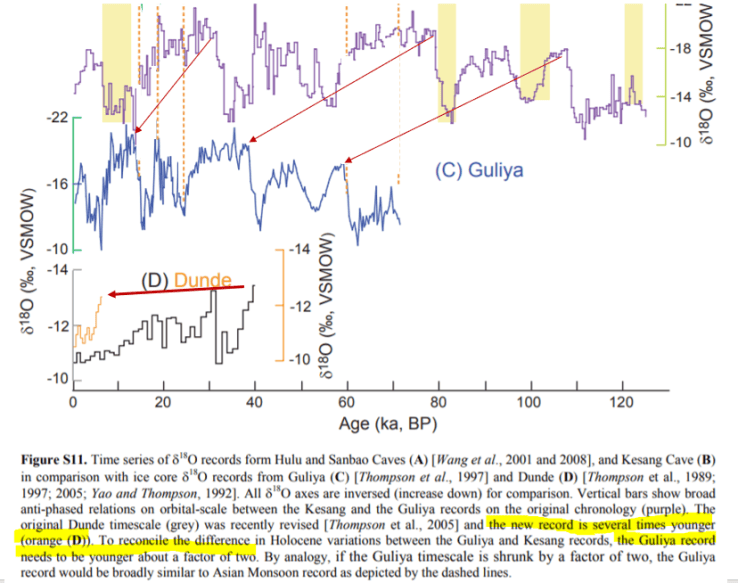
The base of the Dunde ice core – series (D) below – is re-dated from ~40000 BP (in the Last Glacial) to ~6400 BP (mid-Holocene). Note that the vertical scale is reversed – more depleted values up. This re-dating was motivated in part by belated disclosure in 2005 by Thompson et al (pdf) of organic material beneath the glacier dated to 6440 BP. With this radical re-dating, the shape of the Dunde ice core – more depleted in the mid-to-early Holocene – is consistent with the speleothem results. Cheng et al also proposed a reduction of Guliya dates by about 50% across the board – not nearly as severe as at Dunde. It seems to me that they still do not have secure dating for Guliya and that even more radical re-dating, commensurate with Dunde re-dating, may be another shoe to drop.
In the article itself, rather than directly and unambiguously calling out Thompson’s screwed up results, Cheng et al offered weasel words, falsely conceding the possibility that Thompson’s seemingly upside-down interpretation of Dunde might be due to differences in elevation and locality:
“Both the Guliya and Kesang relationships could be valid, with differences related to the different elevations and localities of the sites”.






One Comment
Thanks, Steve, just like the good old days. Small error?: “while Dunde (according to Thompson) becomes less depleted” should be “more depleted”? Cheers, Simon Scott