The Team versus Stott et al 2004

The Team (at both realclimate and NOAA) have stated in the strongest possible terms that the Holocene Optimum was restricted to summer in the NH extratropics. Reviewing their positions, realclimate here

The [Holocene Optimum] is a somewhat outdated term used to refer to a sub-interval of the Holocene period from 5000-7000 years ago during which it was once thought that the earth was warmer than today. We now know that conditions at this time were probably warmer than today, but only in summer and only in the extratropics of the Northern Hemisphere.

NOAA (with a very recent update in Nov 2006) stated:

In summary, the mid-Holocene, roughly 6,000 years ago, was generally warmer than today, but only in summer and only in the northern hemisphere.

On a previous occasion, I discussed recent findings of Newton et al with convincing evidence of an MWP in the Pacific Warm Pool (as well as related evidence in Stott’s webpage (the series is identifiable as MD81 although not specifically identified on the webpage.) Here is an important graphic from Stott et al (Nature 2004) showing the location of 3 cores in the PAcific Warm Pool (top) with Mg/Ca temperature series and dO18 salinity series below, about which Stott says the following: Continue reading

1933

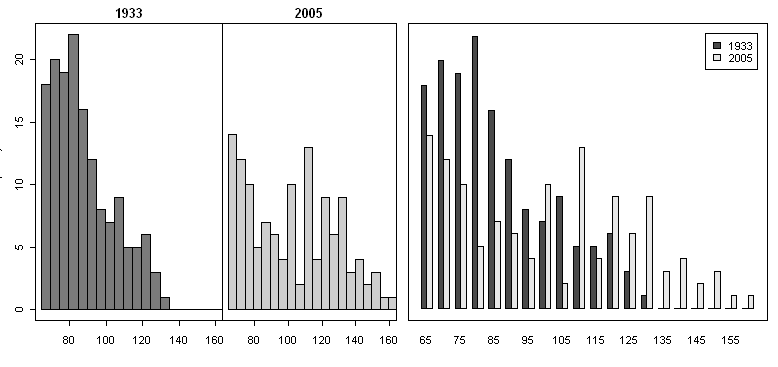
Earlier we noted that the number of hurricane-days in 1933 actually exceeded the number of hurricane-days in 2005. However, the 2005 PDI was significantly higher than 1933 PDI, which indicates fairly trivially that hurricane speeds in 2005 were estimated to be higher than 1933. So here is a histogram of 1933 compared to 2005 wind-speed counts in 5 knot increments – first a 1933 histogram, then a 2005 histogram and then the same data side-by-side. Obviously the 2005 distribution is skewed towards higher wind speeds. When you cube the wind speeds in a PDI calculation, this difference is exacerbated.

The shape of the 2005 histogram is actually a little odd – it’s got a bimodal look that surprises me. Does anyone know what is the explanation for this?  There definitely seems to be a bias to measurement in even 10s that is more pronounced in the 2005 measurements and which seems surprising given that these are supposedly scientific measurements. The peak in the 110 knot tranche is also very remarkable in the 2005.

1933 was a notable year in other respects. As I recall, it is still the record year for U.S. temperature. It was the bottom of the Great Depression, with a dust bowl in the Prairies.

1933h5.gif

Paul Linsay's Poisson Fit

Paul Linsay contributes the following:

Using Landsea’s data from here, plus counts of 15 and 5 hurricanes in 2005 and 2006 respectively, I plotted up the yearly North Atlantic hurricane counts from 1945 to 2004 and added error bars equal to \pm \sqrt{count} as is appropriate for counting statistics.

The result is in Figure 1.

linsay6.jpg
Figure 1. Annual hurricane counts with statistical errors indicated by the red bars. The dashed line is the average number of hurricanes per year, 6.1.

Continue reading

PDI and Hurricane-Days

Here’s a figure showing Judith Curry’s PDI as compared to calculations from my collation of the ATL track data previously archived, also comparing PDI – which is the integral of wind speed cubed against other measures: a count of hurricane-days, an integral of wind speed and an integral of wind speed squared (which I think is what they call “ACE”). I’ve plotted the data back to 1851 ti see what it looks like prior to truncations by Curry, HW, Eamnuel or others.

All of this is plotted here for the Atlantic and thus is biased through progressively improved measurements of eastern storms through the century. I haven’t done any smoothing since the data is simple enough that people should be allowed to look at the raw data – rather than take the risk that impressions are introduced through smoothing artifacts such as Emanuel’s end-point pinning.

As an impression, it looks to me like the transformations by which wind speeds are summed, then squared, then cubed, results in a difference between late 20th century levels and (say) late 19th century levels that isn’t present in the simple count. This indicates that the count of hurricanes is similar but that the average speed and/or average length of hurricane has increased in the later period. Obviously the measurement of wind speeds in the late 19th century was not done in the same way as in the late 20th century. Without parsing through the data on every storm, I don’t see how one can draw any conclusions based on this data as to whether the differences result from technical changes or from climatological changes.
Continue reading

Ellesmere Island Driftwood

It turned out that the age of Ellesmere Island ice shelves is estimated by driftwood located on the shore. an age of ~3,000 years is estimated for the Ward Hunt ice shelf (in which a crack recently developed) based on driftwood located onshore. I haven’t seen corresponding information on the Ayles ice shelf (which actually has broken up.)

In attempting to evaluate how much weight to put on absence of upbeach driftwood as an ice shelf dating method, I ran across a very interesting article, Dyke et al 1997, online here entitled Changes in Driftwood Delivery to the Canadian Arctic Archipelago: The Hypothesis of Postglacial Oscillations of the Transpolar Drift, which sheds light on how much weight to place on presence/absence of driftwood upbeach of modern ice shelves. Continue reading

Curry on Landsea 1993

The following is from Judith Curry:

Whether changes in the characteristics of tropical storms observed in the last few decades [1,2] are the result of only natural variability, due to climate change, or a combination of both factors is the subject of intense debate [3]. Central to the debate is the quality of the tropical cyclone data [3,4]. Continue reading

Ellesmere Island Ice Shelves

The break-up of (Ward Hunt and Ayles) ice shelves on the north shore of Ellesmere island gets in the news from time to time (google “Ward Hunt ice shelf”) and has been mentioned by posters here. The issue as framed by Steve Bloom is:

However, if [the Ward Hunt Ice Shelf] is ~3000 year old as cited in the Mueller [et al 2003 ] paper, Ward Hunt Ice Shelf did survive the MWP, and it has now broken up.

This is a fair enough question. Indeed, we don’t hear much of Mannian multiproxy studies these days, but we do hear about ice shelves in both the Arctic and Antarctic, which are being adduced as evidence of “unprecedented” change. Anyone interested in relative medieval-modern levels has to fairly consider this evidence. (Although I will add that if such evidence were to show conclusively that there was no MWP, I would not agree that this vindicated MBH any more than alternative proofs of evolution vindicated the Piltdown Mann.)

My view of relative medieval-modern levels in the Arctic is very much influenced by (what I believe to be) irrefutable evidence of significantly more northerly treelines in Russia (e.g. Yamal) and of warmth in Greenland and the north Atlantic. If the ice shelf information at the north shore of Ellesmere Island yields a different story, then that needs to be factored into one’s view – maybe it says something about ocean currents. Bur before reflecting on such possibilities, let’s see exactly what the evidence is for and against the Ward Hunt Ice Shelf in the MWP. This will take a few posts, as the answer, as so often, leads into interesting by-ways and sidetracks. Continue reading

Wind Speed in Holland and Webster

Perhaps the key issue in Emanuel 2005 (as observed in Landsea’s 2005 comment) was the adjustment to the ATL data set performed by Emanuel (citing an old publication, Landsea 1993). We’ve snickered a bit recently at Martin Juckes using older data rather than newer data – only in climate science would this seem possible. And we see another such incident in Holland and Webster – this time with wind speed methodology – where they use a method of Landsea 1993 rather than the recommendations of Landsea 2005.
Holland and Webster stated:

We use the “best-track” tropical cyclone data base from the National Hurricane Center (Jarvinan et al. 1984). The only changes to the data set data have been to include the intensity corrections recommended by Landsea (1993).

Sounds innocent enough. But underneath this is the raging debate between Emanuel and Landsea about adjustment of wind speeds in the Hurdat database. I reviewed Landsea 1993 and Landsea 2005 here which, upon re-reading, stands up as a pretty reasonable representation of the debate. As noted in my earlier post, Landsea 2005 stated:

It is now understood to be physically reasonable that the intensity of hurricanes in the 1970s through to the early 1990s was underestimated, rather than the 1940s and 1960s being overestimated. To examine changes in intensity over time, it is therefore better to use the original hurricane database than to apply a general adjustment to the data in an attempt to make it homogeneous.

Despite this explicit statement from Landsea, Holland and Webster apply the method of Landsea 1993 without even citing Landsea 2005. Whether Landea 2005 is right or wrong, this adjustment is a topic that any competent data analyst needs to deal with before analyzing trends; however, Holland and Webster simply ignore the issue.

I noticed this matter when I experimented with a plot of the average length of a ATL cyclone and the average length of an ATL hurricane (which I examined in the course of examining the supposed constancy of proportion of hurricane-days to cyclone-days.) The average length of an ATL hurricane declines in the late 1960s, coinciding with the issue raised in Landsea 1993. Holland Webster presumably reduce wind speeds prior to 1970, but don’t provide any details on the adjustment other than what I’ve quoted. Landsea 1993 is specific to the aircraft reconnaissance period – but one would need to check whether H and W adjusted wind speeds for earlier periods as well.
The early years with high hurricane-days mentioned previously – 1886, 1887, 1933 – were not done with aircraft reconnaissance and would not, on the face of it, be subject to Landsea 1993 adjustments in any event. But H and W would need to be checked somehow to see if they adjusted data prior to the aircraft reconnaissance period as well. The results that I’ve presented so far have been based on the methodology recommended in Landsea 2005 – using the original Hurdat data – and will therefore not reconcile precisely to HW results (but are obviously a valid sensitivity study that the original data analysts should have done as well). I urge people interested in the topic to read or re-read my earlier post on Landsea 1993 versus Landsea 2005, as this affects H and W as well.

The IPCC 4AR Zoning Variance: a CA Contest

A comment by Judith Curry reminded of a suggestion that Ross McKitrick sent me for a CA contest. Judith said:

There is no fear of H/W making it into IPCC4, the closing for papers to be accepted was over a year ago.

What Judith said here is what IPCC rules said prior to IPCC AR4. However unbeknownst to many active climate climate scientists such as Judith, IPCC varied their rules. The rules which were sent out to third-party scientists ahead of time were:

In practice this means that by May 2005, papers cited need to be either published or available to LAs in the form of a reasonably accurate draft of what is expected to be the final publication….This means that LAs need to ensure that drafts of any such papers are sent to the TSU before or at the same time as the chapter drafts, for which the absolute deadline is August 12….When the second draft of the AR4 is written authors need to be sure that any cited paper that is not yet published will actually appear in the literature, is correctly referenced, and will not be subsequently modified (except perhaps for copy editing). In practice this means that by December 2005, papers cited need to be either published or “in press”….When the second draft of the AR4 is sent to Governments and experts for the second round review, the TSU must hold final preprint copies of any unpublished papers that are cited in order that these can be made available to reviewers. This means that by late-February 2006 if LAs can not assure us that a paper is in press and provide a preprint we will ask them to remove any reference to it.

In July 2006, IPCC sent out the following:

In preparing the final draft of the IPCC Working Group I report, Lead Authors may include scientific papers published in 2006 where, in their judgment, doing so would advance the goal of achieving a balance of scientific views in addressing reviewer comments. However, new issues beyond those covered in the second order draft will not be introduced at this stage in the preparation of the report.Reviewers are invited to submit copies of additional papers that are either in-press or published in 2006, along with the chapter and section number1 to which this material could pertain, via email to ipcc-wg1@al.noaa.gov, not later than July 24, 2006. In the case of in-press papers a copy of the final acceptance letter from the journal is requested for our records. All submissions must be received by the TSU not later than July 24, 2006 and incomplete submissions can not be accepted

Here’s Ross’ contest suggestion:

I was thinking it might be fun on CA to have a contest. Post the IPCC letter where they changed the deadline for papers to be used in the AR4 draft, and then have people guess which paper they think the IPCC wants to insert after the deadline that everyone else was adhering to.

I’ll start off with my nominations: (1) Osborn and Briffa 2006. (2) Ammann and Wahl 2007 ?. Neither of these articles met IPCC publication deadlines. Osborn and Briffa 2006 was not published until February 2006 and was not even available as a preprint in the First Order Draft. Ammann and Wahl still isn’t published. The accepted version was not filed with IPCC TSU until the issue was raised here. As a reviewer of the Second Draft, I pointed out in writing that these articles were ineligible under IPCC publication deadlines (alo Hegerl et al 2006).

However, I suspect that a third nomination may show its head: (3) Hansen et al 2006. It would be pretty cheeky for IPCC to include this article as it wasn’t available for reviewers of either the First or Second Draft. But Hansen’s got a lot of attention and what’s a zoning variance between friends.

Whatever is on IPCC’s collective mind, you can be sure that there’s a reason for the variance. I’m not familiar with literature outside the paleoclimate area. Maybe there’s some interesting candidates there.

So the question: your suggestions as to the studies that will be cited in IPCC AR4 that were grandfathered by the July 2006 zoning variance.
Hurricanes – West Division

OK folks, here’s a question – no peeking. In terms of the total number of hurricane-days (i.e. days at wind-speed gt 65 knots) west of 69W, where does 2005 rank in the league table including all years since 1851?  Bonus points if you get the top five right regardless of order.