So How'd They Do That?

Question
One of my follow-up FOI questions on Oct 31, 2008 about the gridded Briffa et al MXD data was the following:

I examined Gridbox 7(132.5E 72.5N) in more detail. It contains one series: omoloyla. The gridded series (#7) has values from 1400-1991, but the underlying omoloyla chronology at ITRDB only goes from 1496 to 1991 and the underlying measurement data for omoloyla at ITRDB only has values for the period 1496-1991. Please provide any manuals, computer code, documents or correspondence explaining how the values from 1400-1495 were obtained. If a different omoloyla data set was used for this study than the data set at ITRDB, would you please advise and provide the data actually used in this study. If there are similar discrepancies for other sites, would you please provide a listing of sites for which the version used differs from the ITRDB version.

The reason for asking for manuals, documents or correspondence is this: straightforward questions to the Team don’t get answers. If they don’t want to answer straightforward questions, I’ll do the next thing: go to FOI requests. But under FOI, I’m entitled to ask for documents, not for answers. So I ask for documents, such as manuals. Having refused to answer questions, the Team now takes offence at being asked for documents. The form of request is not onerous: no business accountant would blink at being asked such a question. However, Phil Jones wrote to the Santer 17 complaining as follows:

He now wants to know why some individual series were excluded from the chronologies and why some chronologies were excluded in subsequent analyses. This time they have asked for manuals, computer code and correspondence explaining the exclusions! It seems neverending. If they just did some paleo fieldwork with trees, corals, sediment cores they might understand why some samples are excluded.

As it happens, I have experience in mining exploration programs and I can assure Phil Jones that, contray to this experience enabling me to “understand why some samples are excluded”, it gives me exactly the opposite perspective. It makes it virtually impossible for me to think up valid explanations for “excluding” some samples. It’s illegal in the businesses that I know.

Anyhow, CRU answered as follows:

We have checked our files and no manuals, computer code, documents or correspondence are available. We can confirm, however, that we did not use a different Omoloyla data set and therefore there is no further data to provide.

Briffa has published over 8 articles on his MXD data and yet they have the nerve to say that “no manuals, computer code, documents or correspondence are available”.

Their website has values for Gridbox 7 from 1400-1495 even though there are no measurements from 1400-1495. But they have no idea how these numbers were calculated. And they don’t have any “manuals, computer code, documents or correspondence” explaining how they got these values. Did they just make the numbers up?

And the climate science community gets mad at me for criticizing this crap, rather than the people who deposited it.

Another Brick in the Wall

After years of effort, the chronologies of Briffa et al 2001 were recently made public, although the date on which these became public is itself clouded in mystery. [Update – this minor mystery is clarified: it looks like the data was unlocked on Sep 9, 2008, the day after my FOI request but before my followup request.]

The MXD data from Briffa et al 2001 had been displayed in IPCC 2001 (and again in IPCC 2007); this data had also been used in Rutherford et al 2005 (an “independent” contributor to the IPCC 2007 spaghetti graph and again via the Rutherford et al gridded version in Mann et al 2008. For years, Briffa refused to identify the locations of the sites used in Briffa et al 2001. (Much of the data had been archived at WDCP by Schweingruber, but, without knowing which Schweingruber sites were used, one couldn’t get a foothold.)

Briffa had made information available to the initiate on a password-protected basis:

The focus of the SO&P project is the climate of the last 1000 years, and data that have been collected for use in the project or that have been produced by SO&P are accessible from here. Some data are password-protected because they are not publicly available yet.

My efforts to obtain access to the password-protected site were rebuffed in 2005, which I satirized at CA here observing:

I can somewhat understand the argument for data being private for a limited period (although I would be pretty tough on enforcing the terms of the contract), but I’m having trouble understanding the rationale for password protected sites with access limited to the initiate. I’ve tried unsuccessfully to get access to the European data at SO&P, managed by Briffa and Osborn. We can only hope that Briffa’s concept of a reasonable period of exclusive use will be less than 22 years.

From time to time, I re-visited this always without success. Briffa, after all, is Phil Jones’ closest colleague at CRU, the Phil Jones of “We have 25 years invested in this. Why should we make our data available to you, when your objective is to find something wrong with it?” – a comment, by the way, not made to me but to another person and long before the start of CA.

In the wake of Mann et al 2008, I re-visited the matter, this time using the FOI act. Mann et al referred to gridded MXD data, which proved to derive from Rutherford (Mann) et al 2005. Although Rutherford et al 2005 promised in the Journal of Climate text that their data was available, the URL for the MXD data was not available at the designated website, which said to “contact Tim Osborn” (Briffa’s colleague). I wrote to CRU in September 2008 as follows:

In the Supporting Information to Mann et al (PNAS 2008), in particular http://www.pnas.org/content/suppl/2008/09/02/0805721105.DCSupplemental/SD1.xls , a number of “Schweingruber” series are listed, with nomenclature such as schweingruber_mxdabd_grid11, which I presume were provided by Keith Briffa or Tim Osborn of the UEA.

Pursuant to the Freedom of Information Act and/or Environmental Information REgulations, whichever is aplicable, would you please provide me with a digital version of these data sets in the form provided to Dr Mann, together with any relevant meta-data, manuals or literature describing the grid locations of the series and the method of their calculation.

A few weeks later, as reported at CA, the gridded data versions were posted up at CRU together with meta-data providing the lat-longs of the gridcells (which had been misreported in one of the Mann et al 2008 SI datasets, now altered to the correct values corrected with the original error notice reporting the change now deleted.)

Unfortunately, this still left some puzzles and some gaps in the data. While the majority of the sites could be cross-identified against Schweingruber data archived at WDCP, a number of sites contributed to the gridded data, but had not been archived at WDCP/ITRDB. There were some other puzzles, which I’ll discuss on another occasion. In any event, on October 31, 2008, I sent the following followup inquiry asking for the data that remained unavailable:

5) Not all series listed at the Osborn webpage are in the ITRDB data set. Some examples are:
id name type long lat start end
327 gartogfi Gartog PCBA 98.52 29.67 1709 1993
328 haizefi Haize Shan PCBA 99.50 30.30 1777 1993
329 lhamafi Lhamcoka PCBA 99.12 31.82 1784 1994
330 lhambfi Lhamcoka PCBA 99.13 31.80 1669 1994
331 lhamcfi Lhamcoka PCBA 99.10 31.82 1768 1994
332 lhamdfi Lhamcoka PCBA 99.10 31.82 1630 1994
333 qamdofi Qamdo PCBA 96.95 31.08 1406 1994
334 riwofi1 Riwoqe PCBA 96.48 31.23 1709 1994
335 riwofi2 Riwoqe PCBA 96.48 31.30 1673 1994
Can you please provide this data.

This inquiry, which I had not made public, had previously been the topic of a derogatory email by Phil Jones to the 17 Santer coauthors on Nov 11, saying:

Don’t feel picked on – we in CRU had another FOI request related to tree-ring data yesterday as well. It is in a similar vein. We put up all the individual tree-ring series (widths, densities) – i.e. what we consider the raw data. He already had the chronologies. He now wants to know why some individual series were excluded from the chronologies and why some chronologies were excluded in subsequent analyses. This time they have asked for manuals, computer code and correspondence explaining the exclusions! It seems neverending.

If they just did some paleo fieldwork with trees, corals, sediment cores they might understand why some samples are excluded.

I would urge the 4 NOAA people on the paper to make a joint response to the FOI request when it filters through that the raw data for our paper are all publically available. I know it’s not in their (skeptic) make up, but the sooner they get their hands dirty with the sorts of analyses we/you’ve done for this and many other papers the better. They seem only to want to come in at the interpretational end, particularly on the statistical side.

On other occasions, CRU has used confidentiality of correspondence as a reason to refuse FOI requests, but it’s interesting that in a case of perceived adverse interest, their policies did not seem to require them to preserve the confidentiality of my inquiry.

In any event, a few weeks later, notwithstanding Phil Jones’ complaint to the Santer 17, on Dec 3, 2008, I was informed

These chronologies are in fact already available elsewhere on our website — see: http://www.cru.uea.ac.uk/cru/projects/soap/data/proxy/

In order to lessen the number of multiple archives of the same data set on the internet, it is preferred that the ITRDB be used as the primary source wherever possible. However, as some of the chronologies that were used are apparently not available at the ITRDB, the above webpage holds a copy of the chronology data that were actually used. Important information regarding the standardisation applied in the construction of these chronologies is given at this webpage and should be read and considered carefully when using these data.

The cited webpage proved to be the SO&P webpage where the data had previously been password-protected. Later on Dec 3, I reverted to the CRU FOI officer as follows:

Thank you very much for this. I’m glad the password protection for the SO&P tree ring data has been removed (this data was password protection at one point). I presume that the password protection was done in the past month in response to the present request and I appreciate this. The covering webpage http://www.cru.uea.ac.uk/cru/projects/soap/ still refers to password-protection and you might want to suggest that that be changed. In addition, the webpage http://www.cru.uea.ac.uk/cru/projects/soap/data/proxy/ currently says “Last updated: November 2005, Tim Osborn”. I don’t think that this is correct, since, as far as I know, the page showed that the data was password protected well after that date.

I asked David Holland about this, who said on Dec 3, 2008:

SO&P was protected only a few days ago when I last looked.

When I revisited the site a couple of days later, the site now said:

Last updated: August 2008, Tim Osborn

This claim, that they updated the site in August 2008, yields a date which, if true, conveniently precedes both Mann et al 2008 and my FOI request on Sep 8, 2008 and validates their assertion that the data was “already” available when they responded to me. I must admit that I’m getting a bit cynical about these folks and I don’t believe that the webpage was “last updated” in August 2008, particularly given David Holland’s evidence on the matter. Additional evidence against this date being true is that that the link to the zipped file refers to a directory structure that did not exist until September 9, 2008. The webpage with information on the gridded sites was changed on Nov 16, 2008, a few days after Phil Jones’ complaint to the Santer 17. However, I didn’t personally check the site on October 31, 2008 and, as we know from our experience with Gavin Schmidt at Mann’s SI, even if you checked the website at 11.30 am, the data might have changed by 12.15 pm the same day, so you have to watch pretty carefully. As noted above, David Holland says that he checked a few days ago and, unless he erred, it hadn’t been unprotected then. Maybe I’ll send an FOI request asking for the exact date on which the password protection was actually lifted. [Update – a commenter below observes that the Google cache of this page taken on Sep 12 shows that the passwords have been removed. My guess is that the password protection was removed on Sep 9, the day after my FOI request on Sep 8, perhaps by coincidence. The dating is a small curiosity and I think that the Sep 9 date is pretty much established.]

Aside from being an important chapter in a data request that has been going on for years now, there are some interesting features to the new version of the data (which differs in important aspects from other versions), which I’ll discuss in another post.

And, oh yes, Another Brick in the Wall which nicely articulates the Team’s attitude towards questions.

Smoothing Dongge

Mann reported a “significant” correlation of -0.5481829 between Dongge dO18 and gridcell temperature. Today I will report on exactly how Mann calculated this “significant” correlation. In keeping with recent requests, I will refrain from making any comments on this procedure, in the confident expectation that my critics will provide some commentary on what they think of this procedure.

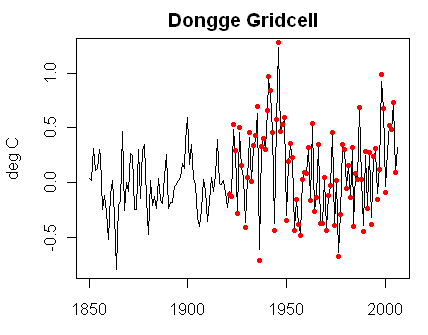
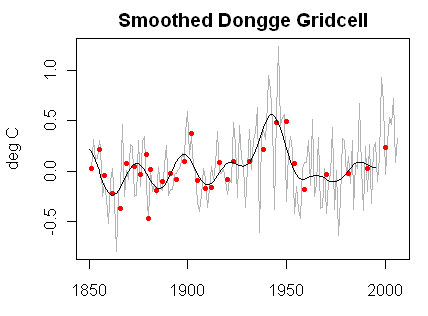
Let me start by describing the data sets used in the calculation. The temperature data used in the calculation is Mann’s infilled version of CRU data for gridcell 27.5N 107.5E, with the Mann version shown below against current CRU annual data (red dots). The CRU series starts in 1921, so the first half of the temperature data is not “observed” directly but has been “infilled” by Mann in a calculation that I have not yet had an opportunity to examine.

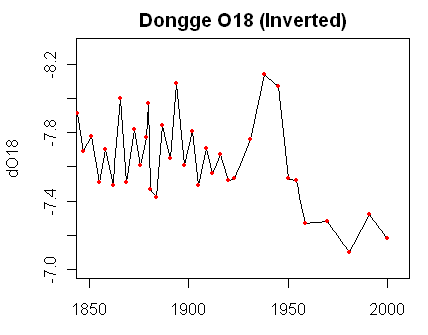
The Dongge O18 data is shown below (inverted orientation); the original data is not available annually but only in irregular years (shown in red dots), with the Mann data interpolated linearly. There are 11 values after 1921 (the start of the actual CRU instrumental record) and 33 values since 1850, the start of the infllled instrumental record. The age model used by Mann is the “tuned” age model, with the age apparently “tuned” using the method criticized by Gavin Schmidt in his critique of Loehle.

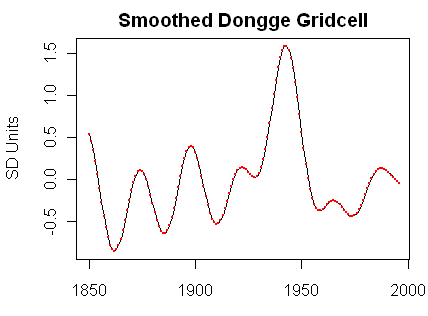
Mann’s low-frequency correlation proved to be the correlation between highly smoothed versions of both series: each series was Mannian smoothed using a Butterworth filter with f=0.05. For reference, the smoothed gridcell series is shown below (this is shown in SD Units below, together with the version extracted from clidatal, which matches very closely.)

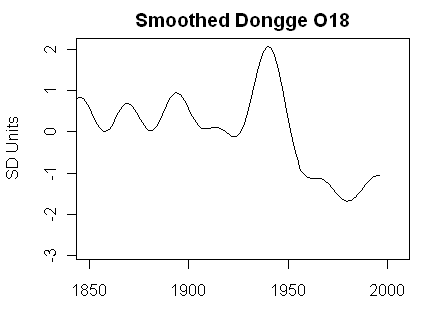
Next here is the corresponding smoothed version of the Dongge O18 series:

In their SI, Mann et al say:

Owing to reduced degrees of freedom arising from modest temporal autocorrelation, the effective P value for annual screening is slightly higher …For the decadally resolved proxies, the effect is negligible because the decadal time scale of the smoothing is long compared with the intrinsic autocorrelation time scales of the data.

Obviously, the radical smoothing of these two series will reduce the number of degrees of freedom. Santer et al 2008 recently commented on the effect of autocorrelation on degrees of freedom and, presumably, one of the first observations that a co-author of Santer et al 2008 (such as Gavin Schmidt) reviewing this article would make is: ummm, Mike, can you flesh out your argument that autocorrelation in the “decadally resolved” series doesn’t matter?

Y’see, the number of years is 146 (1850-1995). The autocorrelation of the residuals in a linear regression is 0.9945544 and the resulting degrees of freedom using the Quenouille formula used in Santer et al 2008 (N(1-r)/(1+r) is only 0.399, something that must have worried Gavin Schmidt.

As an experiment, I tried the following procedure to calculate the relationship between O18 and Dongge gridcell temperature. I made the assumption that Dongge O18 could not teleconnect with future temperatures. Based on this assumption, for each year in which there was a Dongge speleo O18 reading, I calculated the average gridcell temperature for the prior years (up to the previous reading.) The results are shown below (with the “binned” temperature as red dots), compared with the original “infilled” series and the Mannian smooth.

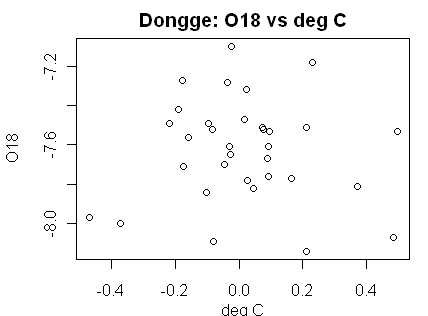
Now I realize that this procedure does not exploit all possble covariance information between Dongge O18 and ring widths of Argentine cypress, but this is just a blog and not a “peer reviewed” publication in an esteemed journal such as PNAS. If critics will grant me the permission to proceed with the analysis on this basis, below is a scatter plot between the “binned” gridcell temperature and Dongge O18.

The r2 of the relationship is 0.0006547 (adjusted r2: -0.03158) with a t-statistic of -0.143, a value which does not meet any significance test.

Spurious correlations between smoothed series (the Slutzky-Yule effect) has been known to economists and statisticians since the 1930s. It has been mentioned in recent climate literature e.g. Gershunov et al (J Clim 2001) who state:

spurious relationships abound, especially when one deals with low-frequency phenomena diagnosed in short time series (Wunsch 1999). In general, the apparent presence of trends and periodicities in short filtered random time series is known as the ‘‘Slutsky–Yule effect’ (Stephenson et al. 2000).

Mann et al 2008 – Another Error Notice

In previous posts, I’ve observed my inability to replicate Mann’s verification statistics, the source code for which was not archived despite representations to the contrary in the original article.

Mann has issued another uninformative correction notice (bearing the date Dec 1, 2008) which states:

UPDATE 1 December 2008: Supplementary Figure S8a had a small error due to improper calculation of the validation statistics. The corrected figure can be found here (PDF)

OK, now, pretty please, what are the properly calculated validation statistics? And, pretty please, where did the error occur?

Five Monsoon O18 Series

Jud Partin observed yesterday that a “fantastic new record” had been recently (early Nov 2008) published from Wanxiang, China. Zhang et al report that their new record is “broadly similar” to the reconstructions of Esper, Mann and Jones 2003 and Moberg as follows:

The Wanxiang record, with a d18O range of ~1.3 per mil (‰) (Fig. 1), exhibits a series of centennial to multicentennial fluctuations broadly similar to those documented in Northern Hemisphere (NH) temperature reconstructions, including the Current Warm Period (CWP), Little Ice Age (LIA), Medieval Warm Period (MWP), and Dark Age Cold Period (DACP) (5–8). [Esper, Mann and Jones; Moberg]

They illustrate this “broad similarity” with the following image:

[Dec 4 – the following paragraphs have been revised to incorporate comments from Jud Partin below].

The data for Wanxiang (33°19’N, 105°00’E, 1200 m) was promptly archived in the paper SI. Almost concurrent with publication, another somewhat nearby speleothem from Heshang (30°27’N, 110°25’E; 294 m) was archived at WDCP, previously published in Hu et al EPSL 2007. As Jud Partin had done in 2007 with his Borneo data, the speleothem data for all three caves has been made available with commendable promptness.

The authors of Zhang et al 2008 observe in their SI, a point that needs always to be kept in mind when placing interpretations on autocorrelated data.

In interpreting such records in terms of changing climate, we are pushing the limits of these archives in terms of signal to noise ratio.

I expressed frustration the other day with the handling of the monsoon affected proxies, but didn’t entirely explain the frustration. Jud Partin observed that the orientation for the Dongge O18 record was consistent with the Wanxiang cave record (more negative dO18 up). This observation appears to me to have the corollary (though this goes beyond Jud’s specific comments) that, even if Mann’s reasons for showing the Dongge proxy more negative up originated in through data mining, the actual orientation of the Dongge O18 proxy was not objectionable.

(In defence of my prior post, I didn’t actually take a position on how these proxies should be interpreted as I’m still finding my footing with these proxies. My point was the narrower one that the Mangini orientation was not “unique” and that Gavin Schmidt’s slagging of Loehle for use of the Mangini proxy therefore required a more substantive argument. It now appears that a number of Chinese speleothem proxies have the same orientation as Mangini used.)

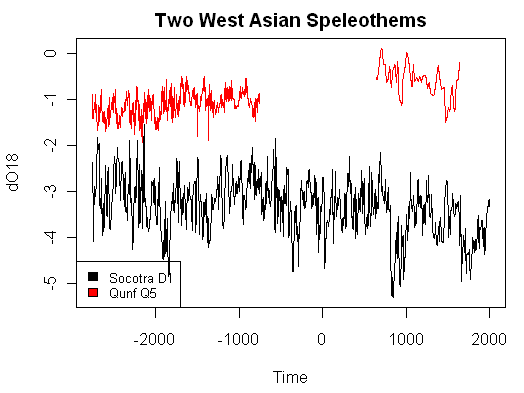
The other issue that I had on my mind was the opposite orientation of Socotra speleothem O18 and Dasuopu ice core O18, both monsoon proxies as well and both oriented oppositely to the Chinese speleothems. Indeed, the Dasuopu O18 record (negative dO18 down) is by far the strongest contributor to the Thompson hockey stick.

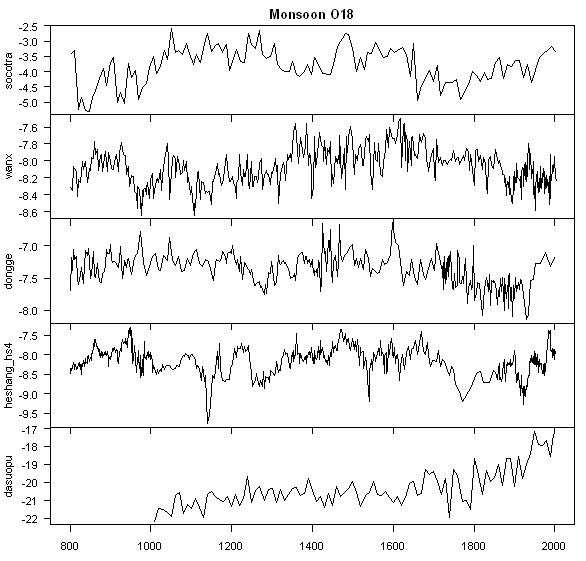
For reference, I’ve plotted five O18 series below: Socotra (from Mann data), Wanxiang, Heshang HS4, Dongge D4 and Dasuopu. All of these series are O18 series and all are monsoon records. All are oriented with negative dO18 down (this is opposite to the orientation of the Zhang et al graphic). Jud Partin pointed out below that it is customary in paleoclimate literature that “warmer and/or wetter conditions” be plotted up. For now, given the different orientations that result from the interpretations of different authors, I want to show dO18 for all series in a consistent way (saving the warmer/wetter interpretation for a second step), since, for now, I’m interested in consistency between O18. If they were all shown with negative dO18 up in accordance with the interpretation of the Chinese speleothems, it wouldn’t accord with the usual orientation of Dasuopu where more negative dO18 is interpreted as colder rather than warmer/wetter.)

Based on a visual inspection of the 5 series, I find it hard to think up a reason why the Wanxiang, Heshang and Dongge records should be oriented with negative dO18 up, while the Socotra and Dasuopu records are oriented with negative dO18 down. (I note, in passing, that the Dasuopu record has a very odd appearance relative to the well-dated speleothems. The Dasuopu ice core is in a high-accumulation area; errors in dating would increase exponentially and I’m really wondering how certain the dates of the Dasuopu ice core are, but that’s a big topic.)

Perhaps Jud or someone else can explain why some monsoon O18 records should be oriented with negative dO18 up and some with negative dO18 down. For me, such an explanation needs more than saying – Dasuopu is an ice core and Socotra is in southwest Asia not southeast Asia. I know both those things, but don’t consider these particular points to be an “explanation”.

[Dec. 5: Jud has provided a citation for the Socotra record, which I will review. He is not familiar with the Dasuopu (ice core) record. This is the one that particularly interests me, since it is so widely used and an opposite behavior is attributed to it. It’s collected under quite different circumstances: by raising the issue, I am not precluding a plausible reconciliation, merely observing that it seems like something that would be nice to see in the literature.]

References:
Hu, Chaoyong, Gideon M. Henderson, Junhua Huang, Shucheng Xie, Ying Sun, and Kathleen R. Johnson, 2008. Quantification of Holocene Asian monsoon rainfall from spatially separated cave records. Earth and Planetary Science Letters Vol. 266, No 3-4, pp. 221-232, February 2008

Zhang, Pingzhong, et al., 2008. A Test of Climate, Sun, and Culture Relationships from an 1810-Year Chinese Cave Record. Science Vol. 322, No 5903, pp. 940-942, November 7, 2008

Reblog this post [with Zemanta]

All-Proxy CPS

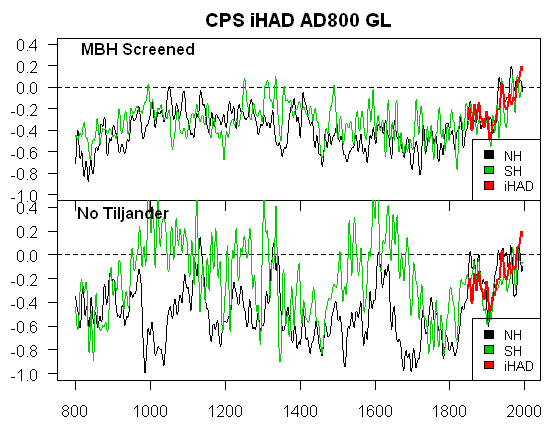
As first fruits of my Mannian CPS emulation, I did a quick sensitivity to see what results looked for the AD800 network without the Tiljander upside-down sediments. I did the run with all proxies except Tiljander sediments as I first cut, since Mannian screening of series that are supposed to be proxies is not a proven method. I’ve also simplified public access to my code quite considerably since yesterday so that it should be relatively easy for someone to experiment.

The top panel shows my emulation of the Mann NH and SH iHAD (land-ocean) reconstructions using the AD800 network (no splicing), together with the Mannian iHad instrumental (I haen’t parsed the relationship of this to HAD and am just using it as is). In the panel below that, I did the same thing using all proxies except the Tiljander sediments. As you see, there is a profound difference particularly in the SH, where the 20th century is not in the slightest anomalous according to this information. Another odd point in the bottom panel version is that the NH 11th century which is believed to be one of the “warm” centers of the MWP emerges, together with the late 17th century LIA, as one of the coldest times of the millennium – something that doesn’t make a whole lot of sense, even for MWP opponents. At present, I don’t know which proxies are leading to this result.

I haven’t been able to replicate Mannian verification statistics calculations. The Mannian “base case” has higher RE and CE statistics than the variation in the bottom panel, but the bottom panel variation is also “99.9% significant” according to the Mannian canon.

The puzzle of deciding between two conflicting reconstructions that are both “99.9% significant” was one that I raised at Climate of the Past Discussions (an interesting point which was ignored by the reviewers, but which remains unresolved.) In likelihood terms (e.g. Brown and Sundberg calibration), I think that the right answer is that one reconstructions would be slightly more “likely” than the other and that the confidence intervals have to be wide enough to encompass both.

Now be careful in using this comparison, as it varies three things – 1) it uses “all” and not just “screened” proxies. Mannian EIV uses “all” proxies, so it’s hardly unreasonable to examine the effect of using “all” proxies under Mannian CPS. 2) it emulates Mannian CPS but without the stupid pet tricks (I realize that this latter term is not very formal, but it’s intended to cover weird programming decisions that probably don’t matter a huge amount in the total scheme of things, but which cannot be justified – sort of like the rain in Spain thing.); 3) the upside-down Tiljander sediments aren’t used. I realize that this is one extra source of variation, but I really can’t stomach doing calculations with upside-down sediments.

Allocating the amount of difference to each thing is something that would be done in an engineering-quality report, something that one would surely expect of the original authors. For now, most of the difference of the difference arises from the use of screened proxies as opposed to all proxies, though I haven’t sorted out what the active ingredients are. I presume that the screening here is another embodiment of the Esper Doctrine, one which makes most statisticians scratch their heads:

this does not mean that one could not improve a chronology by reducing the number of series used if the purpose of removing samples is to enhance a desired signal. The ability to pick and choose which samples to use is an advantage unique to dendroclimatology.

I’ve provided code below that would enable interested readers to experiment with their own allocations. The following two lines download a collation of all the relevant Mannian data, including relevant smooths, which don’t need to be re-smoothed over and over again. (This was collated in the script uploaded yesterday, which is a reference.)

library(signal)
# download.file(“http://data.climateaudit.org/data/mann.2008/Basics.tab”,”temp.dat”,mode=”wb”);load(“temp.dat”) #collection of information in utilities
source(“http://data.climateaudit.org/scripts/mann.2008/utilities.txt”)

reconstruction=list()
raw.mbh=manniancps(k=11,criterion=passing$whole, outerlist=outerlist.mbh, lat.adjustment= -1, smoothmethod=”mann”,verbose=”default”) ;tsp(raw.mbh)
cps.mbh=cpsf(raw.mbh)
reconstruction[[“mbh”]]=list(raw=raw.mbh,cps=cps.mbh)

The control on proxy selection is the parameter criterion which is a logical vector of length 1209 describing the inclusion or exclusion of proxies in a network. The table details.tab is a convenient basis for constructing logical vectors. Mannian program pointlessly creates huge inventories of multiple versions of proxy subsets which are then pointlessly re-smoothed. In fact, all that is needed is to to do the smoothing once and then pick the appropriate subset. nodendro is another logical vector that can be used. Here is code for the all-proxy cps reconstruction (excluding the 4 Tiljander sediments).

notiljander=is.na(match(1:1209,1061:1064));sum(notiljander)
raw=manniancps(k=11,criterion=notiljander, outerlist=outerlist.sensible,lat.adjustment= 0, smoothmethod=”sensible”,verbose=”default”)
cps=cpsf(raw)
reconstruction[[“notilj”]]=list(raw=raw,cps=cps)

The plot is done as follows:

layout(array(1:2,dim=c(2,1)),heights=c(1.1,1.3))
par(mar=c(0,3,2,1))
plot(year,reconstruction[[1]]$cps[,1],type=”l”,xlab=””,ylab=””,axes=FALSE,ylim=ylim0)
axis(side=1,labels=FALSE);axis(side=2,las=1);box();abline(h=0,lty=2)
lines(year,reconstruction[[1]]$cps[,2],col=3)
lines(c(time(instr.smooth)),apply(instr.smooth[,c(4,8)],1,mean),col=2,lwd=2)
legend(“bottomright”,fill=c(1,3,2),legend=c(“NH”,”SH”,”iHAD”),cex=.8)
text(790,.35,”MBH Screened”,font=2,pos=4)
title(“CPS iHAD AD800 GL”)
par(mar=c(3,3,0,1))
plot(year,reconstruction[[2]]$cps[,1],type=”l”,xlab=””,ylab=””,axes=FALSE,ylim=ylim0)
axis(side=1);axis(side=2,las=1);box();abline(h=0,lty=2)
lines(year,reconstruction[[2]]$cps[,2],col=3)
lines(c(time(instr.smooth)),apply(instr.smooth[,c(4,8)],1,mean),col=2,lwd=2)
legend(“bottomright”,fill=c(1,3,2),legend=c(“NH”,”SH”,”iHAD”),cex=.8)
text(780,.35,”No Tiljander”,font=2,pos=4)

Emulating Mannian CPS

I’ve spent an inordinate amount of time working up a practical emulation of Mannian CPS and have uploaded a function to do this. While Mann has made a decent effort to archive code and intermediates, as others have noted, the code itself is chaotic and hard to figure out. Added to this are the “stupid pet tricks” – the allocation of proxies to more than one gridcell if they are on a fence-post, the unexpected (and unmentioned in the running text) 1 degree displacement of all gridcells to the south and the repetitive smoothing of truncated proxies at each step. Plus the archived reconstructions are spliced versions, so it becomes that much harder to reconcile.

However, with the help of UC’s Matlab runs and key assistance from CA readers (especially Roman’s filtfiltx function), I now have a working function manniancps which is presently located at http://www.climateaudit.info/scripts/mann.2008/utilities.txt. It requires the downloading of a considerable amount of data which can be carried out by executing http://www.climateaudit.info/scripts/mann.2008/collation.cps.txt (requires the package signal for Mannian smoothing).

A “verbose” version of the function will also yield various intermediates. These are compared to UC Matlab versions for the AD1000 step NH iHAD in the script http://www.climateaudit.info/scripts/mann.2008/replication.cps_AD1000.txt.

For comparison of reconstructions, I’ve used the SH iHAD reconstruction since, although the archived versions are spliced, the peculiar Mannian splicing procedure preserves the AD1000 network in this network, rendering it more useful for benchmarking than other networks.
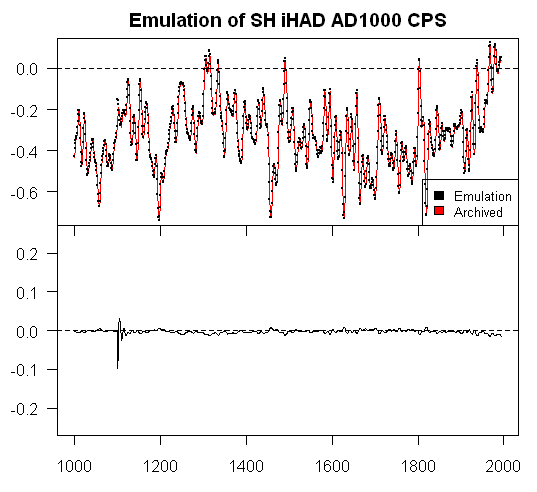
Here is a comparison of my emulation of the SH iHAD cps series to the archived version.

Top – SH iHAD CPS – top: emulation vs archive (splice in this case); bottom – differences.

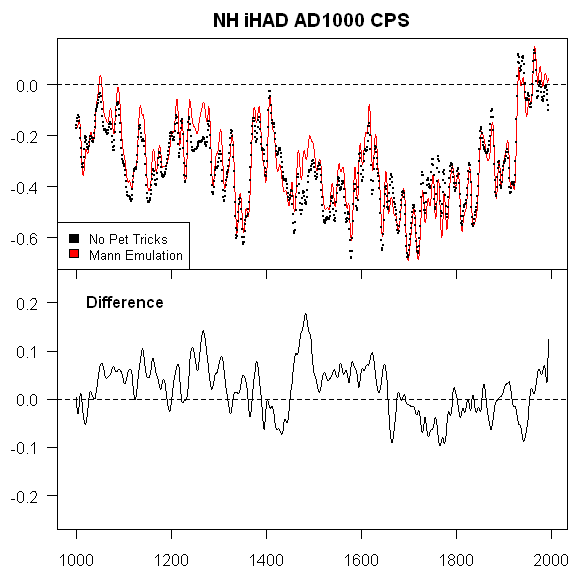
The algorithm sets three parameters to control for “stupid pet tricks” – smoothmethod; outerlist and lat.adjustment. If these are set to “sensible” procedures i.e. smoothing the entire proxy record once and using this smoothed record throughout; allocating proxies to only one gridcell and not displacing the gridcells, one gets a somewhat different NH reconstruction, as shown below.


Figure 2. Comparison of NH iHAD CPS with and without “stupid pet tricks”

The “pet tricks” have a not inconsiderable effect on the relationship between the 1930s and 1980s.

To analyze substantive issues like the impact of using Tiljander proxies upside-down, one has to wade through this stuff. It’s taken a while to get the emulation to stand still, but I should be able to now do these sensitivities in fairly short order. (The EIV recons remain a bit of a black box, unfortunately, and will take some time to parse.)

The differences arising from “stupid pet tricks” are, in some cases, a not inconsiderable proportion of the claimed uncertainty. At present, I have no idea how Mannian “uncertainties” were calculated. I asked Mann et al 2008 reviewer for information on this topic, and, in his best traffic cop manner, he told me to “move on” – which I take to mean that he doesn’t have a clue how they were calculated.

Calibrating Tropical Speleothems

Readers have inquired recently about how tropical speleothems are calibrated to temperature. Judd Partin, Kim Cobb (both of Georgia Tech) and associates wrote an excellent article last year (Cobb et al, EPSL 2007) on detailed O18 observations near a Borneo speleothem about which they had published. They introduced the article with the following observation that will resonate with most CA readers:

Detailed on-site analyses of the relationship between large-scale climate and local rainfall d18O are critical to accurate climatic interpretations of many terrestrial paleoclimate reconstructions based on ice core, tree ring, or stalagmite d18O, but few such studies exist.

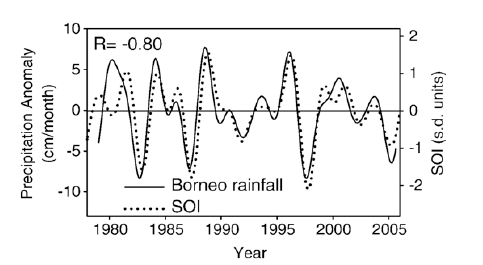
They report a pronounced variation in northern Borneo dO18 values as follows (see graphic below):

Rainfall d18O values range from −11.5‰ to −2.5‰, with a mean of − 6.7 ± 2.8‰. A ~ 6‰ seasonal cycle is visible, with lighter values (− 10‰) occurring from August to October and heavier values (− 4‰) occurring from December to March.


Fig. 4. Interannual variability of northern Borneo precipitation (gridpoint centered at 3.75°N, 113.75°E,CMAPdata) (Xie and Arkin, 1997) plotted with the Southern Oscillation Index (http://www.cpc.noaa.gov/data/indices/). Both timeseries have been filtered with a 2–7 yr bandpass filter

They observe that these substantial variations cannot be explained by local temperature variations since:

Temperatures lie between 26 and 27°C year-round, as recorded by on-site temperature loggers.

Indeed, they note that this viewpoint is also held by other students of tropical speleothems:

In the tropics, stalagmite d18O records are largely interpreted as rainfall d18O reconstructions, with a minor role for relatively small temperature changes that occur in the tropics.

However, this seemingly plausible explanation cannot be transposed directly to northern Borneo as precipitation amount is not nearly as variable as the dO18 fluctuations. Cobb et al:

The ~ 6‰ seasonal cycle in rainfall d18O cannot be ascribed to seasonality of precipitation amount, which has a weak semi-annual nature, with relative rainfall maxima occurring in late boreal spring and from September to December (Fig. 2). In fact, a low correlation between Mulu rainfall d18O and Mulu precipitation (R = 0.05) suggests a limited role for a local “amount effect” stemming from fractionation in a local convective event. Likewise, the observed seasonal variability cannot be explained by variations in source water d18O, which are less than 1‰ across the Warm Pool (Brown et al., 2006).

An interesting conundrum. Strong annual variations in dO18, but not explainable either by temperature or precipitation amount.

The authors conclude that the strong variations are caused by changes in seasonal wind direction, with low dO18 coming when the wind direction leads to a water source further from northern Borneo and thus greater rainout.

Rather, we hypothesize that the observed rainfall d18O seasonality is caused by the increased rainout, and hence greater isotopic fractionation, that occurs during late boreal summer, and vice versa during late boreal winter. In late boreal summer, the ITCZ has reached its northernmost position, and mean southeasterly winds carry moisture from the Java Sea to Gunung Mulu, leading to significant rainout as moisture is carried long distances over the mountainous interior (Fig. 3). The remaining water vapor would be significantly depleted in d18O via both the “degree of rainout” and orographic fractionation mechanisms. Conversely, during late boreal winter, when the ITCZ lies south of Borneo, northeasterly winds carry moisture from the Sulu and South China Seas to Gunung Mulu (Fig. 3). The heavier rainfall d18O values measured during late boreal winter are consistent with the relatively short moisture pathway during this time of year.

All of which is fairly sensible.

People who like Hubert Lamb (of Little Ice Age and Medieval Warm Period fame) can hardly cavil at someone using wind direction as a proxy. So readers should not immediately start piling on to the obvious point that these dO18 records merely indicate wind direction, as Hubert Lamb placed great importance on prevailing wind directions as indicator of centennial climate fluctuations.

Equally, however, climate scientists who want to use such information in Mannomatics and the like need to remind themselves that the best information that they are getting from such records is information on wind direction. If you had detailed measurements of wind direction in northern Borneo (or south China or Yemen), how helpful would that be in determining global temperature?

Reference:
Cobb, K. M., J. F. Adkins, J. W. Partin, and B. Clark. 2007. Regional-scale climate influences on temporal variations of rainwater and cave dripwater oxygen isotopes in northern Borneo. Earth and Planetary Science Letters 263, no. 3-4: 207-220. http://shadow.eas.gatech.edu/~kcobb/cobb07.pdf

On the Divergence Problem

Tree rings are widely used for reconstructing climate and past climates are critical for putting the current climate (including global temperatures) into the proper perspective. Is current warming unusual? Only a comparison to the past can tell.

To help gain a better understanding of the past and how global temperatures may have behaved, researchers frequently try to extract climate information that may be stored in the annual growth ring of trees. The standard practice is to calibrate annual tree ring width (and/or wood density) to the temperature under which the trees were growing using a linear model based on recent (e.g., 20th Century) data, and then interpret past rings widths as indicators of temperature. A linear model is one in which a unit change in temperature produces a corresponding unit change in the tree ring attributes—and a linear model assumes that this relationship applies over the entire range of temperatures.

A recent research paper (Loehle, 2008) showed that if this linear model is mis-specified (i.e., a linear growth response is assumed but in reality the growth response is non-linear), even a model that appears to work well during the “training” (or “calibration”) period—the time during which both temperature and tree rings are available—may fail miserably during the reconstruction period—the time in the past when only tree rings or available, that is, prior to direct temperature measurements.

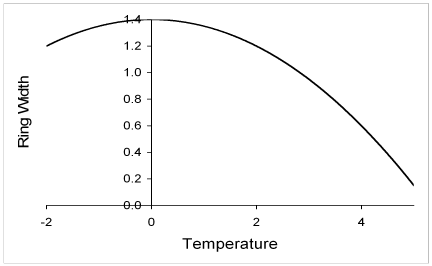
For example, Figure 1 shows a hypothetical non-linear growth response curve. On the left-hand side of the curve, as temperature increases, tree ring width also increases, but as temperatures continue to rise and the temperature exceeds a certain threshold, the tree-ring width begins to decline. This could be the result of the physiological response of that particular tree species, or to the influence of other environmental variables (for example, moisture could become limiting at higher temperatures).

Figure 1. Hypothetical non-linear growth curve that shows a changing tree-ring width response to temperature changes (from Loehle, 2008).

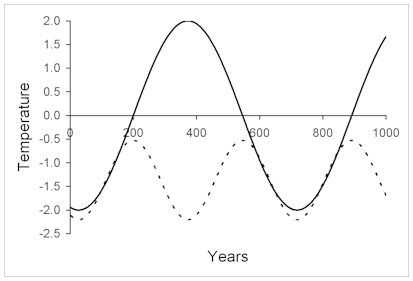
If a temperature/tree-ring model is built only during a period of time when the observed temperatures rarely exceeded the threshold temperatures, and thus a linear model is assumed and produces a good fit, the model makes a mess of things when reconstructing the temperature during a time when the true temperature exceeded the threshold temperature. Figure 2 demonstrates this. In this example, the true temperature (the solid black line) is poorly reconstructed (dotted line) from a linear model built when observed temperatures were below the threshold. In fact, the entire character of the true temperature change is misrepresented and warm periods actually are reconstructed as cool periods.

Figure 2. Reconstructed temperature (arbitrary scale) (dotted line) vs. actual (solid line) using a linear approximation to the quadratic from Figure 1. Temperatures larger than the threshold become inverted. Time scale can either be forward, showing divergence, or back in time showing failure to detect past warm periods (from Loehle, 2008).

This result indicates why one can not use tree rings for any periods warmer than the calibration period—a situation which is difficult to know a priori. The same issue could affect certain other types of temperature proxies (besides tree rings) as well.

For a much more detailed description of this “divergence” problem in tree-ring reconstructions of past climate, see A MATHEMATICAL ANALYSIS OF THE DIVERGENCE PROBLEM IN DENDROCLIMATOLOGY pdf.

Reblog this post [with Zemanta]

Gavin Schmidt and "Uniquely" Oriented Speleothems

In our examination of the new Mann proxies, there is a notable increase in the prevalence of speleothem proxies in the MWP network.

Craig Loehle used a couple of speleothem proxies in his reconstruction. One was a grey-scale series from Holmgren’s Cold Air Cave, South Africa.

Not to be outdone, Mann et al used two series from Holmgren’s Cold Air Cave, using, however, two other series: C13 and O18.

The second spelothem series used by Loehle was a temperature reconstruction by Mangini on a European speleothem, which had an inverse orientation to the native dO18 series because Mangini ascribed a negative correlation between temperature and speleothem dO18, which Gavin Schmidt excoriated as follows:

As mentioned above, there are a priori reasons to assume d18O records in terrestrial records have a temperature component. In mid-latitudes, the relationship is positive – higher d18O in precipitation in warmer conditions. This is a function of the increase in fractionation as water vapour is continually removed from the air. Most d18O records – in caves stalagmites, lake sediment or ice cores are usually interpreted this way since most of their signal is from the rain water d18O. However, only one terrestrial d18O record is used by Loehle (#9 Spannagel), and this has been given a unique negative correlation to temperature.

However, Mangini’s speleothem record is no longer uniquely oriented, due to recent spelunking by Mann and associates.

The first figure below shows the orientation of the original dO18 data (positive dO18 is up and negative dO18 is down), the orientation advocated above by Gavin Schmidt.


Figure 1. Dongge O18 (in s.d. units) preserving original orientation

Despite Gavin Schmidt’s excoriation of Craig Loehle, the Mann et al algorithm orients speleothem records according to their most opportunistic correlation with gridcell temperature.

In the case of the Dongge dO18 record, this is negative (as shown in the archived rtable) and the orientation of the series is accordingly inverted during the Mannian algorithm. Here is how the Dongge gridcell goes into the Mannomatic – obviously upside down from the original series.

So the orientation of the Mangini dO18 series no longer stands alone, joined now by the Mannian Dongge Cave dO18 series.

Schmidt concluded his discussion of the Loehle reconstruction, citing this and other issues, by aying:

What does this imply for Loehle’s reconstruction? Unfortunately, the number of unsuitable series, errors in dating and transcription, combined with a mis-interpretation of what was being averaged, and a lack of validation, do not leave very much to discuss.

Having examined details of the Mann study, I can confidently say that “the number of unsuitable series, errors in dating and transcription, combined with a mis-interpretation of what was being averaged, and a lack of validation” in the Mann study result in precisely the opposite: there is a great deal to discuss.

The parable urges us to remove the beam from our own eye before worrying about the mote in the other fellow’s eye. One feels that Schmidt and Mann should think about a similar policy: removing the uniquely oriented speloethem from their own reconstruction before worrying about the uniquely oriented speleothem in the other fellow’s reconstruction.

Reblog this post [with Zemanta]