More developments from Bishop Hill on the strange relationship between the University of East Anglia and the supposedly “independent” Muir Russell review. On yet another occasion, the University gave untrue answers in order to avoid FOI disclosure, an untrue answer that led to several follow-up FOI requests that they were unable to subvert, but which ultimately showed the mendacity of the original refusal.
In this case, the original request from David Holland in December 2010 (see CA post here) was for the documents, that “in the view of the University, comprises the contractual basis under which Sir Muir and his team operated and under which the University was contractually obliged to pay the sums that you have disclosed”. The request was not limited to Muir Russell, but included, for example, the retainer of professionals, including Luther Pendragon and lawyers.
Please provide me copies of the Correspondence between the University and Sir Muir Russell that, in the view of the University, comprises the contractual basis under which Sir Muir and his team operated and under which the University was contractually obliged to pay the sums that you have disclosed of what, I assume, is taxpayers money.
Please advise me as to how the disbursements were made. For instance, were the fees of the legal advisors paid directly by the University? If not who paid and how were they reimbursed.
In its response, the University denied the existence of relevant documents:
The University does not consider that there was a contractual relationship with Sir Muir Russell or the inquiry team; it was by way of a public appointment (as is commonplace in these circumstances). Nonetheless, it may be helpful to you in understanding the terms on which the appointment was made if we refer you to the agreed terms of reference (see: http://www.ccereview.org/pdf/FINAL%20REPORT.pdf, p.22) and certain email correspondence between Professor Acton and Sir Muir. (see attached .pdf file).
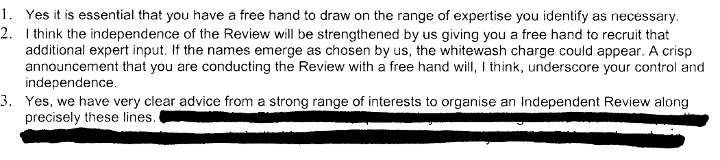
The attached correspondence consisted of a single email from Acton to Muir Russell, referring to an earlier email (never produced) and to a conversation in a taxi, including the following (part of which was blacked out for reasons that remain unclear):

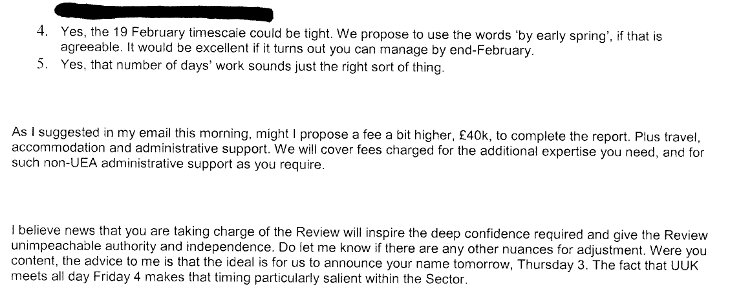
Up to that point, I think that it’s fair to say that anyone who’d bothered turning their mind to the issue would have presumed that either (1) Muir Russell and the various members of the panel had worked under agreements with the University and were paid under those agreements, or, less likely, (2) that Muir Russell had set up the Muir Russell Review Team as an unincorporated entity, established a bank account for the Team and paid and received invoices from panel members and suppliers through that bank account. (Many Climate Audit readers do not work in the public sector and think about details such as this.)
A few months later, Andrew Montford, an accountant by day, tried again, this time asking for general ledger and invoice details.
1. A detailed lists of amounts expended – i.e. at invoice level – for the two inquiries. For each amount processed through the ledgers, I would like the following fields
– invoicer/payee name
– date
– amount
– contents of narrative field
– authorised by
2. Please provide copies of invoices (or equivalent documentation) used to process the above payments.
This time (see CA here plus Bishop Hill) , the University provided the general ledger information but refused to provide invoices, claiming:
The additional work required to actually provide copies of the invoices would place the time required well over the appropriate limit.
At that time (May 2011), I commented:
Even from this information, the UEA’s claim that Muir Russell was a “public appointment” looks increasingly fantastic. If a public appointment had really taken place, then there would be invoices from the Muir Russell Review Group to the University of East Anglia, instead of, as seems to be the case here, invoices directly from Geoffrey Boulton, Luther Pendragon etc to the UEA.
I also observed:
Despite the efforts by the UEA to avoid showing the invoices from Muir Russell and others, I think that they will come out. And will show that the UEA’s attempt to claim Muir Russell as a “public appointment” was just another subterfuge to avoid compliance with an earlier FOI request.
David Holland also followed up with an FOI request to Muir Russell, following up the apparent implication of the University’s claim that he was a “public appointment” – if he was a “public appointment”, then presumably the Muir Russell Review Team was a “public authority” and thus itself subject to FOI. Muir Russell rebuffed the request as follows (referring to FOI (Scotland):
I have however taken advice and I am satisfied that I am not, and the Review Team as a whole is not, a public authority for the purposes either of the 2002 Act or the 2004 Regulations. In the circumstances we are not under any legal obligation to make information concerning the Review available to any person under that legislation. [referring to Scottish Act]
The new development is that Montford requested copies of large invoices, including those from Muir Russell, Boulton and Luther Pendragon, all of which have been provided (see here). As so often, the details of the invoices told a different story that told by the University in subverting the original FOI request.
Remember how the University said that it “does not consider that there was a contractual relationship with Sir Muir Russell or the inquiry team”. However, when it came to collecting his ₤40,000 from the University, Muir Russell had no doubt whatever of the existence of an agreement between him and the university that he should get paid ₤40,000. Muir Russell signed and submitted a UEA Form4/5 for Occasional Work/Self-Employed Work referring in his own handwriting to an “agreed fee” with the University (see here):
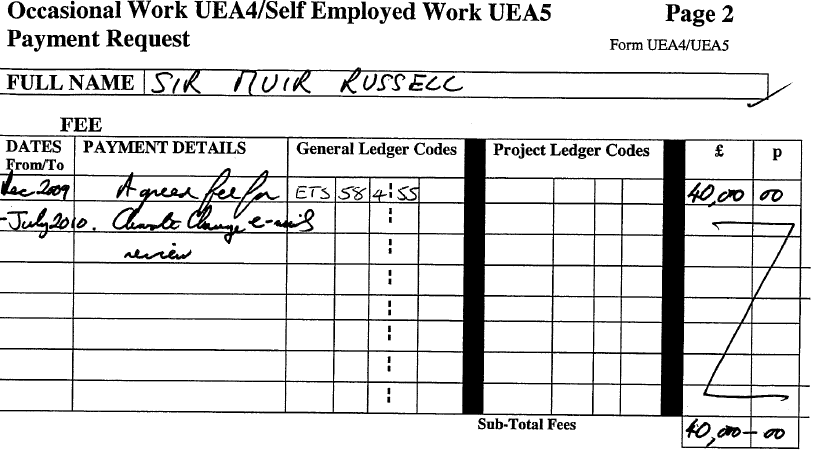
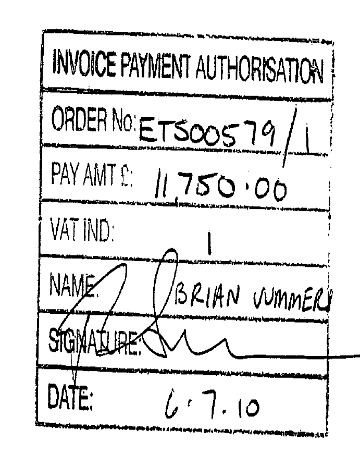
Muir Russell’s Forms 4/5 for expenses up to July 2010 were approved by Lisa Williams, while his claim for ₤40,000 in fees was signed by (I think) UEA official Brian Summers. Muir Russell submitted his claim for fees and expenses on July 15, 2010, shortly after delivery of the report. A second claim for expenses of ₤881.25 using UEA Form 4/5 was submitted on Nov 29, 2010 for expenses incurred on Nov 17, 2010, labeled (perhaps) “Brodie’s ???”, also approved by (I think) Brian Summers.
Holland’s original request had covered documents from professionals – also not provided at the time. Four invoices from Luther Pendragon (a public relations firm) were provided – see here. All four invoices (from March 2010 to July 2010) were addressed to Climate Change Emails Review, Box 16, Edinburgh. Three of four invoices were approved by Brian Summers of UEA on his own; one invoice was first approved by Muir Russell with a second approval from Summers. All were directly paid by UEA.
The two invoices from Olswang LLP (lawyers) was similarly addressed to Climate Change Emails Review, Edinburgh, but both were approved by Brian Summers of UEA and paid by UEA. The invoice for the period May 20 to July 31, 2010 refers to an attached “narrative” (standard in legal invoices), but this was withheld from the documents with no apparent justification. The other invoice for the period July 1, 2010 to July 2010 refers to the provision of legal services “relating to Freedom of Information advice”. This was shortly before the apparent destruction of emails by the University of Edinburgh pertaining to activities of Muir Russell panelists. Although Muir Russell had promised transparency, my guess (and it is only my guess) is that they took legal counsel on how they could legally destroy documents.
Marsh, an international insurance firm, provided professional indemnity coverage. There are two invoices, one from 2010 and one just recently in 2011. The first invoice (2010) was addressed to Climate Change Emails Review, Edinburgh; the second to Lucy Mouland, Climate Change Emails Review, University of East Anglia, Norwich. The first invoice was approved by Brian Summers; the second by Lucy Mouland. Both were paid by the University of East Anglia.
Panel member Jim Norton submitted four invoices for fees and expenses, charging a per diem of ₤1250/day. His invoices are all directly addressed to the “University of East Anglia” and include VAT charges (Muir Russell and Boulton did not charge VAT). The first and second invoice were approved by Muir Russell; they were accompanied by UEA Forms 4/5 that were not signed by either Norton or Muir Russell; they were signed by Summers and appear to have been prepared by the UEA Registrar’s office. Norton’s third invoice (dated May 4, 2010) does not have an approval signature from either Muir Russell or Summers; again the UEA Form 4/5 was signed by Summers and appears to have been prepared by the Registrar’s Office.
There are two invoices from Edinburgh Research & Innovation Ltd for the services of Peter Clarke, charged out at ₤800/day. The invoices were sent to the Climate Change Emails Review team, Edinburgh. Both were approved by Muir Russell and, for UEA, by personnel in the Registrar’s Office. No expenses were included with these invoices.
There were two invoices from the Royal Society of Edinburgh, some of which were for room rental – rates were as high as ₤682 for May 26, 2010. They also charged for William Hardie’s services at ₤490/day.
Former BP executive David Walker, hired on as a consultant to salvage the mess in March, submitted three invoices, all addressed to the Climate Change Email Review, Edinburgh. A covering UEA Form 4/5 accompanied each invoice, none of which was signed by Walker. In each case, they were signed by Muir Russell and countersigned by Summers; they were paid by the University. Walker’s rate was ₤1200/day.
Finally, Geoffrey Boulton submitted four UEA Form 4/5s, each of which was accompanied by a schedule entitled “Log of Work: UEA-CRU Review Team”. Details of the schedules appear to have been expurgated prior to delivery, in particular, information on the number of hours charged out by Boulton and his unit rate were expurgated in all but page 6 where Boulton’s daily rate is ₤1500/day, nearly double the rate of Peter Clarke who was charged out through Edinburgh Research. On other Form 4/5s, the corresponding information appears to have been hidden from the FOI requester. Boulton’s Form 4/5s are signed by himself, Muir Russell and countersigned by Summers.
It will not come as any surprise to anyone that Boulton, the most conflicted member of the panel, was brought on board first. His December 2009 log itemizes “Advising Sir M-R on remit, science and personnel for review team, contacting potential members, arranging video conference.”
The invoice (page 6) shows that he spent two days (Jan 13/14) reviewing the emails, one day (January 17) on the “development of criticisms of CRU form published/web/email” and two weeks later (Feb 2) one day on “production and circulation of document “Scoping the Issues”.
Observations
In the past, we’ve speculated on what the Climate Change Email Review was as a legal entity – most of which has resulted from disinformation from the University of East Anglia.
After examining the invoices, invoice approval process and invoice payment process, I don’t think that there can be any serious doubt as to the legal status of the Climate Change Email Review: that it was nothing more than a university committee with outside members.
We now know (and while we may have suspected this, we did not “know” this) that the Review did not have a bank account nor did it invoice the university for interim payments nor did it pay its members according to invoices and then re-invoice the university. It bore no marks of independent legal existence.
As a comparison, consider the Investigation Committee formed by Penn State in respect to Mann. Let’s suppose that such an Investigation Committee established a mailing address in a separate building. That wouldn’t establish a legal existence for the Investigation Committee separate from the University. Suppose now that the Investigation Committee included members from another university or from a professional society. It still remains a university committee with outside consultants. Same thing applies here even when all the members are outside consultants.
The invoices show that the Muir Russell Email Review was a university committee with outside members. Muir Russell was nothing more than a consultant to the university with a fee agreement. The university directly paid all invoices sent to the committee and, in many cases (as shown above) the invoices were directly approved and paid within the registrar’s office. Legally, the Climate Change Email Review should be subject to Freedom of Information, no greater and no less than any other university committee.







 Climate Audit