O’Donnell et al 2010 Refutes Steig et al 2009,

Do some of you remember Steig et al 2009, a pre-Climategate Nature cover story? Like so many Team efforts, it applied a little-known statistical method, the properties of which were poorly known, to supposedly derive an important empirical result. In the case of Steig et al 2009, the key empirical claim was that strong Antarctic warming was not localized to the Antarctic Peninsula (a prominent antecedent position), but was also very pronounced in West Antarctic. Their claims are set out firmly in the opening sentences of their abstract as follows:

Assessments of Antarctic temperature change have emphasized the contrast between strong warming of the Antarctic Peninsula and slight cooling of the Antarctic continental interior in recent decades. This pattern of temperature change has been attributed to the increased strength of the circumpolar westerlies, largely in response to changes in stratospheric ozone. This picture, however, is substantially incomplete owing to the sparseness and short duration of the observations. Here we show that significant warming extends well beyond the Antarctic Peninsula to cover most of West Antarctica, an area of warming much larger than previously reported. West Antarctic warming exceeds 0.1 deg C per decade over the past 50 years, and is strongest in winter and spring. Although this is partly offset by autumn cooling in East Antarctica, the continent-wide average near-surface temperature trend is positive.

Their claims were illustrated on the cover of Nature as shown below:
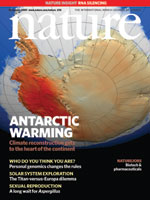
Again, to be very clear about this, the “novelty” of Steig et al 2009 were their results for West Antarctica – the location of the West Antarctic Ice Sheet. Otherwise, there was nothing in their article that warranted an article in Nature, let alone a cover.

There were a variety of problems with their analysis, many of which were documented at CA and tAV at the time. The remarkable episode of Gavin, International Man of Mystery, plagiarizing a small point on a CA thread arose in the context of Steig et al. At an early stage, it seemed that Steig’s rather complicated method was spreading results from the Antarctic Peninsula into other parts of the Antarctic, a surmise that proved correct.

After an abusive peer review process in which the Team were evidently involved, an article has been accepted by Journal of Climate (O’Donnell [Ryan O], Lewis [Nic L], McIntyre and Condon [Jeff Id]) refuting the West Antarctic claims of Steig et al 2009.

Their results proved to be sensitive to the number of retained principal components, with Steig et al selecting only 3 PCs, using arguments that contradicted Wahl and Ammann’s efforts to retain bristlecones in MBH. Steig et al themselves did not appear to realize that Chladni patterns emerge from spatially autocorrelated time series, a peril known for many years (“Castles in the Air”) but apparently forgotten by Steig et al and the Nature reviewers.

Using a more rational (though not magical) policy on retained PCs, a very different picture emerged as illustrated below. The “traditional” picture of very strong warming on the Antarctic peninsula re-emerged, together with large areas of cooling on the continent. Instead of the West Antarctic being a location of anomalous warming, as Steig et al had purported to show, parts of it were actually cooling.

The gauntlet that had to be run shows that practices in climate science journals remain unchanged despite Climategate. Horton’s essay for Muir Russell noted that conflicts of interest were not simply financial. In this case, the Journal of Climate appointed a reviewer – or shall we say a representative of a Team of reviewers – whose energy in attempting to suppress the article went far beyond an unconflicted reviewer. Ultimately, the reviews and responses totalled 88 pages! And Andy Revkin and others blame critical authors for not running such gauntlets. The reviewers for Ross’ and my comment at IJC on Santer et al 2008 were even worse. All too often, in the case of Santer et al, after Team reviewers sabotaged a straightforward and correct comment, Santer and other Team members criticized us for not publishing in the PRL after getting data and continued to put their results forward as unblemished despite knowing of unrebutted criticisms. Getting this article accepted is entirely to the credit of Ryan O’Donnell who did more than the lion’s share of the work.

Climategate documents show the asymmetry between the puffball “pal reviews” that Jones submitted for Mann or Schmidt or Wahl and Ammann, as compared to the Team “going to town” on criticism. Unfortunately, the Muir Russell “inquiry” did not investigate the peer review incidents evidenced in the emails (not even the “going to town” incident) nor did it comment on pal review nor did it make the slightest effort to see if there were other peer review incidents in other CRU documents (part of their terms of reference.)

The gauntlet that was created in this particular incident had nothing to do with additional due diligence occasioned by perhaps overturning a well established result. Steig’s results, showing West Antarctic as a particular locus of warming, were themselves novel and, if anything, contradicted prior views of Peninsula warming. Our results were straightforward – the 88 pages of review and response were nothing more than obstruction, “going to town” on the comment rather than the original article.

Substantively, what is actually left of the signature results about the West Antarctic, which were:

Assessments of Antarctic temperature change have emphasized the contrast between strong warming of the Antarctic Peninsula and slight cooling of the Antarctic continental interior in recent decades… Here we show that significant warming extends well beyond the Antarctic Peninsula to cover most of West Antarctica, an area of warming much larger than previously reported. West Antarctic warming exceeds 0.1 deg C per decade over the past 50 years, and is strongest in winter and spring.

Nothing. Steig’s West Antarctic warming results from a spreading of warming in the Peninsula to the West Antarctic through choices made in their principal components. Different choices – ones more plausible in the circumstances – lead to opposite results.

Also see blog posts at Jeff Id here and WUWT here.

Update Dec 7: Online SI here http://www.climateaudit.info/data/odonnell/

Assange on Climategate

Jeff Id links to a YouTube video of WikiLeaks’ Assange making a variety of untrue or inflated claims about Climategate and WikiLeaks’ role.

Assange falsely claimed that the Climategate emails were broken by WikiLeaks. This is obviously untrue as CA readers know. I can date WikiLeaks’ entry by contemporary comments. The first notice of the emails at WikiLeaks was 2009/11/21 at 2.50 AM Eastern (12:50 AM blog time). The emails had been downloaded by many people (including me) from a Russian server on Nov 19 and had been downloaded by WUWT moderators on Nov 17. A contemporary comment in a CA thread says that WikiLeaks was down and refers people to megauploads. WikiLeaks has not even been a major reference for Climategate – that belongs to eastangliaemails.com (originally anelegantchaos.org) which was up on Nov 20 and provided a searchable database.

Assange adopted Gavin Schmidt’s disinformation about the “trick… to hide the decline”. While the term “trick” can be used to denote a sophisticated mathematical method, it can also denote something as simple and unscrupulous as deleting adverse data. It is necessary to investigate the facts of the matter and the context. In the example of interest, the Climategate correspondents did not use a sophisticated mathematical method; they simply deleted data that didn’t accord with their expectations. The “investigations” ought to have denounced/renounced such methods and their failure to do so is to their shame.

Given the remarkable lack of speculation about foreign intelligence services hacking into the present WikiLeaks dossier, Assange made some remarkably unsubstantiated fantasies about Russian intelligence, that are almost wild enough for Raymond Pierrehumbert whose similar fantasies were reported on by the NY Times last year.

Assange asserted that UK newspapers had close involvement with UK intelligence, that he had supposedly been told by UK reporters that they had received the dossier from the FSB (presumably FSB, the Russian intelligence) just three days before the Copenhagen conference. Assange then proclaimed that the UK intelligence tried to “frame us as a conduit for the FSB – absolutely outrageous”.

The dates of the Copenhagen conference were Dec 7 to 18, 2009 (see here for example). Gertting the Climategate emails three days before Copenhagen (Dec 4,2009) was hardly a scoop. By that time, even Jon Stewart had done a comedy segment and Minnesotans for Global Warming had issued the Hide the Decline video.

Assange’s lieutenant then observed that the UEA had observed that the Climategate dossier had been selected and that statements had been taken out of context and that the university had promised to “publish the rest of the material to correct the full picture.” In fact, as CA readers know, Acton of the UEA intervened to prevent the panel charged with examining the rest of the material from doing so and the rest of the material remains unexamined and unavailable.

http://www.youtube.com/v/W17dW_aJEwU?version=3

Update: Ross writes in in his usual forceful style:

What a pair of blowhards. They were obviously unnerved by the question. They evidently like leaks that embarrass their political opponents, but in this case they found themselves tagged with a leak that had damaged the side they like; and since it seems to be more about political warfare against governments they dislike than some impartial ideal of transparency and freedom of information, they were stuck scrambling to make up a story about how it really served some nobler purpose. Of course they should simply have said that they weren’t the source of the leak, that it was in full circulation long before anyone looked to them for a copy and they didn’t know much about the details of what followed. But that would have been too humble, especially in front of a room full of simpering hero-worshippers. So they pretended to be insiders and proceeded to deliver a few minutes of sheer drivel.

While I was in the UK last fall, there was brief interest by the UK tabloids in the Russian angle, and an article appeared in the Daily Mail speculating that Russian intelligence officials had hacked the UEA and stolen the emails. But nobody took that line seriously and the story died within 48 hours. If Assange has a shred of evidence to support his lunatic theory he should release it. What’s with these secret communications between him and UK intelligence: out with it, Mr Wikileaks! Bloody poser.

On this issue at least they are nothing but fakes and cretins. Saying that UEA released all the background emails and whatnot to provide the full context is beyond idiocy; and Assange’s discussion of the “trick” is just painful to watch.

Just Doing Their Jobs – “Robustly”

In the NYT this year:

While declining to comment on the details of the cables, Mrs. Clinton said the disclosures painted a picture of American diplomats doing their jobs: collecting information and impressions and communicating them in an unvarnished way to policy-makers in Washington.

Gavin Schmidt on the Climategate correspondents:

People working constructively to improve joint publications; scientists who are friendly and agree on many of the big picture issues, disagreeing at times about details and engaging in ‘robust’ discussions;

Gavin Schmidt’s term “robust”, right up to the quotation mark, was also used by Hilary Clinton:

She even used the occasion to plug the “robust” diplomacy of the Obama administration, noting that it assembled an international front to react to Iran’s nuclear program.

The Hypocrisy of the New York Times

The New York Times is making quite a meal of the WikiLeaks documents.

As others have observed, they refused to print Climategate emails involving senior IPCC Lead Authors, Coordinating Lead Authors. While their hypocrisy on this score was rightly criticized last year, it is being revisited this year in light of WikiLeaks. And rightly so.

While criticism has focused on Andy Revkin – for whom, as CA readers know, I have considerable personal respect, attention should really be directed to the policies of the New York Times itself, as articulated by editor Clarke Hoyt on Dec 6, 2009 last year.

Continue reading →

Was there an actual legal opinion?

In today’s post, I discuss the following statement by the Muir Russell “inquiry” – a topic previously discussed here with further information provided today.

Muir Russell stated:

in the opinion of UEA‘s legal advisers, unconstrained access to the contents of e-mails on the server by the Review would raise potential privacy and data protection issues.

This sounds sort of impressive. But imagine the difference if they had said:

in the opinion of UEA Vice Chancellor Acton, unconstrained access to the contents of e-mails on the server by the Review would raise potential privacy and data protection issues.

That would have made quite a difference. Documents obtained subsequent to the publication of the Muir Russell report show that the latter is almost certainly what happened. Continue reading →

The IPCC Doctrine of Implicit Confidentiality

In their most refusal of David Holland’s FOI request for IPCC review comments, the U of East Anglia relied on a supposed IPCC doctrine of implicit confidentiality – a doctrine that is more or less equivalent to “omerta”. Even for the University of East Anglia, the provenance of this doctrine is remarkable. Acton and Trevor Davies must have sniggered.

In their refusal, UEA stated:

The fact that the IPCC has clear protocols for what information is to be in the public domain also points to the implicit assumption that, as the requested information is outside those protocols, it has never been intended to be publicly available.

They apply the alleged doctrine of IPCC implied confidentiality to impute confidentiality to Annex C1 authors who did not claim it when requested. For example, they say of John Fyfe, Lead Author of a different chapter:

John Fyfe LA for Chap 8 of WG1: Did not clarify his position regarding confidentiality, but this is implicitly assumed following IPCC procedure

The doctrine of implied confidentiality in the running text is derived from the statement in Annex C2, which stated:

By explicitly indicating what materials should be openly archived, the IPCC implicitly indicated that other materials should not be disclosed.

If anyone is to speak on behalf of IPCC, it is the IPCC secretariat. However, in the 32nd meeting in Busan in October 2010, only a few weeks prior to the UEA refusal, the IPCC secretariat stated that, while the rights and responsibilities of IPCC cadres under national FOI and the Aarhus Convention needs to be clarified, the IPCC itself cannot provide individual legal advice:

E2. The rights and responsibilities of all those involved in IPCC activities under the Aarhus Convention and in relation to requests under national Freedom of Information legislation needs to be clarified for the various groups: elected officials (Bureau), staff of the Secretariat, TSU staff, and experts involved in IPCC activities. However, IPCC cannot provide individual legal advice.

I’ll discuss the merit (or rather lack of merit) of the doctrine of “implied” confidentiality on another occasion. Today, I’ll answer a smaller question: if the IPCC declined to interpret its procedures for FOI requests, who was the authority for the novel doctrine of “implied” confidentiality? The remarkable answer: Continue reading →

East Anglia: More Sucking and Blowing

David Holland’s well-known FOI 08-31 included the following request:

1. The IPCC stated on July 1, 2006:

“We are very grateful to the many reviewers of the second draft of the Working Group I contribution to the IPCC Fourth Assessment Report for suggestions received on issues of balance and citation of additional scientific literature.”

Did the IPCC receive any such “suggestions” in a written form other than those reported in the documents for each chapter entitled “IPCC Working Group I Fourth Assessment Report: Expert and Government Review Comments on the Second-Order Draft”2? If so, please provide them.

The U of East Anglia rejected a refreshed request in respect to the Wahl emails on the basis that the email to Briffa (acting here in his capacity as an IPCC author) was “not provided to the IPCC, only to Prof. Briffa and therefore is outside the remit of question 1”

Appendix F (08-31)

There is no question that a suggestion was received by Prof. Briffa from Eugene Wahl and this material is publicly available and has been widely commented upon. This ‘suggestion’ was not provided to the IPCC, only to Prof. Briffa and therefore is outside the remit of question 1.

Now let’s turn to their position refusing Holland’s related FOI request 08-23. In that case they argue that emails from IPCC authors are communications “received from the IPCC as an organisation”.

I believe that we have shown that the IPCC qualifies as an international organisation covered by the exception, and that, given the nature of the IPCC structure, information received from convening authors and authors of the Working Group, in effect, is communication received from the IPCC as an organisation.

I.e. they argue that communications sent from IPCC authors to IPCC Lead Author Briffa are communications sent by IPCC as an organization, but communications received by IPCC Lead Author from IPCC authors are not received by IPCC as an organization.

I wonder if they snickered when they wrote this.

UEA: IPCC Requires Secrecy, Not Openness

In the recent U of East Anglia refusal of David Holland’s renewed request for IPCC review comments, held out of the IPCC archive through conduct described by Fred Pearce as a “subversion” of IPCC principles of openness and transparency, East Anglia stated:

recent guidance given to IPCC lead authors has clearly indicated that communication between lead authors is to remain confidential, and that emails and preliminary versions of work are not made public, cited, quoted nor distributed. We believe that this is persuasive evidence that the IPCC feels that the release of such material would adversely affect their interests.

Has anyone seen a copy of this alleged “guidance”? I quickly looked at documents presented at the IPCC October 2010 meeting in Busan and didn’t see anything responsive.

Pachauri’s July 5, 2010 memo on the media, that caused some controversy at the time, doesn’t contain such instructions. Hoggan’s comments at desmog about that particular botch seem to apply to CRU as well:

Andy Revkin’s revelations over the weekend about the botched media relations strategy deployed by the head of the Intergovernmental Panel on Climate Change, Rajendra Pachauri, demonstrate that the IPCC has failed to learn from its recent missteps in managing public communications.

If you don’t have anything to hide, don’t act as if you do.

Words that CRU would do well to heed.

Again, has anyone seen this document? I wonder if the University of East Anglia will claim that it’s confidential if someone FOIs it.

David Walker, Muir Russell Project Manager

The Muir Russell report thanks a “David Walker” for serving as Project Manager without identifying him. Despite Walker’s importance as Project Manager, Muir Russell did not provide a bio at the Inquiry website. David Walker is a common name. So who is this David Walker?
Andrew Montford also wondered about this at one time, but did not arrive at any conclusions or even hypotheses.
Continue reading →

Another Stupid UEA Trick

On October 22, 2010, David Holland re-iterated his FOI requests 08-23 and 08-31. Once again, the University of East Anglia has refused 08-31, this time using an excuse the obtuseness of which is remarkable even for the University of East Anglia. Continue reading →