Muir Russell and the Oxburgh Embarrassment

The April 1, 2010 Sir Muir minutes state:

The Review noted the recommendation of the Science and Technology Panel that the Review and Lord Oxburgh’s Scientific Appraisal Panel should map their activities to ensure that there are no unmanaged overlaps. The Review agreed to follow this up by writing to Lord Oxburgh.

I wonder if they got an answer.

The April 13, 2010 Sir Muir minutes state:

A short statement from the Review should be prepared for media purposes once the Oxburgh Science Assessment Panel has reported its findings.

I haven’t seen such a statement. Perhaps even Sir Muir was too embarrassed by the Oxburgh “report” to issue a statement. After all, Sir Muir had said at his press conference on Feb 11, 2010 (minute 55 or so) that they weren’t going to get anywhere “if this is just an ex cathedra proposition.”

The key thing is to record, to be transparent, to keep it out there. We’re not going to get anywhere if this is just an ex cathedra proposition.

Yup.

Oxburgh Refuses to Answer

I asked Ronald Oxburgh, chairman of what may be the most [self-snip] “inquiry” in recent experience, a few simple questions about the terms of reference and documentation of this “inquiry” – an “inquiry” in which, to their shame, Kerry Emanuel, David Hand, Herbert Huppert, Lisa Graumlich, Michael Kelly and Huw Davies, were complicit.

Oxburgh sent me an all-too-academic answer in which he editorialized about all sorts of things while evading or refusing to directly answer my questions. I’ll provide my email, Oxburgh’s answer and then re-examine my questions and insert the answers net of the editorializing.

The net result, as you will see, is that Oxburgh says that they have no documents evidencing the terms of reference of the inquiry or the selection of the eleven papers, no notes, transcripts or other documentation of the interviews with CRU employees and Oxburgh refused consent for panelists to directly provide me with any notes that they might have taken.

Breathtaking.

Continue reading

Losing Glacier Data

On February 27, Gerald “winged it” North emailed me (and several other blogs) instructing us not to mention him in our blogs.

Hi All,
I would appreciate your leaving me out of your blogs.
Jerry North

If he wanted me to not mention him, a good starting point would be to stop saying stupid things. Unfortunately, since Climategate, he’s done exactly the opposite.

A few days before sending me this email, North had ridiculed the idea that some one who had gone to the ends of the earth to get glacier data should go to the trouble of archiving the data before he lost it.

North at the AAAS in February on the imposition of requiring what Oxburgh calls “outstanding and experienced scientists” to archive their data:

The question, Gerald North of Texas A&M University wanted to know, “is just how much is enough?” One glaciologist he knows was asked to track down early glacial-melt data. Which, it turns out, were on the type of punched cards used in computers typical of the mid-1970s. The glaciologist couldn’t even remember where he might have packed away those boxes of cards.

Imagine. What sort of petty mind would expect an “outstanding and experienced scientist” to remember where he packed away his boxes of punched cards.

I presume that North is talking about Lonnie Thompson here. And isotope data (not glacial melt.) But precision is no longer one of Gerry’s strong points. Perhaps this also explains why Lonnie Thompson has refused to archive sample data for Dunde cores taken in 1989 – still an important contributor to proxy studies. He doesn’t know where the data is and doesn’t want to admit it.

Update: Life Cycle of Glacier Data as approved by Gerald North Continue reading

East Anglia Covers Up Their Trick on Channel Four

Yesterday, I reported that the University of East Anglia had refused to release attachments to Climategate emails, attachments that would confirm that Wahl and Briffa had knowingly violated IPCC rules on review comments. Their excuse was, in effect, that Wahl and Briffa had agreed their violation of IPCC rules would be done in secret and the University was obliged to honor this compact.

The University had an additional consideration in withholding the document as it also covered up a trick by the University on Channel Four earlier this year, which resulting in Channel Four pulling coverage of IPCC rule violations by CRU and Eugene Wahl. This trick has not been previously reported and I will do so today.
Continue reading

East Anglia Learns Nothing

In breach of calls for openness and transparency in climate science, the University of East Anglia, together with Eugene Wahl and Caspar Amman, have refused to provide documents critical to the inquiry that Muir Russell should be undertaking. Continue reading

EPA and the “National Contingency Plan”

Did any of you know that the US supposedly has a National Contingency Plan for dealing with very large oil spills? And that EPA has legal responsibility for maintaining readiness for such an eventuality? Who knew? I’ve watched hours of coverage and this hasn’t been mentioned anywhere.

The National Oil and Hazardous Substances Contingency Plan Act was signed into law in 1994 (superceding previous legislation that went back to the 1969 Torrey Canyon oil spill.) Laws and regulations are collated here. The EPA has an online book describing the National Continency Plan. See for example http://www.epa.gov/oem/docs/oil/edu/oilspill_book/chap7.pdf (change the number to get other chapters.) Continue reading

IPCC Pads Review Editors

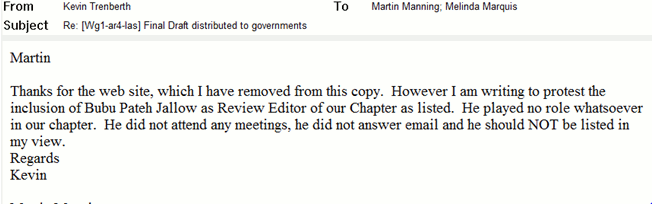
Ross McKitrick points out that IPCC AR4 Chapter 3 listed three Review Editors, one of whom was Bubu Jallow:

On Oct 31, 2006, Kevin Trenberth (with Phil Jones, one of two Coordinating Lead Authors of chapter 3) wrote to IPCC protesting Jallow’s inclusion as a Lead Author because he did not attend any meetings, answer any emails or play any “role” whatsoever in the preparation of Chapter 3.

IPCC listed Bubu Jallow as a Chapter 3 Review Editor anyway – presumably on the basis that there was nothing in his conduct that fell below IPCC standards for due diligence.

Another Trick from the U of East Anglia

Volume II of the Report of the UK Science and Technology Committee – here – contains supplementary answers by the University of East Anglia that have thus far not attracted commentary. The University’s answer to a question about the July 2009 FOI requests was untruthful in important respects. Continue reading

The BP Oil Spill Response “Plan”

The BP Oil Spill Regional Plan (BP Regional Plan) is online here. This document is relied on and incorporated in the Exploration Plan for the Macondo site (online here) via the following certification:

since BP Exploration & Production Inc has the capability to respond to the appropriate worst case spill scenario included in its regional OSRP approved on November 14, 2008 and since the worst-case scenario determined for our Exploration Plan does not replace the appropriate worst-case scenario in our regional OSRP, I hereby certify that BP Exploration & Production Inc has the capability to respond to the maximum extent practicable to a worst-case discharge …resulting from the activities proposed in our Exploration Plan.

The BP Regional Plan was prepared by The Response Group, 13231 Champion Forest Dr., Suite #310, Houston, TX 77069 281-880-5000 url. They appear to be an American group – as are the drilling contractor (Transocean) and major suppliers such as Haliburton.

In light of recent events, some surprising aspects of the BP Regional Plan have attracted little to no comment thus far despite the massive coverage.

First and perhaps most surprisingly, the scale of the blowout (even if 20,000 barrels per day) is an order of magnitude lower than the “Worst Case Scenario” contemplated in the BP Regional Plan. On page 509, the Worst Case Scenario for an offshore blowout of an exploratory well is said to be 250,000 barrels per day.

Given the anticipated reservoir thickness and historical productivity index for the Miocene, worst case discharge is expected to be 250,000 barrels of crude oil per day. Calculations are based on formulas defined by MMS regulations.

In addition, the pro forma location of such a blow out in the regional plan (28° 30’ 47.42” N, 88° 52’ 40.84” W, Distance to Shore: 33 miles ) is a reasonable pro forma location for Macondo. The Response Plan even shows Plaquemines Parish as the landfall most likely to be affected by an unabated spill, so Billy Nungasser’s problems were not exactly unanticipated.

Although the Response Plan is 583 pages in total, there are only a couple of pages (see 509 ff) that say what they will do in the event of an offshore blow out. And these couple of pages say little more than that they have standing contracts with regional responders (Marine Spill Response Corporation (MSRC) and the National Response Corporation (NRC) ) who are said to have more than sufficient skimming capacity to deal with the Worst Case Scenario of a 250,000 barrel/day blow out. (I presume that the BP Oil Spill Response Plan is more or less similar to Response Plans by other operators in the region.)

Here are the salient paragraphs:

BP will make every effort to respond to the Worst Case Discharge as effectively as possible. BP has contracted with Clean Caribbean & Americas (CCA), Marine Spill Response Corporation (MSRC) and the National Response Corporation (NRC) as primary Oil Spill Removal Organizations. Contact information for the OSROs can be found in Figure 7-6A. Upon notification of the spill, BP would request a partial or full mobilization of the resources identified in the attached Appendix E, including, but not limited to, dispersant aircraft from CCA, ASI & MSRC and NRC & MSRC skimming vessels.

Offshore response strategies may include attempting to skim utilizing MSRC &NRC’s Oil Spill Response Vessels (OSRVs), Oil Spill Response Barges (OSRBs), ID Boats, and Quick Strike OSRVs, which have a combined derated recovery rate of 491,721 barrels/day. Temporary storage associated with the identified skimming and temporary storage equipment equals 299,066 barrels.

The Plan has a short discussion of dispersants – a discussion that shows that dispersion capacity of 6-7,000 barrels/day is far short of Worst Case requirements – though not the original discharge estimates. Corexit is specified as the dispersant, so this should not have been a surprise to regulators and environmental organizations.

Plaquemines Parish is mentioned as the most likely area to be affected. However, the Response Plan contains nothing specific to Plaquemines Parish – only B-school generalities e.g. the following:

If the spill went unabated, shoreline impact would depend upon existing environmental conditions. Nearshore response may include the deployment of shoreline boom on beach areas, or protection and sorbent boom on vegetated areas. Strategies would be based upon surveillance and real time trajectories provided by the Response Group that depict areas of potential impact given actual sea and weather conditions. Strategies from the Area Contingency Plan, The Response Group and Unified Command would be consulted to ensure that environmental and special economic resources would be correctly identified and prioritized to ensure optimal protection. The Response Group shoreline response guides depict the protection response modes applicable for oil spill clean-up operations. Each response mode is schematically represented to show optimum deployment and operation of the equipment in areas of environmental concern. Supervisory personnel have the option to modify the deployment and operation of equipment allowing a more effective response to site-specific circumstances. (For information on resource identification, see Section 11; for more information on resource protection methods, see Section 13.)

Overall, the “plan” for a Worst Case blow out of an exploratory well is extraordinarily cursory (though elsewhere the Plan is remarkably specific. For example, they specify that the center for public relations should have a podium and a wall clock.)

It seems to me that the response problem is a little different than characterized by commentators to date.

The blow out is “only” 20,000 barrels/day or so, while the Regional Plan says that the various response organizations have a skimming capacity of 491,721 barrels/day.

It’s not that the Response Plans didn’t contemplate a Worst Case as bad as the present blow out (they contemplated much worse scenarios). The problem seems to be that the effective skimming capacity seems to be vastly less than the rated capacity.

Obvious questions: how real is the rated capacity of 491,721 barrels/day? Is this apples and apples relative to a point discharge of 20,000 barrels/day? Does a larger dispersion cone reduce the effective capacity of the skimmers by a couple of orders of magnitude? Or is there some elementary mismatch between the apparent skimmer capacity and the job that needs to be done?

I have no personal knowledge of the technologies and am more or less throwing the topic up for discussion by readers more knowledgeable than me.

Another point. I also presume that the BP Oil Spill Response Plan (including prior editions) and Response Plans of other operators have been available not merely to regulators, but to environmental organizations for many years (I don’t know this, I am presuming it.) If effective skimming capacity is insufficient to deal with the present blow out – or whatever else is missing in the remediation capacity – shouldn’t this have been apparent to someone in the environmental movements? Has this been an ongoing topic of controversy for environmental organizations over the past 10 years? Not just in the abstract way of condemning all offshore drilling, but in the practical way of pointing out potential shortfalls in skimming capacity (or other practical defects in the Response Plan)? Just asking.

BP’s Hayward and the Climategate Inquiry

Last week, in the wake of the BP fiasco in the Gulf of Mexico, I wondered whether David Eyton, BP Group Vice President, Research and Technology, and former Vice President of BP’s Gulf of Mexico Deepwater, didn’t or shouldn’t have something more important to do than wade through CRU emails – like, say, R&D into blow out preventers. (And why climate scientists had been silent on the BP presence in this inquiry.)

There was another small puzzle in the Eyton appointment. Unlike most of the other appointees, he didn’t seem to be connected to Geoffrey Boulton’s Royal Society of Edinburgh or University of Edinburgh.

CNN has been carrying wall-to-wall coverage of the oil spill, with James Carville calling every day for criminal proceedings to be instituted against BP executives, saying that the notorious Louisiana prisons (seen in many American movies) would have a special place for BP CEO Anthony Hayward – who otherwise looks like Mr Bean Visits the Beach. (The situation is very difficult, but Hayward has sure done about as bad a job of dealing with the public as it seems possible to do.)

The answer to the David Eyton mystery lay not in his CV, but in Hayward’s CV.

BP appears to be a generous contributor to the Royal Society of Edinburgh and the University of Edinburgh (and Hayward himself personally.) Hayward has a PhD in geology from U of Edinburgh.

On March 2, 2009, Hayward was appointed a Fellow of Boulton’s Royal Society of Edinburgh.

On June 29, 2009, Hayward was awarded the Honorary Degree of Doctor of Science from Boulton’s University of Edinburgh.

I’ll bet dollars to doughnuts that Boulton talked to Hayward and that Hayward then asked Eyton to go on Boulton’s “inquiry”.