Curry: Thermodynamic Feedbacks in the Climate System

Judith Curry writes:

I’ve posted the chapter on Thermodynamic Feedbacks in the Climate System from my text “Thermodynamics of Atmospheres and Oceans” on my website, the links can be found at

Text: http://curry.eas.gatech.edu/climate/pdf/Ch13_GalleyC.pdf
Figs: http://curry.eas.gatech.edu/climate/pdf/chapter13_figs.pdf

For my more recent thoughts on the subject of climate feedbacks, I refer you to my previous post on the spencer thread, post #23

I will have some time this week (but not alot) to respond to any comments

More on the Logarithmic Formula

A logarithmic relationship between CO2, radiative forcing and direct impact is reported by IPCC and widely relied on. While this may well be a plausible relationship (Luboš, for one, endorses it), it is not easy finding a proof of the relationship. In a recent post, I noted this in connection with IPCC AR1 (1990), where I reported their references. Today, I’m going to discuss the handling of the logarithm formula in AR4, AR3 and then report on today’s search for the source of the Nile. Continue reading

IPCC "Explains" the Greenhouse Effect

One of the fundamental questions for someone interested in the impact of doubled CO2 is exactly how (1) the greenhouse effect works; and (2) how the “enhanced” greenhouse effect works. AR4 FAQ 3.1 poses the question:
natura2.gif

I’m going to show their answer to this question in full because the answer does not rise about a primary school level and can hardly be considered an adequate answer to the question. (And it’s not answered in AR1, AR2 or AR3 either.) While I think that this is the sort of thing that should be laid in detail in one of the reports, I could understand if they chose to refer interested readers to texts containing expositions that met IPCC standards. But no luck there. We simply get a grade school brochure without references. Continue reading

AR4: "ad hoc tuning of radiative parameters"

Chapter 1 of AR4 has some surprisingly interesting comments about models that, to the extent that the points are disclosed in the body chapters, are disclosed so opaquely that they would be undecipherable to anyone other than a few. Here are some interesting comments about flux adjustment – an issue that must surely raise civilian eyebrows. A “flux adjustment” in a GCM is defined below as an “empirical correction that could not be justified on physical principles” i.e. a fudge factor, and one of the accomplishments of recent GCMs has been to apparently get past that. AR4:

The strong emphasis placed on the realism of the simulated base state provided a rationale for introducing ‘flux adjustments’ or ‘flux corrections’ (Manabe and Stouffer, 1988; Sausen et al., 1988) in early simulations. These were essentially empirical corrections that could not be justified on physical principles, and that consisted of arbitrary additions of surface fluxes of heat and salinity in order to prevent the drift of the simulated climate away from a realistic state. The National Center for Atmospheric Research model may have been the first to realise non-flux-corrected coupled simulations systematically, and it was able to achieve simulations of climate change into the 21st century, in spite of a persistent drift that still affected many of its early simulations. Both the FAR and the SAR pointed out the apparent need for flux adjustments as a problematic feature of climate modelling (Cubasch et al., 1990; Gates et al., 1996).

By the time of the TAR, however, the situation had evolved, and about half the coupled GCMs assessed in the TAR did not employ flux adjustments. That report noted that ‘some non-flux adjusted models are now able to maintain stable climatologies of comparable quality to flux-adjusted models’ (McAvaney et al., 2001). Since that time, evolution away from flux correction (or flux adjustment) has continued at some modelling centres, although a number of state-of-the-art models continue to rely on it.

This raises an obvious question: which “state-of-the-art models” continue to rely on flux adjustments? One of the annoying aspects of IPCC WG1 reports is their refusal to make such identifications, which might put one of the group in hot water with his funders, I suppose. I’d like to know which models make flux adjustments so that I can keep an eye out when the “ensemble” results are reported.

They go on to make the following interesting comment that I;ve not seen in print elsewhere:

(1.5.3) The design of the coupled model simulations is also strongly linked with the methods chosen for model initialisation. In flux adjusted models, the initial ocean state is necessarily the result of preliminary and typically thousand-year-long simulations to bring the ocean model into equilibrium. Non-flux-adjusted models often employ a simpler procedure based on ocean observations, such as those compiled by Levitus et al. (1994), although some spin-up phase is even then necessary. One argument brought forward is that non-adjusted models made use of ad hoc tuning of radiative parameters (i.e., an implicit flux adjustment).

No reference is given for this powerful statement. This is exactly what Gavin Schmidt denies and yet here’s IPCC WG1 worrying about “ad hoc tuning”. Does anyone know anything more about this?

IPCC and Radiative Forcing #2: 1992 and 1994.

In our summary of IPCC AR1 (1990) on radiative forcing, I noted that the logarithmic relationship and 4 wm-2 values were attributed to: Hansen et al (1988), which in turn cited Lacis et al 1981; and Wigley (1987) which is not presently available to me (or to Wigley himself) and appears not to have been peer-reviewed (FWTW). Feedback analysis primarily relied on Cess et al 1989. I’ll examine those references at some point, but today I’ll continue the review through two supplements to IPCC (1990), published in 1992 and 1994. Continue reading

AR4: "Now-Classic" Results on Cloud Uncertainty are "Unsettling"

AR4 (chapter 1 on the History of Climate Science) contains the remarkable statement:

The strong effect of cloud processes on climate model sensitivities to greenhouse gases was emphasized further through a now-classic set of General Circulation Model (GCM) experiments, carried out by Senior and Mitchell (1993). They produced global average surface temperature changes (due to doubled atmospheric CO2 concentration) ranging from 1.9°C to 5.4°C, simply by altering the way that cloud radiative properties were treated in the model. It is somewhat unsettling that the results of a complex climate model can be so drastically altered by substituting one reasonable cloud parameterization for another, thereby approximately replicating the overall intermodel range of sensitivities.

As they say, it is somewhat unsettling. On the basis that these results are “now-classic”, one would have expected them to have been prominently featured in TAR. [yeah, right.] So let’s how prominently TAR featured these results – were they as prominent as the Hockey Stick? Continue reading

IPCC: "Lively Interchanges" as a Form of Due Diligence

It is very difficult for the general public to understand that IPCC does not carry out independent due diligence. The answers of Michael Mann in 2003 to questions from Sen Inhofe are well worth re-reading in the present context. Mann says that it is “against the mission” of IPCC to “carry out independent programs” or to “carry out studies”. Instead, they have “lively exchanges”.

Perhaps that’s how Gerry North got his understanding of how expert panels, such as the NAS panel, should carry out business. You may recall North’s statement that the NAS Panel “didn’t do any research”, that they just “took a look at papers”, that they got 12 “people around the table” and “just kind of winged it”, saying that’s what you do in these sort of expert panels.

Continue reading

IPCC on Radiative Forcing #1: AR1(1990)

As an innocent bystander to the climate debates a couple of years ago, I presumed that IPCC would provide a clear exposition of how doubled CO2 actually leads to 2.5-3 deg C. The exposition might involve considerable detail on infra-red radiation since that’s relevant to the problem, but I presumed that they would provide a self-contained exposition in which all the relevant details were encompassed in one document (as one sees in engineering feasibility studies.)

Having re-raised the issue in the context of AR4, Judith Curry has said that this sort of issue is not covered in AR4 since it’s baby food. She’s referred us back to the early IPCC reports without providing specific page references, mentioning IPCC 1990 in particular. In a later post, I’ll show that TAR and AR4, as Curry says, do not contain sought-for explanation. So let’s see what IPCC 1990 has to say on the matter. Continue reading

A NASA Request for Review

Here is an account of an intriguing review carried out by NASA in response to a civilian Request for Review.

NASA’s webpage on the Data Quality Act states:

In accordance with the President’s Management Council, NASA implements the Office of Management and Budget (OMB) following requirements for quality of information. Section 515, “OMB Guidelines for Ensuring and Maximizing the Quality, Objectivity, Utility, and Integrity of Information Disseminated by Federal Agencies” and NASA Guidelines for Quality of Information.

The latter document contains clauses permitting affected persons to request correction of information disseminated by NASA as follows:

D.1. Requesting Correction of Information by NASA: If an affected person believes that information disseminated by NASA does not meet the guidelines for quality (utility, objectivity, and integrity), he or she may seek correction of the information

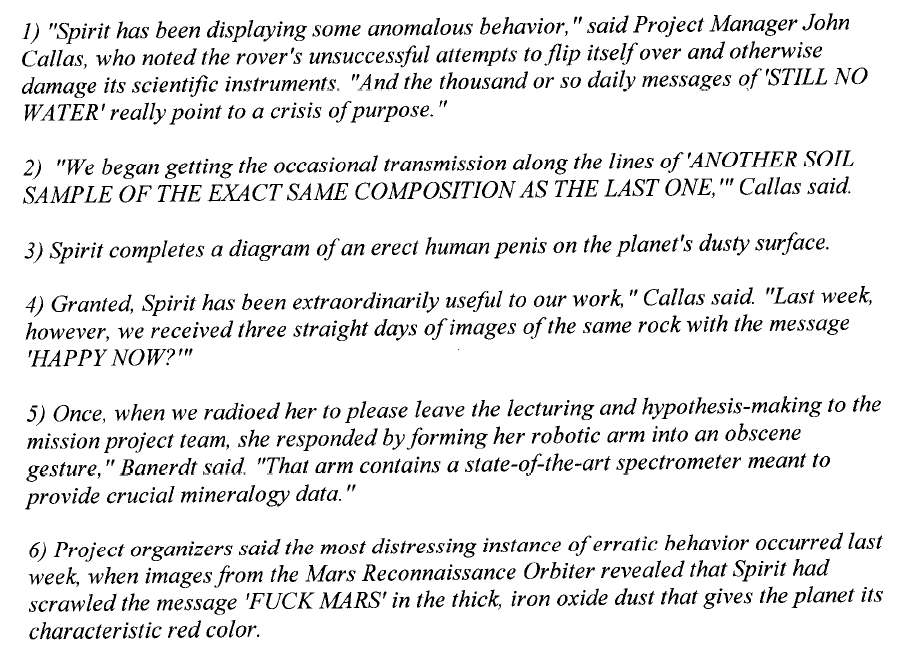
The webpage includes a report on a Request for Correction and their disposition of the request. In a separate category, they also report on a Request for Review and their disposition of this request. The Request for Review is entitled <a href="http://www.sti.nasa.gov/rfr_10-28-06_mars_exploration_rover.pdf (73K) and the Response RFR_Response_10-28-06_Mars Exploration Rover (102K) Here are the allegations dutifully investigated by NASA:
nasah39.gif

In response, NASA carried out the requested review concluding that “none of the Rover behaviors alleged in this web article are true”.

James Annan on 2.5 deg C

I’ve been seeking an engineering-quality exposition of how 2.5 deg C is derived from doubled CO2 for some time. I posted up Gerry North’s suggestion here , which was an interesting article but hardly a solution to the question. I’ve noted that Ramanathan and the Charney Report in the 1970s discuss the topic, but these are hardly up-to-date or engineering quality. Schwartz has a recent journal article deriving a different number and, again, this is hardly a definitive treatment. At AGU, I asked Schwartz after his presentation for a reference setting out the contrary point of view, but he did not give a reference. I’ve emailed Gavin Schmidt asking for a reference and got no answer.

James Annan, a thoughtful climate scientist (see link to his blog in left frame), recently sent me an email trying to answer my long-standing inquiry. While it was nice of him to offer these thoughts, an email hardly counts as a reference in the literature. Since James did not include a relevant reference, I presume that he feels that that the matter is not set out in existing literature. Secondly, a two-page email is hardly an “engineering quality” derivation of the result. By “engineering quality”, I mean the sort of study that one would use to construct a mining plant, oil refinery or auto factory – smaller enterprises than Kyoto.

Part of the reason that my inquiry seems to fall on deaf ears is that climate scientists seem to be so used to the format of little Nature and Science articles that they seem not to understand what an engineering-quality exposition would even look like.

Anyway on to James who writes: Continue reading