Here’s an assignment for JEG’s hockey stick class. Try to replicate the reported proxy-gridcell temperature correlations reported in Mann et al 2007 SI.
The table showing correlations between 112 proxies (the AD1820 network presumably) and gridcell temperature are shown in column 5 of the spreadsheet here. Data for the 112 proxies in the AD1820 proxy network is here. I used the HadCRU2 gridcell version for the calculations shown here, but experiments using HadCRU3 or vintage versions would be welcome.
First here is a barplot showing the reported correlations, color coded by proxy type, with distinct colors for instrumental temperature, instrumental precipitation, tree ring chronologies, tree ring temperature reconstructions, coral dO18, ice core dO18 and melt pct and miscellaneous (coral indices that aren’t dO18 and ice accumulation.) Mann reports an average correlation of 0.26, an average which is obviously helped along by the very high correlation of instrumental temperature to instrumental temperature.
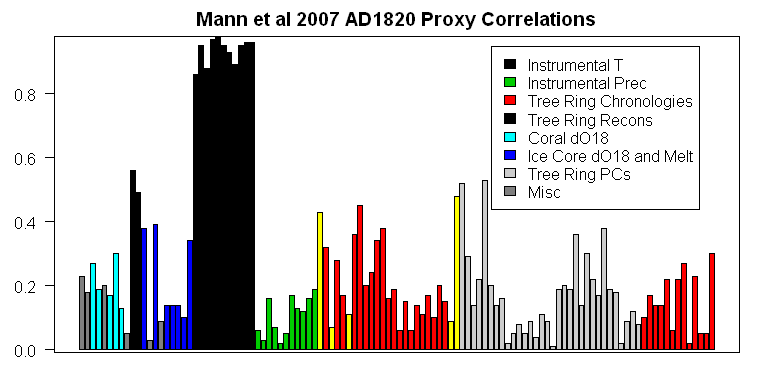
Note: Yellow in this graphic and below are tree ring temperature recons.
Now here’s the same barplot using the reported locations in the table and the proxy data from http://holocene.meteo.psu.edu/shared/research/MANNETAL98/PROXY/data1820.dat. The correlations of instrumental temperature to instrumental temperature match nicely, but otherwise many of the correlations do not match. One obvious difference is that all the reported correlations are positive, while the actual correlations are a mixed bag. In some cases, there is a plausible physical basis for reversing the orientation of the proxy – thus, I’d have no trouble if (say) coral dO18 proxies were inverted
(if that’s what specialists do) – provided that all of them were inverted. Similarly with say ice core accumulation. What I don’t buy is opportunism: scientists should at least be able to specify the orientation of supposed temperature proxy in advance – rather than deciding afterwards.
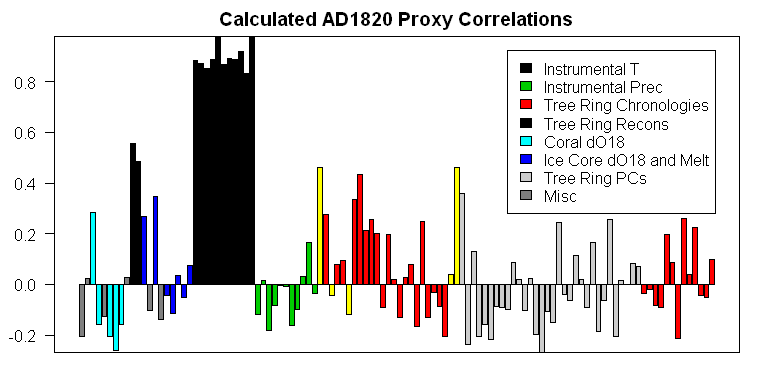
PC series present a bit of a conundrum as there is no intrinsic orientation. For tree ring PCs, the PC1 can be interpreted as a weighted average – often looking something like an average – and if the eigenvector values are negative, one can reasonably prefer the positive orientation. However, past that, lower order PCs are orthogonal to the PC1 and may be best interpreted as contrasts – in which case, it’s hard to pick a gridcell to assign the PC to or think up a reason why the contrast should have a correlation to that particular gridcell temperature. If the PCs have undergone varimax rotation, then there may be a cluster of sites that are heavily weighted e.g. the bristlecones tend to maintain a distinct identity even in lower order PCs. But the allocation is something that you have to work at.
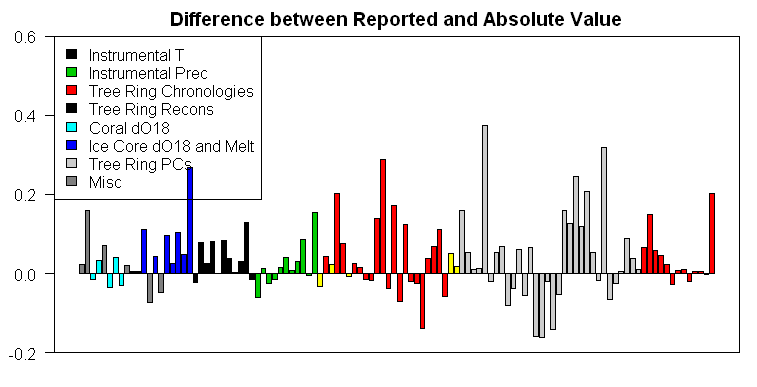
Now I don’t think that you can arbitrarily decide the orientation of a series after the fact, but let’s say that that’s what Mann did (and he obviously did so), then the difference between the reported correlation and the calculated absolute value correlation is shown below – the differences being material.
After I did the above calculations, I noticed something quite weird about the Mann et al 2007 SI. The longitudes are inconsistently reported. For series 80-83 and 96-112, west is positive, while for the other series, west is negative. So I placed the longitudes on a consistent basis (also in the process changing the longitude of series 84-92 from a 0 to 360 basis to a -180 to 180 basis. I then re-ran the two calculations above. There is a separate list of lat-longs here which appears to be consistent. Again one finds a mixture of positive and negative orientations.
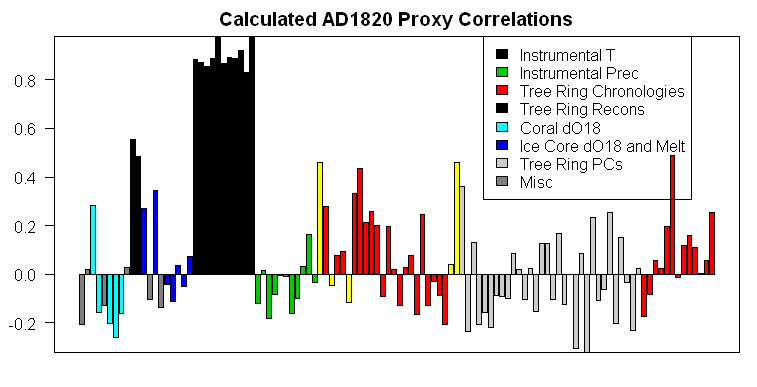
Then here again is the difference between reported and calculated correlation (this time correcting the inconsistent longitudes in Mann’s table):
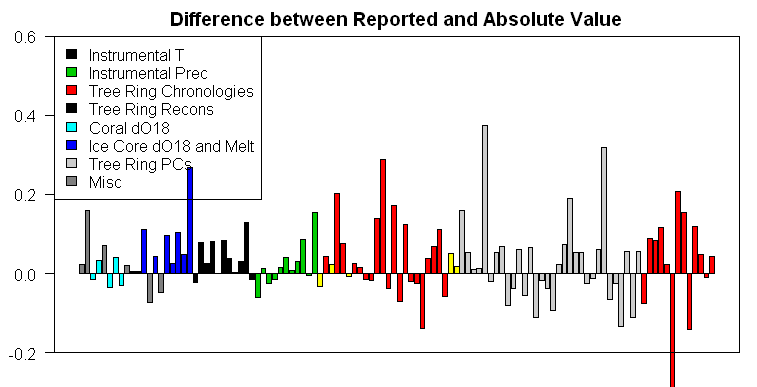
That’s my try at replicating Mann’s correlation table. The homework assignment for EAS8100: can you achieve a better replication of Mann’s correlation table – perhaps using a different temperature series? Perhaps a different proxy version? Use your imaginations.









 Climate Audit