A new Holland and Webster paper is here. Some discussion already started on this thread http://www.climateaudit.org/?p=900
Update: Judith Curry sent in the following data file http://data.climateaudit.org/data/hurricane/natldata.xls
A new Holland and Webster paper is here. Some discussion already started on this thread http://www.climateaudit.org/?p=900
Update: Judith Curry sent in the following data file http://data.climateaudit.org/data/hurricane/natldata.xls
This is the 2nd Christmas for climateaudit. Right now I feel like I’ve probably more got more posts to write than I did when I started. And AR4 hasn’t hit the presses yet. We’re probably going to hear more next year about 12,000 years than 1,000 years – so there’s going to be lots to talk about. More about ocean sediments and ice shelves and less about tree rings.
In our family, last year’s Christmas was dominated by the aftermath of my grandson’s severe head injury (from which he recovered miraculously). No such immediate cloud hangs over this year’s Christmas. The Christmas present that we hope for is an announcement that cystic fibrosis can be managed like diabetes. Our children and grandchildren are all in Toronto – so today will be a happy day and this will probably be my only computer time.
Last year, when we were only at post 471 as opposed to the present 978, I mentioned:
The blog has been both work and fun. I wouldn’t do it if I didn’t like doing it and I wouldn’t do it if there wasn’t an audience. … The blog was John A’s idea and design and I’m glad that people other than me have thanked him for his efforts. I repeat my thanks. I’ve met some nice people through the process, sometimes in person, sometimes by email.
I repeat these sentiments. I met quite a few regular CA readers this year and made many new friends. Merry Christmas.
Dear CA readers and commenters,
I am happy to welcome you back after our short hiatus. This should be the last downtime until the next time.
I apologize for the delay, which was due to a clerical error between myself and the webhost which left us unaware that we were still using the old shared webhost rather than the VPS that Steve is paying for.
We are now fully on the VPS and ready to go for 2007.
The only (temporary) problem is that LaTeX no longer functions, but I’m working on a solution (Christmas? What Christmas?)
I’ve just discovered an issue which will cause CA to need to be shutdown for a short while to be resolved. I hope to do this change early in the morning (GMT) of 23rd December (tomorrow).
I apologize in advance for the disruption. What will happen is that there may be a period when comments will no longer update.
Please bear with us while this is resolved.
The following comes from Pat Frank regarding my question here
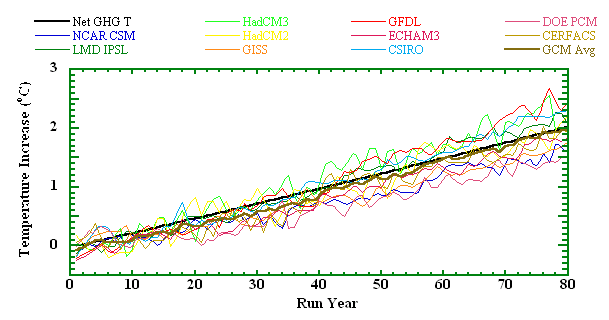
This plot shows projections from 10 of the 15 GCMs tested in the “Intercomparison of Present and Future Climates Simulated by Coupled Ocean-Atmosphere GCMs” CMDI Report No. 66. The GCM data were digitized off Figure 27 of the Report. The plot also shows the linear average of the GCM projections and the results of a simple calculation of global average temperature increase due to increases in greenhouse gases (GHGs). The acronyms at the top of the plot designate the GCMs that were used to make the respective projection, their average (GCM Avg.), and the simple calculation (Net GHG T).
The Legend to Figure 27 is: “Globally averaged difference between increasing-CO2 and control run values of annual mean surface air temperature (top) and precipitation (bottom) for the CMIP2 models. Compare with Figure 1, which gives control run values.”
And the comment on the CO2 boundary condition of the GCM projections in the text is: “To begin our discussion of model responses to 1% per year increasing atmospheric CO2, Figure 27 shows global and annual mean changes in surface air temperature and precipitation under this scenario, i.e., differences between the increasing-CO2 and control runs.” The control runs were essentially flat lines with low-intensity wiggles.
The “Net GHG T” line reflects my own calculation and assumed the same 1% per year increase in atmospheric CO2 as the GCM simulations. This calculation also included forcings from methane (CH4) and nitrous oxide (N2O). The increase in these gases was extrapolated from polynomial fits to the measured trends.
The calculation further assumed that greenhouse gasses produce 40% of the total greenhouse warming above the Top of Atmosphere temperature. This 40% includes warming due to the increased water vapor induced by the same GHGs.
The forcings for CO2, CH4, and N2O were calculated according to the equations in G. Myhre, et al., (1998) “New estimates of radiative forcing due to well-mixed greenhouse gases” Geophys. Res. Lett. 25(14), 2715-2718, Table 3.
The net temperature increase is just a linear extrapolation of the temperature from the fraction of GHG forcing in the start year (1960 in all cases), i.e., global average T is scaled by the increase in GHG forcing.
Histrorical methane was obtained from: D.M. Etheridge, L.P. Steele, R.J. Francey, and R.L. Langenfelds. 2002. Historical CH4 Records Since About 1000 A.D. From Ice Core Data. In Trends: A Compendium of Data on Global Change. Carbon Dioxide Information Analysis Center, Oak Ridge National Laboratory, U.S. Department of Energy, Oak Ridge, Tenn., U.S.A; source URL: http://cdiac.ornl.gov/trends/atm_meth/lawdome_meth.html
Historical N2O was obtained from: Khalil M.A.K.; Rasmussen R.A.; Shearer M.J.(2002) “Atmospheric nitrous oxide: patterns of global change during recent decades and centuries” Chemosphere, Volume 47(8, June), 807-821. The percent 1900 forcing was obtained by linear extrapolation of the BRW and CM data from Table 1 of the reference.
Pat’s Comment: The simple GHG-induced temperature projection goes right through the middle of the pack of GCM simulations, and closely tracks the GCM average. As the average of GCM projections is typically accounted to more accurately follow measured climate trends, the same criterion indicates that the simple GHG projection is more accurate than any of the GCM projections. It seems lots of money spent hasn’t gotten us much. One other thing of serious note: It is now obvious that GCM modelers assume that the only element driving net climate change is the level of GHG gasses in the atmosphere. This seems extraordinarily naàÆà⮶e, physically.
Here’s an interesting graphic from lecture notes of Jed Schneider and Kathryn Clapp here showing the flow of ice through a mountain glacier. If this is representative of flow in mountain glaciers, one wonders at what exactly is being recorded in a vertical drill hole away from the summit (such as Guliya Core 2). I’ll try to show my query below.
Continue reading
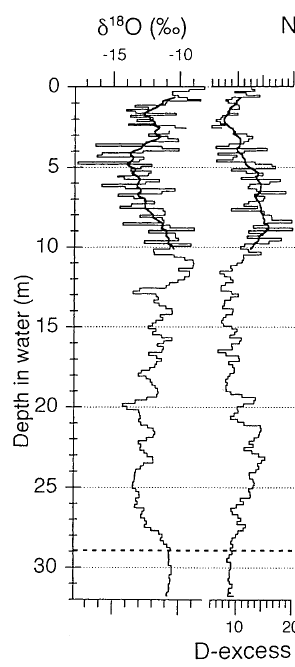
Here’s an interesting graphic from Shiaiwa et al (Ann Glac 2002) showing dO18 for the top 30+ meters of the Glaciar Tyndall, Patagonia (by comparison, the Kilimanjaro glacier is only about 50 m thick and Thompson’s Himalaya glaciers (other than Guliya Core 2) are about 100-150 meters thick. You will notice sharper dO18 definition in the 10 meters of the core.
Three cores were drilled at Dasuopu. We don’t hear much about Core #1. It was drilled in a flow zone and, despite being 160 m deep, is only back to 1922 in the most recent discussion.
I’m intrigued with this for a variety of reasons, including the fact that Guliya Core #3, the one that we’ve been discussing, was not drilled at the summit.
Dasuopu is a Thompson core and, needless to say, there is no systematic description of the core or archiving of the data. So it’s a “dance of the seven veils” to decode anything and results are inconsistent between one publication and another, seemingly with no reconciliation.
Continue reading
I’ve submitted two short review comments on Juckes et al – one on their representation of M&M issues and one on the Union reconstruction. The comment period expires on December 21.
My comments overlap somewhat with Willis’ draft. I’ve paid attention to various comments by others here, but, in these short reviews, it’s hard to reflect everything and I’ve not attempted to do so. Regardless of the outcome at CoP, I think that we’ve discussed Juckes et al pretty thoroughly here and readers of this blog have a pretty good understanding of the limitations of this study.
BTW I’ve been invited to act as a CoP reviewer for another submission and I suspect that they are not unaware of our discussions of the Juckes submission.
Here’s a quick summary of the overlap of proxies in three widely publicized “independent” 2006 studies. The number of proxies are all small (Juckes -18; Osborn – 14; Hegerl – 12). All three use multiple bristlecone/foxtail chronologies: Juckes 4; OSborn 2; Hegerl 2. All three use Fisher’s Greenland dO18, Tornetrask (Juckes twice, Hegerl mis-identifying it); Taimyr; the Yang composite; Yamal. Several series are used in 2 of three studies: Chesapeak Mg/Ca; Alberta (Jasper) tree rings; Jacoby Mongolia tree rings. There are very few “singletons” – Osborn 3; Hegerl 3 and Juckes 6, although the Juckes singletons were used in Moberg 2005 or MBH98. Continue reading





 Climate Audit