[JohnA: For reasons that I don’t understand, posting comments became nearly impossible for some people for a short while. This comment from Willis I thought should be captured for future reference so I made it into a post.]
Willis Eschenbach writes:
Well, on the 4th of this month I posted a couple of questions on the Climate of the Past discussion site. After 10 days (on the 15th), I got tired of waiting for an answer, and I posted the following:
I had made the foolish assumption that this discussion board was an opportunity to discuss the paper with the authors. However, they seem to be curiously unwilling to respond to my questions. If they are not willing to answer questions … what is the point of having a discussion forum at all?
w.
Continue reading →
This is a continuation of the original post for comments.
Chris Monckton has replied to Al Gore’s characterization of his articles here. The relevant section on the Hockey Stick is on page 11.
I know that Steve does not agree with all of Monckton’s analysis, so can we take that as read?
Does anyone think that Kerry Emanuel and Judith Curry each have an obligation to issue a report in Nature and/or Science on the 2006 hurricane season? Corporations can’t just issue financial statements when they have good years; they have to issue reports in bad years. And let there be no doubt – 2006 was a “bad” year for hurricane alarmists. I’ve collated all the storm track data to date. Storm and hurricane days are each off 30%; cat 3+ days by 50% and cat 4+ days by 54%. Hurricane days were at their lowest levels since 1989 and storm days at their lowest levels since Dvorak measurements were introduced in the Pacific in 1987. To my knowledge, this is the first quantitative report of these 2006 hurricane results. Emanuel had something in print using 2005 hurricane data in December 2005 (Reply to Landsea). What’s the over/under on when Emanuel and/or Webster/Curry will report on 2006 results in peer reviewed literature?
The results for storm, hurricane cat 3 and cat 4+ days are indicated in the graphic below:
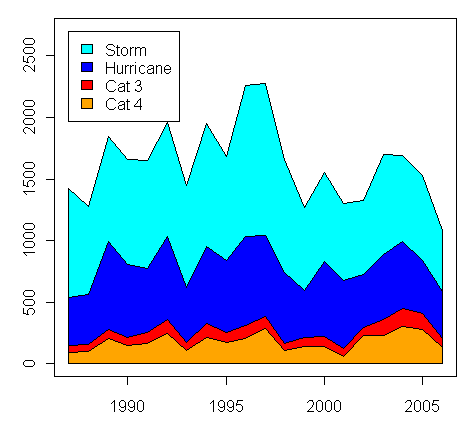
Figure 1. Total storm, hurricane, cat 3 and cat 4+ days for 5 basins (Atlantic, W Pacific, E PAcific, N Indian Ocean, S Indian Oean + S Pacific). (Storm includes all greater categories etc.) Continue reading →
here . Gore has much to say on the hockey stick.
Ralph Cicerone, President of NAS, personally reviewed Hansen’s recent article, which is available for free at the PNAS website here.
George Denton, a very distinguished paleoclimatologist of the older school – one whose work will undoubtedly long survive that of the Team, recently contributed an article entitled Holocene elephant seal distribution implies warmer-than-present climate in the Ross Sea”. The period in question was 1100-2300 BP. Unlike the Hansen article, the article here is not publicly accessible without purchase. Abstract for Hall et al:
We show that southern elephant seal (Mirounga leonina) colonies existed proximate to the Ross Ice Shelf during the Holocene, well south of their core sub-Antarctic breeding and molting grounds. We propose that this was due to warming (including a previously unrecognized period from 1,100 to 2,300 14C yr B.P.) that decreased coastal sea ice and allowed penetration of warmer-than-present climate conditions into the Ross Embayment. If, as proposed in the literature, the ice shelf survived this period, it would have been exposed to environments substantially warmer than present.
Proxy attention seems to have migrated away from things like bristlecones (still waiting for Hughes’ 2002 Sheep Mountain update) to the Antarctic Peninsula ice shelves, with the major break-ups of the Larsen 1-A and 1-B ice shelves. An interesting illustration of NH-SH asymmetry is that the latitude of the Larsen 1-A ice shelf is 64 45S; in comparison, the latitude of Tornetrask is 68N. The difference is presumably due to the impact of the Antarctic continent on the one hand and the Arctic Ocean on the other.
I’m going to post up a note on Domack’s prominent Nature article on the break-up of the Larsen 1-B ice shelf, but first I’m going to post a note on Brachfeld, Domack et al 2003, an earlier article on the break-up of Larsen 1-A. Domack’s articles are interesting and well-presented, but the Nature article is on the one hand less informative and on the other hand contains annoying Naturisms (“unprecedented”) that did not occur in the earlier article – you can draw your own conclusions.
Continue reading →
As a workaround to the server configuration issue, I have moved the last 45 comments from the original Monbiot v Monckton thread so that the conversation can continue. This will mean that the numbering will refer to what it was in the orginal and not what it is here, but c’est la vie
For those who missed this, George Monbiot penned his reply to Monckton’s two part articles here dipping his metaphorical pen in concentrated sarcastic acid.
I can’t say I’m impressed with Monbiot’s arguments because they appear to be of the distinctly strawy kind. He does mention asking Gavin Schmidt about blackbodies (in relation to Monckton’s use of the Stefan-Boltzmann formula) and gets a logically correct but misleading answer…
Continue reading →
I’m going to Cornell University on Nov. 17 at the invitation to give a lecture to Sinan Unur’s economics policy class on my adventures in climate. Oddly enough, I’ve never given a presentation to a university class in my life. It wasn’t something that you did in math classes in the olden days. My only previous invitation from a university came from KTH in Sweden for their seminar in September. (My presentation at Vreij University in Amsterdam was sponsored by Natuurwetenschap & Techniek, rather than the university.)
Continue reading →





 Climate Audit
Willis on “Getting authors to respond to questions”
[JohnA: For reasons that I don’t understand, posting comments became nearly impossible for some people for a short while. This comment from Willis I thought should be captured for future reference so I made it into a post.]
Willis Eschenbach writes:
Well, on the 4th of this month I posted a couple of questions on the Climate of the Past discussion site. After 10 days (on the 15th), I got tired of waiting for an answer, and I posted the following:
Continue reading →