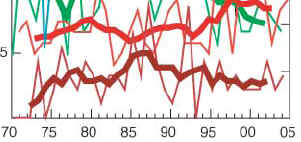
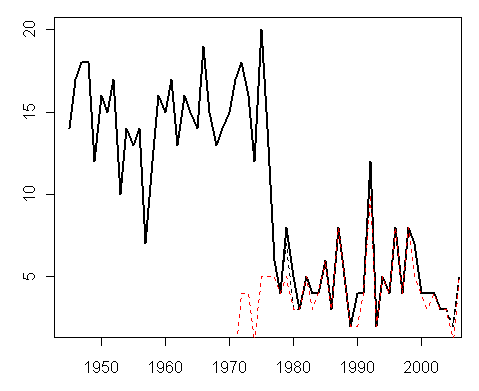
Readers of this blog are familiar with the Yamal subsitution. Briefly, Briffa et al 1995 reported in Nature that 1032 was the coldest year of the millennium based on no more than 3 poorly dated and short cores in the 11th century.
Subsequently new cores were dated to the 11th century by Schweingruber, resulting in the opposite situation – a very warm 11th century. Instead of reporting the new information, Keith Briffa in Briffa 2000 seamlessly inserted another site – Yamal – over 100 km away – indeed this site is sometimes denoted “Polar Urals” – without reporting the “bad” results from the Polar Urals.
However, Esper didn’t get the memo and used the Polar Urals update in his 2002 reconstruction. This resulted in a rather elevated MWP in Esper, which he attempted to “solve” by using not one but two foxtail sites to lower the MWP.
By itself, using the Polar Urals Update, instead of the Yamla substitution, gives a high MWP to (say) the Briffa 2000 reconstruction. So how did the Euro Hockey Team grasp this particular nettle? Here’s what they say:
the Polar Urals data of ECS2002 [Esper], MBH1999 and the Tornetraesk data of MSH2005 [Moberg] have been omitted in favour of data from the same sites used by JBB1998 and ECS2002, respectively (i.e. taking the first used series in each case).
In what other field would people use the older data instead of the newer data? The audacity of the Team in moving the pea under the thimble is sometimes breathtaking.
Continue reading