Pat Frank on North's Seminar

Here is Pat Frank’s post on North’s seminar. You should also look at North’s answers in the Chronicle Q&A session yesterday. North has a slide in his presentation entitled “Enter the Amateurs”. If one associates professionalism with care and due diligence, one wonders whether he has placed this particular cue at the right location in his presentation. Continue reading

Nature Again

We took another try at Nature corrspondence. In their news report on the Mann graph discussed here , they stated:

In its report, released on 22 June, the NAS committee more-or-less endorses the work behind the graph.

They published a whining letter about the NAS panel and news conference by Mann et al, where they claimed that it was "hard to imagine" how they could have disclosed uncertainties more fulsomely. Of course, it was very "easy to imagine" and we sent in a letter to Nature, which they refused to print.

Now obviously whatever else the NAS Panel did, they did not "more or less endorse the work behind the graph". So we sent the following letter tracking the form of language of the Mann et al letter to some extent:

Your News story “Academy affirms hockey-stick graph”‘? (Nature 441, 1032; 2006) states that the US National Academy of Sciences (NAS) panel “more-or-less endorses the work behind the [Mann et al hockey stick] graph”‘?. This conclusion was not stated in the NAS report itself nor by any of the panellists at the NAS panel press conference releasing the report.

Many specific findings of the NAS panel show that they did not endorse the work behind the hockey stick. The NAS report stated that the Mann et al decentered principal components methodology should not be used; that temperature reconstructions should avoid the use of strip-bark bristlecones and foxtail proxies; that the Mann et al reconstruction was strongly dependent on these problematic proxies; that their reconstruction failed important verification tests; and that they had incorrectly estimated uncertainties in their reconstruction.

At the press conference, panel chairman North said that he agreed with the “substance”‘? of the Mann et al reconstruction. However, this language is nowhere used in the report itself, where the panel expressly referred to the reconstruction merely as “plausible”‘? and specifically withheld any attribution of confidence intervals for the period before 1600.

Nature, who seem to have abandoned any attempt at an even-handed treatment of the issues, even where they have themselves inaccurately reported on a matter, replied:

Thank you for your Correspondence submission, which we regret we are unable to publish. Our news story was indeed citing North’s comments at the press conference, which as they say "substantially" support Mann et al., and which is clear from the text of the news story.Thank you again for writing to us.

For comparison, once again, here is the letter from Mann et al which was published:

Your News story “Academy affirms hockey-stick graph”‘? (Nature 441, 1032; 2006) states that the US National Academy of Sciences (NAS) panel “concluded that systematic uncertainties in climate records from before 1600 were not communicated as clearly as they could have been”‘?. This conclusion is not stated in the NAS report itself, but formed part of the remarks made by Gerald North, the NAS committee chair, at the press conference announcing the report.

The name of our paper is “Northern Hemisphere temperatures during the past millennium: inferences, uncertainties, and limitations”‘? (Geophys. Res. Lett. 26, 759″€œ762; 1999). In the abstract, we state: “We focus not just on the reconstructions, but on the uncertainties therein, and important caveats”‘? and note that “expanded uncertainties prevent decisive conclusions for the period prior to AD 1400″‘?. We conclude by stating: “more widespread high-resolution data are needed before more confident conclusions can be reached.”‘? It is hard to imagine how much more explicit we could have been about the uncertainties in the reconstruction; indeed, that was the point of the article!

The subsequent confusion about uncertainties was the result of poor communication by others, who used our temperature reconstruction without the reservations that we had stated clearly.

Gerry North Presentation on NAS Report

North has a Texas A&M Seminar presentation here (deleted available here) . North is a nice and decent guy but this is a frustrating presentation in a lot of ways. At minute 55 or so, he describes panel operating procedure by saying that they “didn’t do any research”, that they just “took a look at papers”, that they got 12 “people around the table” and “just kind of winged it.” He said that’s what you do in these sort of expert panels. Obviously I suspected as much, but it’s odd to hear him say it.

AGU Fall Meeting 2006

Session U12 of the AGU Fall meeting (Session organizers: Gerald North, Bette Otto-Bliesner, John M. Wallace, and Ian Kraucunas[ of NRC]) has the following session description

Numerous studies concerning large-scale surface temperature reconstructions have been published over the last decade. The National Research Council recently completed a report summarizing the status of these efforts. The session invites contributions on the various types of proxy evidence and methods used to derive large-scale climate reconstructions for the past 2,000 years. Of special interest are updated proxy records or new proxy data from under-sampled regions, the spatial and temporal extent of past temperature anomalies as well as their central locations and timings, and reconstructions of solar and volcanic forcing, precipitation, or other climate variables over the past two millennia.

Abstracts are due by Sept 7. Here is my draft. Suggestions are welcome.

The report of the National Research Council (NRC) panel made several important recommendations about reconstruction methodology, including concluding that strip-bark samples (bristlecones/foxtails) should be avoided in temperature reconstructions and that non-robustness to subset selection should be considered in confidence estimation. Inconsistently, their report relied on and illustrated studies that are affected by these problems. We demonstrate the impact of implementing NRC panel recommendations on prominent reconstructions, showing that none of them provide reliable information on relative medieval-modern temperature levels.

New Article in Chronicle of Higher Education

Here is a link to a new article in Chronicle of Higher Education about the HS debate in congress. This link should work for the next 5 days. A sidebar is available at the following link. There will be an online discussion Wednesday Sept. 6 at noon eastern time with Gerald North about the hockey stick and the broader issue of politics and science at http://chronicle.com/live/.

The tone is less antagonistic towards me than an article last year. A couple of obvious and annoying errors though. The realclimate blog started first and devoted much of its initial energy to trying to preempt our ctiticim of the HS, which was then about to be published. ClimateAudit.org was started in response.

They also say in the sidebar that other recent studies do not use the contested bristlecones. In fact, the two most recent studies, Osborn and Briffa 2006 and Hegerl et al 2006, in small populations of 14/12 sites each use Mann’s PC1 plus a separate foxtail series.

My Prediction for dO18 at Bona Churchill

In 2000, Lonnie Thompson drilled ice cores at Kilimanjaro which were published 2 years later. In 2003, they drilled ice cores at Bona Churchill in Alaska. They made a presentation at AGU with press release in 2004 about looking for (and not finding) White River Ash from an 803 AD eruption.

But no publications so far.

Here’e my prediction about dO18 levels at Bona Churchill.: 20th century dO18 levels will be more negative ("colder") than levels in the early 19th century – the opposite pattern to the pattern that Thompson is promoting for tropical glaciers.

There is evidence for this prediction over and above conclusions drawn simply from the lack of published results. Continue reading

Greene: I am not, nor have I ever been a member of a data-mining discipline

Many of the problems in multiproxy studies have very strong parallels in econometrics. It’s really econometricians – who know all about autocorrelated series and data mining – rather than statisticians who really should be involved in climate statistics.

Here are some quotes from Clinton Greene, from an article about data mining from an issue of J Econ Meth (2000) which was devoted to the topic.

One of Greene’s resonant conclusions is that sometimes analysts simply have to wait for more data to provide a true out-of-sample test. He points out that repetitive use of the same data sets makes statistical tests invalid. He uses the example of an econometrician who develops his theory from data up to 1980 waiting until 2010 to test it. There’s much to be said for this in the present quandary of proxy studies – if Gasp” cedars for example were a "key proxy" up to 1980, then there’s a very easy way to see if they are a proxy for temperature – bring the damn series up-to-date.

Here are some comments from Greene, then I’ll mention a comment by Bradley below. Continue reading

More Tangled Webs

Here’s something amusing.

Mann has written to the House Energy and Commerce Committee, arguing that we made a fundamental and obvious mistake in how we calculated AR1 coefficients for the North American tree ring network, which exaggerated the HS-ness of the simulated hockey sticks – a mistake that Ritson has now supposedly picked up and which supposedly any reviewer would have picked up.

The irony is that the method that we used to calculate AR1 coefficients is identical to the method used by Mann in his Preisendorfer diagram for the NOAMER network submitted to Nature and posted up at realclimate, as I prove below. Continue reading

More Bender on Hurricane Counts

Posted for bender.

bender writes:

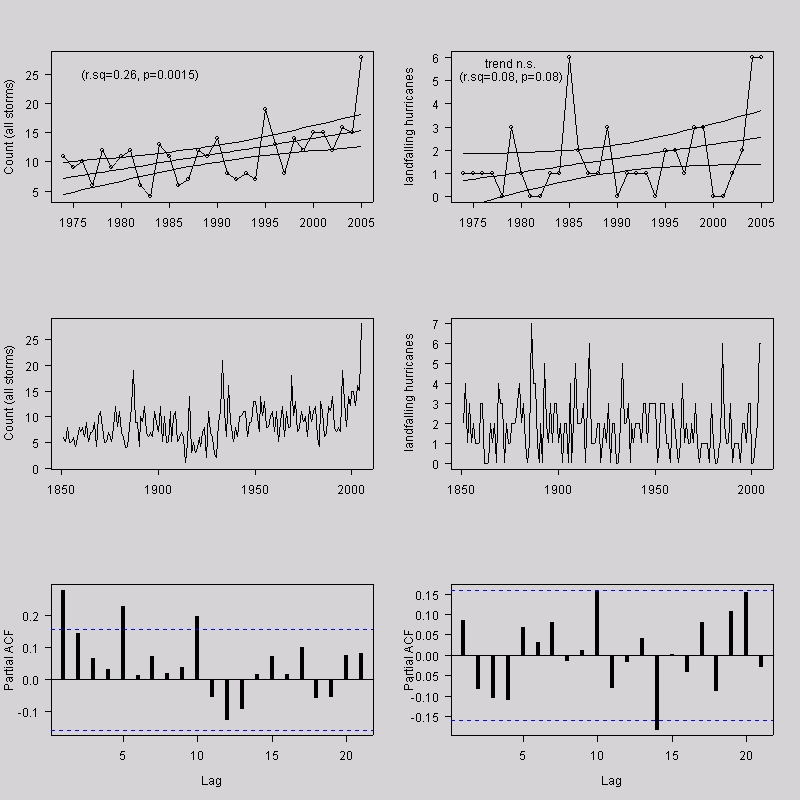
Attached are analyses of Willis’s landfalling hurricane data in post # 35. Interesting facts:
1. 1974-2005 trend is "n.s." (Note 95% confidence intervals now present.)
2. PACs for lag 10 and 20 are marginally significant. (Recall that for total # hurricanes lag 5 and 10 were sig. It is as though NAO affecting sea storms is operating on a 5y time-scale and continental high (blocking effect from decadal/bidecadal solar cycle?) is operating on a 10/20y cycle. Not sure if this has been noticed in the literature because I don’t read that literature. But I know that continental drought in the US is weakly forced by the 11/22y solar cycle, so why not the process of hurricane landfall? (i.e. You take your pick: hurricanes in 2005 are the ultimate solution for droughts in 2001-2003!) Note how this fits nicely with your "persistence" theory!


Script

Take a Ritalin, Dave

The Team have snarled back at Wegman here . They’ve posted up an August 16, 2006 letter from David Ritson to Waxman, accusing Wegman of not responding with a request for information that had been outstanding for almost 3 weeks (?!?) .

Yes, you read it right. Jeez, I’ve been waiting almost three years for data and the Team complains to Congress if they have to wait for 3 weeks.

Take a Ritalin, Dave.

I guess it’s time to re-submit a request to Mann for the actual stepwise results from MBH, how he calculated the confidence intervals, how he retained principal components… It’s all too ridiculous for words. Continue reading