I’ve recently shown some histograms for site ring widths and opined that they loooked somewhat gamma-ish. Louis Hissink said that they looked log-normal to him. Louis is right for Gotland anyway.
Continue reading →
One of the reasons that I’m going to parse through Esper’s Gotland series is the virtual absence of archived RCS chronologies, despite the fact that they are sweeping the field in multiproxy studies. Continuing on with Esper’s Gotland series
First (and this is not shown by Esper) is a simple histogram of RWM and MXD measurements. Obviously both distributions are skewed. It’s actually a somwhat interesting problem to think about what sort of distribution of temperatures and distribution of age responses would combine to yield final distributions like this.
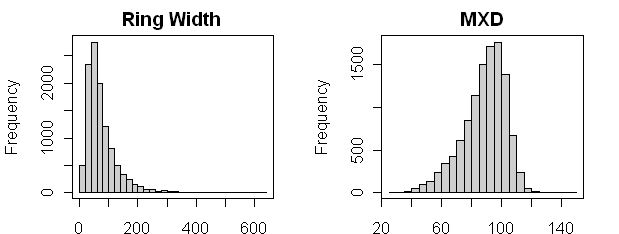
Figure 1. Gotland Histograms – RW and MXD.
Continue reading →
An important new proxy series, which is one of only 8 in Mann and Jones [2003] and one of only 11 low-frequency proxies in Moberg et al [2003], is the Chinese composite of Yang et al [2003]. Unlike the Hockey Team, Prof. Yang promptly provided the underlying data set upon request. Here are some early thoughts. Continue reading →
Just as an experiment, I plotted up all the ring widths for the Gaspé and Polar Urals sites, with each core displaced a little. What I was thinking of the type of graph that you see in seismic surveys. The look is interesting, given how much weight is placed downstream on these data sets in multiproxy reconstruction. Continue reading →
One of the main Hockey Team studies is Esper et al 2002, which is published in Science and, naturally, no data is archived. Esper has not deigned to reply to any emails by me requesting data. Esper and coauthors have just published an article in QSR leading with a discussion of the Mann controversy. I’m told that Esper could not even bring himself to mention my name in connection with this and therefore cited Regalado [2005] (the Wall Street Journal article) – no doubt surprising the reporter. Actually it’s rather ironic that ES&T trashed the Wall Street Journal for this article – can you think of any other newspaper article in recent memory which has been cited in a serious academic journal and by Esper no less.
Esper does not do archiving; so it’s hard to get much traction on Esper et al [2002]. However, I recently read an article at his website discussing RCS on the Gotland site (mentioned in Esper et al 2002). So I’ve got a bit of a foothold. Continue reading →
As a result of refusals by Moberg, Sonchkin and Lauritzen, I’ve filed a Materials Complaint with Nature, which will hopefully result in the delivery of the data in less than geological time. In an email to me concerning a possible one year misdating of U.S. bristlecones, Moberg said that their "reconstruction does not contain any information on timescales shorter than 4 years". As I point out below, the SI contains an annual reconstruction, so this statement is not exactly correct. Here’s the complaint. Continue reading →
We get considerable criticism from paleoclimate scientists that complying with requests for data and methods sufficient to permit replication is much too onerous and distracts them from "real work". However, the problem is not our request, but that any request should be necessary in the first place. In my opinion, a replication package should have been archived at the time of original publication so that any subsequent researcher can replicate the results without needing to contact the original author. From my personal experience, non-academics typically assume that there are adequate due diligence packages and find it difficult to believe otherwise. It appears that significant academic experience is necessary to instill a belief that a due diligence package is an imposition.
Right now, it is obviously practical and feasible to create replication archives at the time of publication and this is a mandatory requirement in some fields (econometrics). In business, adequate compliance with regulations is often based on available practices. So I’ve tended to think that if this is feasible in empirical econometrics, it is feasible in paleoclimate science (where the structure of the datasets is surprisingly similar to empirical econometrics). During all of this, I have remained firmly convinced that climate scientists will not be able to avoid complying with proper standards for archiving data and methods much longer.
When I first ventured into climate replication, my framework was one of business audits and feasibility and engineering studies, a framework which has been ridiculed by some academics (inappropriately in my opinion.) I’ve often described myself as feeling like an anthropologist in studying the behavior of climate scientists, because their standards of replication and audit (or lack of them) seem as foreign to me as tribal customs must have seemed to early 20th century anthropologists in the South Sea Islands. During this journey, I have encountered some commentary on replication from within the academic community (though not the climate science community), especially from Dewald et al., McCullough and Vinod and Gary King, which captures almost exactly what I had in mind. We referred briefly to this in our E&E article and I’ll expound a little more today on this. Continue reading →
Last year, I presented a paper at the AGU Fall Meeting (December 2004) which was the core of our GRL paper. I’ve just submitted an abstract for the 2005 Fall Meeting for session PP-19 co-chaired by Hans von Storch. Continue reading →
Dmitry Sonechkin, the #2 author of Moberg, Sonechkin et al [2005], has replied that he cannot send the Indigirka series used in Moberg et al [2005] because the "series developers do not want to disseminate it. They say this series will be re-calculated soon to reject some errors in it (a general trend etc.)." Continue reading →
Anders Moberg sent a courteous response on the Lauritzen issue mentioned in More Moberg and Brandon Whitcher sent some comments on end effects in waveslim. Update Sep 7-8: I’ve been blown off totally so far by Moberg and Lauritzen in trying to obtain the digital data underlying the discrepant graphs. Continue reading →





 Climate Audit