For those who have been following the posts on water vapor and its relationship to climate change, here’s an article on water vapor, radiative modelling and the effects on the greenhouse effect:
http://www.sron.nl/www/code/eos/atmos/h2o/PWMAY03.pdf
A new video presentation from the University of Calgary on climate change has been published on the "Friends of Science" website at this link
It’s an overview of the current controversies in climate science from a skeptical point of view in a simple presentation. I’m not aware that any television station has broadcast it, however. It is quite Canadian oriented, but you get the idea. It covers the issues of climate change, with special reference to the "Hockey Stick" reconstruction. Continue reading →
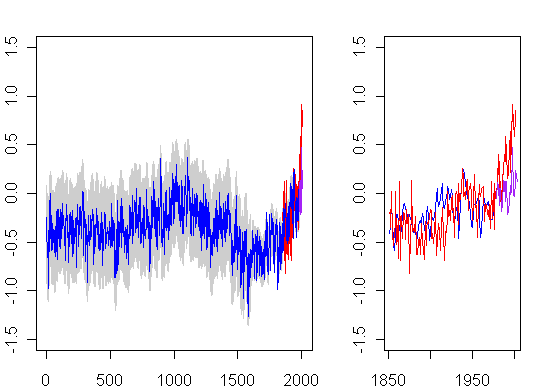
Here is an interesting splice of Moberg and satellite data. Blue is Moberg, grey is Moberg error bars, red is instrumental, all downloaded from the Nature SI; purple is satellite. At right is the post-1850 blow-up. You can see that the post-1980 satellite temperatures are high but not off the charts relative to Moberg’s reconstruction.
 Continue reading →
Richard G. Anderson, William H. Greene, Bruce D. McCullough and H. D. Vinod have some very interesting comments in a recent Federal Reserve Bank of St Louis Working Paper about the importance of archiving data and code, in which they cite our work approvingly. Here’s a nice cut phrase that they quote:
An applied economics article is only the advertising for the data and code that produced the published results.
Continue reading →
I find it difficult to believe that so many scientists have seemingly accepted the realclimate argument that Preisendorfer’s Rule N applied to a principal components calculation is somehow a substitute for proper statistical analysis. To show the goofiness of this argument, I asked a friend to compile a list of weekly closing prices for 20 tech stocks in the bull market. Of these, there were 15 stocks with at least 581 values. I then substituted 15 tech stock prices for 15 bristlecone pines in the NOAMER tree ring index. The results are pretty funny. Continue reading →
(deliberate pun in title)
Michael Mann has been interviewed by yet another journalist who didn’t do the background reading. Read it all at Mother Jones
Roger Pielke has done a good job of exposing the politicization of climate science on the Prometheus blog.
I think its very wrong to equate a view on a particular aspect of climate science with a political viewpoint. I know of many people of liberal political views who believe that anthropogenic climate change is minor and probably beneficial, and that the IPCC’s viewpoint is fundamentally flawed – yet for reasons which are now obvious, are viewed as political fellow travellers of the US Republican party or neoconservatives or libertarians. One climatologist told me he was being investigated by a journalist looking for funding from the oil industry because of his "non politically correct views" on climate science (by the way, there’s no money to be found).
Of all news outlets across the world, the supposedly unbiased BBC has been one of the greatest cheerleaders of global warming alarmism in general, and the Hockey Stick in particular. My encounters with the journalists who write on the BBC website have been brusque and condescending. As a mere taxpayer and license fee payer, I have no right to give askance to the BBC, because the BBC is not simply a television company and a news agency, but a British institution, like the Queen.
Institutions in the UK cannot be completely wrong. Therefore anyone who points out that the BBC is wrong once is a nuisance, twice an irritant, three times or more a lunatic. So usually they’ll answer nicely (to show you the error of your ways) the first time, then brusque the second time, then dismissive after that.
Continue reading →
Briffa’s Tornetrask temperature reconstruction is done by regression analysis. Previously I reported that Briffa purported to justify his upward adjustment of 20th century MXD chronology (and downward adjustment of MWP reconstruction) by a very slight improvement of R2 (going from 0.503 to 0.553 – see Clim. Dyn 1992). I’ve attempted to replicate these regression calculations — I show an R2 using unadjusted data of 0.555 and with adjusted data of 0.558 (both using Briffa’s 1876-1975 reference period). With a reference period of 1851-1980, the corresponding unadjusted R2 is 0.571 (adjusted 0.572). As mentioned before, my RW chronology calculations are based on the 65-core dataset used in the MXD calculation. Continue reading →
Wild et al. [2001], a blue-chip study, shows that the downward longwave radiation in cold, dry climates is dramatically under-estimated in the GCMs used in IPCC TAR, as shown in the following excerpt from their Figure 4 (from one of the best GCMs). The bias is systemic.
FIG. 4. Annual cycles of model-calculated and observed DLR (W m22) at some of the most reliable high-latitude sites, midlatitude sites, and low-latitude sites (see Table 1 for more information on these sites): model calculations by ECHAM3 (dotted) and ECHAM4 (dashed), and observed (solid). Continue reading →
Since 2000, there have been a number of very important new studies, increasing the estimated NIR absorption parameters of water vapor, stimulated by the discovery of the HITRAN-96 clerical errors, but amounting to significant increases over and above those errors. The increases seem to account for much missing atmospheric absorption. Again, the issue here is not the "greenhouse" effect of water vapor, but a type of anti-greenhouse effect of water vapor, whereby water vapor absorbs incoming solar radiation in near infra-red (NIR) and visible wavelengths, rather than absorbing outgoing IR wavelengths. This directly cuts into hypothesized positive feedback effects of increased IR absorption of water vapor by creating a negative feedback. Belmiloud et al [2000] with a variety of blue-chip authors have a compelling cut-phrase:
There is another lesson to be learned. Making sure the database is valid is necessary foundation for all modelling of atmospheric radiation transfer, especially so when theory and observation fail to agree.
Continue reading →







 Climate Audit
Water vapor: The missing link
For those who have been following the posts on water vapor and its relationship to climate change, here’s an article on water vapor, radiative modelling and the effects on the greenhouse effect:
http://www.sron.nl/www/code/eos/atmos/h2o/PWMAY03.pdf