Speculating Privately

Iridge versus TTLS. What if a key text on this conundrum of the day resided in an anonymous open peer review? Would we, within the ethical standards of modern climate science, be entitled to speculate on the identity of the author of these pearls? Or would that be an ethical violation “as bad as possible”? Even if we merely speculated privately, alone here on the internet, just you and I, dear reader? Sometimes truth is stranger than fiction.
Continue reading →

Publishing Review Comments – the Crowley Incident

In order to respond to Nielsen-Gammon’s comments about the morality of publishing review comments and/or speculating on reviewer identities, I think that it would be helpful to review a couple of other incidents.

Today I’ll review an incident involving Tom Crowley’s publication of a farrago of falsehoods in EOS (as well as in contemporary interviews) concerning our previous correspondence. In an effort to defend myself, I published both the underlying correspondence and the review comments on my attempt to reply at EOS.

In an unexpected byproduct of O’Donnnell et al 2010, Crowley recently (Jan 4, 2011) apologized unconditionally both for his initial article and his failure to apologize previously.

Let’s review these events under Nielsen-Gammon’s moral compass. Continue reading →

Limits to “Justified Disingenuousness”

John Nielsen-Gammon has articulated a doctrine of what might be termed justified disingenuousness as applying to climate scientists acting as reviewers. I criticized this doctrine in yesterday’s post.

In comments to that post, Nielsen-Gammon said that I made unrealistic assumptions about the academic world, that I was (in effect) too idealistic, perhaps even a pollyanna about the hard truths of modern academic climate science. (I’m expressing his points in more lively terms, but I think that the characterization is fair. Readers in doubt of my characterization are asked to review N-G’s comments here.) Nielsen-Gammon paints a picture of a world where scientists fear reprisals, if they have the temerity to criticize the dons. Where safety exists only in anonymity. Accordingly, Nielsen-Gammon has harsh words for those who break the sanctity of the witness protection program. While many CA readers have criticized the witness protection program, Nielsen-Gammon’s words of caution deserve attention, lest the cure be worse than the disease.

Fear of reprisals is definitely at large in modern climate science. Some surprisingly prominent climate scientists have told me privately – and only under the condition that their identity remain confidential – that, in their opinion, our criticism of Team-style proxy reconstructions had ended that line of argument and that 1000-year proxy reconstructions would be unable to advance without the development of more reliable proxies. Despite their apparent prominence, for fear of reprisals, they were unwilling to express these views publicly or to allow me to use their names in support.

Police undercover agents are also permitted latitude for “justified disingenuousness”, but, even for police undercover agents, there are limits. Surely there are limits in climate science as well. I submitted the following incident to Nielsen-Gammon for assessment:

One of the complicating issues in this has been Steig’s public statements at realclimate and elsewhere. Another example not in Lucia’s list is a comment at RC from Steig on March 24, 2010. ( His review had been submitted three weeks earlier on March 5.) Steig’s allegation that we had been “unwilling” to do the work of re-analysing his data was completely untrue. At the time, as Reviewer A, he knew that we had submitted a comprehensive article. (Santer’s allegation was untrue as well. McKitrick and I had twice submitted an article showing that important Santer results did not hold up with updated data, and each time the article was rejected with scurrilous reviews.) Steig:

Eric Steig says:

24 Mar 2010 at 7:04 PM

The Guardian responds


comment-page-1/#comment-167866

Here are my edits of Ben Santer’s comment, so that it applies to me:
In fact, my position on this matter was that Mr. McIntyre’s data requests were superfluous and frivolous, since Mr. McIntyre already had access to all of the raw climate model data my colleagues and I had used. Mr. McIntyre also had access to all the algorithms required to calculate intermediate “value-added” information from the raw climate model data. With some work – which he was unwilling to do – Mr. McIntyre could have replicated all of the
calculations performed in the 2008 Santer Steig et al. International
Journal of Climatology
Nature paper.

Anyone see a pattern here?

While I find it hard the doctrine of justified disingenuousness in climate science as pretty hard to choke down, it seems to me that here Steig went far beyond any conceivable doctrine (however repugnant). Steig’s allegations were untrue on multiple counts.

That we now know that Steig was Reviewer A (who submitted his first review on March 5, 2010) makes this assertion even worse than we previously thought. Extensive analyses of Steig et al 2009 had obviously been carried out at CA and tAV in 2009. But, at the time that Steig made this comment, he knew that I was one of the coauthors of O2010, which had carried out a comprehensive analysis of Antarctic data from the bottom up. His public statement about being “unwilling” to do the work was completely untrue and malicious.

The “unwillingness” to do work in connection with Steig et al 2009 is not the only untruth here. Santer’s allegation is also untrue – something that Santer knew as well. Ross and I had twice submitted a comment showing that key results of Santer et al 2008 fell apart with updated data. Our comment had been twice rejected. (McKitrick et al 2010, published later in 2010, revisited this topic using different methods and was accepted in a statistics journal.) The first rejection was promptly reported to Phil Jones by Peter Thorne in a climategate letter – search “fraudit” – before anyone unconnected with the review process was aware of the rejection.)

Steig’s statement about data availability was also untrue. At the time of my initial inquiry, no Steig data had been placed online. Some of the data was made available very grudgingly. As of August 2009, Ryan’s requests for underlying AVHRR data had been stonewalled. The AVHRR data was made available only after a Materials Complaint to Nature (which, despite criticism, is taking a harder line on data obstruction by climate scientists than Science and some other journals.)

Nielsen-Gammon replied by email as follows to my a request for a specific comment on the Steig incident:

Steig is on record as strongly favoring the peer-review process for legitimate criticisms of his work, and frowning upon blog postings with incomplete analysis as a way of advancing the science. It seems to me that Steig is criticizing the blog postings. Note that Steig retains past tense: “was unwilling to do” instead of “is unwilling to do”.

I’d also point to the fact that after the paper does come out, he compliments you for doing the work.

If I remember the context correctly, one of the initial concerns that featured prominently in your blog posts was problematic data from station ‘Harry’, etc., which when the calculations were finally performed turned out to be of little or no consequence to the reconstruction results. You’d have to ask Steig yourself if that’s the sort of thing he was referring to.

I will, however, acknowledge, using the same words as Ryan O’Donnell used with regard to his conduct immediately following Steig’s RealClimate post, that Steig’s comment was “not optimal”.

“Not optimal” are faint words relative to his criticism of Ryan O’Donnell breaking the code of omerta on peer reviewer identity. Nor do I believe that a rational code of conduct would acquiesce in scientists making this sort of untrue statement that Steig made here, while preventing the targets from defending themselves through exposure of Steig as Reviewer A.

N-G: “Reviewers may need to be disingenuous”

John Nielsen-Gammon writes as follows in a comment in the preceding post:

If you are a reviewer and wish to remain confidential while remaining engaged in scientific discourse, it is necessary for you to pretend to not be a reviewer. Scientists expect this and know that reviewers may need to be disingenuous when talking publicly about a paper they have reviewed.

I welcome John’s comments, which have been constructive and interesting, but I don’t think that he has fully thought through what happens when the scientist wishes to talk to the public.

Scientists may expect “disingenuous” conduct from other scientists, but the public doesn’t. The last thing that the climate debate needs right now is more climate scientists being “disingenuous” in their communications with the public – there lies the road to “hide the decline”.

There has to be something wrong with a policy that results in or condones a climate scientist talking “disingenuously” to the public. In the case at hand, I think that N-G goes wrong on his premise:

lf you are a reviewer and wish to remain confidential while remaining engaged in scientific discourse

It seems to me that a reviewer, wishing to engage in public discourse on the reviewed paper, should disclose that he was a reviewer. If he does so, there is no need for dissembling. If he doesn’t want to disclose that he was a reviewer, then he doesn’t need to make public commentary. (I present this as a suggestion, rather than a settled position.)

Steig could easily have avoided the conduct that led Lucia to characterize him as the “Rod Blagojevich” of Science. Steig was on record as saying that he disdained blog commentary on his peer reviewed articles (an odd position for a realclimate founder but that’s another story). If Steig didn’t want to disclose to the public that he was a reviewer of O’Donnell et al 2010, then he could have refrained from public commentary. He could have said that he would reply to O2010 in the peer reviewed literature. But that’s not what he did. After disdaining blog commentary by critics, he himself published blog commentary against those critics and made comments at blogs and to blogs about O2010.

Under the protocol that I suggest here, if he decided to comment to the public either at blogs or to reporters, he should have stated that he had been a reviewer of O’Donnell et al 2010, that, as a reviewer, he had argued that the article was flawed and that the article was ultimately published over his protests. All of this would have been true and would have forestalled at least some of the recent controversy.

In addition, once a reviewer embarks on a path of public criticism of an article that he reviewed, it seems to me that this is (or should be) an implied waiver of any confidentiality claim that the reviewer might expect on his review (in those cases where the journal has confidentiality policies binding on the authors.) It might be worthwhile for journals to think about this issue.

Reasonable people can disagree about precisely how reviewers should deal with this sort of situation. But any policy that results in more climate scientists being “disingenuous” in their communications with the public cannot be right. End of story.

Spectator on Steig v O’Donnell

The Steig-O’Donnell story is featured in this week’s Spectator in the UK. Authors are Nic Lewis, a coauthor of O’Donnell et al 2010, and Matt Ridley.

Are Review Comments Confidential?

Over the past week, there has been considerable controversy over the outing of Eric Steig as Reviewer A, together with the publication of the voluminous review comments and review responses for O’Donnell et al 2010. John Nielsen-Gammon has been a sharp critic of Ryan’s decision (see here and elsewhere.)

The history of the affair is quite lengthy and will not be reviewed in this post. (See here for example.) Two very distinct issues arise in regard to the Steig situation:

1. do originating authors have a duty of confidentiality under journal policies or otherwise to maintain review comments received from journals in confidence? And, if so, where is this duty set out and what are the limits of the obligation?

2. did O’Donnell have a duty of confidentiality arising out of his correspondence with Eric Steig in December? And, if so, did Steig’s conduct breach whatever understanding he had with O’Donnell sufficiently to justify O’Donnell’s backing off his December promise to Steig? Potential examples of such conduct would be blog comments that suggested to third party readers that he was not Reviewer A (e.g. the comments that gave rise to Lucia characterizing Steig as the Rod Blagojevich of Science and Steig the Shameless) or by re-litigating issues that he had raised as Reviewer A in his Feb 1 realclimate post without disclosing that he had been Reviewer A and that he had previously raised these issues as Reviewer A (and that he had been unsuccessful in convincing the “editor and knuckleheaded reviewers” of his point.)

Over and above these issues, the validity anonymous peer review as a component in a quality control process is something that, to say the least, puzzles people from an engineering or commercial background, where signed reviews are typically mandatory.

Continue reading →

Steig and the “KNUCKLEHEADED REVIEWERS”

Over the past few days, Eric Steig aka Reviewer A has made a series of increasingly puzzling and strident outbursts, as the inconsistency between his RC post of Feb 1 as Eric Steig and his conduct as Reviewer A has been exposed.

Yesterday, Steig placed his latest and wildest diatribe online at two blogs – John Nielsen-Gammon here and Josh Halpern here. Steig writes:

John Nielsen Gammon, while you seem to be supporting me, which I appreicate it, it isn’t very useful support.

I did not, repeat not, repeat not, forget “that this amounted to his own insistence on iridge as a reviewer.” I did NOT recommend iridge in the first place. I did NOT bring it up. I SIMPLY DID NOT THINK I COULD ARGUE WITH THE EDITOR OR THE KNUCKLE-HEADED REVIEWERS that is should not be used.

This is not complicated folks. O’Donnell and gang, not liking my criticisms of the way they used TTLS, and in particular the fact that the truncation parameter they wanted to use, suddently started using IRIDGE. This has the advantage of having a build in verification function, which means you can’t see what the verification statistics are, which means that it is much easier to NOT SHOW THE BAD VERIFICATION STATISTICS I was criticizing them for. Maybe that is not why they used iridge. I don’t know WHY they used IRIDGE but I did not suggest it to them nor endorse it.

GET IT?

P.S. Yes I am shouting. That’s what the CAPS mean.
P.P.S. O’Donnell gave ‘his word’ (that’s what he said) that would not reveal my name, nor print the reviews verbatim. He lied to me.
P.P.P.S So if anyone wants to speculate that hiding table S3 is O’Donnell lying again, go for it, since speculation is all most people seem to be doing these days.
Posted by: Eric Steig at February 12, 2011 04:36 PM

The full story began long ago when Steig appeared incognito in the review of O’Donnell et al as Reviewer A. I’ll review the chronologies in two states – the recent public debate involving Eric Steig and then the Reviewer A backstory.

Continue reading →

A Two-Way Street

Reader Jan at Lucia’s makes the following sensible comment – one that has particular irony given Gavin Schmidt’s umbrage against Fred Pearce the day after Steig’s Feb 1 post that precipitated the present controversy:

Jan writes (Comment#69196) February 11th, 2011 at 2:47 pm :

I might suggest another mistake. It appeared that after the release of O10, there was some burgeoning respect and trust for each other on the part of the antagonists. I therefore think it was a mistake of Dr. Steig to endanger that fragile state of trust and respect by posting his rebuttal to O10 without giving Ryan O’Donnell, et al a head’s up and perhaps a chance to respond privately before posting it to the world.

Had he done so, Ryan would have, at least, had the opportunity to challenge the apparent hypocrisy of recommending one method during review and then proposing to criticize that method in a public blog post where nobody but those involved could have been aware of what had actually unfolded during the review process. After all, Dr. Steig had been given that ‘head’s up’ opportunity, although initially anonymously, with respect to the published paper. He was well aware that he was no longer anonymous to Ryan and as he himself had blown his cover. While I gather Dr. Steig felt that a lack of anonymity opened up the potential for some abuse, abuse, especially of trust, is a two way street.

I think giving Ryan an opportunity to comment privately in advance on his post would have been, by far, the fairest and most ethical way of handling the situation. Sadly, that didn’t happen.

In the week preceding Ryan’s angry post, the Team boycotted the Lisbon reconciliation workshop in order to perpetuate its fatwa against critics. Gavin Schmidt’s excuse for maintaining the fatwa was widely discussed last week. On Feb 2, Gavin widely broadcast his umbrage ( e.g. here) at Fred Pearce’s characterization of his refusal to attend the Lisbon reconciliation workshop as because the “science was settled”. Ironically, this is the precise terminology used by EPA in their Statement of Litigation (but that’s another story), when Gavin’s precise words were that the science issues presented by the organizers in their proposal (including climate sensitivity) were not “‘conflicts’ in any real sense within the scientific community”. To many readers, this was a distinction without a difference, but, for whatever reason, it was important to Gavinm, who complained bitterly:

Fred Pearce did not interview me for this piece. I should like to request that in future, if my views are of interest, that he (or anyone else) should actually ask me directly. I am not hard to contact.

Gavin’s Complaint was echoed by Joe Romm, William Connolley and others, all of whom called for Pearce’s head for not contacting Gavin.

Now think about a two-way street. In the days following Steig’s Feb 1, did Gavin or anyone else ask Steig whether he had contacted Ryan to clear up potential misunderstandings? Didn’t think so.

Ryan O’Donnell Responds

Subsequent to my post on Feb 7, 2010 here, Steig informed me by email that he had not seen our Response to his Third Review, as I had previously assumed. I apologize for my misunderstanding on this point, which was, however, incidental to the major concerns expressed in my post. A more detailed response on matters raised in Steig’s most recent RC post and other issues will be forthcoming.

My misunderstanding over whether Steig received the Response to the Third Review does not alter the fact that Steig acting as Reviewer A, in his Second Review, had asked the editor to “insist” that we present the “most likely” West Antarctica trends, specifically proposing iridge, although, in an email yesterday, Steig expressed “total surprise” that we had complied with his iridge proposal and, in his Feb 1 RC post, even criticized us for complying his proposal. We will have more to say on this near the future, as his explanations remain insufficient.

Nor do I agree that the criticisms in his RC posts of the methodology have any merit. In his Third Review, Steig had raised similar points against iridge, notwithstanding his Second Review proposal of the approach and his Third Review comment that “use of the ‘iridge’ procedure makes sense to me, and I suspect it really does give the best results”. We responded fully to these concerns in our Response to his Third Review, although we were unaware until Feb 8, 2011 that Steig had not received a copy of our Response.

In any event, Steig knew or ought to have known that our response must have satisfied the editor of Journal of Climate and should have familiarized himself with our response before condemning the method that he had previously encouraged. Had Steig informed me that he had not seen a copy of our Response to his Third Review, I would have been delighted to send it to him. Instead, he chose to publicly disparage our paper using arguments that were both irrelevant and satisfactorily addressed – which was, unfortunately, no different than the tactic he used during review.

Steig’s recent outbursts are merely his most recent effort to obfuscate the underlying point of our critique: that whatever was original in Steig et al 2009 was based on faulty mathematics; and that whatever was correct in Steig et al 2009 was already known.

Coffin, meet nail.

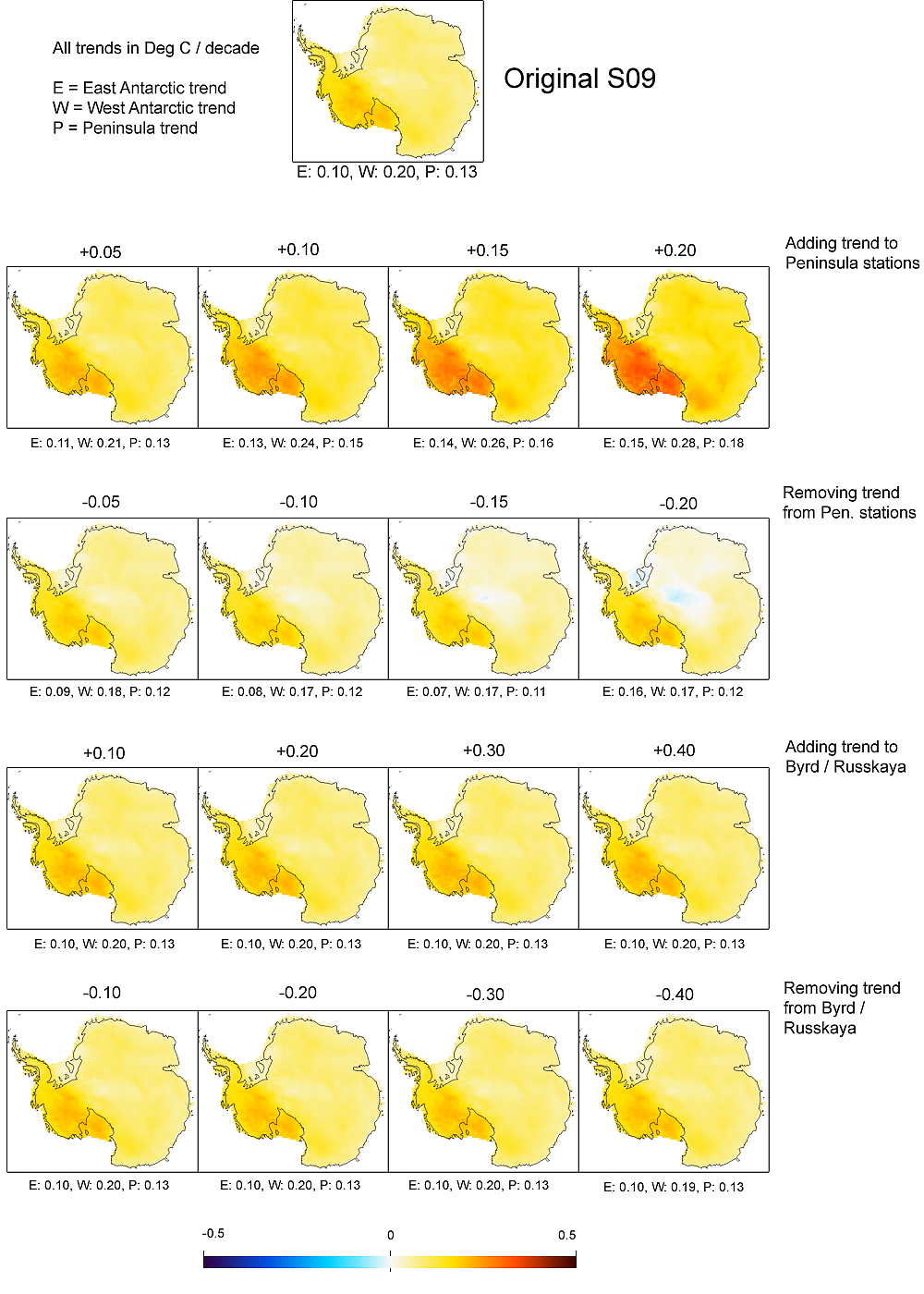
For those who are not mathematically inclined and did not entirely follow the discussion about Eric’s reconstruction in the previous post, well, a picture is worth a thousand words.

This is what happens to Eric’s reconstruction when you:

Top row:  Add the designated trends to the Peninsula stations

Second row:  Remove the designated trends from the Peninsula stations

Third row:  Treat Byrd as a single station, and add the designated trends to Byrd and Russkaya

Fourth row:  Treat Byrd as a single station, and remove the designated trends to Byrd and Russkaya


Please note how Eric’s reconstruction responds quite well to changes in the Peninsula . . . except it teleconnects them to the Ross Ice Shelf and the south pole.

Please also note how Eric’s reconstruction does not respond at all to changes in the only two West Antarctic land stations they used:  Russkaya and Byrd (the response is even less if only the manned Byrd station is used).

Anything that he “got right” . . . as I said before . . . was by accident.


I am quite tired of people who are willing to spend tens of pages during a review making claims without bothering to check.  I am quite tired of people who are willing to spend a couple of hours writing posts about how they “got it right” and I “got it wrong” without bothering to check.

Eric . . . feel free to confirm this for yourself.  I assume you have your own code handy.