Look, I’m all in favor of verifying studies and claims. However, when I do this sort of exercise, I try to carefully quote whatever it is that I’m analyzing and to replicate their analysis as best as I can as part of the commentary. I quote extensively and carefully from the original study.
In contrast, Arthur Smith makes strong and untrue allegations against Climate Audit here without providing any citations from Climate Audit to support his allegations. Smith:
What’s definitely not legitimate is presenting a graph that is specifically stated to be showing one thing, but actually showing another. That might happen just by accident if somebody messed up in creating the graph. But the ClimateAudit discussion and Mosher/Fuller book appeared to claim that in one figure in the 3rd IPCC report (TAR WG1 figure 2.21, 2001) and in one figure in the 4th report (AR4 figure 6.10b, 2007) there was a real instance where “the scientists had actually substituted or replaced the tree ring proxy data with instrument data” deliberately, for the purpose of “hiding the decline”.
Smith does not bother to link to the ClimateAudit discussion, but, from the context, it appears to me my same-day commentary of March 31, 2010 on the Parliamentary Committee report.
Like Brian Angliss, Arthur Smith has gotten a little punch drunk from different versions of tricks from the Team and has incorrectly presumed that I have been wrongfooted by the Team. I don’t, for a minute, wish to suggest that it’s easy not to be wrongfooted by the Team. They’ve wrongfooted me on a number of occasions. However, in this particular case, I’ve had a pretty good idea what to look for and am confident that I haven’t fallen prey to any of the errors alleged by Arthur Smith.
Smith would have saved people considerable effort if he had bothered considering the analysis in my Heartland presentation, which I reported here as my most systematic exposition of the Trick so far.
But let’s help Smith (and Angliss) along a little by showing the versions of the Trick side by side, showing the different versions currently being discussed. On the far right is a plot of the Briffa reconstruction in the style of AR4 using the data from the October 1999 Climategate Letters (up to 1960, it matches AR4 data archived here at CRU.) Second from the right is re-plot of the actual AR4 smoothed data (using CRU versions) colored to more or less synchronize with TAR colors; second from the left is Angliss’ version of the TAR diagram zoom ( a zoom first shown in May 2005 at Climate Audit); on the left is the WMO 1999 diagram re-scaled to match the others.
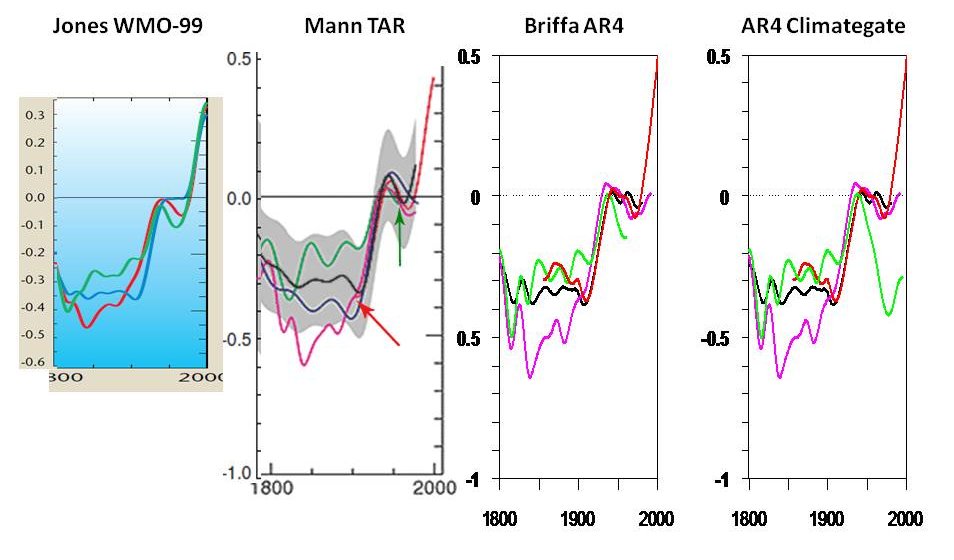
Figure 1. Trick Versions. Left – Jones’ WMO 1999 discussed in the trick email; second – Mann’s version in IPCC TAR (2001); third – Briffa’s version in AR4 (2007); right – Climategate version (1999), smoothed as in AR4.
Going from right to left, the Trick becomes increasingly layered. However, in each Team version, actual data is replaced by something else.
Using non-truncated data (as preserved in the Climategate emails), the 1980 value of the Briffa reconstruction is -0.41 (anomaly deg C ), obviously not very close to the actual temperature.
The data used for AR4 is identical to Climategate data except for the deletion of post-1960 values. Having deleted actual data, to effect the smooth shown in AR4, Briffa padded values from 1960-1975 with the 1945-1960 mean and smoothed using a gaussian smooth; then he truncated back to 1960. Had he used actual 1960-1975 values, the truncated curve would have ended in 1960 at -0.22 deg C. By padding with 1945-1960 values instead of actual values, the closing endpoint in 1960 was raised somewhat to -0.15 deg C. (Inconvenient post-1960 values were, as is now well known, not shown.) The first two drafts of AR4 did not report the deletion of post-1960 values; no climate scientists objected to this. However, I had rather vehemently objected and Briffa grudgingly mentioned it, a reference that they are now rather glad to have.)
If you look at the TAR (Mann) and AR4 (Briffa) versions of the same Briffa reconstruction, you can see that Mann’s done something different. Post-1960 data have been deleted, but Mann’s done something else as well. In TAR, the 1960 value of the smoothed Briffa reconstruction is about -0.03 deg C or so, as opposed to the -0.15 deg C in AR4. Mann used a different filter (40-year hamming rather than gaussian), but this, in itself, is not enough to account for the difference. TAR itself doesn’t even disclose the deletion of the data, so it is little help in reverse engineering what Mann actually did. A couple of different alternatives have been experimented with by Jean S, UC and myself, each of which involves padding 20 years of something else from 1960-1980 instead of actual data. Jean S and UC have got pretty good replications using variations of (a) actual instrumental data; (b) average instrumental data 1961-1990 (zero by definition of the reference period). After replacing/substituting actual Briffa data with something else, Mann then smoothed and truncated back to 1960. Whatever Mann substituted, it resulted in higher closing values in 1960 than Briffa’s gaussian smooth with mean padding used in AR4.
Jones’ WMO 1999 on the left (discussed in the Trick email, which in turn is discussed in the UEA submission to the Parliamentary Committee) is a more extreme version and does something that Mann said had never been done by any climate scientist – Jones deleted post-1960 reconstruction data, replaced it with instrumental data and smoothed them both, leaving a rhetorical impression that all the reconstructions did a pretty good job.
In my various descriptions of the Trick, I’ve adhered closely to the above understanding. Obviously, I haven’t re-capped the analysis in every post, especially in posts that are commentaries on contemporary events, such as the Parliamentary Committee report.
With this in mind, let’s turn to spitballs from the confused Arthur Smith. Smith:
The first discussion point in Angliss’ review of the claims and in the ClimateAudit back and forth is the meaning of the “trick” to “hide the decline” phrase found in the stolen emails. This has been adversely interpreted in a couple of different ways but the actual meaning has been clearly identified as the process of creating graphs that do include tree-ring-based temperature “proxy” data only up to 1960, or 1980, a point where they start to diverge from temperatures measured by instrumental thermometers. There is nothing scientifically nefarious or “wrong” about this – the “divergence problem” has been extensively discussed in the scientific literature including in the text of the most recent IPCC report. If you have reason to believe a particular collection of tree ring data is a good measure of temperature before 1960 but for some still uncertain reason not after that point, then it’s perfectly legitimate to create a graph using the data you think is reliable, particularly if these choices are all clearly explained in the surrounding text or caption.
Smith provides no authority for the doctrine that it’s OK to delete data that doesn’t do what you expect. It is not a statistical procedure that is recognized in legitimate science. Even the Oxburgh inquiry said that it was “regrettable”. However, Team supporters, having now acquiesced in this vice, now are unoffended by it. Alexander Pope’s words apply to the Trick:
“Vice is a monster of so frightful mien,
As to be hated needs but to be seen;
Yet seen too oft, familiar with her face,
we first endure, then pity, then embrace”
However, the fact that Team supporters are unoffended does not show that any actual Climate Audit statement was unfounded.
And by the way, the truncation of the Briffa data was NOT “clearly explained in the surrounding text or caption” in TAR. Quite the contrary. It wasn’t even mentioned. Nor was it mentioned in the TAR citation. It took careful parsing back and forth of the diagrams in 2005 to figure out that the data had been deleted.
Next let’s parse Smith’s paragraph quoted above.
What’s definitely not legitimate is presenting a graph that is specifically stated to be showing one thing, but actually showing another.
I agree with that but obviously do not agree that Smith has presented any examples or evidence of this occurring at Climate Audit.
Smith continues:
That might happen just by accident if somebody messed up in creating the graph. But the ClimateAudit discussion and Mosher/Fuller book appeared to claim that in one figure in the 3rd IPCC report (TAR WG1 figure 2.21, 2001) and in one figure in the 4th report (AR4 figure 6.10b, 2007) there was a real instance where “the scientists had actually substituted or replaced the tree ring proxy data with instrument data” deliberately, for the purpose of “hiding the decline”.
Contrary to Smith’s allegation, to the best of my knowledge, I have never asserted that AR4 figure 6.10b, 2007 involved the replacement of actual data with instrumental data. My criticism of the AR4 graphic was based on the truncation of data. Smith provided no citation or reference supporting this allegation. (If someone can find evidence otherwise, I will defer to such evidence.) As to the TAR diagram, as noted above, the mere fact that it differs from the AR4 diagram shows that something else has been substituted. Based on Jean S and UC’s reverse engineering, I am convinced that instrumental data (either annual or reference period mean) for 1960-1980 was used instead of actual data for the TAR smooth and have reported this on various occasions. However, to be clear, this is based on reverse engineering; the actual methodology has never been disclosed, but clearly differs somehow from the AR4 padding. It would have been nice if one of the inquiries had actually inquired into the trick and taken this unknown off the table.
Smith continued:
As Angliss cited, McIntyre definitely uses the word “substitution”, and Fuller highlighted a portion of the Mosher/Fuller book using the word “replaced”. McIntyre later clarified that his claim was not related to these IPCC figures but rather something else.
Once again, Smith is confused and presumes that I share his confusion. In the post in question, I was commenting on a statement by the UEA which was about the trick email, which in turn was about the WMO 1999 diagram, in which instrumental data was clearly spliced with proxy data.
While it is my strong belief (as noted above) that the TAR diagram involves the substitution of 1960-80 instrument data (either annual or reference period mean) for actual proxy data, this substitution is only a rhetorical tweak , with the main effect deriving from the deletion of data – a point made on many occasions at CA.
Angliss didn’t understand that the UEA submission referred to the WMO 1999 diagram (though this was well known to CA readers) and somewhat acknowledged his error relatively promptly. But only somewhat. Angliss had originally stated:
If the scientists had actually substituted or replaced the tree ring proxy data with instrument data, then McIntyre and Fuller would have a valid claim of fraudulent behavior by Phil Jones et al. However, nothing was substituted or replaced.
Confronted with unequivocal evidence that Jones had “actually substituted or replaced the tree ring proxy data with instrument data”, Angliss deleted the above paragraph. (As noted on many occasions, I don’t use words like “fraud”.)
In my opinion, Smith was correct in one observation – that, in comment #7 on Angliss’ article at June 8, 2010 at 12:34 pm, Mosher slightly mis-described the padding method in AR4 -Mosher said that this diagram also used instrument padding, rather than 1940-1960 proxy mean padding. (To my knowledge, this point did not arise in CRUTape Letters – I didn’t see any mention of this detail in a quick peruse this morning.) Here is part of Mosher’s comment #7:
The TAR is the third Report. We are talking about the FAR. figure 6.10. But I can make the same point with the TAR was with the FAR. You clearly don’t know how the trick works. Let me explain. The tree ring data POST 1960 is truncated. That is step 1. That step is covered in the text of chapter 6 ( more on that later ) The next step is to SMOOTH the data for the graphical presentation. The smoothing algorithm is a 30 year smooth.
and later:
So still, after all this time people do not understand the trick because they have not attended to the math.
1. the series is truncated at 1960.
2. a smoothing filter ( typically 30 years) is applied.
3. To compute the final years of the smooth ( half the filter width) the temperature series is used.
That procedure is the trick. in a nutshell. If you want directions read Jones’ mail.
Mosher’s comment here is not correct for all versions of the trick. As noted above, the AR4 version of the trick pads with 1945-1960 mean values rather than instrumental values and thus differs somewhat from what Mosher described above. Mosher can perhaps clarify this for himself.
All Smith has shown here is that a Climate Audit reader somewhat mis-described one of the versions of the Trick in a comment at another blog. He demonstrated precisely nothing about statements made by me at Climate Audit. Smith’s insinuation that Climate Audit had somehow been associated with “presenting a graph that is specifically stated to be showing one thing, but actually showing another” is totally unjustified.