As noted at CA last week, Briffa published a partial response to Yamal issues at the CRU website, one post discussing the impact of the Yamal chronology in various studies and another post discussing the Yamal chronology itself. For a response to Briffa’s online article on the impact of Yamal, I refer readers to last week’s analysis on this topic and my original post on this topic here. Briffa’s online articles on the Yamal chronology (and by “Briffa”, I include Melvin and Briffa’s associates) include a covering discussion here, a “sensitivity” analysis here and a data page here, which includes new measurement data and chronologies. (I’ll provide some tools and collations in due course.)
I am finalizing a lengthy post on population inhomogeneity which I’ll finish in a day or two. This extends previous discussion of population inhomogeneity in the “small” Yamal data set to the extended data set presented last week.
Today’s post is intended to clear away some side issues, showing in particular that Briffa did not endorse any of the arguments presented by realclimate or their followers. Not only did Briffa not endorse realclimate arguments, vituperative or otherwise, he specifically endorsed the legitimacy of CA-style sensitivity analyses. This may surprise both supporters and critics, but I submit that it is a fair reading of Briffa’s response as detailed below.
Indeed, it seems to me that Briffa did not actually contradict or rebut any specific empirical or statistical observation in any of my Yamal posts nor did he try to defend the aspects of Yamal methodology that were specifically criticised. Briffa’s defence was in effect the classic Team defence – “moving on”. Briffa argued that they can “get” a Stick from an expanded data set that was neither used in AR4 nor ever previously presented. Obviously, criticisms of the Yamal data set used in AR4 do not necessarily extend to the new data set; it has to be evaluated on its own merit. Equally however, the belated presentation of the “new” data set, whatever its merits may ultimately be, cannot “refute” or “rebut” criticisms of the existing data set. They may ultimately render discussion of the Yamal data set used in AR4 as moot, but they cannot “refute” any valid criticism.
Briffa’s online article, together with its accompanying data, although done quickly and presumably while Briffa is still recovering from a serious illness (I presume that Melvin was the main author), is a much more comprehensive presentation than anything in the “peer reviewed literature” about the Yamal chronology, which, despite the absence of even elementary information like core counts, was used by IPCC and multiproxy authors. While I think that there are important defects in the online article (especially the failure to demonstrate population homogeneity in the extended data set, a defect in the original chronology as well), nonetheless the online article is a big improvement over the previous literature and thus full credit to Briffa and associates for using online publication to improve the standard of presentation of the Yamal chronology from their previous defective presentations in academic journals.
With this lengthy preamble, I’d like now to examine the Briffa response in context of recent debate over CA posts that put the Yamal issue into play.
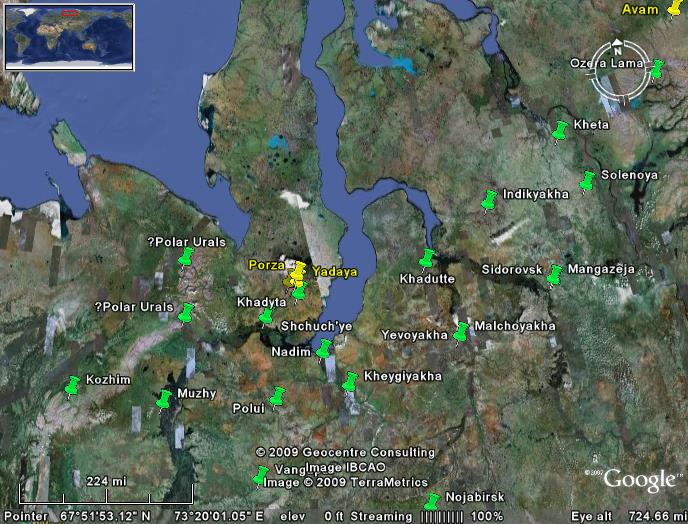
Khadyta River
Gavin Schmidt (and others) vituperatively criticized my use of Schweingruber’s Khadyta River data set to analyze Yamal RCS chronology sensitivity. Schmidt characterized me as merely using data “that [I] found lying around on the web.” However, Briffa stated that it was entirely appropriate to include Khadyta River in a Yamal chronology:
it is entirely appropriate to include the data from the KHAD site (used in McIntyre’s sensitivity test) when constructing a regional chronology for the area.
Briffa said that the only reason why they had not included this data themselves was that they simply didn’t think of it.
However, we simply did not consider these data at the time, focussing only on the data used in the companion study by Hantemirov and Shiyatov and supplied to us by them.
Gavin Schmidt was not the only critic to argue that using Khadyta River in a sensitivity test was some sort of violation of scientific principle. I haven’t noticed any withdrawal of such claims in the wake of Briffa’s response by Gavin Schmidt or others.
Sensitivity Testing of RCS Chronologies
Not only did Schmidt and others criticize the use of Schweingruber’s Khadyta River in sensitivity tests, they vituperatively criticized the very idea of a sensitivity analysis along the lines carried out here. However, Briffa’s response explicitly recognized and endorsed the sort of sensitivity study carried out at Climate Audit:
When using the RCS technique, it is important to examine the robustness of RCS chronologies, involving the type of sensitivity testing that McIntyre has undertaken and that we have shown in this example. Indeed, we have said so before and stressed in our published work that possible chronology biases can come about when the data used to build a regional chronology originate from inhomogeneous sources (i.e. sources that would indicate different growth levels under the same climate forcing).
Obviously, Briffa believes that he can work around the CA findings with the larger data set presented in his online article, but he recognized both the validity and importance of testing homogeneity and inhomogeneity. IMO, the new and larger data set is not out of the woods on inhomogeneity by any means; this is an issue that I will pursue in a technical post.
Abandoned Camp Sites
I had criticized the abysmally low 1990 core count in an RCS population, quoting Briffa’s own methodological observations in this context. I had also criticized the use of the corridor standardization subset (with its exclusive use of long cores) in an RCS program, again using Briffa’s own standards to criticize Yamal methodology. Some critics of CA counter-argued that 10 cores in 1990 was just fine and that the use of the corridor subset was just fine.
While Briffa did not explicitly concede either point, neither did he make any attempt to rebut my criticisms of the use of 10 cores in 1990 for RCS chronology or the use of a corridor subset of old trees for RCS chronology. He was completely silent on these issues.
Instead, his entire defence was one of “moving on”. Not that the prior methods were defensible, but that they could still “get” a similar result using a data set and methodology that were compliant with RCS standards.
In terms of camp site management, when campers move on, it would be nice if they tidied up the abandoned camp site i.e. denoting their agreement on issues that they were no longer defending – a practice which would avoid continued argument by third parties. However, the usual Team practice is to “move on” like nomads and leave abandoned camp sites in a total mess and unfortunately this happened once again here. This point about camp site etiquette reminds me of another frustrating aspect of Team debating style. Let’s suppose that the Team moves on to a new camp site and that they have proper hygiene and methodology at the new camp site. That doesn’t “refute” or “rebut” criticisms of their hygiene at the old camp site.
It will take more than a day or two to see if the hygiene and facilities at the new camp site are much of an improvement over the old camp site. We only learned of the new camp site last week. I think that Team supporters need to wait until the new camp site has been inspected before making a large down payment on the property.
False Accusations by Gavin Schmidt
Briffa took some care not to associate himself with untrue allegations made by Gavin Schmidt and others. Briffa observed that “subsequent reports” had misrepresented not merely his work, but also my original posts:
Subsequent reports of McIntyre’s blog (e.g. in The Telegraph, The Register and The Spectator) amount to hysterical, even defamatory misrepresentations, not only of our work but also of the content of the original McIntyre blog, by using words such as ‘scam’, ‘scandal’, ‘lie’, and ‘fraudulent’ with respect to our work.
While one understands that Briffa is more concerned about false allegations made against himself than false allegations made about me, it would have been constructive if Briffa had more explicitly disassociated himself from misrepresentations by Gavin Schmidt such as the following:
So along comes Steve McIntyre, self-styled slayer of hockey sticks, who declares without any evidence whatsoever that Briffa didn’t just reprocess the data from the Russians, but instead supposedly picked through it to give him the signal he wanted. These allegations have been made without any evidence whatsoever.
But at least Briffa did not perpetuate or endorse Schmidt’s false accusations and took pains to distinguish my remarks from remarks made by others. Even small steps are sometimes constructive.
Polar Urals and the Divergence Problem in West Siberia
On the minus side, Briffa totally avoided two critical reconciliations.
The online article made no mention whatever of Polar Urals and did not present any rationale for why the Polar Urals update has never been reported in “the peer reviewed literature” despite a shortage of millennial proxies. Nor did it present a rationale for using Yamal rather than Polar Urals (or a combination.) These questions remain even if they “move on” to a new Yamal data set.
In addition, the online article failed to reconcile the Yamal Stick (either old or new) with regional West Siberian results from the Schweingruber network (or Esper et al Glob Chg Biol 2009 discussed recently here [link]) showing a second-half 20th century decline in ring widths across a large population of sites. On numerous occasions, I’ve pointed to regional reconciliations as (IMO) critical in trying to advance paleoclimate beyond cherrypicking and data snooping and argued that a serious effort to investigate, analyze and reconcile this sort of regional reconciliation is what’s really required here.
Confirmation Bias
Briffa’s explanation of why the Khadyta River data wasn’t used is (IMO) an interesting example of confirmation bias.
Briffa agreed that there was nothing wrong with including the Khadyta River data in a regional chronology, but explained that this idea simply didn’t occur to them. Let me state clearly that I take them at their word and that I don’t have any reason to believe (nor do I think) that somewhere at CRU there is a “censored” directory with unreported adverse results with KHAD data together with verification r2 results.
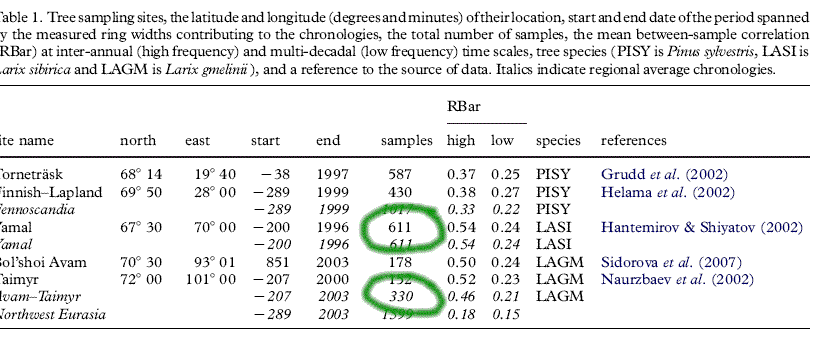
On the other hand – and this is the precise point that instigated my Khadyta River analysis – over at Taimyr, where there was a particularly problematic divergence problem, the divergence problem led them to look for nearby data sets even though there was a lot more data at Taimyr than Yamal. At Taimyr, they ended up adding data from up to 400 km away, including from Schweingruber data sets contemporary with Khadyta River. Arguably, Yamal has a “divergence” in the opposite direction: its blade is unreasonably big. But this was the sort of result that they “expected” and they did not “think” about doing the same sort of procedure that they had carried out at Taimyr – look for nearby qualified sites. Had they done so, Khadyta River would have turned up right away for them, as it did for me (once I was aware that they had done this sort of thing at Taimyr.)
This seems like precisely the sort of confirmation bias that we’ve seen over and over again in this field. There seems to be more alertness to problems going the “wrong” way than there is to problems going the “right way”. The “residence time” of problems going the “right way” seems to be a lot longer than the “residence time” of problems going the wrong way, imparting a bias in reconstructions at any given time.
Data Availability
In a highly constructive departure from “peer reviewed” articles on Yamal, the article published on their webpage includes measurement data. Although the metadata is negligible (other than the location of the sample sites), the availability of measurement data accompanying the article in real time is a big improvement over prior defective presentations in the “peer reviewed literature” where there is no insistence on data archiving.
The big issue for this version (as it should have been for the last version) is population homogeneity – an issue that is not analysed or discussed in Briffa’s online article. I will post on that in the near future. For now, I’ll re-iterate the points at the start of this post: that the Briffa response accepts the legitimacy of the issues raised about Yamal at CA and that it does not endorse any of the attacks (or defences) advocated by Gavin Schmidt and realclimate supporters. Both constructive in different ways.