Svalgaard Solar Theory

Lif Svalgaard writes (moved from another thread for convenience”)
Line 1:
The Total solar Irradiance (TSI) has several sources. The first and most important is simply the temperature in the photosphere. The hotter the sun, the higher the TSI. Some spectral lines are VERY sensitive to even minute changes in temperature. Livingston et al. has very carefully measured the line depth of such temperature-sensitive lines over more than 30 years spanning three solar cycles [Sun-as-a-Star Spectrum Variations 1974-2006, W. Livingston, L. Wallace, O. R. White, M. S. Giampapa, The Astrophysical Journal, Volume 657, Issue 2, pp. 1137-1149, 2007, DOI; 10.1086/511127]. They report [and I apologize for the somewhat technical turn my argument is taking, but if you really want to know, there is no avoiding this], “that both Ca II K and C I 5380A intensities are constant, indicating that the basal quiet atmosphere is unaffected by cycle magnetism within our observational error. A lower limit to the Ca II K central intensity atmosphere is 0.040. This possibly represents conditions as they were during the Maunder Minimum [their words, remember]. Within our capability to measure it using the C I 5380A line the global (Full Disk) and basal (Center Disk) photospheric temperature is constant over the activity cycles 21, 22, and 23″. I have known Bill Livingston [and White] for over 35 years and he is a very careful and competent observer.

Line 2:
Since the 1960 we have known that the sun’s surface oscillates up and down [with typical periods of ~5 minutes]. These oscillations are waves very much like seismic waves in the Earth [caused by earthquakes] and just as earthquake seismic waves can be used to probe the interior of the Earth, they can be used to probe the solar interior. There are millions of such solar waves at any given time and there are different kinds (called ’modes’) of waves. The solar p-modes are acoustic [sound waves] normal modes. You one can imagine a frequency increase with an increasing magnetic field, due to the increase in magnetic pressure raising the local speed of sound near the surface where it is cooler and where the p-modes spend most of their time. Of course one can also imagine higher frequencies may result from an induced shrinking of the sound cavity and/or an isobaric warming of the cavity. Another kind is the solar f-modes that are the eigenmodes of the sun having no radial null points [i.e. asymptotically surface waves; again I apologize for the technical mumbo-jumbo]. From the solar cycle variations of p- and f-modes [and we have now enough data from the SOHO spacecraft to make such a study] we now have an internally consistent picture of the origin of these frequency changes that implies a sun that is coolest at activity maximum when it is most irradiant. Now, how can that be? How can a cooler [overall, including the cooler sunspots, for instance, as the temperature of the non-magnetic areas of the sun didn’t change {see line 1 above}] sun radiate more? It can do that, if it is bigger! The change in the radius of the Sun from minimum to maximum is about 1 km. Goode and Dziembowski (Sunshine, Earthshine and Climate Change I. Origin of, and Limits on Solar Variability, by Goode, Philip R. & Dziembowski, W. A., Journal of the Korean Astronomical Society, vol. 36, S1, pp. S75-S81, 2003) used the helioseismic data to determine the shape changes in the Sun with rising activity. They calculated the so-called shape asymmetries from the seismic data and found each coefficient was essentially zero at activity minimum and rose in precise spatial correlation with rising surface activity, as measured using Ca II K data from Big Bear Solar Observatory. From this one can conclude that there is a rising corrugation of the solar surface due to rising activity, implying a sun, whose increased irradiance is totally due to activity induced corrugation. This interpretation has been recently observationally verified by Berger et al. (Berger, T.E., van der Voort, L., Rouppe, Loefdahl, M., Contrast analysis of Solar faculae and magnetic bright points. Astrophysical Journal, vol. 661, p.1272, 2007) using the new Swedish Solar Telescope. They have directly observed these corrugations. Goode & Dziembowski conclude that the Sun cannot have been any dimmer, on the time steps of solar evolution, than it is now at activity minimum.

Line 3:
Foukal et al. (Foukal, P., North, G., Wigley, T., A stellar view on solar variations and climate. Science, vol. 306, p. 68, 2004) point out the Sun’s web-like chromospheric magnetic network (an easily visible solar structure seen through a Ca II K filter) would have looked very different a century ago, if there had been a significant change in the magnetic field of the sun supposedly increasing TSI. However, there is a century of Mt. Wilson Solar Observatory Ca II K data which reveal that the early 20th century network is indistinguishable from that of today.

Line 4:
Svalgaard & Cliver have recently (A Floor in the Solar Wind Magnetic Field, by L. Svalgaard and E. W. Cliver, The Astrophysical Journal, vol. 661, L203–L206, 2007 June 1, 2007) shown that long-term (∼130 years) reconstruction of the interplanetary magnetic field (IMF) based on geomagnetic indices indicates that the solar wind magnetic field strength [and thus that of the sun itself, from which the IMF originates] has a “floor,” a baseline value in annual averages that it approaches at each 11 yr solar minimum. In the ecliptic plane at 1 AU [at the Earth], the IMF floor is ∼4.6 nT, a value substantiated by direct solar wind measurements and cosmogenic nuclei data. We identify the floor with a constant (over centuries) baseline open magnetic flux at 1 AU of ~4*10^{14} Weber, corresponding to a constant strength (∼10^{11} Ampere) of the heliospheric current. Solar cycle variations of the IMF strength ride on top of the floor. They point out that such a floor has implications for (1) the solar wind during grand minima — we are given a glimpse of Maunder minimum conditions at every 11 yr minimum; (2) current models of the solar wind — both source surface and MHD models are based on the assumption, invalidated by Ulysses, that the largest scale fields determine the magnitude of the IMF; consequently, these models are unable to reproduce the high-latitude observations; and (3) the use of geomagnetic input data for precursor-type predictions of the coming sunspot maximum — this common practice is rendered doubtful by the observed disconnect between solar polar field strength and heliospheric field strength [the wrong prediction by the NASA panel for cycle 23 was based on this, and the prediction {of a high cycle} by one half of panel for cycle 24 is also partly based on this]. The constancy of the IMF also has implications for the interpretation of the Galactic cosmic ray flux.

Line 5:
But maybe it is the Ultraviolet flux that varies and affects the stratospheric ozone concentration and thereby influences the climate. I have earlier in (Calibrating the Sunspot Number using the “Magnetic Needle”, L. Svalgaard; CAWSES News, 4(1), 6.5, 2007] pointed out that the amplitude of the diurnal variation of the geomagnetic Y-component is an excellent proxy for the F10.7 radio flux and thus also for the EUV flux (more precisely, the FUV, as the Sq current flows in the E layer). There is a weak trend in the amplitude of 10% since the 1840s that can be understood as being due to an increase of ionospheric conductance resulting from the 10% decrease of the Earth’s main field. Correcting for and removing this trend then leads to the conclusion that (as for the IMF) there seems to be a “’floor’” in rY and hence in F10.7 and hence in the FUV flux, thus the geomagnetic evidence is that there has been no secular change in the background solar minimum EUV (FUV) flux in the past 165 years.

Line 6:
Careful analysis of the amplitude of the solar diurnal variation of the East-component of the geomagnetic field [we have accurate measurements back to the 1820s] allows us the obtain an independent measure of the FUV flux (and hence the sunspot number) back to then. The result is that the Wolf number before ~1945 should be increased by 20% and before ~1895 by another 20%. The Group Sunspot number in the 1840s is 40% too low compared to the official Wolf number. When all these adjustments are made we find that solar activity for cycles 11 and 10 were as high as for cycle 22 and 23. Thus there has been no secular increase in solar activity in the last ~165 years [a bit more precise than the 150 years I quoted earlier]. Of course, there has still been small and large cycles, but we are talking about the long-term trend here [or lack thereof].

————–

Direct measurements (although beset by calibration problems) of the Total Solar Irradiance (TSI) from satellites have only been available for 30 years and indicate that solar irradiance increases with solar activity. Correlating mean annual TSI and sunspot numbers allows one to estimate the part of TSI that varies with the sunspot number. If TSI only depends linearly on the sunspot number then irradiance levels during the Maunder Minimum would be similar to the levels of current solar minima. But TSI is a delicate balance between sunspot darkening and facular brightening, and although both of these increase (in opposite directions) with increasing solar activity, it is not a given that there could not be secular variations in the relative importance of these competing effects. Several earlier reconstructions of TSI, reviewed in Fröhlich, C. & J. Lean (Solar Radiative Output and its Variability; Evidence and Mechanisms, Astron..& Astrophys. Rev., 12(4), 273, 2004, Doi;10.1007/s00159-004-0024-1.[6] all postulate a source of long-term irradiance variability on centennial time scales. Each group of researchers have their own preferred additional source of changes of the “background” TSI, such as evidence from geomagnetic activity, open magnetic flux, ephemeral region occurrence, umbral/penumbral ratios, and the like. The existence of “floors” in IMF and FUV over ~1.6 centuries argues for a lack of secular variations of these parameters on that time scale. The five lines of evidence discussed above suggest that the lack of such secular variation undermines the circumstantial evidence for a “hidden” source of irradiance variability and that there therefore also might be a floor in TSI, such that TSI during Grand Minima would simply be that observed at current solar minima.

——

#87: The Zeeman splitting is not applicable because the floor is not derived from solar magnetograph data. The point about the radius is well-taken and there are efforts underway to measure the radius precisely. Helioseismology [as well as the success of general relativity] has pretty much ruled out a rapidly rotating solar core which would give rise to oblateness. And it is perfectly true that there may be effects we don’t know about, but as Wittgenstein said “of that which we don’t know we should be silent”.

Now, this is a BIG subject and you are in a sense watching science in the making, but the picture is becoming clearer and there is enough NEW evidence that simply quoting old papers [even rather recent ones] is old hat. If you look carefully at the various reconstructions they all rely on some combination of the [too low] Group Sunspot numbers and/or the [too low aa-index] and/or the now discredited “doubling of open magnetic flux in the last 100 years” [not even Lockwood thinks so anymore]. With these things out of the way there is little support anymore for the “all-time high solar activity”. But as I said, this whole thing will probably take some time to play out – let’s say about a solar cycle’s worth. Each of the issues mentioned above is complicated and requires a lengthy analysis and much convincing before they sink in. But at least you are now forewarned 🙂

All the lines are connected, you cannot easily accept some and reject the others [with possible exception of #1]. So accept all or reject all. I’m very willing to discuss any and all of them in detail, but it has to be done with civility [windandsea: nobody is ‘flinging nonsense’. People are either ignorant (which is no shame) or have other hidden motives (which is no shame either)]. I have learned that civility is a precious commodity in the GW debate, but we can all do our part.
CO2 Levels

Leif Svalgard writes:

In 2006 less CO2 was added to the atmosphere than in 1983. In 1980 more CO2 was added to the atmosphere than in 2004. Why is that? I’m sure that the world’s human population has increased its output of CO2 significantly since the 1980s. Where did it go? Why does the growth rate change from year to year? Biology? Algae in the sea? I don’t know, just asking. And why does nobody else ask this?

I don’t think that it’s accurate to say that “nobody” asks this. The CO2 “sink” has worried many people. Needless to say, this has already led to many responses. This is a topic that many readers are interested in and I’m re-threading the comments to avoid the other thread from getting over-ridden. I do not want the thread to get involved in discussion of the problems with the Beck paper. That’s been amply done. NO discussion of CO2 measurement methods. Just the narrow issue of the sentence above.

It is not a topic that I’ve spent time, but I do not believe that there are any substantive issues as to the existence of increased CO2 levels.

Here are some sensible comments on the matter by Ferdinand Engelbeen on this. Continue reading

Unthreaded #26

Continuation of Unthreaded #25

Loehle Proxy MD95-2011

One of Loehle’s proxies – the one that ends in the 16th century – has occasioned some interest and I took some time to investigate it. It is an alkenone SST estimate from ocean sediment core MD95-2011 from the Norwegian Sea (66 58.19N, 07 38.36E and 1048 m). The series ends in the 16th century because it was a piston core and the top of it was lost. However box core JM97-948/2A was drilled i the same location and provides a high resolution series right to the 1990s.

Both cores are in high-accumulation zones and have been closely sampled – a sample spacing of 0.5 cm in core JM97-948/2A and 1.0 cm in core MD95-2011 – yielding resolution of about 3.4 years and 8.4 years, respectively. Both have been discussed in a number of scientific reports and a number of relevant data sets have been archived at http://www.pangaea.de, a repository for much ocean sediment data.

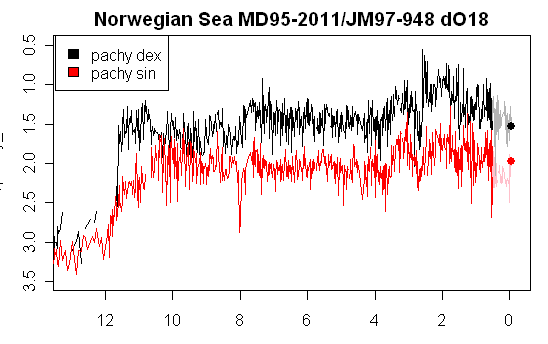
The archive includes dO18 values for both N pachy dex and N pachy sin for both MD95 and JM97; the combined data being shown in the plot below, with a slight difference in color denoting the change in core. Do these measurements indicate that dO18 values in the Norwegian Sea are at unprecedented levels? You tell me.

md95_211.gif
Figure 1. dO18 for Md95 and JM97. In the archive, the dates for the JM97 series are incorrectly reported. I asked CA reader Richart T about this and he was able to confirm that there was an error. I’ve plotted the data by re-calculating the dates in the JM97 dO18 series to match the date model. JM97 data from http://doi.pangaea.de/10.1594/PANGAEA.510799?format=textfile and MD95 data from http://doi.pangaea.de/10.1594/PANGAEA.510782?format=textfile. Dating from http://doi.pangaea.de/10.1594/PANGAEA.510806?format=textfile. X-axis in kyrs.

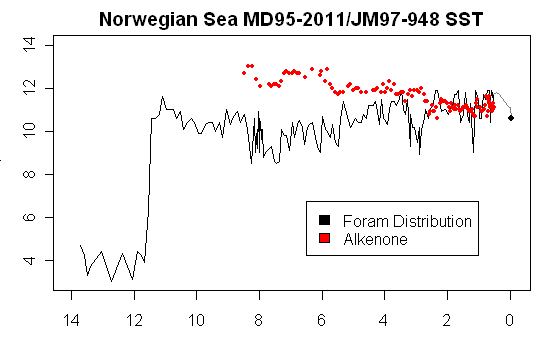
While dO18 is sometimes used as a temperature proxy (e.g. Lonnie Thompson’s ice core), it has not been used as one here. SST was estimated in two different ways for this core – (1) by an analog based on foram distributions; (2) alkenone SST. The SST estimates from foram distribution are archived for both MD95 and Jm97 and are plotted below; for alkenone SST, only the MD95 values are archived. I’ve been informed that JM97 values have been calculated but they have not been archived or reported, apparently because of inconsistency problems. Here is a plot:

md95_212.gif
Figure 2. SST estimates. Black – from foram distributions; red dots – alkenone SST from MD95. SST estimate and abundance of forams for MD95 from http://doi.pangaea.de/10.1594/PANGAEA.510781?format=html and for JM97 from http://doi.pangaea.de/10.1594/PANGAEA.510801?format=html. Alkenone SST for MD95 from loc=”http://doi.pangaea.de/10.1594/PANGAEA.438810?format=textfile.

Some References:
Calvo E., Grimalt J. O. and Jansen, E. (2002) High resolution UK37 sea surface temperature reconstruction in the Norwegian Sea during the Holocene. Quaternary Science Reviews, 21, 1385-1394. https://bora.uib.no/bitstream/1956/385/2/2001PA000654.pdf

Andersson, C. Bjørg Risebrobakken,2 Eystein Jansen,1,2,3 and Svein Olaf Dahl4 2003. Late Holocene surface ocean conditions of the Norwegian Sea (Vøring Plateau), Paleooceanography.

Risebrobakken, B; Jansen, E; Andersson, C et al. (2003): High-resolution study of Holocene paleoclimatic and paleoceanographic changes in the Nordic Seas, Paleoceanography

Mann and Sabbatelli 2007

Mann connoisseurs eagerly await any offerings from the Maestro and, just as the Christmas season typically brings a new potboiler from John Grisham, so Christmas 2007 has brought us a new offering from the Maestro, this time on hurricanes. Readers will not disappointed. Continue reading

ABC: Global warming puts fish stocks at risk

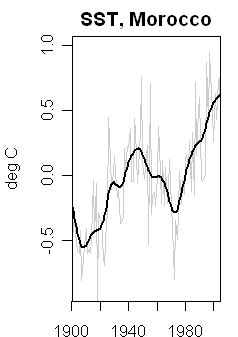
While trawling for high-resolution ocean sediment cores, I noticed an interesting core offshore Morocco, reported by McGregor et al (Science 2007) earlier this year. This study was released just prior to IPCC complete with press release. Can’t we all think back to a quieter time when a scientist having labored to produce a detailed analysis of ocean sediments or tree cores would merely publish his study in an academic journal? When I first became familiar with the climate field, I was astonished at the idea of scientists issuing press releases that would make mining promoters cringe. This study is an interesting example of the counterplay between the fine print of the academic article and the promotion in the newspaper.

The heading to this thread is from an article by the Australian Broadcasting Corp (ABC) that went on to say:

Global warming puts fish stocks at risk Their analysis found that climate-induced changes in the ocean have never been more dramatic than in the past three or so decades.

The core in question was from 30.845N 10.0983W in 1999 at 355 m depth. GeoB6008-1 was 5.4 m long, sampled at 2 cm intervals, with resolution decreasing downcore from 6 to 25 years; the top value dated to 1971, the bottom to 518 BC, GeoB6008-2 was a short core sampled at 1 cm intervals and dated from 1998 at the top to 1912 at the bottom, with resolution decreasing from 2 to 4 years.

Alkenone values were obtained for use in SST calculations (available here) . The raw alkenone values are shown in the graph below against depth, and,as you see, they show a remarkable change through the 20th century. On the right is shown the HadSST gridcell value for the relevant gridcell, showing an increase of about 1 deg C. This core (31N) is just to the north of the “Main Development Region” for hurricanes (up to 20N). The vertical dashed line marks the depth allocated to the start of the 20th century in GeoB-1.

 geob6822.gif  geob6823.gif

Left: Alkenone versus depth. The points show the short GeoB-2 core and the lines the long GeoB-1 core. The vertical dashed line marks the depth allocated to the start of the 20th century in GeoB-1. Right HadSST for gridcell 32.5N, 12.5 W containing the core location.

So this looks like evidence that Al Gore would love. Something unprecedented in the core. Fish stocks at stake. But there’s a catch (which Richard T may have spotted already.) The catch is nothing to do with bioturbation – although, as an aside, having seen similar sorts of changes through the mixed layer in connection with coarse fraction, I do wonder whether there might be some unconsidered interaction going on in the mixed layer that might account for this change. (But that’s not the issue today.)

Take one more look at the graph and see if you can figure out the sleight of hand that I’ve done here.
Continue reading

Donnelly and Woodruff 2007

Richard T and I had an interesting discussion here about the bioturbation and coarse fractions in the Arabian Sea G Bulloides proxy that is very influential in Moberg and not used in Loehle (as it was not calibrated to temperature.)

I had observed that the increase in G Bulloides percentage in the very top part of the RC2730 core was almost exactly matched by what paleoclimatologists would call a “remarkably similar” increase in coarse fraction percentage. The G Bulloides series from this core is a huge contributor to the 20th century-MWP accounting in Moberg.

I also discussed some literature which pointed out that bioturbation was an established phenomenon which caused an upward percolation of coarse fraction, leading to a concentration of coarse fraction in the top mixer layer (which was a transient phenomenon). I observed that bioturbation had been summarily rejected by the Arabian Sea G Bulloides series authors as it was in an oxygen-minimum zone, but other literature (including Arabian Sea literature) reported bioturbation even in an oxygen-minimum zone. We discussed (without any agreed resolution) whether this phenomenon could have accounted for the G Bulloides percentage increase or whether this increase was independent of the coarse fraction phenomenon. Richard T signed off as follows:

A prediction: If bioturbation-driven sediment sorting (rather than homogenisation) is important, it should be a general pattern, observable in most cores. Whereas, if the increase in coarse fraction is climatically driven, it should only occur in a few sites. Coarse fraction is measured fairly often, so it should be possible to test your hypothesis.

Donnelly and Woodruff (2007) is a very recent Nature study that applies lagoon sediments from Laguna Playa Grande, Vieques, Puerto Rico (17N, 65W) to reconstruct hurricane activity for the past 5,000 years. Their proxy is the bulk mean grain size(in microns). I see some parallels between increasing coarseness here (although measured differently) and the Arabian Sea situation (but am just thinking out loud in this instance.)

The Donnelly and Woodruff core is sampled at 1 cm intervals over a core length of 396 cm. Their resolution at the top of the core is about 5 years, increasing to about 30-40 years at the base. The topmost segment is assigned a data of 2000 AD. So this qualifies as a high-resolution data set covering the past 2 millennia. Continue reading

AGU Honors Nobel Peace Prize Winners

I received the following notice today:

On Thursday, 13 December AGU will hold an event at the Fall Meeting to honor those AGU members who participated in the Intergovernmental Panel on Climate Change. Winning the Nobel Peace Prize is a wonderful recognition of the importance of their hard work, and AGU would like to congratulate those scientists. This tribute to our members will take place from 1815h-1930h in Moscone South, Room 104, before the Town Hall meetings. It will be open to all meeting registrants, but because seating is limited, we are asking that interested members register in advance for this event. If you were a participant in the IPCC, please indicate that when registering. Please click on the link below to register, we ask that you do so no later than 1700 UT on 6 December.

That would include me :).

Scafetta and West 2007

Francois O writes in:

For those interested in the role of the Sun on the climate, and how reconstructions can be used to assess it, there is an interesting paper just out in JGR by Nicola Scafetta and B J West. The paper is available here. This is a continuation of their previous work. Basically they use a phenomenological approach. So instead of taking the reconstructed TSI values, plug them into a model, and find that indeed the Sun has only a minor influence (like Ammann et al. did in their PNAS paper of March 6, 2007 | vol. 104 | no. 10 | 3713-3718 ), they make no prior assumption on the total Solar forcing. They just assume, mostly rightly, that the Sun was the main driver of climate variability. Then from the solar reconstruction and the temperature reconstruction, they deduce which model of solar forcing best matches the two together.

They have a nice discussion in the introduction about the pitfalls of the usual method. For the record, even though they use both Mann03 and Moberg05 reconstructions, they refer to MM05 and the Wegman report as pointing to the flaws of Mann03.

This is all to show that temperature reconstructions do play an important role in understanding the human role on climate.

I’ve not spent as much time on Nicola Scafetta’s work as I would like to have. I spent about an hour with him at last year’s AGU and he gave an impressive explanation of his ideas. One of the fundamental assumptions of modern models (as I understand it) is that all “forcings” are equal. “Forcings” is a useful metaphor but what if, for some reason, all forcings are not the same. For example, it doesn’t seem inconceivable to me that 1 wm-2 of solar forcing (visible wave length, high energy photons, low entropy) could have a different effect than 1 wm-2 of GHG “forcing” (infrared, low energy, high entropy). I’m not saying that they do or don’t; I haven’t studied the issue in any detail – just that I don’t see the harm in working through the assumptions of non-equal forcing “efficacy”. Mathematicians like to work through the analysis of alternative axioms to see what happens and it’s hard to see that any harm would result in this case. Arguably Scafetta finds empirical evidence suggesting that this may actually be the case.

I don’t vouch for this paper as I have merely skimmed it and have not even begun to work through the details. At this point, I am threading it for discussion.

Luboš discusses it here and Rasmus(now out of the penalty box) at RC here .

Almagre Panoramas

Pete H has uploaded some terrific Almagre panoramas online here . Pete says:

Also, I’ve uploaded many of the new panoramas that provide a way to see this bristlecone forest in context. They will soon be integrated into Google Earth. Visit http://www.GigaPan.org and search for Almagre to see this work in progress

Integrated into Google Earth no less. Pete also reports:

The Almagre Bristlecone Gallery now contains several new albums with detailed photos on all the trees that we cored and that were revisited in trip #4 (undertaken to obtain detailed angle and bark measurements and photos.)

Tree numbers 024, 026, 028, 030, 031, 033, 037, 047 and 048 all have detailed photo folders now.

Quite a contrast to how real climate scientists do things. /snark