Waldo in Bagdarin, Siberia

A CA reader, John Goetz, has written in with a mind-numbing puzzle related to Waldo in Bagdarin, Siberia, where Waldo appears to have experienced an adjustment unusual even by the standards of NASA chiropractors. Continue reading

Anthony Watts at UCAR

Anthony’s presentation at Roger Pielke Sr’s seminar at UCAR appears to have been well-received. He’s posted some interested online reports at his blog and been written up here and here.

In response to the criticisms about the failure of sites to meet standards, Lawrimore of NOAA said that they already adjusted for these problems:

For the USHCN stations being checked by Watts and others, Lawrimore said there are checks to ensure the data is accurate. Some stations are placed on less-than-ideal sites, but he said it’s important to note the impact of those has been analyzed and accounted for.

It’s nice to that the adjusters are on the scene. Given the number of adjustments that seem to be required, should we start describing Hansen and his colleagues as chiropractors?

MBH Proxies in Bo Li et al

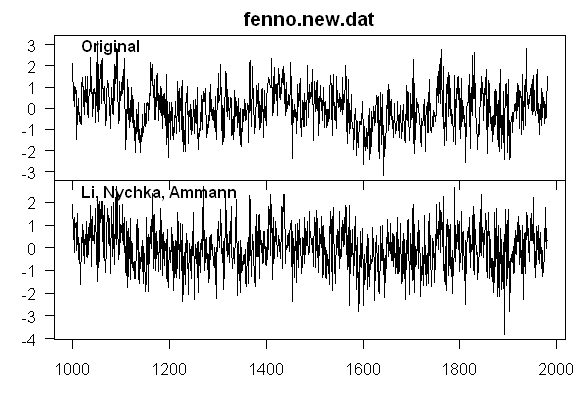
We have a new article from the Mannian school, this time involving supposedly “independent” NAS panelist, Doug Nychka, and geologist Caspar Ammann, who is very enthusiastic about calculating covariances using Mannian proxies. The lead author is a statistician, Bo Li. The article purports to use MBH99 proxies and says

we do not critically evaluate these proxies but simply apply them as the best available set at the time of 1999

They then proceed to use what appears to be Mann’s PC1, plus no less than 4 different time series from Quelccaya (Core 1 dO18 and accumulation, Core 2 dO18 and accumulation) with each different core remarkably and mysteriously teleconnecting in different ways with “climate reconstruction fields” such that mere covariances are interpreted as having physical meaning.) But more on the statistics on another occasion. The article concludes by saying:

The authors thank Dr. Michael Mann for providing the proxy data.

Jean S observed that the proxy series do not match the MBH versions that he had. I checked this as well. The figure below compares MBH99 Quelccaya Core 2 accumulation (with its characteristic pattern that Hans Erren figured out a few years ago) and the Quelccaya Core 2 version used by Li et al. The two proxy series are clearly not the same; the correlation is 0.70. Correlations of about this value are typical. It’s hard to say what Mann has done this time. I checked the a.c.f’s of a couple of versions to see if Mann had given them smoothed versions, but, in the examples that I looked at, the new series did not have additional autocorrelation. The correlation of the original version to the new version was consistently about 0.70 for all of the series – which is close to the square root of 1/2 – but why? All these proxies could have been obtained from WDCP so I don’t know why they didn’t use original data. Pretty mysterious.

bolih41.gif

Here’s another example:

bolih42.gif

UPDATE: The above surmise that noise was added to the data has proved correct. Bo Li has confirmed that noise was added to the proxies and that they archived a sample of synthetic data and did use original proxies. She has accordingly corrected the description of the data sets on her webpage to “synthetic” instrumental and “synthetic” proxy and responded cordially, apologizing for any inconvenience. This resolves the proxy issue, which was an odd one. When I get a chance, I’ll look at the statistics.

The data sets that I posted on my website are not the real Northern Hemisphere temperature and the MBH99 proxies. They are generated by adding white noise with unit variance to the standardized real data. The pseudo data sets on my website only serve as a toy example to try the R code that I used in my paper. However, the results in Li et al. (Tellus, in press) are based on the real data instead of the pseudo data. I am sorry that I did not explain very clearly what the data set on my webpage is and also sorry for the confusion that I brought to you as a consequence. I have modified my webpage to make the point more explicitly.

In our paper, we looked at the residuals in calibration (14 proxies against not PC1 of instrumental, but full N-Hem average) and found that there is enough serial correlation that an AR2 process is warranted to represent the “noise”. Then, the approach was to simulate a set of ensembles that fulfill the criterion during calibration so that the explained variance is the same but that the noise is different (using that AR2). Then, because we wanted to establish a method to study the maximum decadal values, we then simulated all series. Simulating time-evolving series was necessary because we have serial correlation, and thus decadal maxima can be computed. The goal was not to be producing the best reconstruction that is currently possible, but to demonstrate a way of how one could go and address the decadal max question. This question was not well addressed in the NRC report, and thus this work is a followup as collaboration between stats and geoscience to show how one could better answer the significance question for the old MBH99 framework.

Waldo: South America

Waldo, Hansen’s ROW trend, is not in Africa nor in Antarctica. Is Waldo in South America? Continue reading

Where's Waldo: Antarctica #2

If you’ve not read Where’s Waldo: Antarctica #1, please do so first. Continue reading

Where's Caspar?

As you know, we are eagerly awaiting the publication of the following article by Wahl and Ammann reported here:

Wahl, E and C Ammann (In press). “Robustness of the Mann, Bradley, Hughes reconstruction of northern hemisphere surface temperatures: Examination of criticisms based on the nature and processing of proxy climate evidence.” Climatic Change (accepted).
May 10, 2005 — In review
September 27, 2005 — Revised
December 12, 2005 — Provisionally Accepted
February 28, 2006 — Accepted for Publication

I have made many posts on Wahl and Ammann – see here for Category and have been following the snail-like progress of this article for some time as it slouches towards Boulder. I objected to its inclusion in IPCC AR4 on the basis that it did not meet IPCC publication deadlines of acceptance by December 2005 and in print by February 2006. This objection was disregarded. Their revised version is the version that includes their confirmation of our result that MBH verification r2 was ~0 – although they and UCAR had issued a press release that our results were unfounded. As I reported previously, Wahl and Ammann withheld this information in their first draft and included the information in their revised version only after I filed an academic misconduct complaint against Ammann.

Their Climatic Change submission relies on a concurrent submission to GRL for their benchmarking of the RE significance. Their GRL submission, said to be “in review” in their version filed with IPCC, had in fact been rejected before they filed their revised version with IPCC.

I’m intrigued as to what the final Wahl and Ammann version will look like. They have an intriguing choice: the inclusion of a reference to this article in AR4 was premised on their article being “in press” which would prohibit them from re-working their article to deal with the GRL rejection. But the article needs to be re-worked since it will look pretty silly to describe their GRL article as “under review” over 18 months after it has been rejected.

I check Climatic Change from time to time to see how they are coming along. Today, to my great surprise, I noticed that Climatic Change had published an Ammann and Wahl article online on August 24, 2007 abstract . However, it’s not the Robustness article. It’s a different article: Caspar M. Ammann and Eugene R. Wahl, The importance of the geophysical context in statistical evaluations of climate reconstruction procedures. They continue to toil in MBH vineyards however.

Abstract A portion of the debate about climate reconstructions of the past millennium, and in particular about the well-known Mann-Bradley-Hughes (“MBH” 1998, 1999) reconstructions, has become disconnected from the goal of understanding natural climate variability. Here, we reflect on what can be learned from recent scientific exchanges and identify important challenges that remain to be addressed openly and productively by the community. One challenge arises from the real, underlying trend in temperatures during the instrumental period. This trend can affect regression-based reconstruction performance in cases where the calibration period does not appropriately cover the range of conditions encountered during the reconstruction. However, because it is tied to a unique spatial pattern driven by change in radiative balance, the trend cannot simply be removed in the method of climate field reconstruction used by MBH on the statistical argument of preserving degrees of freedom. More appropriately, the influence from the trend can be taken into account in some methods of significance testing. We illustrate these considerations as they apply to the MBH reconstruction and show that it remains robust back to AD 1450, and given other empirical information also back to AD 1000. However, there is now a need to move beyond hemispheric average temperatures and to focus instead on resolving climate variability at the socially more relevant regional scale

The submission-acceptance schedule says the following:

Received: 22 August 2000 Accepted: 13 June 2007 Published online: 24 August 2007

This seems like a long time for acceptance of this article, even for Ammann and Wahl; the topic also seems prescient for 2000; I presume that there is a misprint. It is also curious that this article, accepted only on June 13, 2007, has been published prior to their Robustness article “accepted” in February 2006.

Anyway I eagerly await the final version of this article to see exactly what decision Stephen Schneider, editor of Climatic Change, took, when faced with the Hobson’s Choice described above.

Where's Waldo: Antarctica #1

Waldo (the ROW warm trend) is not in Africa (or the United States). Is Waldo in Antarctica? (For those of you who haven’t bought toys in 30 years, Where’s Waldo is a game.)

Antarctica is about 8.9% of the world’s land surface (about 1.5 times the contiguous 48). There are 116 Antarctica sites in the GISS data set, of which 48 are classified as “urban” in Peterson et al 2007. (Just joking). They are all GISS-rural. Since a particular interest is how 1934 compares to 1998, I selected all the sites with records that go back to 1930 and extend past 1990, yielding the remarkable results shown below, which was undoubtedly one of the major reasons why Hansen and Schmidt were so confident of relative temperatures between the 1930s and the present. Continue reading

Unthreaded #19

No discussion of CO2 measurements please.

Waldo in Africa

Gavin Schmidt and James Hansen say that errors in the U.S. “don’t matter” because it is only 2% of the earth’s surface (about 6% of the land surface). This implies that the accuracy of measurements in other parts of the world can be relied on. In the U.S. the 1930s have a similar level to recent levels, while the ROW has a striking difference. The surface area of Africa (30,300,000 km” ) is about one-fifth of the Earth’s land surface. 148,939,100 km”), about 4 times the size of the contiguous 48. I guess that this would be a good place to look for the high-quality stations that Schmidt and Hansen are counting on. Continue reading

Jesting with Adjusters

Hansen tells us that he won’t “joust with jesters”, as presumably he’s too busy adjusting to have time for jousting. We by contrast have lots of time to jest with adjusters.