Roger Pielke pointed out that Holland and Webster have presented a PPT presentation posted up at UCAR (the home of IPCC WG1), the content of which is relevant to recent discussions at climateaudit and prometheus. The entire presentation is about data problems relating to storm trends in the eastern Atlantic and to landfall hurricanes, topics discussed at length at our respective sites. Continue reading →
Opinions expressed on Climate Audit, other than those expressed by Stephen McIntyre personally, are those of the individual posters and do not necessarily reflect the opinions of Climate Audit or myself.
Continue reading →
One of the common operations in the types of analyses done here is simply counting things. I am constantly amazed by the tremendous productivity of the tapply function in R – I use it over and over – for producing interesting results at warp speed. There’s nothing particularly novel in how I use it, but I’ve got a lot of experience now and have a few little techniques that I find useful. I made a little improvement in how I use it the other day and thought that it might be useful to some readers to illustrate this. The method has no mathematical significance – but efficiency in handling new data sets is important for what I do and I thought that I write it up and illustrate a couple of simple and useful techniques. The issue arise during the collation of hurricane landfall data. Continue reading →
Here’s a post which I wrote last June but didn’t post up at the time because the NAS Panel report came out and I had other pressing matters to comment on. My post as then drafted started:
Last week, through Chefen, Jean S and myself, here here here and here , we showed that MBH98 contained questionable statistical methodology for assessing the relative contribution of solar and greenhouse gases to increased warming and outright false claims about the robustness- the falseness of which was easily determined, making it remarkable that they’ve remained undetected so long.
Now one of the things that we know about the Hockey Team is that most things have a purpose. It may not be obvious and it may not be stated. (I don’t think that one can properly understand the MBH98 reconstruction and its rapid inhaling into policy other than in the context that the IPCC wanted to “get rid of the MWP”‘?.) So what was the purpose of MBH98 Figure 7 in the context of the times? What scores were they trying to settle? What was the pre-MBH98 status of attempts to correlate forcings and temperature?
IPCC reports prior to TAR are usually a good place to start. Here are some notes, which (I think) place MBH98 Figure 7 in context and which, in turn, provide some very interesting leads to follow up on, now that Figure 7 has been overturned.
The rest of my notes follow only slightly modified. I’ll try to post up some notes at some point on the work of Reid 1991 and White et al (JGR 1997) on correlations between solar and tropical SST.
Continue reading →
A few people, most recently Jean S, have pointed out the interesting critique of the Stern Review (I should have posted up this thread earlier).
Abstract:The Stern Review: A Dual Critique
Part I: The Science
Robert M. Carter, C. R. de Freitas, Indur M. Goklany,
David Holland & Richard S. Lindzen
Part II: Economic Aspects
Ian Byatt, Ian Castles, Indur M. Goklany, David Henderson,
Nigel Lawson, Ross McKitrick, Julian Morris, Alan Peacock,
Colin Robinson & Robert Skidelsky
World Economics, Vol. 7, No. 4, October-December 2006.
Full paper here
There seems to be lots of interest in solar issues and lots of controversy among specialists. For now, let’s simply look at the millennial proxies for solar activity. For now, I don’t want to discuss issues like cosmic ray modulation or that sort of stuff on this thread – all in good time. Put it on Unthreaded if you like, but save this thread to try to assess the proxies. Let’s start by at least canvassing what the proxy data is.
There are two classes of proxy data – Be10 from ice cores in Antarctica and Greenland; and àŽ”¬?C14 from tree rings. There are several main protagonists in the field of solar proxies – on the one hand, Usoskin, Solanki et al who argue that 20th century solar activity is at unusual elevated levels; on the other hand, Muscheler et al who argue that 20th century solar activity is not anomalous; Ralph Bard is another important protagonist.
Here I’m going to present some of the primary solar reconstructions. I’m not going to comment extensively on the pro’s or con’s of any of the reconstructions as I’m still feeling my way through the data and methods. It’s a complicated area in itself and I’m doing other things as well.
Continue reading →
Paul Linsay continued his look at the statistics of hurricanes by looking at the entire record, which I present here:
I went back and repeated the analysis for the Atlantic hurricane data but this time used all the data back to 1851. There is some question about undercounts prior to 1944 but I ignored that issue and used the data as is. The principal change is that the mean number of hurricanes dropped to 5.25 per year from 6.1 for the period 1944 – 2006. The plot of the yearly counts again looks trendless ( Figure 3).
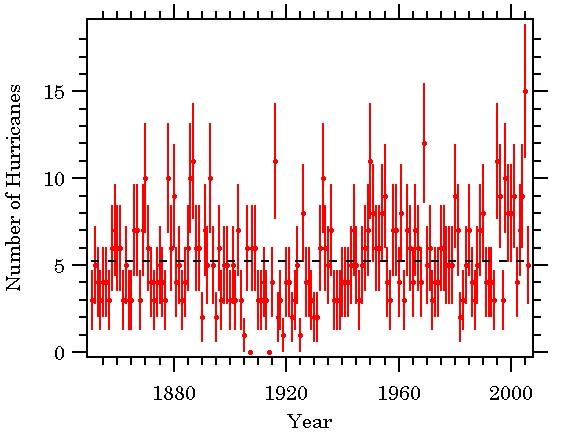
Figure 3. All hurricane counts from 1851 to 2006. The dashed line is the mean of 5.25 hurricanes per year.
Continue reading →
Luboà…⟠Motl has kindly directed our attention to the following interest paper by S. Redner and M. Petersen, On the Role of Global Warming on the Statistics of Record-Breaking Temperatures, scheduled for publication in Phys Rev Letters E, presently online here with abstract:
We theoretically study long-term trends in the statistics of record-breaking daily temperatures and validate these predictions using Monte Carlo simulations and data from the city of Philadelphia, for which 126 years of daily temperature data is available. Using extreme statistics, we derive the number and the magnitude of record temperature events, based on the observed Gaussian daily temperatures distribution in Philadelphia, as a function of the number of elapsed years from the start of the data. We further consider the case of global warming, where the mean temperature systematically increases with time. We argue that the current warming rate is insufficient to measurably influence the frequency of record temperature events over the time range of the observations, a conclusion that is supported by numerical simulations and the Philadelphia temperature data.
I won’t have an opportunity to go through it in detail, but it seemed on a quick browse to be a sensible treatment of the topic. The submission history of the article suggests that it had been previously submitted to the Journal of Climate. Perhaps these findings were inconsistent with Journal of Climate editorial policy. It would be interesting to see why the article was rejected by Journal of Climate (if this was the case) as the treatment seems professional enough.
Continuation of Unthreaded.
Continued by Unthreaded #3





 Climate Audit
Critique of Stern
A few people, most recently Jean S, have pointed out the interesting critique of the Stern Review (I should have posted up this thread earlier).
Full paper here