Keigwin’s Sargasso Sea temperature reconstruction, used in Moberg et al 2005, was de-selected by Juckes in what he represented to be the Moberg CVM composite and in making the Union composite (although he managed to use Tornetrask twice ?!? under different names). Although he de-selected the Sargasso Sea temperature reconstruction, he used Moberg’s Arabian Sea percentage G bulloides – a HS shaped proxy discussed here on a number of occasions – in both the Moberg CVM and the “Union” composite.
Previously, I reported that a Moberg CVM using the Sargasso Sea proxy instead of the Arabian Sea G bulloides series and Indigirka instead of Yamal led to a very different result – higher MWP than modern.
Juckes did not report that he had de-selected any Moberg proxies and did not identify which proxies were de-selected. When confronted with the Sargasso Sea de-selection, he replied that the proxy ended in 1925, a point which he said that he confirmed with the originator (Lloyd Keigwin). It sort of sounds like a plausible reason, but I thought that I’d follow up.
There are a couple of issues that I had in mind: (1) on its face, Keigwin’s Sargasso Sea proxy is a vastly more valid proxy for SST than G bulloides percentage – which is said by the authors to be a proxy for wind speed; is highly non-normal in distribution with G bulloides counter-intuitively being a cold water foraminifera, demonstrating coldwater upwelling rather than warm SSTs; (2) since both are box cores, I wondered why there would be material differences in the end dates of the series – is this an artifact? (3) are there modern benchmarks for the Keigwin series? Continue reading →
OK, folks. We finally extracted enough information from Martin Juckes to be able to replicate SI Figure 1. I’ll show here how one gets from point A to point B, which will help understand us understand exactly why Juckes did this the way he did. One more time, here is Juckes’ Figure 1 with its legend. Continue reading →
In order to reduce noise levels, I am going to act as a type of chairman of the Juckes Omnibus thread. If you wish to comment on that thread, please do so here. If there’s something that I feel should be transferred to the Juckes Omnibus Thread for Juckes to reply to, I’ll do so. We ourselves can chat about that thread here, but let’s leave that thread for Martin Juckes to respond to,. if he so chooses.
Writing a blog is different than writing a referees’ report. I diarize certain points for the blog as I notice them. The function of these notes is to be topical and somewhat interesting. Martin Juckes has been trying to answer some questions and, to avoid strewing comments over multiple threads, I’d like to use this thread to deal with all further specific comments about replicating Juckes et al 2006. People can still comment on Juckes et al in a general way in other threads, but if you post on this thread, it had better be a precise question or comment or I’m going to delete it- even if it’s something that I’d otherwise let pass. OK?
I’ll try to add in a list of outstanding issues as I’ve noticed them to date. I’ll continue to diarize some issues as I get to them.
Note: In order to reduce noise levels, I am going to act as a type of chairman of this thread. If you wish to comment on this thread, please do so at the thread Your Comments on Juckes Omnibus. If there’s something that you post up that I feel should be transferred here for Juckes to reply to, I’ll do so. We ourselves can chat about this thread over there, but let’s leave this thread for Martin Juckes to respond to, if he so chooses.
List in Progress:
1. Calculation of SI Figure 1. How does one get from the mbh, mbhx, std and cen series to what’s illustrated in SI Figure1? This is resolved. As discussed elsewhere, Juckes used an unreported re-scaling procedure using rms instead of standard deviation. This raises other questions which will be dealt with in turn.
2. Signal "enhancement" by removing Sargasso Sea from proxy roster
3. Signal "enhancement" by removing Indigirka from proxy roster.
4. Continued presence of false statement in online submission about code availability.
5. Removal of Tsoulmajavri series
…. to be continued as I collate other points
Subsequent to MM05 (GRL), the issue of covariance and correlation PCs as applied to the North American tree ring network was considered in Huybers [2005], our Reply to Huybers [2005] and the NAS Panel. It was also discussed in the rejected Ammann and Wahl submission to GRL. Juckes did not even cite the discussion on this topic in Huybers or the NAS Panel, but does cite Wahl and Ammann’s Climatic Change submission.
The story so far
Just to review the bidding, contrary to what one might think in reading Juckes, there are no actual differences between the parties in the values of the different series. There is a difference in terminology – I’ve referred to covariance and correlation PCs; instead of using these terms, Juckes uses the terms "centered " (cen) and "standardized" (std). The term "standardization" is also used in dendroclimatology to describe the process of making tree ring chronologies, so I think that the terms covariance and correlation PCs are more precise.
Continue reading →
Chris Monckton has started a series of weekly articles on the current state of climate science, including the Hockey Stick affair and Steve McIntyre’s contributions in that area, in the UK newspaper the Sunday Telegraph
The Royal Society says there’s a worldwide scientific consensus. It brands Apocalypse-deniers as paid lackeys of coal and oil corporations. I declare my interest: I once took the taxpayer’s shilling and advised Margaret Thatcher, FRS, on scientific scams and scares. Alas, not a red cent from Exxon.
In 1988, James Hansen, a climatologist, told the US Congress that temperature would rise 0.3C by the end of the century (it rose 0.1C), and that sea level would rise several feet (no, one inch). The UN set up a transnational bureaucracy, the Intergovernmental Panel on Climate Change (IPCC). The UK taxpayer unwittingly meets the entire cost of its scientific team, which, in 2001, produced the Third Assessment Report, a Bible-length document presenting apocalyptic conclusions well beyond previous reports.
This week, I’ll show how the UN undervalued the sun’s effects on historical and contemporary climate, slashed the natural greenhouse effect, overstated the past century’s temperature increase, repealed a fundamental law of physics and tripled the man-made greenhouse effect.
The article is here and the background information (or at least the first part) is given here in pdf format. The backgrounder in particular is a pretty good overview of the current state of the science, such as it is, and covers the salient points from MM03, MM05GRL and MM05EE pretty well.
There are some slips of the keyboard in the backgrounder, so perhaps someone would like to e-mail Chris about them, or mention them in the comments.
Also to bring to your attention is a remarkable (in several senses of the word) attack on the notion of climate catastrophe by Mike Hulme, director of the Tyndall Centre for Climate Change Research in the UK
As I reported here, Juckes et al 2006 stated that the source code for MM05 (GRL) was not "available". On Oct 29, I objected to Juckes and coauthors about this false claim. It turned out that Juckes had been unable to locate the relevant code and had been remarkably ineffective in his efforts to locate the code. Let’s look at how he’s tried to justify this. Continue reading →
Peter Kuikman, the secretary of the WAB program (which finances the Mitrie project), is reported as saying that the Mitrie project was funded 89,000 euro (US$113,000). Let’s step back for a moment and look at the terms of reference for the project and see if the Dutch government is getting what they contracted for. Continue reading →
Last night, the life of one of my friends was saved by a defibrillator located at a squash club. He was only 36; he’d played a doubles match that wasn’t particularly intense. He played in the match before me and several of us were chatting about the match. Suddenly he felt faint and collapsed. Quickly matters got worse as his heart stopped. 911 was called, but the paramedics took about 12-15 minutes to get there.
The squash club (not my club) had installed a defibrillator only last Friday. One of the members who had been trained in the defibrillator happened to be there and took charge of the matter. The defibrillator gave oral instructions, diagnosed the situation and shocked my friend. It worked almost instantaneously and he returned. A doctor happened to be there, but he said that anything other than a defibrillator would have been ineffective and my friend would have been dead by the time the paramedics arrived. Or if we had played at that club last week instead of this week, he would have been dead.
Juckes has archived 64 reconstruction variations in the file mitrie_new_reconstructions_v01.csv (mirrored in mitrie_new_reconstructions_v01.nc). The 9th platter in the jukebox is mr_mbh_1000_cvm_nht_01.02.001_pc – which is some kind of composite-variance-match version of MBH (whle he has 1 CVM version each for Esper, Hegerl, Jones and Moberg, he has no fewer than 7 different versions for MBH and I’m having difficulty sorting out which is which. However, the plot of the 9th platter is inriguing as shown below:
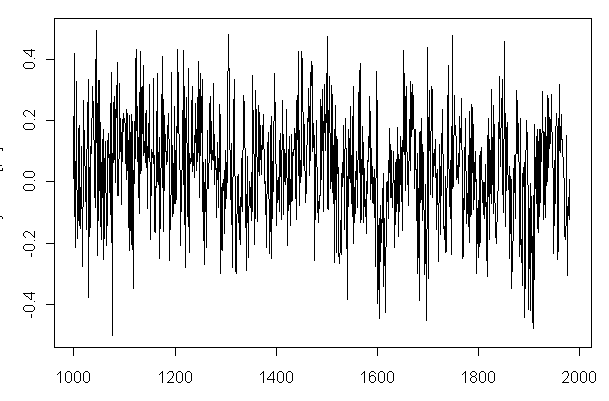
Plot of Juckes Reconstruction #9.
Here’s a plot of the smoothed version.
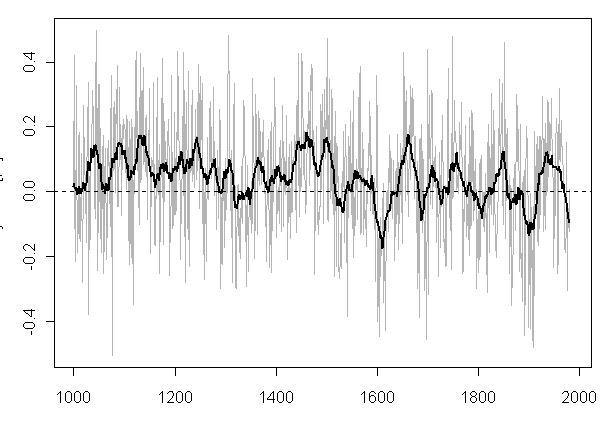
I guess if you stick this in a spaghetti graph and put on a beard on the end of the series (i.e. overlay the instrumental record in a heavy line), you can make this look like a HS. But otherwise??
I re-iterate that this is not one of my sensitivity variations of a Team reconstruction, but one of Juckes’ own reconstructions.