This just in:
Apparently Dr Michael Mann is to testify in front of the Whitfield Subcommittee (I think) on July 27th at 2pm EDT. I assume that our readers want to tune in to see what happens.
This just in:
Apparently Dr Michael Mann is to testify in front of the Whitfield Subcommittee (I think) on July 27th at 2pm EDT. I assume that our readers want to tune in to see what happens.
Dr Edward Wegman
Dr Gerald North
Dr Thomas Karl
Dr Thomas Crowley
Dr Hans von Storch
Mr Stephen McIntyre
Rep Whitfield revealed that Dr Wegman’s report was also peer reviewed, despite what Mann claimed.
Dr Mann was not available to come today but another invitation has been extended for Dr Mann to appear "next week"
Update (Steve): I’ve read the Wegman Report and it’s obviously very gratifying. I won’t be able to provide a review for about a week as we’ve got a family reunion this week-end with two of my sisters and their families arriving from Colorado and B.C. , plus I’ve got to do some preparation for next week. It’s not that I don’t have anything to say about it.
John A: The report mentioned in today’s WSJ article has been released on the House Energy Committee’s website.
The full report is here and the shorter factsheet is here
The Chairman of the Committee on Energy and Commerce as well as the Chairman of
the Subcommittee on Oversight and Investigations have been interested in an
independent verification of the critiques of Mann et al. (1998, 1999) [MBH98, MBH99]
by McIntyre and McKitrick (2003, 2005a, 2005b) [MM03, MM05a, MM05b] as well as
the related implications in the assessment. The conclusions from MBH98, MBH99 were
featured in the Intergovernmental Panel on Climate Change report entitled Climate
Change 20013: The Scientific Basis. This report concerns the rise in global temperatures,
specifically during the 1990s. The MBH98 and MBH99 papers are focused on
paleoclimate temperature reconstruction and conclusions therein focus on what appear to
be a rapid rise in global temperature during the 1990s when compared with temperatures
of the previous millennium. These conclusions generated a highly polarized debate over
the policy implications of MBH98, MBH99 for the nature of global climate change, and
whether or not anthropogenic actions are the source. This committee, composed of
Edward J. Wegman (George Mason University), David W. Scott (Rice University), and
Yasmin H. Said (The Johns Hopkins University), has reviewed the work of both articles,
as well as a network of journal articles that are related either by authors or subject matter,
and has come to several conclusions and recommendations. This Ad Hoc Committee has
worked pro bono, has received no compensation, and has no financial interest in the
outcome of the report.
Now read on….
Update (Steve): I’ve read the Wegman Report and it’s obviously very gratifying. I won’t be able to provide a review for about a week as we’ve got a family reunion this week-end with two of my sisters and their families arriving from Colorado and B.C. , plus I’ve got to do some preparation for next week. It’s not that I don’t have anything to say about it.
John A: The report mentioned in today’s WSJ article has been released on the House Energy Committee’s website. The full report is here and the shorter factsheet is here
The Chairman of the Committee on Energy and Commerce as well as the Chairman of the Subcommittee on Oversight and Investigations have been interested in an independent verification of the critiques of Mann et al. (1998, 1999) [MBH98, MBH99] by McIntyre and McKitrick (2003, 2005a, 2005b) [MM03, MM05a, MM05b] as well as the related implications in the assessment. The conclusions from MBH98, MBH99 were featured in the Intergovernmental Panel on Climate Change report entitled Climate Change 20013: The Scientific Basis. This report concerns the rise in global temperatures, specifically during the 1990s. The MBH98 and MBH99 papers are focused on paleoclimate temperature reconstruction and conclusions therein focus on what appear to be a rapid rise in global temperature during the 1990s when compared with temperatures of the previous millennium. These conclusions generated a highly polarized debate over the policy implications of MBH98, MBH99 for the nature of global climate change, and whether or not anthropogenic actions are the source. This committee, composed of Edward J. Wegman (George Mason University), David W. Scott (Rice University), and Yasmin H. Said (The Johns Hopkins University), has reviewed the work of both articles, as well as a network of journal articles that are related either by authors or subject matter, and has come to several conclusions and recommendations. This Ad Hoc Committee has worked pro bono, has received no compensation, and has no financial interest in the outcome of the report.
Now read on….
John A: In today’s Wall Street Journal comes a mention of a report by three independent statisticians on the Hockey Stick
It is routine these days to read in newspapers or hear — almost anywhere the subject of climate change comes up — that the 1990s were the "warmest decade in a millennium" and that 1998 was the warmest year in the last 1,000.
This assertion has become so accepted that it is often recited without qualification, and even without giving a source for the "fact." But a report soon to be released by the House Energy and Commerce Committee by three independent statisticians underlines yet again just how shaky this "consensus" view is, and how recent its vintage.
The claim originates from a 1999 paper by paleoclimatologist Michael Mann. Prior to Mr. Mann’s work, the accepted view, as embodied in the U.N.’s 1990 report from the Intergovernmental Panel on Climate Change (IPCC), was that the world had undergone a warming period in the Middle Ages, followed by a mid-millennium cold spell and a subsequent warming period — the current one. That consensus, as shown in the first of the two IPCC-provided graphs nearby, held that the Medieval warm period was considerably warmer than the present day.
Mr. Mann’s 1999 paper eliminated the Medieval warm period from the history books, with the result being the bottom graph you see here. It’s a man-made global-warming evangelist’s dream, with a nice, steady temperature oscillation that persists for centuries followed by a dramatic climb over the past century. In 2001, the IPCC replaced the first graph with the second in its third report on climate change, and since then it has cropped up all over the place. Al Gore uses it in his movie.
The NAS Panel showed the following spaghetti diagram.
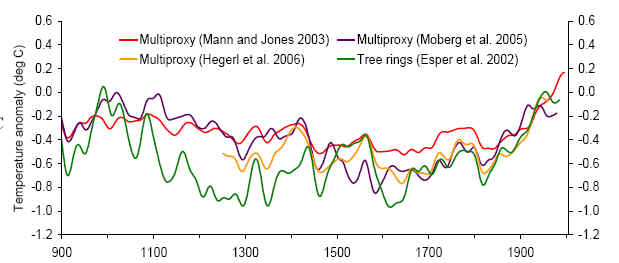
From NAS Panel.
The Esper et al 2002 reconstruction shown here is not actually in Esper et al 2002 in this form, but attributed to Cook et al 2004. I wonder where they got the digital version, as I’ve been unable to locate this version, although it is a linear transformation of the Esper series archived at WDCP here.
I’ve tried to replicate this simple calculation, but, as usual with anything to do with the Team, nothing’s ever straightforward. Continue reading →
Here with accompanying editorial by Terence Corcoran here.






 Climate Audit
Whitfield SubCommittee: Edward Wegman Testimony
Wegman goes through his conclusions in the report.
Highlights:
“The decentering error preferentially produces Hockey Sticks”
” Decentering has a big effect on reconstruction”
” With proper centering, the Hockey Stick shape disappears”
“Dr Mann has unusually large reach with the other 43 authors”
“Peer review is not as independent as would normally be the case”