Pollack and Schrag at the NAS Panel

I know that many of you want to hear our take on Mann (and on ourselves). I’ll get to that. I want to set down some notes on the other speakers while my notes are relatively fresh in my mind; my notes on the morning session are not great, but I’ll give a gist of what happened with Pollack and Schrag.

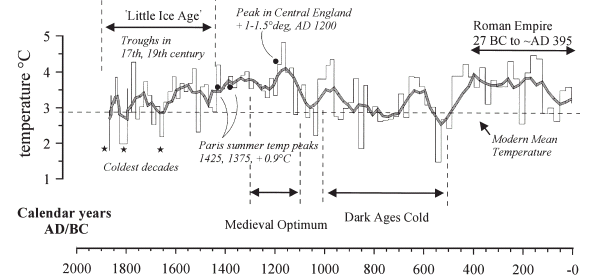
Both confirmed that they could not estimate temperature 1000 years ago within a half degree. Schrag emphasized that that using proxies to estimate average temperature is a “very difficult statistical problem” and policymakers are “asking more than the community can provide”. That might well be the take-home message from the panel. Continue reading

Von Storch at NAS

Back from Washington and quite tired. Lots to report, but don’t have much time today. Anybody hoping that we would be sent home with our tails between our legs will be disappointed. I don’t think that I’ll say much about the panel, at least for now, but I will talk about some of the presentations.

Von Storch (and others) were very cordial to us and made a very strong and critical presentation posted at his website here: 8.7 Mb PPT ‘ and you’ll find it pretty interesting. Here are a few points from his talk.

“‚⠠ " [with respect to MBH]: Premature declaration of validity of a knowledge claim;
“‚⠠ Critique stifled instead of encouraging debate and discussion to get a full air[ing] for concern of misuse in the political process;
“‚⠠ Peer review process: no publication without reproducible description of complex methodology;
“‚⠠ IPCC and related processes: Have independent scientists doing the review; not the key authors in the field.
“‚⠠ Data access: Relevant data and details of algorithms need to be made public even to “adversaries”."

Von Storch cited with disbelief Phil Jones’s refusal of data to Warwick Hughes (and he had gone to the trouble of confirming with Jones that the quote was correct as he had trouble believing that any scientist could say such a thing.)

"We have 25 or so years invested in the work. Why should I make the data available to you, when your aim is to try and find something wrong with it." (Jones’ reply to Warwick Hughes, 21. Februar 2005; confirmed by P. Jones)

Towards the end of his presentation, Von Storch (who spoke just before us) posted up a slide with Boehlert’s questions and began answering them. (We also referred to three Boehlert questions in our presentation and provided similar answers). This prompted a little discussion with the Chairman (North) as it seems that the Committee had never seen Boehlert’s letter and the chairman was concerned that answering these questions was outside the task of the Committee, which already had, in his view, a large mandate. However, he allowed the topic to be covered, and Von Storch gave short answers to several Boehlert questions, including to the following questions:

2) What is the current scientific consensus on the conclusions reached by Drs. Mann, Bradley and Hughes? What are the principal scientific criticisms of their work and how significant are they? Has the information needed to replicate their work been available? Have other scientists been able to replicate their work?

Among von Storch’s answers:

“‚⠠ The [MBH] information required for replication was not made available in a suitable manner. The original publication in “nature” did not provide this information and was obviously published without careful review of the methodology.

“‚⠠ The MBH work is widely accepted as truth outside of people directly engaged in the issue, because of a less than satisfactory marketing by the IPCC.

Ned has characterized the House Science Committee staffer’s (Goldston) comment more or less correctly. Goldston said that there were lots of big science questions that were out there and that there were going to be many big debates in the future, but I understood him to say that the House Science Committee, in commissioning this study, wanted answers to specific and narrower questions. When you read the two documents side by side, there certainly does seem to be a discrepancy between what the House Science Committee asked for and what NAS has commissioned the panel to do. I suspect that we’ll hear more about that in days to come.

One observer's report on the NAS panel

I thought this was too good a report to be buried in a comment thread but deserves a wider audience:
Continue reading

A new reconstruction of past climate

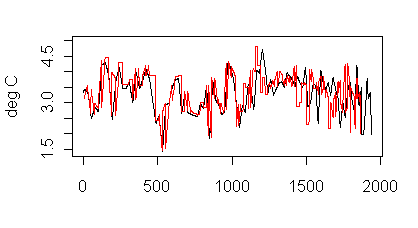
While Steve is away, and in honor of the NAS Panel which is so convivially considering the question of the reconstruction of past climate, Dave Stockwell decided to do his own reconstruction using exactly the same methodology as the Hockey Team.

As you can see, his results are clearly consistent with the results of the Hockey Team, showing an anomalous 20th Century warming in true Hockey Stick style (MBH98/99, Osborn and Briffa[2006])

Stockwell's reconstruction
Continue reading

Off to Washington

Off to Washington this afternoon. I’ve been contacted in advance by one representative of the media who’s going to be covering the entire event. If anyone wishes to contact me, email me in the next few hours and I’ll give a cell #. I’ll post up our presentation in a few days. I appreciate the advice and good wishes. Reportedly, Mann is not attending tomorrow’s proceedings; so we won’t be able to sing rugby songs together at the reception after all.

On another topic, I always like it when organizations do smart things. Despite all our writings about “hockey sticks” and despite 20 years of driving children to hockey leagues (if you’re not Canadian, you probably don’t know how time-consuming rep hockey leagues are) , I like basketball much better than hockey. I watch an inordinate amount of basketball and suffer through the travails of the Toronto Raptors. Today they hired Bryan Colangelo as GM away from the Phoenix Suns. It was a bold move and is receiving great acclaim in Toronto. Restoring confidence is always hard to do and with one bold stroke, they’ve accomplished it.

Thompson, Hardy, Hemp and the Snows of Kilimanjaro

An interesting article was published in Der Spiegel a week ago on the glaciers atop Mount Kilimanjaro, and the research into why the glaciers are melting.

The article features Lonnie Thompson who has been taking cores from tropical glaciers for a long time, and publishing articles about them, without bothering to put the data into public archive for others to examine.
Continue reading

Moberg Corrigendum #2

I checked the Lauritzen series sent to me a few days ago by Moberg and found more discrepancies. I originally observed a discrepancy between the figure in the source article and the figure shown in the SI to Moberg et al [2005] as shown below.

The graphic in Nature ended in the 1930s, while the figure in the original article ended in the 1860s. Here’s the original figure (as posted up before):

When I plotted up the new data set sent to me by Moberg, it looked just the same as the figure in Nature. The data is described as follows:

column 1: Time (years) before 2000 AD
column 2: Speleothem d18O values for speleothem SG93, as described in Lauritzen S-E and Lundberg J, 1999: Calibration of the speleothem delta function: an absolute temperature record for the Holocene in northern Norway. Holocene 9, 659-669.

The data sent by Moberg begins at 2311 before AD2000. The last 4 values in the data are shown below – so the series seems to terminate in AD1938 consistent with the plot in Nature (rather than how the original article appeared.)

84.30 -7.54 3.113
69.27 -7.61 3.331
67.77 -7.48 2.925
61.79 -7.12 1.800

I looked back at the original article and found the following interesting comment:

The “‹Å“Little Ice Age’ (LIA). The sample was not actively growing when collected. Since TIMS dating gave an average age of 253 years for the top 5 mm with a “‹Å“cooling’ trend in the isotopes (Figure 7), the coldest signal (–7.12″‚°) here is taken as an extreme LIA signal. [my bold]

The figure in the original article shows that the "extreme LIA" signal was dated in the 19th century.

Now we can track the value of -7.12″‚° back into the newly disclosed data set – except this time the coldest signal (–7.12″‚°) is dated to 1938 – an unusual data, to say the least, for an "extreme LIA" signal. No explanation whatever is provided in the Moberg Corrigendum for this startling and very dissatisfying discrepancy.

Indigirka Series
The data file contains the following request:

[21] "NB! The user of this file is asked to note that, although the Indigirka series "
[22] "has previously been discussed in the literature (Sidorova OV, Naurzbaev MM 2002: "
[23] "Response of /Larix cajanderi/ to climatic changes at the Upper Timberline and "
[24] "in the Indigirka River Valley, Lesovedenie 2, 73-75, in Russian),"
[25] "they are anyway unpublished data that have not been made publicly available, "
[26] "as explained in the Corrigendum (Nature 439, 1014)."
[27] " "
[28] "The authors of the Moberg et al. paper therefore ask the user of this file "
[29] "not to publish these data anywhere, neither in printed nor in electronic form. "
[30] "The authors behind the Indigirka series plan to publish an updated version "
[31] "of their series in due time."

I’m thinking about whether that applies to graphs. For what it’s worth, the series has very high MWP and low modern values. It generically looks like the Updated Polar Urals series (rejected by Briffa and Wilson) and not at all like the hockey stick Yamal substitution.

Bloomfield's Advice to Briffa

Briffa et al [Holocene 2002] describes a procedure for estimating confidence intervals that is applied in Jones et al [2001] as well. Bloomfield (pers. comm.) is cited as a source, although it’s inconceivable that he was aware of the Briffa truncation. I don’t see how you can claim precise confidence intervals when your post-1960 completely falls apart. But here is Briffa’s argument (any comments welcome; Im going to post up a puzzling excerpt from MBH99 as well):

Briffa et al [Holocene 2002]
Appendix: computing uncertainty ranges for reconstructions

The estimates of regional growing-season temperature constructed by simple linear regression (shown in Figures 11 and 12) include uncertainty ranges in terms of +- 1 and +- 2 standard errors about each estimated value. Each error range is based upon the uncertainty in the regression coefficients (the intercept, a, and the gradient, b) and the residual temperature variance (s^2) that is not captured by the regression-based reconstruction. The latter is typically the largest source of error in the reconstructions presented here, though the other terms can be non-negligible. The standard errors of the regression coefficients (SEa and SEb) are readily obtained (see, e.g., equations 1.4.5 and 1.4.2 of Draper and Smith, 1981). Given a time series of the predictor, x(t), then the predicted temperature is simply

yË’€ (t) = a + x(t) * b (A1)

where the Ë’€  indicates that this is a prediction of the actual temperature, y. When the residuals from the regression are not autocorrelated, then the standard error of this prediction, SEy, is given by:

[SEy(t)]^2 = s^2 + SEa^2+ [x(t) – mean(x)]^2 * SEb^2 (A2)

where mean(x) is the mean of the predictors over the calibration period.

The uncertainty ranges are in fact timescale-dependent, and therefore need to be computed for each timescale at which the results are presented. Equation A2 is valid for the raw reconstruction, but in general a reconstruction might be presented after applying a smoothing function, replacing the value at time t by àŽ⡨i) w[i]*y^[t-i] where the weights, w[i], sum to one. In Figures 11 and 12, we use a Gaussian-shaped smoothing operator. For the smoothed reconstruction, the standard error must be modified (Peter Bloomfield, personal communication) to give

[SEy(t)]^2 = s^2 * àŽ⡠w[i] ^2 + SEb^2 * { àŽ⡠ w[i] * (x[t-i]-mean(x)) }^2 (A3)

(comparing equations A2 and A3, note that the predictor anomaly is replaced by its smoothed value in the final term, but the more important change is that the first term is now scaled by the sum of squared weights, which is always 1 and the uncertainty range is increased. For the case of a smoothed reconstruction, the first term on the right-hand side of equation A3 is multiplied by the same factor.

NAS News and Schedule

Here’s the appearance schedule. There are 10 presentations. Hughes and Mann each get a separate speaking slot while Ross and I are combined into one. It’s a pretty blue-chip set of speakers. We get the last speaking spot on Thursday at the end of a long day, just before cocktails. Hughes and Mann get to wrap with two spots on Friday, Mann getting the last word.

NAS has added a new member to the panel. (BTW three of the panel are either current or past UCAR trustees: North, Turekian and Dickinson, added to the two UCAR employees – Otto-Bliesen and Nychka.) It is a statistician, Peter Bloomfield of North Carolina State, who has a lengthy resume with many interesting-looking papers. Bloomfield is a coauthor with Nychka in several publications. He is cited in two pers. comms. in Briffa et al [Holocene 2002] where Briffa describes how they went about estimating confidence intervals for their MXD reconstruction – you know, the one where they chop off the period after 1960. Out of all the statisticians in the world, why would they pick one who consulted on confidence intervals for one of the Hockey Team studies?

Needless to say, they’ve paid no attention so far to any of our suggestions or comments on composition and balance. I wonder how they actually go about considering panel composition and balance. Anyway, it should be interesting. Continue reading

Briffa vs Esper #2

People have been wondering why there is such difference between Polar Urals versions. In many cases, the archived Osborn and Briffa [2006] version (smoothed) is consistent with the emailed Esper et al [2002] version – but not always. It’s always worthwhile examining differences and here are a few. Continue reading