Overpeck: “You didn’t really believe everything that I said, did you?”

Overpeck gave the Bjerknes Lecture at AGU, modestly entitled “Anticipating the Big Impacts of Anthropogenic Carbon Dioxide Increases”. It was in the largest forum — about 1000 people were there. The room was filled to overflowing and you simply could not get in if you were late. Continue reading

Wall Street Journal, Dec. 10, 2005

The Wall Street Journal mentioned us editorially yesterday here . While it’s nice to be mentioned, they incorrectly say the following:

The Canadians found that the Medieval warm period had indeed occurred, suggesting that periods of warming and cooling were natural trends unrelated to the number of SUVs on the road.

Readers of this blog know that we made no such claim about the MWP. We have repeatedly made it clear that we offer no alternative reconstruction of past climate. We merely demonstrated many flaws in the data and methods of MBH and stated that MBH claims that their reconstruction demonstrated 20th century uniqueness with robustness and statistical skill were invalid – a different and more nuanced assertion than attributed to us by WSJ.

AGU 2005 – #1

The size of the AGU convention is really daunting. Up to Thursday, there were 11,903 attendees. But that doesn’t really portray the size of the presentation effort. Most of those attendees are also presenters. I didn’t see a total of the number of oral and poster presentations, although it would be readily available from AGU. But there were probably over 10,000 oral and poster presentations during the week. Continue reading

EOS 2003 Spaghetti Graph

A reader has kindly sent in an Excel spreadsheet here digitizing two series in the Mann et al [EOS 2003] spaghetti graph. It definitely looks as though the Crowley and Lowery version is some sort of transposition of MBH99 (good spotting by Tim Lambert), which definitely enhances the supposed similarity between the two graphs. Jones and Mann [2004] said that EOS 2003 was an incorrect “version” of Crowley and Lowery; however, Mann did not issue a corrigendum at EOS. It seems to me that a transposition of MBH99 does not qualify as a “version” of Crowley and Lowery at all and that the caption in Jones and Mann [2004] , while noting that there was an error in EOS, has misrepresented the nature of the error, perhaps because they wished to avoid embarassment.

Impact of Shared Proxies

Here’s an interesting calculation showing remarkable coherence between multiproxy averages of red noise, when proxies are shared. Continue reading

Variability: von Storch et al [2004]

Von Storch et al. [2004] argued that the reduced variability of MBH and Jones et al [1998] was possibly due to the use of inverse regression. This hypothesis has received a fair of attention as a rival candidate for the microscopic honor of breaking the hockey stick. I obviously think that our analysis in terms of principal components, bristlecones and RE statistics is the correct one, but I’m sure that more climate scientists would endorse the VS analysis as being on the money. On the face of it, this is a quite plausible explanation. The problem is that it is weakly argued in the original article and simply doesn’t apply to the actual models. Continue reading

Variability: Mann and Hughes [2002]

In response to the high-variability recosntruction of Esper et al. [2002] posted up here , Mann and Hughes [Science 296, 848 (2002)] replied:

The basis used by Esper et al. for comparison with previous studies of NH temperature trends over the past millennium is flawed [imagine Mann calling someone else’s work "flawed"] …

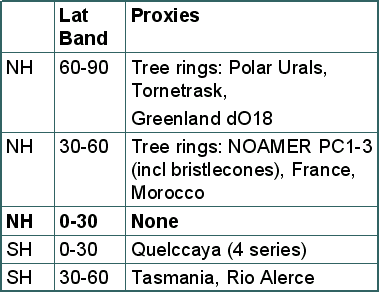
Some of these differences may have a geographic basis. Esper et al. estimate extratropical temperature changes using an entirely extratropical tree ring data set. In contrast the Mann et al reconstruction estimates temperature trends over the full NH using both extratropical and tropical proxy data and targeting the full NH temperature. Half of the surface area of the NH temperature rcord estimated by Mann et al. lies at latitiudes below 30N, whereas the Esper et al. estimate is based entirely on latitudes above 30N. Tropical surface temperatures are typically less variable than extratropical continental surface temperatures at almost all time scales.

This explanation sounds plausible on the surface. However, if you look at the actual proxies used in the MBH99 reconstruction (which are not the same as the 112 proxies of the post-1820 period), you see that MBH99 does not use ANY proxies from 0-30N in their MWP reconstruction.

The Ritson Comment: An Update

In August 2005, the new editor-in-chief of GRL, Jay Famiglietti of UC, Irvine, took over control of our file after two comments, including one by Ammann (UCAR) and Wahl had been rejected by the previous editor. This is discussed here . He gave an interview to Environmental Science & Technology here in which he was reported as follows:

Famiglietti, editor-in-chief of GRL, says that because the McIntyre paper generated a total of four letters, an abnormally high number, he will personally supervise their acceptance. He says that the letters differ in their specific criticisms and adds that he is ignoring the political controversy and focusing on the science.

At the time, two of the four comments had been already rejected. Both were taken out of the garbage can. Famiglietti then dealt with them outside AGU policies for comments. I posted our Reply to Ritson here . There have been some further developments regarding the Ritson Comment, about which Famiglietti informed us in a reply marked as confidential. I’m not sure that merely marking the reply as confidential makes it confidential, but that’s a different issue. We asked Famiglirtti for an on-the-record response, pointing out that he already commented to ES&T . His reply was as follows:

Sorry, I will decline making any comment for the record regarding the Ritson comment.

If he doesn’t want to comment on the record, you’d think that he would have thought about this before talking to ES&T. At some point, people will draw their own conclusions about the state of the Ritson Comment.

In my opinion, the revival of the Ritson Comment was, to some extent, a stalking-horse for reviving the rejected Ammann and Wahl comment, where UCAR has been hanging out with their press release, which announced the submission, but not the subsequent rejection. This has reared its ugly head again. This is very unlike the von Storch-Zorita comment or the Huybers comment, where the authors disagree in good faith. I think that their criticisms are wrong, but everyone seems to behave like human beings and we’ll be seeing one another at AGU.

I haven’t seen the Ammann-Wahl GRL re-submission yet. I assume that they have again withheld the adverse cross-validation statistics, as they did in their Climatic Change submission and their previously rejected GRL submission. I find their continued and intentional withholding of cross-validation statistics to be extremely objectionable. It irritates me that any journal would proceed with reviewing their Comments as long as they withhold this information. It was bad enough the first time when Mann withheld the information from Nature, but it’s farcical for GRL to even think of acquiescing in this a second time or to proceed with a review as long as this information is withheld. We’ll see what happens.

I also don’t think that Ammann and Wahl will find that it is professionally a good idea to re-submit an article where they have intentionally withheld relevant and adverse cross-validation statistics, but that’s their decision. I can’t imagine that they have fully thought through the consequences of this decision, which are not going to be pretty, or else they wouldn’t have done it. I would certainly urge them to immediately and publicly report all cross-validation statistics, including the R2 statistic.
AGU 2005 Draft

Update: a new heavily-edited version sent to me this a.m. by Ross, edited somewhat through the day here. Ross to the rescue.

Here’s a draft Powerpoint presentation for AGU. As with most first drafts, it’s pretty uneven. The topic of the session is variability, so I’ve spent the first part of the presentation on that. I haven’t even thought about time. I can delete sections at will. Comments are more than welcome – the more critical, the better ( don’t be shy, TCO). I’m a big believer in second drafts so I’m not too fussed if a first draft is rough. I know that there are some good points, but I’m probably trying to cover too much.

I’ll be leaving on Monday a.m., but need to finish by Sunday. I’m going to be having dinner/drinks with Huybers, Zorita (von Storch isn’t going) , Roger Pielke, hopefully some others out there, which will be fun. I’m going to take my squash equipment with me as my club has exchange with the University Club in San Francisco. If anyone here wants to contact me, I’ll be at the Westin St Francis.

Crowley Unspliced

As a mindless activity, I’ve re-visited the Crowley data, which we’re discussing. Among other stereotypes, out of 15 series, Crowley uses 2 bristlecones, Polar Urals, Tornetrask and Dunde. Even so, without any grafting, there’s not much hockey-stick-ness to this dataset. When you parse Crowley, you also see some very odd decisions, which result in lowering MWP levels relative to modern levels. The image here is a bit cluttered – I’ve been looking at too many spaghetti graphs, but bear with me on it.

Figure 1: Crowley unspliced. Black – base case using 15 proxies; dashed – Crowley’s own edit excluding 2 proxies, which results in higher modern to MWP levels; red – replication using freshly collated data; blue – sensitivity with freshly collated data and i) no bristlecones; ii) no Dunde and iii) no Polar Urals in the 11th century. Continue reading