An article by Peter Huybers has been accepted at GRL together with our Reply. I’m going to give a preview of this. This will take a few posts. Continue reading →
I’ve had an abstract accepted for the U.S. Climate Change Science Program (CCSP) Workshop, "Climate Science in Support of Decisionmaking," to be held November 14-16, 2005. My abstract is entitled: "More on Hockey Sticks: the Case of Jones et al [1998]". Continue reading →
Taimyr is one of the sites in Esper et al [2002]. It does not make a material contribution to any hockey stick-ness in Esper. The authors have some very interesting things to say about AGW which I’ll post up in a day or two. For now, I want to post up the following graph, which is of great methodological interest to me. Using one site age curve is sweeping the field in dendroclimatic studies. While the various authors genuflect towards the need for homogeneity, there is precious little evidence in their articles of operational procedures to ensure it.
A big and obvious difference and potential source of bias is that some of the newer reconstructions are being done by stitching together cores from live trees and cores from dead trees. Here’s a remarkable graphic from Naurzbaev et al [2002]
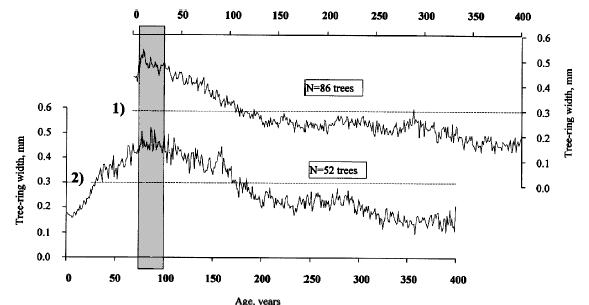 Continue reading →
I more or less jumped into the middle of some technical issues pertaining to Esper et al [2002], without properly describing the study. Esper et al. [2002] is one of the multiproxy studies that is included in all the spaghetti diagrams. It supposedly shows more "variability" than Mann, which is the issue that the Hockey Team is keen on discussing. The issue which interests me is a different one: what are the "active ingredients" in determining the relative levels between the MWP and the 20th century.
Every time I look at these diagrams and try to figure out how they work, I keep hearing strains from a pop song from my childhood:
who put the bop in the bopsy-wopsy-wop?
who put the ram in the rama-rama-ding-dong?
We will look for the rama-rama-ding-dong in Esper et al [2002]. Continue reading →
You’ve all seen my frustration with Jacoby and his doctrine of a "few good men". I haven’t posted on this, but, one thing that puzzled me was some missing inventory numbers at Polar Urals, just before the critical trees 45, 46 and 47 (upon which the "coldest year of the millennium" depends.
Here’s a comment from Esper et al. (Cook, Krusic, Peters, Schweingruber) from Tree Ring Res. 2003, p.92, which may shed some light on this. Tree Ring Research, unlike Science, is intended for narrow circulation.
Before venturing into the subject of sample depth and chronology quality, we state from the beginning, "more is always better". However as we mentioned earlier on the subject of biological growth populations, this does not mean that one could not improve a chronology by reducing the number of series used if the purpose of removing samples is to enhance a desired signal. The ability to pick and choose which samples to use is an advantage unique to dendroclimatology. That said, it begs the question: how low can we go?
It is taking all my will power to avoid making a sarcastic comment or making a slightly out-of-context rhetorical answer to the last question.
Esper et al [2002] divides trees into "linear" and "nonlinear" trees depending on their growth – a classificaiton that is idiosyncratic to this publication as far as I can tell. Esper at al. [2002] provides a citation to a publication "in press" that supposedly explains this, but I can’t locate any explanation in the publication. Perhaps I’m missing something in plain sight, but I don’t think so. Continue reading →
Jaemtland is one of the sites used in Esper et al [2002]. Here is some benchmark information on this site to help see its role, if any, in contributing to any hockey-stick-ness in Esper. Continue reading →
Mann’s answer to the Barton Committee included a bizarre tirade about title to his computer code, which made me ruminate about the tort of conversion. It’s hard to imagine that Mann has done something that is probably unprecedented in the entire history of responses to a congressional committee – the answer to the congressional committee itself constituting the act of conversion – but it’s quite possible according to the theory outlined below. Continue reading →
Barton’s question 7d asked MBH about other verification statistics. We’ve discussed their withholding of the R2 statistic here, here and here. In our GRL article, we also pointed out that their 15th century reconstruction also failed the CE statistic, another verification statistic used in dendroclimatic studies [Cook et al, 1994].
Mann’s retort was that climatologists “prefer” the RE statistic. I recently noticed an interesting discussion of the CE statistic in Mann and Rutherford [2002]. Continue reading →
Esper considered three different methods of standardizing tree ring widths and concluded:
For the Gotland TRW data, the resulting three different chronologies do behave differently in the late 19th and 20th centuries. Such difference would influence one’s interpretation of the climate history represented by these chronologies.
Continue reading →