Well, almost… (if you follow me).
There’s a new piece of open source software for Web browsers called "Site Bar" which you can find at this link
If you install it (and it’s as simple as clicking a link) you’ll get a sidebar full of links to interesting sites. If you select "Sience" then you’ll see climateaudit together with such august websites as Scientific American, New Scientist and less-than-august websites like realclimate.org
Yes, I wrote "Sience". That’s the problem with open-source software – the programmers may be great, but they can’t spell for toffee…
Not bad for a weblog re-started three weeks ago, don’t you think?
I get a lot of questions about post-1980 proxies and I find it a very interesting question. One would expect that 1998 – the "warmest" year of the millennium – and the 1990s – the "warmest decade" of the millennium would leave a loud signal in a valid proxy. I’m going to start discussing some proxies which I have on hand, starting with a ring width series from the Twisted Tree Heartrot Hill (TTHH) site in northern Canada ending in 1999 and where the proxy shows no strong signal in the 1990s or 1998 as shown below:
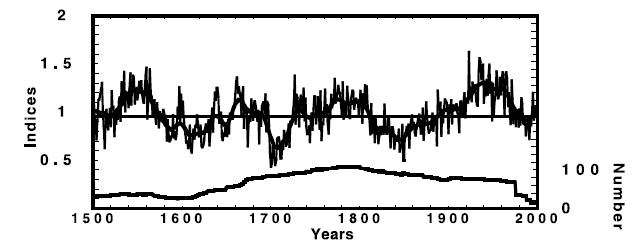
Figure 1. Site Chronology, Twisted Tree Heartrot Hill. Source, D’Arrigo et al [2004]. Continue reading →
This post seems to have caught a chord and has quickly become the most read posting on the site. It was was cited approvingly by Roger Pielke at his blog [now here] and re-printed with slight edits by National Post on Feb. 15, 2005. Continue reading →
Ross McKitrick was on Global TV yesterday and gave an excellent presentation, especially in comparison to the Canadian Environment Minister, Stephane Dion.
There’s going to be an article about the work of M&M in tomorrow’s Wall Street Journal. (Update: Here’s a url
Here’s what’s on the online coverpage:
Climate Graphic Faces Attack
Since it was published four years ago, the "hockey stick" temperature graph has been used by hundreds of environmentalists, scientists and policy makers to make the case that the industrial era is the cause of global warming. Now, a semiretired Canadian mining executive is raising doubts about the graphic’s veracity.
I don’t have an online subscription and haven’t seen the article yet.
UPDATE (feb. 14, 2005): The article is on the front page complete with picture of a certain aging Canadian. The graphics people at WSJ deserve danger pay. I’m gratified by the coverage, to say the least.
We’ve provided a recent non-technical overview of our results here . Webpages providing links and providing htm versions of this overview and links are at either of www.climate2003.com or Ross McKitrick You can contact me at smcintyre25 AT yahoo.ca. If you want to talk to me, I’ll email a cell #. This blog started on Feb. 8, 2005 and had over 14,000 hits in its first week. Recent technical articles are our GRL article (a pre-publication version available here) and the E&E paper here. There has been extensive recent press coverage… Continue reading →
In the last two days, I’ve argued that it’s insufficient for Mann et al. to merely “get” a hockey stick shape some other way, but that they have to show that any such salvage reconstruction meets the representations and warranties of MBH98 as to reasonably even spatial sampling, robustness, statistical skill and proxy validity. I’ve shown that 2 of the 3 MBH98 salvage attempts by Mann et al. the no-PC reconstruction and the Rutherford et al. [2005] reconstruction ” fail not just on one count, but on numerous counts. Today, I’ll discuss the 5 PC or Preisendorfer Rule N salvage attempt and shows that it also fails on numerous counts. Continue reading →
Following on from the prompting of Hans Errin, I took a look at his links on climate change in his country. The Dutch National Institute for Coastal and Marine Management (KNMI) produced the following picture (taken from this document).

As you can see, sea levels were higher during the Medieval Warm Period (1000 years ago) than the depths of the Little Ice Age (550 years ago) and are currently between those two extremes today. It’s also apparent that the sea-levels have been broadly rising since at least the end of the last Ice Age.
In the conclusions, the author notes:
"De waterstandswaarnemingen laten nog geen versnelde zeespiegelstijging zien"
which translates as "The water level measurements show no acceleration in sea level rise" and
"Het is niet altijd goed gedocumenteerd of te achterhalen waarop de getallen voor de scenario’s gebaseerd zijn"
which I transliterate as "It’s not always well documented where the measurements for the data on which the [IPCC] scenarios are based ". (I think Steve has mentioned similar reservations about data archiving and model assumptions)
So the Dutch, who have most to lose from accelerating sea-level rise, see no evidence such an acceleration and find the climate models which suggest such an acceleration for the future unconvincing and poorly documented. Bear in mind that the part of the Netherlands which is below sea-level (more than half of the country and where most people live), is sinking as a result of post-glacial rebound (as is the Southern part of the UK).
While I was working up some other notes, I checked Mann’s reference to a presentation by Jolliffe, supposedly justifying de-centered uncentered principal components analysis. (It doesn’t, but that’s for another day.) Anyway, the hyperlink has disappeared. Chasing up the directory chain, the Jolliffe presentation had been previously stored by the Climate Systems Analysis Group of the University of Cape Town, a climatology group who described themselves as follows:
We are a dynamic group of coffee drinkers…. but, hopefully, we also produce some worthwhile information every now and again
Sorry, but I couldn’t resist.
Can anyone explain to me the meaning of the following email from Hughes to Mann, dated July 29, 1997, archived at Mann’s FTP site at ftp://holocene.evsc.virginia.edu/pub/MBH98/TREE/VAGANOV/ORIG/malcolm_29-JUL-97.
As follow-up, the site arge030 was listed in the original SI as being used in MBH98, but was not actually used in MBH98 calculations evidenced at Mann’s FTP site. We complained about this and other inconsistencies to Nature in November 2003, leading to the Corrigendum by Mann et al. in July 2004. The Corrigendum listed arge030 as one of 35 series in the original SI, which was not actually used in calculations.
The Corrigendum stated that the discrepancies resulted from the application of additional quality control measures i.e. the excluded series were not "conservatively standardized" or their standardization methods were not known to the authors in 1997. I’ve checked this supposed explanation and it can be shown not to be accurate. I’ll post on this on another occasion.





 Climate Audit
Climateaudit.org mentioned as science resource!
Well, almost… (if you follow me).
There’s a new piece of open source software for Web browsers called "Site Bar" which you can find at this link
If you install it (and it’s as simple as clicking a link) you’ll get a sidebar full of links to interesting sites. If you select "Sience" then you’ll see climateaudit together with such august websites as Scientific American, New Scientist and less-than-august websites like realclimate.org
Yes, I wrote "Sience". That’s the problem with open-source software – the programmers may be great, but they can’t spell for toffee…
Not bad for a weblog re-started three weeks ago, don’t you think?