Spot the Hockey Stick! #4 – The US Climate Change Program

Another sighting of our favorite climate reconstruction is to be found at the "Strategic Plan for the Climate Change, Science Program, Final Report, July 2003", published by the US Climate Change Science Program.

This document quotes the opinion of the IPCC 2001 report as the basis for its declaration

Climate research has indicated that, globally, it is very likely that the 1990s were the warmest decade in the instrumental record, which extends back to the 1860s (see Figure 4-1); large climate changes can occur within decades or less, yet last for centuries or longer; and the increase in Northern Hemisphere surface temperatures during the 20th century likely exceeds the natural variability of the past 1,000 years (IPCC, 2001a, d).

Placing instrumental records in the context of longer-term variability through paleoclimate analyses has played a key role in these findings. Moreover, observational evidence together with model simulations incorporating a comprehensive suite of natural and anthropogenic forcings indicate that "…the changes observed over the last several decades are likely mostly due to human activities, but we cannot rule out that some significant part of these changes is also a reflection of natural variability" (see Figure 4-2) (NRC, 2001a).

All climate models used in the most recent Intergovernmental Panel on Climate Change (IPCC) assessment project that global mean temperatures will continue to increase in the 21st century and will be accompanied by other important environmental changes, such as sea level rise, although the magnitudes of the projected changes vary significantly depending on the specific models and emissions scenarios (IPCC, 2001a, d).

Mann Hockey Stick in the US Climate Change Science Program 2003

Figure 4-1: Top Panel: Changes in the Earth’s surface temperature over the period of direct temperature measurements (1860 — 2000). The global mean surface temperature is shown each year by the red bars (with very likely ranges as thin black lines) and approximately decade-by-decade by the continuous red line. Bottom Panel: Proxy data (year-by-year blue line with very likely ranges as gray band, 50-year-average purple line) merged with the direct temperature measurements (red line) for the Northern Hemisphere. The proxy data consist of tree rings, corals, ice cores, and historical records that have been calibrated against thermometer data. Source: IPCC (2001d).

Medieval Treelines #1

Larry Huldén of the Finnish Museum of Natural Science sent me a nice note, mentioning:

I have met Phil Jones in Helsinki during a Climate meeting. My wife had a paper on mediaeval warm period in Finland in which she showed that oak (Quercus robur) forests occurred some 150 km north of the present time limits. Finland was then practically still in the Iron age. Phil Jones tried in many ways to explain that farmers themselves had planted the oak forests, which is complete garbage.

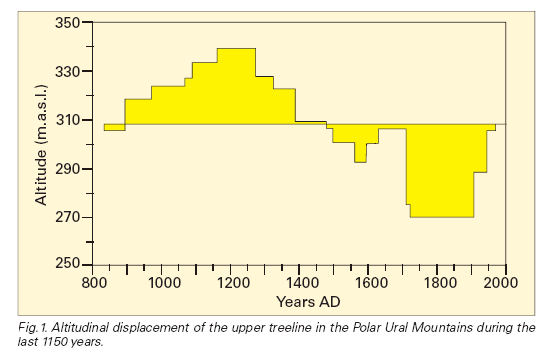
Medieval treelines are a very interesting topic. I’ve collected information on this from time to time and will post up some things that I’ve noticed. Here’s an interesting graphic from the Polar Urals site showing treeline changes. The altitude of trees sampled also changed dramatically over the centuries.
Urals treeline .

Briffa’s temperature reconstruction from the Polar Urals is a staple of multiproxy studies by the Hockey Team. It concluded that 1032 was the "coldest year of the millennium" – a conclusion which seems inconsistent with other evidence. I’ve done a lot of work on the Polar Urals and will mention it on another occasion. I’ve tried to get information on the altitudes of individual trees in order to see what effect the changes in altitude have had on site chronologies. Naturally I can’t get this information.

Feedback from Dr Vincent Gray

McIntyre and McKitrick have done a great job casting doubt on the first part of the Mann "Hockey Stick" and I will be surprised if the IPCC can still retain it in its original form.

 However, we are still up against the second part of the "Hockey Stick" the alleged surface temperature record, as promulgated by Jones, Hansen and Karl., which continues to claim that the current temperature is "unprecedented"

Very little has been done to challenge the accuracy and reliability of the surface record.

I am attaching my own modest attempt, which was originally submitted to Geophysical Research Letters but after interminable delays was originally published on John Daly’s website, where it can still be seen.

It consists of a study of the 5°x5° average temperatures, as calculated by Jones et al from 1900 to 1996, divided into rational regions. I show that there is great variability between boxes, and regions, with much discontinuity of records. I showed that the Russian/Siberia results had a large influence on the averages. McKitrick has shown that this is so, and that there are a large number of gaps in the Russian records. Also, I showed that many of the boxes depended on a very small number of records, in some cases one or two.

It is scandalous that they are allowed to get away with using such defective records. I would like to see a study to identify worthless and defective records and eliminate them from the averages. The Americans (e.g. Vose and Menne Climate Research 2004 2961-2971) have established that you need at least 25 stations for a fair average. They also showed great variability in instrumentation and record keeping, even in the USA. The methods for "correcting" the data have never been fully revealed. The Sea Surface data have been shown to be defective by Christy, Parker et al Geophys Res Letters 2001 Vol 38 183-186, but nothing has been done to correct them.

It is time for a scientific assault on the supposed surface record. Actual visits to key stations with a study of history, records, technical expertise, and instrumentation is needed. Can you find some keen young students who could get a grant to do some of this?

With much encouragement

Regards

Vincent Gray

Ross McKitrick on Canadian TV

Ross will be on the Global television network in Canada at 6:30 pm Eastern time. Stephane Dion, Minister of the Environment in Canada, will be doing one interview. Ross will be doing another. (It was taped today.)

Sir John Houghton and the Hockey Stick #1

Of all people involved in the promotion of the Hockey Stick, Sir John Houghton, head of the IPCC is probably the chief champion of MBH98 and MBH99 as the "scientific consensus" of how the global climate changed in the last millenium.

Here’s Sir John in front of that famous graph

Sir John Houghton and the Hockey Stick

Referring to the Hockey Stick, he lectured:

Global warming is a second and a more important example of this global pollution [other than the smog found in 19th Century London and most cities]. Carbon dioxide that I cause to be emitted, because I drive my car or use electricity or in many other ways, enters the atmosphere, and rapidly spreads around the whole atmosphere, much of it remaining in the atmosphere for 100 years or more. Now, because carbon dioxide is a greenhouse gas, it causes the average global temperature to increase, significantly affecting the climate. So everybody in the world is affected. The Mann Hockey Stick given in the IPCC Summary for Policymakers

But you will see that the nature and rapidity of the change in temperature over the 20th Century is very different from that over the previous 1000 years. In particular the recent years have been the warmest over that entire period. 1998 was the warmest year in the global instrumental record, and a more striking statistic is that each of the first eight months of 1998 was the warmest of those months in the instrumental record – suggesting that the earth really is warming up.

So you see that Sir John links the results presented by the Mann Hockey Stick as key proof that

  • the Earth is warming due to build-up of greenhouse gases, principally carbon dioxide
  • 1998 is the "warmest year of the millenium"
  • the 20th Century warming is "very different from that over the previous 1000 years"
  • that the change in climate is predominently caused by mankind.

Continue reading

Errors Matter #2: the "Different" Method of Rutherford et al [2005]

Yesterday in Errors Matter #1, I argued that any new reconstruction now proposed by Mann et al. as a means of salvaging MBH98-type results has to also meet the representations and warranties of MBH98 used to induce widespread acceptance. I showed that the no-PC reconstruction recently proposed by Mann et al. as a way of salvaging MBH98-type results did not meet those standards. Today, I show that the salvage proposal of Rutherford et al. [2005] (in which many Hockey Team members are co-authors, including Mann, Bradley, Hughes, Jones, Briffa and Osborn) also fails these standards.

Re-capping yesterday, Rutherford et al. [2005] is the "completely different methodology" reported in the following statement from the Hockey Team:

We quickly recap the points for readers who do not want to wade through the details: i) the MBH98 results do not depend on what kind of PCA is used, as long as all significant PCs are included, ii) the results are insensitive to whether PCA is used at all (or whether all proxies are included directly), and iii) the results are replicated using a completely different methodology (Rutherford et al, 2005).

Rutherford et al. [2005] is available in pre-publication form here. As I’ll show in detail, the "completely different methodology" of Rutherford et al. is completely irrelevant to the issues that we have raised.

Continue reading

Errors Matter #1: the no-PC Alternative

Mann et al. have responded to our criticism by claiming that the errors which we have identified “don’t matter” because they can “get” MBH-type results under several different methods, one of which is through not using any PCs. Ross and I previewed an initial reply to these arguments here and plan to issue a pdf version of our reply. I’ll amplify our earlier discussion here, starting with Mann’s no-PC salvage proposal. For a variety of reasons – abandonment of any pretence at even spatial sampling, non-robustness to bristlecone pines and lack of statistical skill over a range of verification statistics – the no-PC reconstruction fails to salvage MBH98.

Here is a typical statement of how the Hockey Team presents this argument:

We quickly recap the points for readers who do not want to wade through the details: i) the MBH98 results do not depend on what kind of PCA is used, as long as all significant PCs are included, ii) the results are insensitive to whether PCA is used at all (or whether all proxies are included directly), and iii) the results are replicated using a completely different methodology (Rutherford et al, 2005).

This hyperlink restates arguments made at realclimate on Dec. 4, 2004 even before our papers were released and underpins public statements by realclimate coauthors Gavin Schmidt and William Connolley.
Continue reading

Collation of Moberg Data

I’ve written a script in R to collate Moberg data from original sources (plus 3 collations of tree ring site chronologies which I’d done previously and 1 digitized version sent to me). This is a working document and subject to change as more information becomes available, but is posted here in case other people are interested in Moberg data (and to save them time). I don’t know why multiproxy authors don’t do these things. I comment here on data access issues that I’ve noticed so far.

Unusually for a multiproxy study, there are data citations for the 9 of the 11 low-frequency series. By data citation, I mean an actual archived digital reference, rather than a print publication reference (which may or may not correspond to the digital citation). For some data citations, there are more than one series in the digital link and it would be helpful in SIs if people would specify how many lines down to look if there are similar sorts of data. Series 7 and 8 do not have digital references. Series 11 is a "combination" of two records, but the form of combination is not stated. I averaged the two series during the period of overlap for now, but perhaps some other method is used. Continue reading

A Trifecta

I can’t complain about news coverage in senior journals with a trifecta of Nature, Science and the Economist. Here’s link to the Economist article. The Science and Nature are pay-per-view, but I quoted from them here and here. While none of them are exactly throwing rose petals as we walk, neither is there a knee-jerk assumption that we are wrong. Feel free to send nice emails to the editor of Geophysical Research Letters, who will undoubtedly be receiving much hate mail, and also to the editor of Energy and Environment. She receives much criticism, but, if she had not asked me to write an article, I would never have ventured into these waters. Before that invitation, I had never written an academic article although I’ve obviously got lots of experience in other types of writing and analysis.

I won’t get in the habit of reporting hit counts, but I’m interested right now – there were hits from 891 different users yesterday and nearly 1500 hits. You don’t need to be quite so shy about posting.

Of the sub-page hits, the comment on other studies has got the most hits. I’ve got a considerable inventory of material on other studies and will starting putting this out; I’ve started with some comments on Crowley. I’ll put a search button to keep this topic locatable. I worked through quite a bit of Moberg yesterday, mostly tracking down data. I’ll post up some of this as I go since it will illustrate what happens when you try to replicate one of these studies. In the red noise simulations for MM05 (GRL), I used simulations from the waveslim package, which is wavelet based, so I’m in pretty good shape for trying to figure out what’s going on with the wavelet analysis and will try to explain it in a simple way.

MBH98: Variance Scaling

I think that Mann et al. are on the horns of an interesting dilemma on variance scaling (and there is no injustice in this.) MàƒÆ’à‚ⵢerg et al. [2005], following von Storch et al. [2004], argue that the use of regression-based methods in MBH98/99 result in the lesser variability in the shaft of the hockey-stick. Here are some excerpts:

Different calibration methods (regression in the work of Mann and Jones versus variance scaling in this study) are another reason [for differing variabilities]….Recent findings[von Storch et al., 2004], however, suggest that considerable underestimation of centennial Northern Hemisphere temperature variability may result when regression-based methods, like those used by Mann et al., are applied to noisy proxy data with insufficient spatial representativity…To calibrate the reconstruction, its mean value and variance were adjusted to agree with the instrumental record of Northern Hemisphere annual mean temperatures in the overlapping period AD 1856–1979 (Fig. 2b). This technique avoids the problem with underestimation of low-frequency variability associated with regression-based calibration methods[von Storch et al, 2004]…

The irony of this is that I’m pretty sure that MBH98 contains an unreported variance scaling step. In our emulation of MBH98, we need to carry out a variance scaling after the regression steps in order to get close to their temperature reconstruction so I’m 99% sure that MBH98 has variance scaling as well. (The reason for the hockey stick being the hockey stick is the bristlecone pine imprint as we’ve discussed elsewhere. )

Here’s their dilemma: do they rebut the criticism of von Storch and MàƒÆ’à‚ⵢerg by stating that the criticisms are invalid because there is still another undisclosed step in MBH98? But if they do that, then they would have to issue Corrigendum #3 as it were (presuming that a Corrigendum #2 is de facto in place with the incorrectly disclosed PC methods). If they now argued that they included a variance scaling step, would they have to produce their source code (and who knows what lurks there)?