UEA Submission to Tribunal on Wahl FOI

UEA made lengthy submission to Information Tribunal, re-iterating their claim that attachments to the Wahl emails have been destroyed.

The present appeal arises in part from Acton telling to the Parliamentary Committee that they did not inquire deeply into Jones’ deletion of email request because the “emails do exist”:

Q84 Graham Stringer: Thank you. Sir Muir, on page 92 of your report you say, and I paraphrase, that there is no attempt to delete e-mails after there had been a request made, whereas in actual fact the e-mail of 27 May from Jones actually asked for deletion of e-mails, didn’t it?

Sir Muir Russell: It requested them. I think we said that there was incitement to delete. You have quoted half the sentence. The first bit says: “There seemed clear incitement to delete but we had seen no evidence of any attempt to delete in respect of a request already made.” That is quite a tricky area because they do still exist, apart from anything else, but the question that I think you’re getting at is whether we sought to chase that particular question about deletion of requested e-mails through our review.

On this point, UEA made the following submission:

In 18-19 GoA, Mr Mclntyre makes allegations to the effect that evidence given by UEA’s Vice-Chancellor, Professor Acton, to the STC as part of its inquiry into climategate was untrue. UEA does not accept that these allegations are well-founded. However, the doctrine of Parliamentary privilege in any event means that these are not allegations which can or should be countenanced by the Tribunal.

Lots of interesting information and interpretation. See here.

Yamal FOI Sheds New Light on Flawed Data

Phil Jones’ first instinct on learning about Climategate was that it was linked to the Yamal controversy that was in the air in the weeks leading up to Climategate. I had speculated that CRU must have done calculations for Yamal along the lines of the regional chronology for Taimyr published in Briffa et al 2008. CRU was offended and issued sweeping denials, but my surmise was confirmed by an email in the Climategate dossier. Unfortunately neither Muir Russell nor Oxburgh investigated the circumstances of the withheld regional chronology, despite my submission drawing attention to this battleground issue.

I subsequently submitted an FOI request for the Yamal-Urals regional chronology and a simple list of sites used in the regional chronology. Both requests were refused by the University of East Anglia. I appealed to the Information Commissioner (ICO).

A week ago, the Information Commissioner notified the University of East Anglia that he would be ruling against them on my longstanding FOI request for the list of sites used in the Yamal-Urals regional chronology referred to in a 2006 Climategate email. East Anglia accordingly sent me a list of the 17 sites used in the Yamal-Urals regional chronology (see here). A decision on the chronology itself is pending. In the absence of the chronology itself, I’ve done an RCS calculation, the results of which do not yield a Hockey Stick.

In today’s post, I’ll also show that important past statements and evidence to Muir Russell by CRU on the topic have been either untruthful or deceptive.

Continue reading

McKitrick Letter to Heartland

I wrote this to Joe Bast this afternoon. I am pleased to report that he replied promptly and agreed to take the billboard down.

dear Joe:

I just saw the billboards that Heartland is using to advertise the 7th ICCC:
http://climateconference.heartland.org/our-billboards/

I am absolutely dismayed. This kind of fallacious, juvenile and inflammatory rhetoric does nothing to enhance your reputation, hands your opponents a huge stick to beat you with, and sullies the reputation of the speakers you had recruited. Any public sympathy you had built up as a result of the Gleick fiasco will be lost–and more besides–as a result of such a campaign. I urge you to withdraw it at once.

Strike the tone in your advertisements that you want people to use when talking about you. The fact that you need a lengthy webpage to explain the thinking behind the billboards proves that your messaging failed. Nobody is going to read your explanation anyway. All they will take away is the message on the signs themselves, and it’s a truly objectionable message.

You cannot simultaneously say that you want to promote a debate while equating the other side to terrorists and mass murderers. Once you have done such a thing you have lost the moral high ground and you can never again object if someone uses that kind of rhetoric on you.

I have just been cc’d on an email from someone who wrote to both my dean and university president, expressing his outrage that a UofG professor is party to such billboards. Had this simply been someone objecting to my speaking at Heartland I could easily have (and would have) defended myself. But notwithstanding that I have tenure and have the full right to speak wherever I want, the fact is that I have to agree with the person — I’m appalled.

I appreciate what Heartland does, and I know this year has been frustrating for you, and your staff may feel like venting. But I can’t be associated with those billboards. I had really been looking forward to participating in this year’s conference, but unless the billboard campaign is immediately suspended I have to cancel my participation.

Yours truly
Ross McKitrick

Update: Donna Laframboise, a fellow Torontonian, withdrew from the conference today. I agree with her remarks here.

Checking In

Sorry for both the radio silence and the lack of notice. No one reason, but a combination of things.

As I mentioned in passing about five weeks ago, I was sick for a while. Nothing serious, just a seasonal cold/flu. But it totally sapped all my energy for about two weeks. I’d mostly recovered about 8 days before the US Squash Doubles, which I’d committed to in the fall. I’ve had one leg injury after another this season and haven’t played much squash this winter and, when I’ve played, my play has been spotty at best. And with the flu, I wasn’t in good shape. So I was a bit embarrassed at my condition and apologized to my partner in advance. To make matters worse, even though we were second seeds, we had a hard draw. We eked out a win in the quarters, 15-13 in the fifth. We had a good win in the semis against a team that has won dozens of championships. In the final, we played the top seeds (we had lost to them in the final last year, points in the 5th; and had lost to them 4 times in a row in finals.) We fell behind 2-0, but prolonged the match to the 5th. Tied 13-13 in the 5th, lost the next point. Match point against. Won the next two points and the championship (over-60s).

We felt pretty good afterwards, but I paid a price over the next 2 weeks. The final went for nearly 2 hours and I’m not in shape to play that long. So I was playing on fumes. And because I was excited about winning, I didn’t do a long stretch afterwards. I also had to catch a plane back to Toronto from New York. My legs totally froze up the next day and gave secondary pain in my knees, my back. It hurt to do anything. I waited to long to get physio. In the second week, I finally got physio to get ready to play in the Canadians. I was able to get on the court but neither of us played well and we lost in the first round to an unseeded team. The combination of results caused some amusement in the squash doubles community. I ended up aggravating injuries and have been pretty miserable for the past two weeks. Nothing serious and nothing that proper physio can’t deal with.

Meanwhile, I’ve been very busy with mining business. I’m not very good at compartmentalizing things and like to work on one thing at a time. I’ve also lost energy as I get older and the blogging took a back seat.

I had also spent some time considering a response to Mann’s book. It amazes me that a reputable scientific community would take this sort of diatribe seriously. Mann’s world is populated by demons and bogey-men. People like Anthony Watts, Jeff Id, Lucia, Andrew Montford and myself are believed to be instruments of a massive fossil fuel disinformation campaign and our readers are said to be “ground troops” of disinformation. The book is an extended ad hominem attack, culminating in salivation in the trumped up plagiarism campaign against Wegman, arising out of copying of trivial “boilerplate” by students (not Wegman himself). Wegman’s name nearly 200 times in the book (more, I think, than anyone else’s).

Virtually nothing in its discussion of our criticism can be taken at face value. Mann begins his account by re-cycling his original outright lie that we had asked him for an “excel spreadsheet”. Mann’s lies on this point had been a controversy back in November 2003. The incident was revived by the Penn State Investigation Committee, which had (anomalously on this point) asked Mann about an actual incident. Instead of “forgetting”, as any prudent person would have done, Mann brazenly repeated his earlier lie to the Penn State Investigation Committee. Needless to say, the “Investigation” Committee didn’t actually investigate the lie by crosschecking evidence, but accepted Mann’s testimony as ending the matter. In the book, instead of leaving well enough alone, Mann once again re-iterated the lie.

Or to pick another example, Mann noted the controversy about the contaminated Korttajarvi sediments (Tiljander), but conceded nothing. Mann said that there was no “upside down” in their “objective” methods and asserted that his results were “insensitive to whether or not these records were used”, a statement contradicted in the SI to Mann et al 2009. In any sane world, Mann would have issued a retraction of the many claims of Mann et al 2008 that depended on the contaminated Korttajarvi sediments. But instead, more attacks on critics.

Picking all the spitballs off the wall is laborious, to say the least.

Perhaps because I was sick, perhaps because I was tired, but, for whatever reason, one day I woke up and I was sick and tired both of the Team and the broader “climate community” that enables them and in which they thrive. I sense that the wider public has a similar attitude.

I’m starting to feel a little better now that spring is coming. I’ll start posting again in a couple of weeks, but doubt that I’ll ever post as much as I have in the past.

Thompson Gets New NSF Grant

Thompson and Gabrielli

Thompson and Gabrielli

Lonnie Thompson, senior research scientist at Ohio State University’s Byrd Polar Research Center, and his colleague Paolo Gabrielli, have just been awarded a three-year $588,000 grant from the NSF’s Division of Atmospheric and Geophysical Sciences “to assess the human impact on the chemical characteristics of the glaciers in the Himalaya and the Tibetan Plateau from the pre-industrial era to the present time”:

Gabrielli and Thompson will use an existing set of unique ice cores retrieved from Guliya (Western Tibetan plateau), Naimona’nyi and Dasuopu (Central Himalaya), Puruogangri and Dunde (Central and Northern Tibetean plateau, respectively) to analyze for a large suite of trace elements. These data will allow discrimination of the natural background components (e.g. crustal, volcanic constituents) from the anthropogenic components (e.g. fossil fuel combustion and non-ferrous metal production) of aerosol deposited to these glaciers over time.

The spatial and temporal characterization of atmospheric pollution at high elevations in the Himalaya and the Tibetan Plateau is very much needed because recent studies suggest that atmospheric “brown clouds” deposition to the Himalayan glaciers may affect their energy balance, resulting in an acceleration of ablation. Knowledge of the initial quality of the meltwater, resulting from the ongoing shrinking of the glaciers in the Himalaya, is also important for planning the availability of water resources for millions of people who live downstream from these glaciers.

Ultimately, this study will serve as a source of fundamental information for policy makers trying to mitigate the impact of trace metals in the environment.

See the press release for further details.

Under previous NSF grants, Thompson has collected a truly amazing amount of valuable data on ice cores. However, he has also been notoriously lax about providing definitive archived versions of his measurements. See, for example, IPCC and the Dunde Variations, Juckes, Yang, Thompson and PNAS: Guliya, Gleanings on Bona Churchill, and Mann on Irreproducible Results in Thompson (PNAS 2006).

Fortunately, since Jan. 2011, all NSF proposals must now include a Data Management Plan detailing how any data collected will be archived for public access, so that we can expect any findings under the new grant to be promptly archived. However, according to an NSF representative who recently spoke at OSU, this requirement merely formalizes a long-standing policy that the results of NSF research, including any “metadata” standing behind the bottom line results, must be made public so that others can use it and/or replicate the final results. Thompson is therefore still obligated to archive the results of his past NSF studies.

Perhaps just by coincidence, in the last 10 months Thompson has archived long-overdue data for Guliya on 2/08/12, for Dasuopu Core 3 on 6/16/11, and two cores from Puruogangri on 8/24/11, on NOAA’s paleoclimatic data website at ftp://ftp.ncdc.noaa.gov/pub/data/paleo/icecore/trop/.

(Thompson also reloaded data for Quelccaya Core 1 on 1/13/12. However, it’s not clear whether this a revision of the original file dating back to 1997, or if it is just a new upload of the original file.)

Update: Steve has observed that the new Quelccaya file states right up front,

Note: This file was reformatted 13 January 2012 to provide column
separation between columns 4 and 5. No data values were changed.
The previous version of this file lacked separation between columns
4 and 5 (at AD 871 and at AD 615 through AD 617), potentially
causing errors reading the data.

Update 4/27
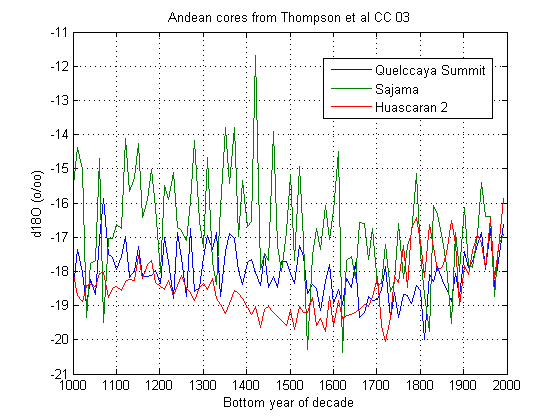
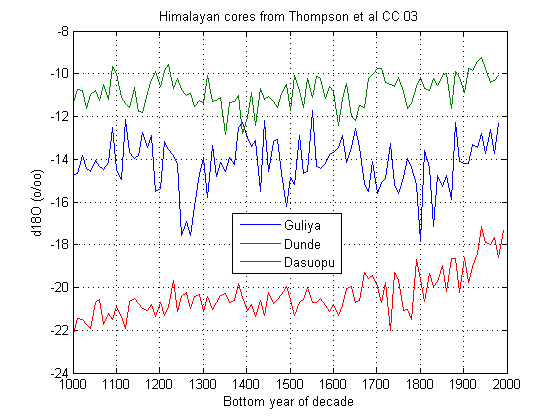
Per the request below by Kenneth Fritsch, Here are graphs of the data on 6 cores back to 1000AD that was used in Thompson’s 2003 Climatic Change article. The newly archived Puruogangri data was used in the PNAS 2006 7-core index that goes back to 0AD, but not in the CC index.

Andean d18O

(Click on image for larger view.)

These graphs are from my paper “Posterior Confidence Intervals in Linear Calibration Problems: Calibrating the Thompson Ice Core Index,” which was discussed in my earlier CA post, “Calibrating ‘Dr. Thompson’s Thermometer'”.

Update 4/29:
Here are Ken’s plots of the new Puruogangri Core 1 and 2 data:

Puruogangri 1 and 2 by Ken Fritsch
While Core 2 is rather flat, Core 1 shows a Current Warm Period, but also suggests a Medieval Cool Period, preceded by a Dark Ages Warm Period. It would have been useful if Thompson had provided a concordance of inferred age versus depth so that the dating assumptions could be reviewed.

Update 5/2
Ken has also plotted for comparison the data from Quelccaya Core 1 and Summit Core, as shown below:
Quelccaya 1 & Summit from Ken Fritsch
The d18O readings from the two Quelccaya cores clearly tell a more coherent story than the two cores from Puruogangri shown above. Their average (as used in MBH99) would presumably have less noise than either series by itself (as in Thompson’s CC03 article).

Both cores also show the attenuation of noise before 1000 AD that characterizes Core 1. This leads me to suspect that the H2O molecules may be able to migrate slowly through the ice. In the later layers this doesn’t make much difference, but in the earlier layers, which are both thinner and have been around longer, it may be causing differences in d18O to average out, creating the appearance of flatter temperatures than really occurred.

Also, if H2O molecules can migrate slowly through ice, it would be interesting to know whether CO2 can also be absorbed from air bubbles into ice, given enough time. This would greatly distort estimates of atmospheric CO2 from ice core records if true.

Washington Post on the Mann FOIA Case

The Northern Virginia reporter for the Washington Post discusses the current state of the ATI FOIA case here.

Lat fall, Mann decided that the University of Virginia was not protecting his interests vigorously enough and moved to be added as a party to the case. Subsequently, the university sent the dossier to Mann, who is no longer an employee.

ATI has applied for the documents provided to Mann, arguing that they can’t give the documents out selectively, citing a 1983 precedent. Several leading Virginia FOIA experts told the Washington Post that ATI has a good argument.

UVA lawyers defended the selective disclosure saying that Mann was “not an adverse party essentially” and, using a not entirely apt phrase, explained that they were “sharing information with a teammate as opposed to the other side”. Ironically, Mann originally asked to be a separate party to the litigation because he felt that “his interest is not currently being adequately protected” – a position that seems inconsistent with UVA’s present position that they are “teammates”.

In addition, ATI has applied to depose Mann on his affidavit, a pretty standard aspect to civil cases. Mann has argued that he should not have to be deposed, with his main argument being (more or less) that ATI are bad people, a perspective frequently held by parties in civil litigation, but not relevant to mundane procedures like depositions.

Mann called ATI’s argument “disingenous”. Mann contradicted the FOIA experts interviewed by the Washington Post:

I’m a bit surprised that anyone professing to be familiar with the law would believe that [ATI’s] argument has any merit at all,”

Vignettes before MM2003

Prior to the publication of McIntyre and McKitrick (2003), there are two references to me in the Climategate 2 dossier.
June 2003
In June 2003, Timothy Carter, a Climate Research editor then embroiled in the Soon-Baliunas dispute, sent Jones (CG2 – 2064) a copy of my June 15, 2003 post at a climate chat group on different versions of the Tornetrask (“Fennoscandia”) chronology, noting, in particular, the Tornetrask chronology then in use in the reconstructions contained a material “fudge” (my term; “bodge” is the CRU term) that (in my words) “hardly seems like a justifiable statistical procedure”. Jones replied:

Tim,
Thanks for this. I’ve been in touch with this guy (Steve McIntyre) before. I think he works in the US. He asked me a few things about the instrumental data, then more, then more and asked for more data. I eventually gave up but he is quite able.
The Finn is Timo Hameranta (or something like that) and is right of right field!
Cheers, Phil

My records of the correspondence are quite different, but that’s another story.

Oct 19-20, 2003

CG2 (1566) also contains a discussion among Mann and the inner team that sheds an interesting light on some long-standing disinformation disseminated by Mann at the time of the publication of MM2003 (which was released one week later.)

On October 17, Bradley, Hughes and Diaz had published a sort of response to Soon and Baliunas (2003). They selected 21 series with properties that by that time were well-known (Yamal, Mann’s PC1, Thompson’s tropical ice cores, etc.) and asserted that a majority had modern “warmth” exceeding levels in the MWP. (Since the properties of the selected series were known in advance of their selection, it was hardly surprising that Bradley, Hughes and Diaz would pick ones where the modern warm period exceeded the medieval warm period, but, again, that is a different story.)

I commented at Timo Hameranta’s chat group as follows:

[Quoting from Bradley et al 2003] Since Lamb’s analysis, many new paleotemperature series have been produced. However, well-calibrated data sets with decadal or higher resolution are still only available for a few dozen locations (see the figure).

A few points:

1)the selection of datasets in these little data-mining exercises always seems arbitrary to me. It’s hard to know how these datasets were selected based on the assertion above.

2) the use of digitally unpublished data is highly frustrating. Of the 23 datsets referred to here, I can only locate 7 at the World Data Center for Paleoclimatology. http://www.ngdc.noaa.gov/paleo/ . Some of the worst offenders in this respect include Mosley-Thompson, Cook, Hughes and Briffa.

3) I looked at series 13, the China speleotherm which I haven’t looked at before and which is at WDCP. The start date is shown incorrectly in this article (the series begins in -665. The data is transformed (in the original article) to remove a “trend” and transformed again to estimate “temperature”. On the actual data, values in early periods are higher than 20th century values. Only after 2 transformations do high 20th century values emerge.

I followed up by writing to the criticized authors, receiving a response only from Cook who affirmed his intention to archive the then recent Oroko data. My initiative also resulted in Konrad Hughen archiving his data. I reported on this initiative a few days later, exempting Cook (who is consistently the most “scientific” of the Climategate correspondents) from my previous criticism. (Many of these series have subsequently become available, in part, because of my criticism of practices in the field.)

Either Mann was monitoring Hameranta’s chat group (unsurprising given his paranoia about “skeptics”) or my comment was passed to him. In any event, on October 19, Mann alerted Jones, Briffa, Bradley, Hughes, Diaz and Rutherford to “McIntyre”. Mann characterized me as “yet another shill for industry”, one who had made “scurrilous” criticisms of the recent Bradley paper.

FYI–thought you guys should have this (below). This guy “McIntyre” appears to be yet another shill for industry–he appears to be the one who forwarded the the scurrilous “climateskeptic” criticisms of the recent Bradley et al Science paper.

Precisely what was “scurrilous” about my observations about the Bradley paper remains unclear to me. Other than, perhaps, the temerity of daring to criticize Bradley. Mann’s email to the others also included our Sept 25, 2003 correspondence, in which I had sent him the file to which I had been directed at his website (pcproxy.txt) as being the proxy data used in MBH98, asking him to verify that this was the version that had been used in the paper. Mann had blown off my request and in his Oct 19 email to Jones and Briffa, notified them that he had done so.

An interesting passing comment in the email is Mann’s observation that I had “been trying to break into” their server. (Only two weeks later, a different version of Mann’s proxy data was made public. Mann claimed that it had been “publicly available” all the time, but Mann’s comment here clearly shows the opposite.)

Here is an email I sent him a few weeks ago in response to an inquiry. It appears, by the way, that he has been trying to break into our machine (“multiproxy”). Obviously, this character is looking for any little thing he can get ahold of. The irony here, of course, is that simple composites of proxy records (e.g. Bradley and Jones; Mann and Jones, etc) give very similar results to the pattern reconstruction approaches (Mann et al EOF approach, Rutherford et al RegEM approach), so anyone looking to criticize the basic NH temperature history based on details of e.g. the Mann et al ’98 methodology are misguided in their efforts…

The best that can be done is to ignore their desperate emails and, if they manage to slip something into the peer-reviewed literature, as in the case of Soon & Baliunas, deal w/ it as we did in that case–i.e., the Eos response to Soon et al—they were stung badly by that, and the bad press that followed.For those of you who haven’t seen it, I’m forwarding an interesting email exchange from John Holdren of Harvard that I got the other day. He summarized the whole thing very nicely, form an independent perspective…
Cheers,
mike
p.s. I’m setting up my email server so that it automatically rejects emails from the “usual suspects”. You might want to do the same. As they increasingly get automatic reject messages from the scientists, they’ll start to get the picture…

Date: Thu, 25 Sep 2003 18:53:33 -0400
To: “Steve McIntyre”
From: “Michael E. Mann”
Subject: Re: MBH98
Bcc: Scott Rutherford , mann@virginia.edu
Dear Mr. McIntyre,
A few of the series terminate prior to the nominal 1980 termination date of the
calibration period (the earliest such instance, as you note, is 1971). In such cases, the data were continued to the 1980 boundary by persistence of the final available value. These details in fact, were provided in the supplementary information that accompanied the Nature article. That information is available here (see first paragraph):
[1]ftp://eclogite.geo.umass.edu/pub/mann/ONLINE-PREPRINTS/MultiProxy/data-supp.html
and here:
[2]http://www.ngdc.noaa.gov/paleo/ei/data_supp.html

The results, incidentally, are insensitive to this step; essentially the same
reconstruction is achieved if a calibration period terminating in 1970 (prior to the termination of any of the proxy series) was used instead.

Owing to numerous demands on my time, I will not be able to respond to further
inquiries. Other researchers have successfully implemented our methodology based on the information provided in our articles [see e.g. Zorita, E., F. Gonzalez-Rouco, and S. Legutke, Testing the Mann et al. (1998) approach to paleoclimate reconstructions in the context of a 1000-yr control simulation with the ECHO-G Coupled Climate Model, J. Climate, 16, 1378-1390, 2003.]. I trust, therefore, that you will find (as in this case) that all necessary details are provided in the papers we have published or the supplementary
information links provided by those papers.

Best of luck with your work.
Sincerely,
Michael E. Mann

At 05:28 PM 9/25/2003 -0400, Steve McIntyre wrote:
Dear Prof Mann,
Here is the pcproxy.txt file sent to me last April by Scott Rutherford at your
direction. It contains some missing data after 1971. Your 1998 paper does not describe how missing data in this period is treated and I wanted to verify that it is the correct file.

How did you handle missing data in this period? In earlier periods, it looks like you changed the roster of proxies in each of the periods described in the Supplementary Information using only proxies available throughout the entire period.

I have obtained quite close replication of the rpc1 in the 20th century by calculating coefficients for the proxies and then calculating the rpc’s using the minimization procedures described in MBH98 and the selection of PCs in the Supplementary Information. The reconstruction is less close in earlier periods. I also don’t understand the reasoning for reducing the roster of eigenvectors in earlier periods. The description in MBH98 was necessarily
very terse and is still very terse in the Supplementary Information; is there any more detailed description of the reconstruction methodology to help me resolve this?

Thank you for your attention.
Yours truly,
Steve McIntyre,
Toronto, Canada

Jones replied to the group, mentioning that he had sent me “some station temperature data in the past”. (This was an earlier version of the station data that Jones subsequently claimed to be top secret.) Jones sneered at the naivete of my criticisms of non-archiving, saying that there were many authors far worse than the ones that I had criticized. (Perhaps so, but they weren’t cited in the Bradley et al paper.)

Dear All,
I’ve had several emails from Steve McIntyre. He comes across in these as friendly, but then asks for more and more. I have sent him some station temperature data in the past, but eventually had to stop replying to me. Last time he emailed me directly was in relation to the Mann/Jones GRL paper. That time he wanted the series he used. I suspect that he is the person who sent the email around about only 7 of the 23 series used by Ray et al. being in WDC-Paleo. I told him then that he needs to get in contact with the relevant paleo people. It seems only Mike, Ray and me got this email from Timo, so I’ll forward it.

He names the worst offenders (ie those not putting data on WDC-Paleo) as being Cook, Mosley-Thompson, Hughes and Briffa !! He clearly should go to a few paleo meetings to find out what is really out there. Last week I saw the Patzold Bermuda coral record again. It is now 1000 years long and all there is an unwritten paper !

The second email I’m forwarding is one from Bill Kininmonth. I’ve met Bill several times at WMO meetings and in Australia. Bill has retired now. When I knew him he knew very little about paleo. I wouldn’t bother replying, unless you want to go into chapter and verse and don’t think through Timo. I would like to believe Bill would be receptive, but it would take time. You could suggest, Ray, he reads your book rather than Lamb’s, but from his tone that might not go down too well ! Both Hubert’s books in the early 1990s are basically updates of his 1974/77 books, with more references and in a chattier style.

Cheers, Phil

It’s interesting to see that Mann, who at that time knew nothing about me, was nonetheless quick to portray me as a “shill” and had recommended strategies for rejecting emails.

An unusual acknowledgement within the academic world

Dr UK writes in about an interesting article about ad hominems in the Climategate emails

Ad hominem arguments in the service of boundary work among climate scientists
By Lawrence Souder, Furrah Qureshi

In their conclusions, Souder and Qureshi contrast the behaviour of climate scientists revealed in the Climategate emails with that of gravity wave scientists studied by H. M. Collins:

In his ethnography of gravity wave scientists, Collins fantasized: “[S]cience done with real integrity can provide a model for how we should live and how we should judge.” He makes this claim not because he finds perfection in the practice of science but because he found practitioners of science in a community who openly revealed their imperfections. This community, he boasted, gave him virtually complete access to their work. On account of this transparency he felt he could trust them implicitly.

I found the Souder and Qureshi paper very interesting. It analyses (in a qualitative way) the different forms of ad hominem attacks found in Climategate emails. It is getting short shrift in the comments at Bishop Hill, and indeed contains some factual errors and misunderstandings. But as commenter The Leopard in the Basement puts it, if one gets past the socio-speak and the references to ‘deniers’:

“I’m pretty sure the Team won’t like this one bit if they ever saw it it.”

Some factual errors in the article e.g. Real Climate was started before Climate Audit, but an unusual acknowledgement within the academic world.

Jolis Reviews Mann

Anne Jolis of WSJ has a sensible review of Mann’s book here. Also an online video here.

She aptly refers to Mann the climate warrior as a “climate kamikaze”. She neatly summarizes the book as follows:

But rather than a chronicle of research and discovery, it’s a score-settling with anyone who has ever doubted his integrity or work: free-market think tanks, industrialists, “scientists for hire,” “the corruptive influence of industry,” the “uninformed” media and public. So, a long list.

Very much so. Mann’s score-settling includes a re-litigation of even the smallest point, conceding nothing. Jolis acutely observes:

The trouble, as Mr. Mann sees it, is that while his own errors have been honest and minor, his detractors’ amount to “disinformation.”

Jolis quotes Mann:

“Given the complexities,” he writes, “it’s easy enough to make mistakes. For those with an agenda, it is even easier to overlook them or, worse, exploit them intentionally.”

On this point, reasonable people can agree.

Jolis acidly calls Mann out on his own tactics:

Yet for all his caviling about “smear campaigns,” “conspiracy theorists” and “character assassination,” Mr. Mann is happy to employ similar tactics against his opponents.

Give the review a read.

P.S. I’ve read the book. Responding to all its disinformation is like getting a root canal without anaesthetic. I’m glad that Brandon Shollenberger has considered some of the points, but, even with the considerable effort that he’s made, he’s only scratched the surface of the disinformation. It amazes me that the climate “community”, which one presumes as having some residual scientific standards, not only takes no offence at Mann’s disinformation, but even embraces it.

Gleick and the HP “Pretexting” Scandal

In 2006-7, officers and/or agents of Hewlett Packard were separately charged under California and federal law for their role in a “pretexting” scandal, a scandal in which an investigator impersonated HP directors and reporters in order to establish responsiblity for leaks of non-public information that appeared to originate from company directors.

Gleick’s impersonation of a Heartland director was a form of “pretexting”, though his alleged forgery and public dissemination of documents go well beyond the HP incident. On the other hand, Gleick’s fraud did not involve public utility records or use U.S. federal identification numbers; as a result, some counts in the HP case do not apply to Gleick, though most do (plus some others).

Most of the limited discussion of Gleick’s conduct has been based on federal law, but state criminal law is very much involved. Hewlett Packard is based in San Francisco and is subject to the same state law as Gleick’s Pacific Institute, located across the bay. In addition, identity theft offences can be charged in the state of the person impersonated.

Once the HP pretexting facts became public, state and federal investigations were quickly launched (as well as congressional hearings.) The dilatory response of authorities in the Gleick case stands in remarkable contrast. Continue reading