IPCC AR5 (First Draft) cited Gergis et al as follows:
New paleo records from Australasia provide evidence of MCA warming around 1250–1330 CE, [my bold] somewhat later than maximum medieval warmth described from many Northern Hemisphere regions (Gergis et al., submitted). Following peak medieval warmth in the early 1300s, a cooling trend reaching a temperature anomaly of approximately 0.5 ± 0.18°C below the 1961–1990 CE climatology during the peak of the LIA, 1830–1859 CE (Gergis et al., submitted).
In addition, the Gergis reconstruction was one of a number of regional reconstructions compared to model simulations.
The “New” Paleo Records
What are the “new paleo records from Australasia” that shed this new light on the medieval period?
Gergis et al has only two proxies in the period 1250-1318: tree ring series from Tasmania and Oroko Swamp, NZ, both from Ed Cook. Neither of them are “new’. Nor is a third long proxy, Law Dome O18 (screened out by Gergis.)
The “New” Gergis Proxies in IPCC AR4
Not only are the “new” Gergis proxies not new; they were prominently displayed in the AR4 section on SH proxies. Indeed they are the only two long proxies so displayed. The commentary in AR4 is as follows:
The paucity of SH proxy data also means that uncertainties associated with hemispheric temperature estimates are much greater than for the NH, and it is more appropriate at this time to consider the evidence in terms of limited regional indicators of temperature change (Figure 6.12).
The long-term oscillations in warm-season temperatures shown in a tree ring reconstruction for Tasmania (Cook et al., 2000) suggest that the last 30 years was the warmest multidecadal period in the last 1 kyr, but only by a marginal degree. Conditions were generally warm over a longer period from 1300 to 1500 (Figure 6.12). Another tree ring reconstruction, of austral summer temperatures based on data from South Island, New Zealand, spans the past 1.1 kyr and is the longest yet produced for the region (Cook et al., 2002a).
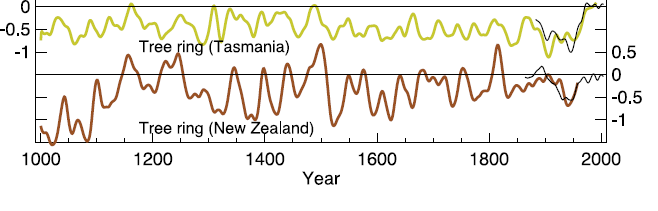
Figure 2. Excerpt from IPCC AR4 Figure 6.11, showing Tasmania and Oroko NZ tree ring chronologies.
The two long series illustrated in AR4 come from the same two sites as the two long Gergis series.
In fact, the Gergis version of Cook’s Tasmania series appears to be identical to the version used by IPCC, as shown in the panel below, where the Gergis versions is overprinted onto the IPCC graphic (rescaling by eye). It appears that Gergis used a newer and somewhat different version of Cook’s Oroko Swamp series, but the differences are not material other than Gergis has values post-1957, while AR4 didn’t. The original article says that logging impacted post-1957 growth; Gergis says that her post-1957 have been adjusted for post-1957 logging (citing a pers comm from Cook), but the adjustment itself is not shown or discussed in the referenced artice.)
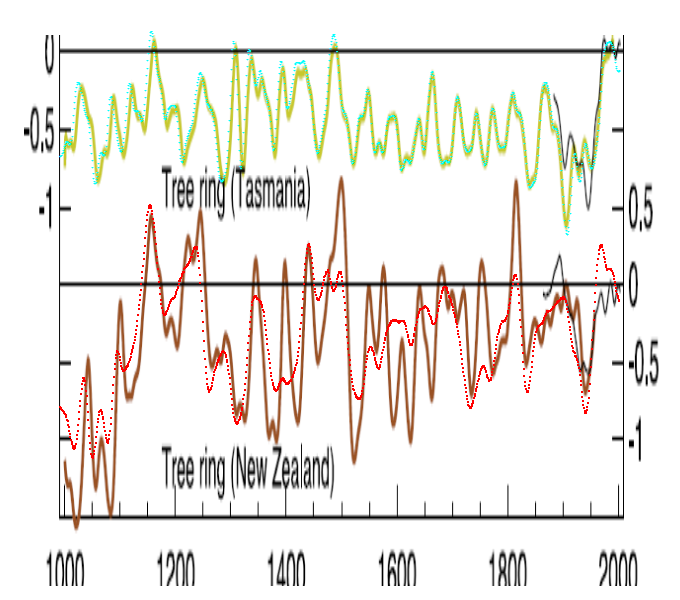
Figure 3. IPCC Figure with Gergis series overprinted (rescaled by eye). Top – Tasmania: Gergis overlay in cyan is indistinguishable; bottom Oroko NZ – overlay in red.
Thus, the statement in AR5 that the Gergis results for the medieval period come from “new paleo records” is untrue. I wonder if reviewers picked this up.
Mann and Jones 2003
IPCC AR4 referred to Mann and Jones 2003, which included a SH reconstruction, as a primary SH reference, noting that they used “only three series”.
There are markedly fewer well-dated proxy records for the SH compared to the NH (Figure 6.11), and consequently little evidence of how large-scale average surface temperatures have changed over the past few thousand years. Mann and Jones (2003) used only three series to represent annual mean SH temperature change over the last 1.5 kyr.
Remarkably, and I hadn’t noticed this until just now, IPCC AR4 didn’t show the Mann and Jones SH reconstruction, for reasons that will become clear below.
Mann and Jones 2003 also screened SH proxies, but with interestingly different results than Gergis. They started with 5 long proxies: Tasmania tree rings, Oroko, Law Dome plus two South American proxies – Quelccaya O18 and a Chilean tree ring series. Whereas Gergis rejected Law Dome and kept Oroko, the screening procedure of Mann and Jones did the opposite: it rejected Oroko and kept Law Dome. Their screening was based on decadal correlation to local instrumental temperature. They reported that Law Dome had a (decadal) correlation of 0.76 to instrumental temperature, while Oroko had negative correlation (-0.25). These results were plotted on Figure 1 of Mann and Jones 2003, shown below;
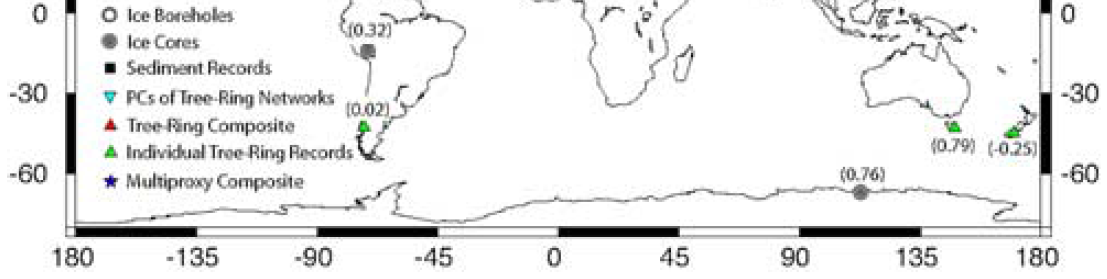
Excerpt from Mann and Jones 2003 Figure 1, showing SH proxies. Correlations to local temperature also shown (decadally smoothed comparison)
Reconstructions – Law Dome vs Oroko
Using Law Dome O18 rather than Oroko led Mann and Jones to SH temperature reconstruction that didn’t have a Hockey Stick, as shown in the excerpt from Mann and Jones 2003 shown below.
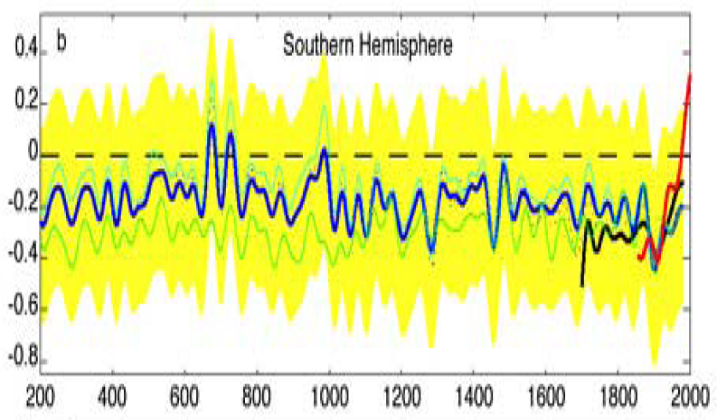
Figure . SH reconstruction from Mann and Jones 2003 Figure 2. Caption: “b) SH reconstruction based on 2 indicators back tovAD 200 (thick blue) and 3 indicators back to AD 470 (blue- dotted). Other weighting schemes shown using color convention of (a) [areal and hemispheric correlation weighting (green), areal weighting only (magenta), local-correlation weighting only (cyan)] Shown for comparison is multi-century composite of previous reconstructions discussed in text (thick black).
This reconstruction wasn’t illustrated in AR4. Instead, IPCC commented on the reconstruction as follows:
The recent proxy-based temperature estimates, up to the end of the reconstruction in 1980, do not capture the full magnitude of the warming seen in the instrumental temperature record. Earlier periods, around AD 700 and 1000, are reconstructed as warmer than the estimated level in the 20th century, and may have been as warm as the measured values in the last 20 years.
Now compare the Mann and Jones reconstruction with the Gergis reconstruction which is shown in AR5 (First Draft) as part of its panel graphic comparing regional reconstructions to models, as shown below. Both have rather small amplitudes; however, the Gergis reconstruction has a small Hockey Stick.
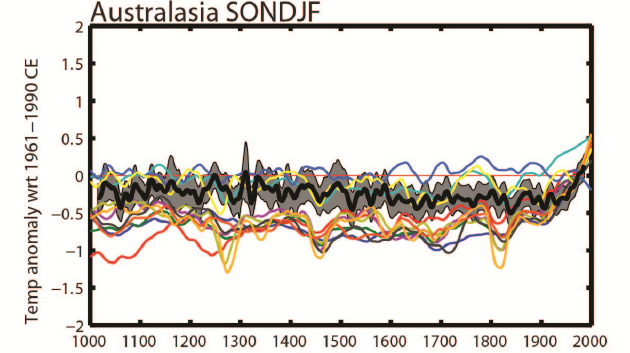
Figure 1. Excerpt from IPCC AR5 Figure 5.9. Caption: “Figure 5.9: Regional temperature reconstructions, comparison with model simulations over the past millennium (1001–1999 CE)…”
Law Dome
Much of the difference between the Mann and Jones 2003 and the Gergis reconstruction arises merely from the presence/absence of the Law Dome O18 series, as can be seen by comparing the Law Dome O18 series (shown below) with the Mann and Jones 2003 SH reconstruction.
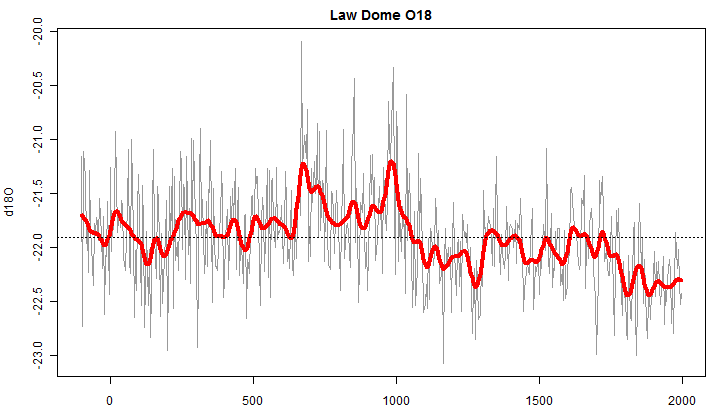
Figure . Law Dome O18 record. Plotted from LD2.1yyr data set sent by email by Tas van Ommen on 2006-03-14.
If you compare the Law Dome series shown here with the Mann and Jones 2003 SH reconstruction, you can see how the Law Dome series directly affects its results. And thus why screening Law Dome out and replacing it with Oroko leads to a very different result. Although Gergis carried out an elaborate ensemble of 3000 permutations, none of these permutations included Law Dome.
In passing, I’ll remind readers of my efforts as an IPCC AR4 reviewer to get the IPCC authors to show the Law Dome data (which I’d received in March 2006 just before review comments) – see CA post here.
CRU’s Tim Osborn led the movement against showing the data. He wrote (709. 1153233036.txt) presenting the problem:
(1) Jones/Mann showed (and Mann/Jones used in their reconstruction) an isotope record from Law Dome that is probably O18 (they say “oxygen isotopes”). This has a “cold” present-day and “warm” MWP (indeed relatively “warm” throughout the 1000-1750 period). The review comments from sceptics wanted us to show this for obvious reasons.
Osborn and the IPCC authors wanted not to show it also apparently “for obvious reasons”, a picture being worth a thousand words.
Law Dome also plays an interesting role in Mann et al 2008 – one that I hadnt appreciated before, but will re-visit. Mann et al 2008 used Law Dome O18, but did not use the long Law Dome O18 series that he had used in Mann and Jones 2003 (with its inconvenient MWP) – which would have had an impact on the sparse SH network. Instead Mann’s version of Law Dome O18 went only from 1761-1970 (!) It is a truncation of an obsolete version. I’ll discuss this backstory in another post as well.
The above graphic shows a 2003 version of Law Dome O18 (which Tas van Ommen sent me in 2006.) Despite the overwhelming importance of O18 as a paleoclimate proxy and the importance of Law Dome as a high-accumulation (high-resolution) core, the Law Dome O18 record shown here has never been archived (or even published by the authors.) The authors have been unfortunately diverted by other projects. [Note: June 4 – the Law Dome 2.1kyr O18 series does not turn up on a search of the Australian Antarctic Data Center under “law dome”. However, the existence of the series is reported at the NASA Global Change Directory, which contains a link to a webpage
which states “The file you have tried to download is not yet available for public access. Contact the Australian Antarctic Data Centre, using the request form, for further details.” Van Ommen says by email that he has not received requests for the data, but will reconsider the matter.]
I will discuss the puzzling history of this important proxy in a follow-up post.





 Climate Audit