Hide the Decline: Sciencemag

Science published one of the first spaghetti graphs (in Briffa and Osborn 1999 here) as part of an invited comment on the Mann et al 1000-year reconstruction, then hot off the press with its supposed proof that 1998 was the “warmest year” of the millennium. Jones et al 1999, discussed recently here, contained a different spaghetti graph. Continue reading

New Light on “Hide the Decline”

In today’s post, I’m going to discuss a previously undiscussed example of “Hide the Decline”, one that precedes Briffa and Osborn (Science 1999), the earliest example discussed so far. CRU did not report it in their submission to Muir Russell.

Jones et al 1999 (Rev Geophys) was published in May 1999, the same month as Briffa and Osborn (Science 1999). However, the latter was a comment with a shorter peer review process, placing Jones et al 1999 at least several months earlier in the queue. Its section 5.6 discussed proxy reconstructions, with its Figure 6 being a spaghetti graph, consisting of the same elements as the later IPCC TAR spaghetti graph: CRU plus the Mann, Jones and Briffa reconstructions. In this case, they used the Briffa et al 1998 (Nature) reconstruction – IPCC TAR used the then unpublished version from Briffa et al 2001. The Briffa series has been truncated in the mid-20th century.
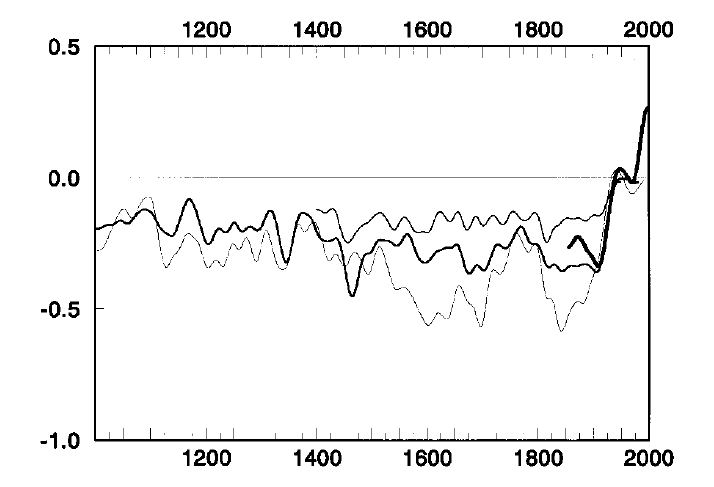

Original Caption: Figure 6. Northern Hemisphere temperature reconstructions from paleoclimatic sources. The three series are Mann et al. [1998, 1999] (thick), Briffa et al. [1998] (medium) and Jones et al. [1998] (thin). All three annually resolved reconstructions have been smoothed with a 50-year Gaussian filter. The fourth (thickest) line is the short annual instrumental record also smoothed in a similar manner. All series are plotted as departures from the 1961–1990 average.

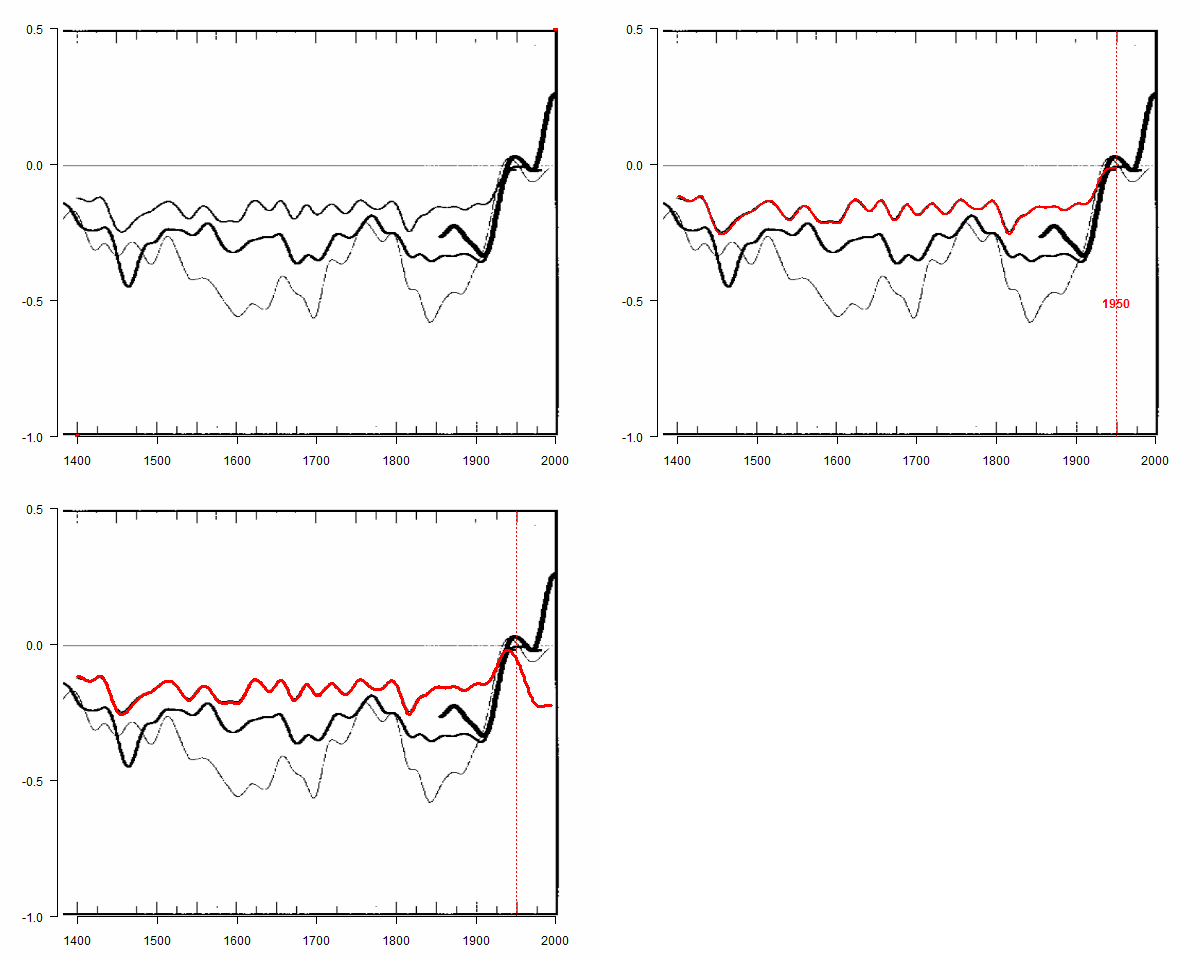
The following graph is an emulation of Jones et al 1999 Figure 6, applying the adjustments (re-scaling and re-centering) of Tim Osborn’s March 1999 program osborn-tree5/pl_mannbriffajones.prom showing the Briffa version in orange. The versions plotted here clearly match the ones in the Jones et al 1999 figure – except for the deletion of Briffa values from 1960 or so on.
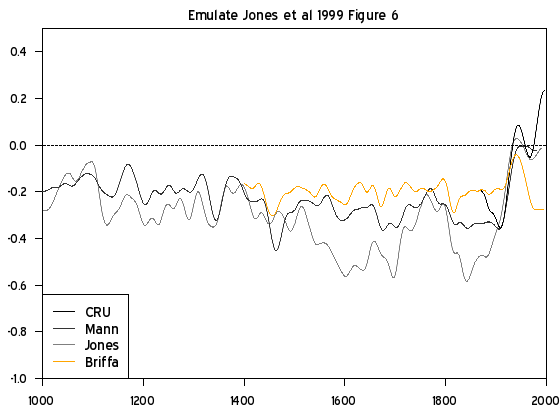

Caption: Emulation of Jones et al 199 Figure 6.

CRU Submission to Muir Russell
In their submission to Muir Russell (page 38), CRU described the “hide the decline” methodology used in IPCC and most other publications (as opposed to the WMO splice) as follows:

(b) Depict the reconstruction over the period for which it can be considered to be a reliable estimate of past temperature variations (typically we have curtailed it in 1960, considering the post-1960 data to be a poor representation of temperature) and overlay separately the appropriate instrumental temperature observations.

They purported to justify the deletion of adverse data (“hide the decline”) as follows:

Presentation type (b) has typically been selected for publications whose purpose is to convey the available range of evidence for past temperature variations. In this situation, it is arguably reasonable to show only data that are considered to provide some information about temperature variations. In the same way that the early parts of a reconstruction might not be shown if they were considered to be unreliable (due, for example, to unacceptably low replication), the post-1960 values are also excluded. This avoids the presentation of values that are known to be unrepresentative of the real temperatures. Of course, the recent divergence in these data will be less clear if post-1960s values are excluded and that represents a potential disadvantage of this exclusion if this divergence is important for assessing confidence in the earlier reconstructed values. Section 1.2 outlines various situations where this is or is not a concern. If this is a concern, then to avoid the exclusion of the recent period resulting in an overly confident impression being given of the accuracy to which past temperatures can be reconstructed, we include appropriate caveats and references to the articles where the limitations are explored in greater detail. Examples of this type of presentation include Plate 3 of Briffa et al. (2001); Figure 2A of Jones et al. (2001); Figure 8 of Briffa et al. (2004); Figure 6.10b of Jansen et al. (2007); and Figure 5b of Hegerl et al. (2007).

The Muir Russell “inquiry”, with their typical negligence, failed to address this “explanation”, which, in Graham Stringer’s words, is “difficult to parody”. Obviously the divergence is “less clear” if the adverse data is deleted.

CRU stated that “If this is a concern, then to avoid the exclusion of the recent period resulting in an overly confident impression being given of the accuracy to which past temperatures can be reconstructed, we include appropriate caveats and references to the articles where the limitations are explored in greater detail.”

This assertion is a fabrication. In virtually all cases in “presentation (b)” style, they included no caveats whatever. To date, I have not identified a single publication in which they explicitly state that they have deleted post-1960 data and why. In some cases, the caption says that the Briffa data is from 1402-1960, but in such cases, there is no explicit statement that data was deleted and why. In other cases, there is not even a hint that the data has been chopped back to 1960.

Jones et al 1999

Jones et al 1999 is a pernicious example where there is not even a hint that data has been deleted. Worse, the running commentary all too often depends on the deletion of the adverse data.

Over the last few years, a number of compilations of proxy evidence have been assembled following the pioneering work of Bradley and Jones [1993]. In Figure 6 we show three recent reconstructions of Northern Hemisphere temperature for part of the last millennium. The reconstructions are all of different seasons (annual [Mann et al., 1998, 1999] and two definitions of summer [Briffa et al., 1998; Jones et al., 1998]). The short instrumental record on an annual basis is superimposed.

Agreement with the annual instrumental record is poorest during the nineteenth century, partly because of the different seasons (summer in two of the series) used. The instrumental record also rises considerably in the last 2 decades, and this cannot be seen in the multiproxy series because they end before the early 1980s, as some of the proxy records were collected during these years. The most striking feature of the multiproxy averages is the warming over the twentieth century, for both its magnitude and duration. The twentieth century is the warmest of the millennium and the warming during it is unprecedented (see also discussion by Mann et al. [1998, 1999] and Jones et al. [1998]). The four recent years 1990, 1995, 1997, and 1998, the warmest in the instrumental
series, are the warmest since 1400 and probably since 1000. The end of the recent El Nin˜o event (such events tend to warmer temperatures globally) and the greater likelihood of La Nin˜a (which tends to lead to cooler temperatures) as opposed to El Nin˜o conditions during 1999 and 2000 means that 1998 will likely be the warmest year of the millennium. The coolest year of the last 1000 years, based on these proxy records, was 1601.

Neither the caption nor the running text gives any hint that the reconstruction of Briffa et al 1998 (Nature) has been deleted after 1960. Yes, the article cites Briffa et al 1998 – which reports the decline – but Jones et al 1999 contains no “caveats” about the decline or about the deletion of data.

Important comments in the running text on Figure 6 also depend on the deletion of the decline. For example, Jones et al state: “Agreement with the annual instrumental record is poorest during the nineteenth century.” Actually, the worst agreement is between the Briffa decline and the late 20th century temperature increase – but that’s been hidden.

Jones et al say: “The instrumental record also rises considerably in the last 2 decades, and this cannot be seen in the multiproxy series because they end before the early 1980s, as some of the proxy records were collected during these years.” Again, this is completely misleading. The Briffa multiproxy series do not end before the early 1980s because of they were collected during those years, but because the post-1960 was deleted.

Jones et al say: “The most striking feature of the multiproxy averages is the warming over the twentieth century, for both its magnitude and duration.” Again, this statement depends entirely on the deletion of the decline. If the Briffa series were shown, the inconsistency of the Briffa reconstruction with the 20th century temperature history becomes the most striking feature of the graphic – calling the validity of the reconstructions into play.

New Light

In my opinion, locating the earliest known example of “hide the decline’ in Jones et al 1999 (Rev Geophys) places hide the decline in a remarkable new light. I think that it’s fair to say that most of us have assumed that “hide the decline” originated with Mann or Briffa. However, it seems to me that this new evidence suggests that the lead author of Jones et al 1999, Phil Jones himself, may have been responsible for CRU’s decision to hide the decline in the spaghetti graph comparisons – initially Jones et al 1999 Figure 6, later, as we all know, IPCC TAR Fig 2.20.

To my knowledge, “hide the decline”, as a technique, was used in every subsequent spaghetti graph using the Briffa reconstruction except one – the Zero Order Draft of IPCC TAR presented to the Lead Authors in Arusha in September 1999. This spaghetti graph – which didn’t hide the decline – went over like a lead balloon with IPCC – thus the busy emails of September 1999, which I’ve previously discussed. The IPCC spaghetti graph in its First Order Draft (October 1999) adopted a hide-the-decline strategy modeled on the techniques “pioneered” in Jones et al 1999 and Briffa and Osborn 1999 (though Mann varied the method somewhat.)

In preparing my emulation of Jones et al 1999, I used the adjustment parameters of Osborn’s program pl_mannbriffajones of March 1999, almost contemporary with the preparation of Jones et al 1999. When one does a cross-chronology of the Climategate programs, there is some further interesting information on the genesis of “hide the decline” that I’ll discuss in another post.

Update Mar 23:
Here is an updated emulation of the Jones et al 1999 spaghetti graph, showing that the hide-the-decline is effective in 1950 (rather than 1960) and that the source information is the 4th column (NHD2) in the Briffa et al 1998 archive.

Figure 2. Excerpt from Jones et al 1999 with annotation.
Graham Stringer Speaks Out

UK MP Graham Stringer has a strongly worded Op Ed here archive (h/t Bishop Hill)

Stringer, who is on the UK Parliamentary Science and Technology Committee, described the Oxburgh “inquiry” as follows:

The Vice Chancellor of the University of East Anglia seemed to share Deer’s desire to get at the truth when he announced an independent review which would “reassess the science and make sure there is nothing wrong”.

Lord Oxburgh who was appointed to chair this panel, disappointed everybody. He explained that the Vice Chancellor was new and did not understand what he had promised. He soon made it clear that he would not reassess the science but he was just going to satisfy himself as to the integrity of the scientists. After a cosy chat with the Climatic Research Unit scientists he decided that they were decent chaps.

Interestingly however following a Freedom of Information Request notes taken by one of the panellists, Professor Kelly from the University of Cambridge, indicated that while there was no “blatant malpractice” it was impossible to show that the Climatic Research Unit scientists had not cherry picked their statistics.

He thought their methodology was “turning centuries of science on its head”. Oxburgh also quietly damned the climate team by saying “it is very surprising that research in an area that depends so heavily on statistical methods has not been carried out in close collaboration with professional statisticians”

This is the equivalent of claiming medical competence whilst operating on a patient without an anaesthetist.

He eviscerates the execrable Muir Russell, describing his report as “almost beyond parody” (almost exactly echoing Clive Crook’s words on the Penn State “inquiry”):

The other review carried out by Sir Muir Russell, a Civil Servant responsible for overseeing the huge over expenditure of the Scottish Parliament building, had even greater resonance with Deer’s concern about the accused investigating themselves. His review was charged with looking at the e-mails themselves. One of the main charges against Professor Jones was that he deleted e-mails that would show he was up to no good scientifically.

In a situation that is almost beyond parody Muir Russell stated that he didn’t ask Jones whether he had deleted the e-mails because they would have had to interview Jones under caution. What was the solution then? The Vice Chancellor asked Jones whether he had deleted the e-mails. This rather negated the purpose of having an independent Inquiry when the only person to ask the crucial question was the Vice Chancellor who saw his prime responsibility to the good name of the University. The accused investigating themselves again.

Stringer concludes:

The release of the unit’s e-mails from the and the accusations that followed demanded independent and objective scrutiny of the science by independent panels. This did not happen.

DOE and Jones’ Delete Request

In considering Phil Jones’ request to delete emails, attention has focussed on this action relative to UK FOI. However, at the time, Phil Jones was funded by the US Department of Energy. Readers may be interested in considering the potential effect.

That Jones was funded by the US Department of Energy has been known for some time, but it’s not something that I’d specifically reflected on in connection with the deletion request.

What brought it to my attention was browsing through the Climategate emails leading up to Jones’ delete request. Only a few emails earlier, also in May 2008, an accountant for the US Department of Energy (the Chicago office of their Office of Science) asked Jones for cost allocations. The memo shows that Jones was being funded by the DOE during the period April-June 2008. In other words, Jones’ delete request was funded by the US Department of Energy.

Here’s the email: Continue reading

More NOAA Disinformation and an Appeal to the UK ICO

On March 9, 2011, NOAA scientist Eugene Wahl claimed that the “emails [he] deleted” were “all” “in the public domain” since the Climategate dossier was released. This is more disinformation from NOAA. “All” of the emails are not in the public domain. Attachments to the deleted emails – including Wahl’s changes to AR4 that are in controversy – remain outside the public domain.

Worse, not only are the attachments not in the public domain, but the University of East Anglia has stated (in recent FOI refusals) that their copies of the attachments to the Wahl-Briffa correspondence have also been destroyed. (This contradicts Vice Chancellor Acton’s testimony to the Parliamentary Committee; the Committee observing with visible exasperation that they found it “unsatisfactory that we are left with a verbal reassurance from the Vice-Chancellor that the e-mails still exist”.)

In addition, if the University of East Anglia is to be believed, Wahl has continued to actively opposed the release of attachments to earlier emails that remain in the possession of the University of East Anglia during his employment at NOAA, most recently in connection with my FOI request of April 2010 (EIR 10-03) for eight documents attached to Climategate emails.

Requests for all but two documents were refused by the UEA. In February 2011, the UK Information Commissioner agreed to consider my appeal of the UEA refusal, the outcome of which is pending. Continue reading

What Did Penn State Know?

In an interview yesterday, Mann told Eli Kintisch of Science (see here) that it has been “known for a year and half” that he forwarded Jones’ delete request to Wahl.

If Mann’s claim is true (and I do not believe it to be true), then this raises serious questions about statements in the Penn State Inquiry Report, authors of which were:

Henry C. Foley, Ph.D., Vice President for Research and Dean of the Graduate School
Alan W. Scaroni, Ph.D., Associate Dean for Graduate Education and Research, College of Earth and Mineral Sciences
Ms. Candice A. Yekel, M.S., CIM, Director, Office for Research Protections, Research Integrity Officer

It’s time to find out whether they knew that Mann had forwarded Jones’ delete request to Wahl, whether they knew that Wahl had thereafter deleted emails as requested and why their Inquiry Report made the findings that they did.

Continue reading

Wahl Transcript Excerpt

From Capitol Hill come excerpted notes from the interview transcript between the NOAA Inspector General and Eugene Wahl. I am advised that it’s not a continuous chain, with some back and forth between the paragraphs excluded. I am advised that the excluded sections, often lengthy, do not place the excerpts in any different light than reading them as presented below.

Neither the Muir Russell nor Oxburgh “inquiries” took transcripts despite requests from the UK Parliamentary COmmittee to do so.

Q. Did you ever receive a request by either Michael Mann or any others to delete any emails?
A. I did receive that email. That’s the last one on your list here. I did receive that.

Q. So, how did you actually come about receiving that? Did you actually just — he just forward the — Michael Mann — and it was Michael Mann I guess?
A. Yes

Q. — That you received the email from?
A. Correct …

A. To my knowledge, I just received a forward from him.

Q. And what were the actions that you took?
A. Well, to the best of my recollection, I did delete the emails.

Q. So, did you find the request unusual, that they were — that the request — that you were being requested to delete such emails?
A. Well, I had never received one like it. In that sense, it was unusual.

Q. I guess if the exchange of comments and your review was appropriate, I guess what I’m just trying to understand why you’d be ask to delete the emails after the fact, at the time that they’re — it appears that the CRU is receiving FOIA requests
A. Yeah. I had no knowledge of anything like that. But that’s what they were — where they were coming from. And so, you’d have to ask Keith Briffa that. I don’t know what was in his mind.

Squash Doubles News :)

And now for something really important 🙂

The new holders of the coveted Canadian squash doubles over-60 championships are Brian Murray and Stephen McIntyre of Toronto defeating John Brazilian and Malcolm Davidson of Boston in the final, held at the Atwater Club in Montreal. Continue reading

IPCC and the East Anglia Refusal

In the University of East Anglia’s recent refusal of David Holland’s FOI request for documents received by IPCC Lead Author Tim Osborn pertaining to the October 2010 IPCC meeting, the University refused many items, stating that they had received “representations from the IPCC itself in which it objected to the release of some of the requested information” and “representations to our institution regarding the release of some the requested information, claiming that the release of the information would adversely affect their [IPCC] interests. They have provided reasons for their position, and where cited, we have accepted those reasons and explanations as justifiable.”

More recently, the Unversity issued a correction letter rescinding, for about half of the refusals, their reliance on IPCC representations about the dire adverse impact, observing that the documents were already public.

The University did not provide copies of the “representations” of the IPCC in which they supposedly objected to the disclosure of documents published on the IPCC website and one cannot help but wonder about what the University actually received from IPCC.

Here’s a quick review. Continue reading

The Muir Russell Budget

In December 2009, Acton sent Muir Russell an email agreeing that Muir Russell would lead the inquiry. The language of the email is not definitive, but gives the impression that a budget of £ 40,000 was contemplated. (Excerpt below, see link for “full” agreement.)

As noted in correspondence on the earlier thread, Acton referred to an email sent earlier that day. David Holland sent a supplementary request for the earlier email (as it pertained to the contract). The University denied that it possessed the email.

Last month, Holland obtained the final cost of the Muir Russell inquiry – nearly £300,000.

While the increase in expenditures is paltry compared to Muir Russell’s oversight of Holyrood construction, which increased 10-fold from £40 million to £414 million, Muir Russell doesn’t seem to have lost his reverse Midas touch.

Muir Russell personally collected the amount that the university seems to have contemplated for the entire inquiry, but, as noted elsewhere, was not sufficiently interested to even attend the only two interviews with Jones and Briffa after the composition of the panel was announced in Feb 2010, leaving the interviews to Geoffrey Boulton, the most controversial participant on the panel.