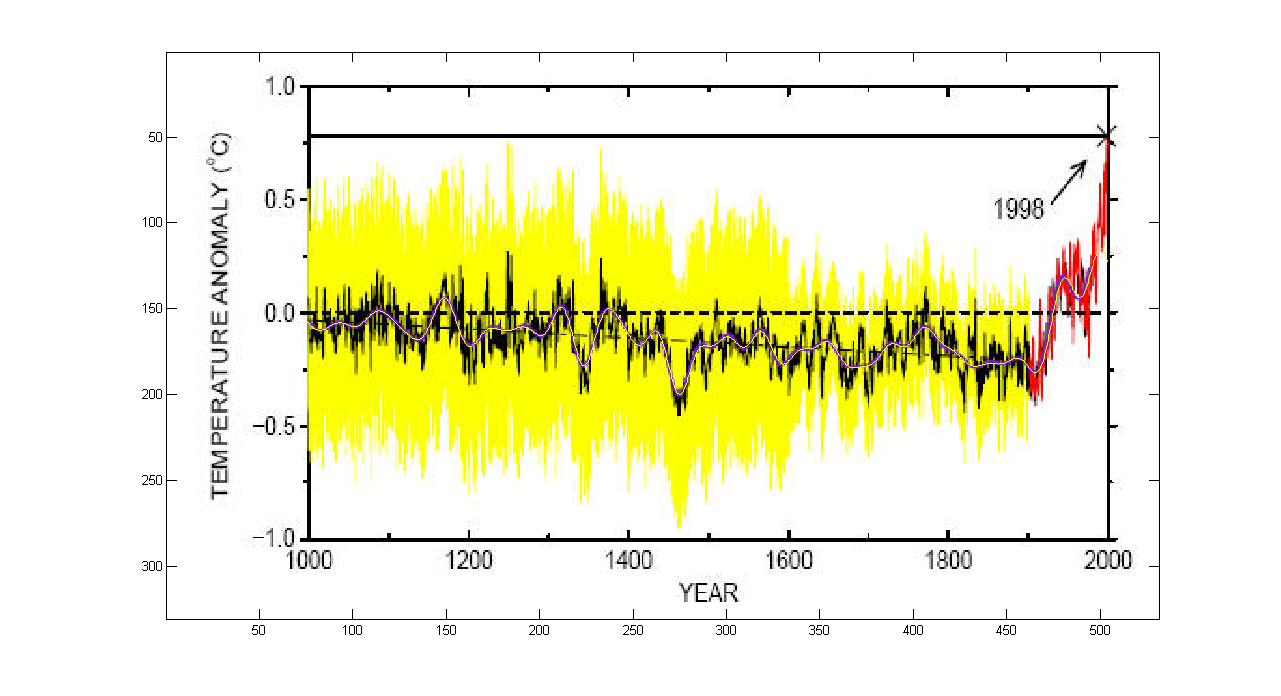
Another “Trick” from the Muir Russell CRU Inquiry

A new controversy involving another “trick” by the Boulton-Russell Inquiry. Today’s post is prompted by a new sentence added to the Inquiry FAQs and an article by Channel Four on the controversial Boulton CV here. As so often, a bit of a backstory. Continue reading

“University ‘tried to mislead MPs on climate change e-mails’”

A savage article in the Times today by Ben Webster about the UEA submission to the UK Parliamentary Inquiry – the letter in which they tried to “trick” the Committee about the contents of the letter from the Information Commissioner. (A “trick”, according to Gavin Schmidt and the Penn State Inquiry, is a “good way” to solve a problem.)

The article – worth reading in full – re-caps correspondence discussed in yesterday’s post on the topic.

The UEA has now posted up all its correspondence.

Webster provides an interesting new statement from Dr Evan Harris, Liberal Democrat member of the Science and Technology Committee:

“It seems unwise, at best, for the University of East Anglia to attempt to portray a letter from the Information Commissioner’s Office in a good light, in evidence to the select committee, because it is inevitable that the Committee will find that letter, and notice any discrepancy.

“It would be a wiser course for the university not to provide any suspicion that they might be seeking to enable the wrong impression to be gained.”

Yup.

McIntyre Submission with Figures

My submission to the UK Parliamentary Committee is here – this version excludes figures. Here is a pdf version with illustrations.

In my situation – which is a little, shall we say, unique- it’s hard to figure out exactly where to start. So I tried to cover topics that I didn’t think anyone else would cover, other than the “trick” where I tried to counter Gavin-esque disinformation.

Update:
I sent the following corrigendum to the Committee responding to an alert comment by reader Tom P:

There was an inconsistency between the caption to Figure 5 and the covering text. The original caption to Figure 5 (which stated “right – varying the Tornetrask and Urals versions to newer versions”) was correct as submitted.
The running text should be changed as follows:

For example, Figure 5 compares the published Briffa (2000) reconstruction (left) with a version derived merely by varying versions of Tornetrask and west Siberia tree ring chronologies (right) substituting the Polar Urals update for Yamal(right). The medieval-modern differential changes with these seemingly inconsequential changes one seemingly inconsequential change of version.

The Trick Timeline

Date: 16 Nov 1999, Phil

I’ve just completed Mike’s Nature trick of adding in the real temps
to each series for the last 20 years (ie from 1981 onwards) amd from
1961 for Keith’s to hide the decline.

Date: 22 Dec 2004, mike


No researchers in this field have ever, to our knowledge, “grafted the thermometer record onto” any reconstruction. It is somewhat disappointing to find this specious claim (which we usually find originating from industry-funded climate disinformation websites) appearing in this forum. Most proxy reconstructions end somewhere around 1980, for the reasons discussed above. Often, as in the comparisons we show on this site, the instrumental record (which extends to present) is shown along with the reconstructions, and clearly distinguished from them (e.g. highlighted in red as here).

Date: 21 Nov 2005, Steve

The MBH versions illustrated also splice reconstruction and instrumental values. Thus, Crowley made two different splices of the temperature record into the proxy record. One splice is made in 1965, with proxy values for the 13-site composite (see below) before 1965 and instrumental values from 1965 to 1998 (with the 11-point smooth version ending in 1993). A second version is spliced in 1870, with proxy values from the 13-site composite before 1870 and instrumental records after wards.

Date: 6 May 2009, UC

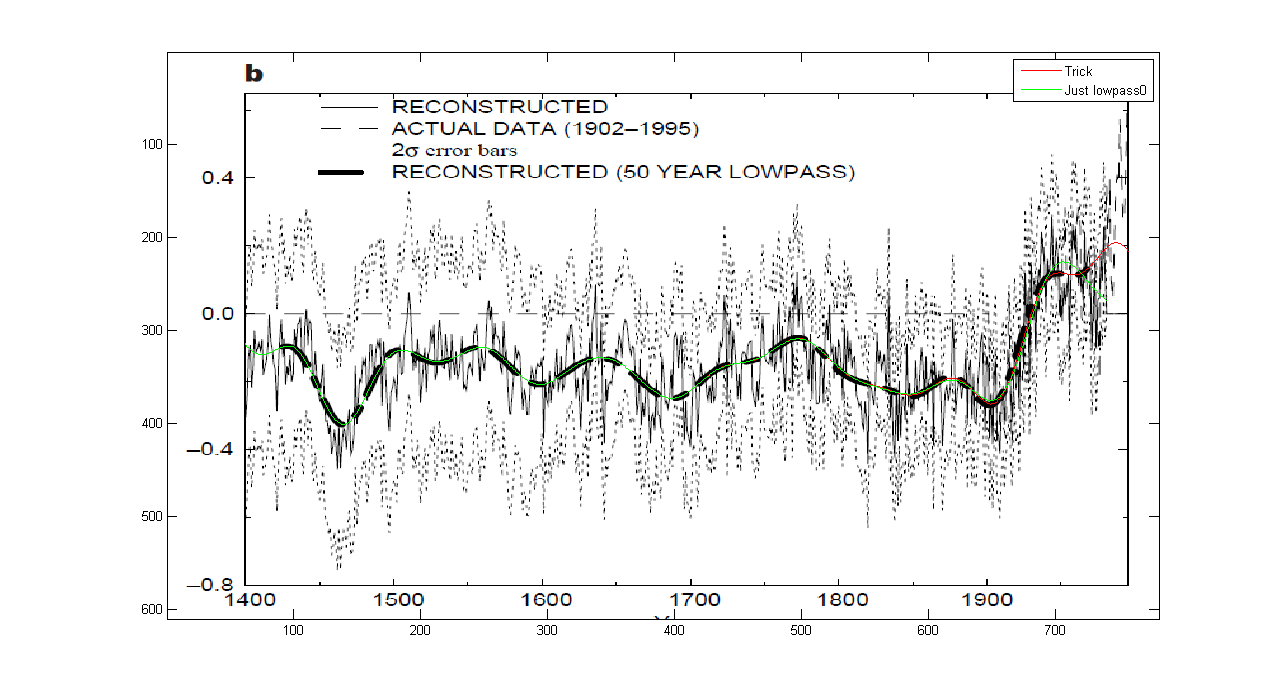
Let’s see; I think this is made by padding with zeros, but 1981-1998 instrumental is grafted onto reconstruction:

(larger image here )

I used Mann’s lowpass.m , modified to pad with zeros instead of mean of the data,

out=lowpass0(data,1/40,0,0);

mbh99smooths

Original CA link

Backup

Date: 20 Nov 2009, UC

“I’ve just completed Mike’s Nature trick of adding in the real temps
to each series for the last 20 years (ie from 1981 onwards) amd from
1961 for Keith’s to hide the decline”

Is this about the MBH99 smooth ?

http://www.climateaudit.org/?p=1553#comment-340175

http://www.climateaudit.org/?p=1553#comment-340207

Date: 20 Nov 2009, gavin

[Response: This has nothing to do with Mann’s Nature article. The 50-year smooth in figure 5b is only of the reconstruction, not the instrumental data. – gavin]

Date: 21 Nov 2009, gavin

And it remains unclear why this was described as Mann’s Nature trick since no such effect is seen in Mike’s paper in any case. – gavin]

Date: 22 Nov 2009, mike

In some earlier work though (Mann et al, 1999), the boundary condition for the smoothed curve (at 1980) was determined by padding with the mean of the subsequent data (taken from the instrumental record).

Date: 24 Nov 2009, CRU

To produce temperature series that were completely up-to-date (i.e. through to 1999) it was necessary to combine the temperature reconstructions with the instrumental record, because the temperature reconstructions from proxy data ended many years earlier whereas the instrumental record is updated every month. The use of the word “trick” was not intended to imply any deception.

Date: 25 Nov 2009, Jean S

UC has corrected me on the fact that adding the instrumental series to the proxy data prior smoothing was used already in MBH98 (Figure 5b), so, unlike I claimed in #66, “Mike’s Nature trick” is NOT a misnomer.

Date: 25 Nov 2009, UC

..and here’s instrumental (81-95)+zero padded Fig 5b smooth (red):

mbh98smooths

Original CA link

Backup

Date: 1 Apr 2010, UC

April Fools, here’s the turn-key(*) code

(*) after you download the two files , http://www.climateaudit.info/wp-content/uploads/2009/11/mbhsmooths1.txt and http://uc00.files.wordpress.com/2010/05/mbh985b.png


Date: Aug 29 2014, Jean S

nails it,

MBH98 has 50-year smoothing with padding of 1981-1995 instrumental. Additionally, the smoothing is cut back 25 samples (half of the “filter length”) from both ends. MBH99 used 40-year filtering with 1981-1997 (not 1998!) instrumental padding. The smooth is cut back 20 samples from the end but not from the beginning.


Institute of Physics Submission

No mincing of words by the Institute of Physics in their submission to the UK Parliamentary Committee.

What are the implications of the disclosures for the integrity of scientific research?

1. The Institute is concerned that, unless the disclosed e-mails are proved to be forgeries or adaptations, worrying implications arise for the integrity of scientific research in this field and for the credibility of the scientific method as practised in this context.

2. The CRU e-mails as published on the internet provide prima facie evidence of determined and co-ordinated refusals to comply with honourable scientific traditions and freedom of information law. The principle that scientists should be willing to expose their ideas and results to independent testing and replication by others, which requires the open exchange of data, procedures and materials, is vital. The lack of compliance has been confirmed by the findings of the Information Commissioner. This extends well beyond the CRU itself – most of the e-mails were exchanged with researchers in a number of other international institutions who are also involved in the formulation of the IPCC’s conclusions on climate change.

3. It is important to recognise that there are two completely different categories of data set that are involved in the CRU e-mail exchanges:

· those compiled from direct instrumental measurements of land and ocean surface temperatures such as the CRU, GISS and NOAA data sets; and

· historic temperature reconstructions from measurements of ‘proxies’, for example, tree-rings.

4. The second category relating to proxy reconstructions are the basis for the conclusion that 20th century warming is unprecedented. Published reconstructions may represent only a part of the raw data available and may be sensitive to the choices made and the statistical techniques used. Different choices, omissions or statistical processes may lead to different conclusions. This possibility was evidently the reason behind some of the (rejected) requests for further information.

5. The e-mails reveal doubts as to the reliability of some of the reconstructions and raise questions as to the way in which they have been represented; for example, the apparent suppression, in graphics widely used by the IPCC, of proxy results for recent decades that do not agree with contemporary instrumental temperature measurements.

6. There is also reason for concern at the intolerance to challenge displayed in the e-mails. This impedes the process of scientific ‘self correction’, which is vital to the integrity of the scientific process as a whole, and not just to the research itself. In that context, those CRU e-mails relating to the peer-review process suggest a need for a review of its adequacy and objectivity as practised in this field and its potential vulnerability to bias or manipulation.

7. Fundamentally, we consider it should be inappropriate for the verification of the integrity of the scientific process to depend on appeals to Freedom of Information legislation. Nevertheless, the right to such appeals has been shown to be necessary. The e-mails illustrate the possibility of networks of like-minded researchers effectively excluding newcomers. Requiring data to be electronically accessible to all, at the time of publication, would remove this possibility.

8. As a step towards restoring confidence in the scientific process and to provide greater transparency in future, the editorial boards of scientific journals should work towards setting down requirements for open electronic data archiving by authors, to coincide with publication. Expert input (from journal boards) would be needed to determine the category of data that would be archived. Much ‘raw’ data requires calibration and processing through interpretive codes at various levels.

9. Where the nature of the study precludes direct replication by experiment, as in the case of time-dependent field measurements, it is important that the requirements include access to all the original raw data and its provenance, together with the criteria used for, and effects of, any subsequent selections, omissions or adjustments. The details of any statistical procedures, necessary for the independent testing and replication, should also be included. In parallel, consideration should be given to the requirements for minimum disclosure in relation to computer modelling.

Are the terms of reference and scope of the Independent Review announced on 3 December 2009 by UEA adequate?

10. The scope of the UEA review is, not inappropriately, restricted to the allegations of scientific malpractice and evasion of the Freedom of Information Act at the CRU. However, most of the e-mails were exchanged with researchers in a number of other leading institutions involved in the formulation of the IPCC’s conclusions on climate change. In so far as those scientists were complicit in the alleged scientific malpractices, there is need for a wider inquiry into the integrity of the scientific process in this field.

11. The first of the review’s terms of reference is limited to: “…manipulation or suppression of data which is at odds with acceptable scientific practice…” The term ‘acceptable’ is not defined and might better be replaced with ‘objective’.

12. The second of the review’s terms of reference should extend beyond reviewing the CRU’s policies and practices to whether these have been breached by individuals, particularly in respect of other kinds of departure from objective scientific practice, for example, manipulation of the publication and peer review system or allowing pre-formed conclusions to override scientific objectivity.

How independent are the other two international data sets?

13. Published data sets are compiled from a range of sources and are subject to processing and adjustments of various kinds. Differences in judgements and methodologies used in such processing may result in different final data sets even if they are based on the same raw data. Apart from any communality of sources, account must be taken of differences in processing between the published data sets and any data sets on which they draw.

“Unprecedented” IPCC Meeting

The IPCC held a meeting (in Bali, not Irkutsk) that is “unprecedented” in a milllll-yun years:

Participants in the unprecedented meeting – held at the annual assembly of the Governing Council of the United Nations Environment Programme’s (UNEP) Governing Council in Bali – were sworn to secrecy over the decision and it is only expected to be announced after its detaled scope and composition have been worked out by UNEP and the World Meteorological Organisation, the two UN agencies that oversee the IPCC’s work.

h/t Anthony

ICO Submission to Parliamentary Committee

The presentations to the UK Parliamentary Committee are online and many are very interesting.

Take a look at the submission by UK Information Commissioner Richard Thomas here who adhere nicely to the policy issues. Here is part of his testimony – testimony that is far more compelling than the flaccid prevarications coming from the likes of Ralph Cicerone and Gerry North:

3.2 … The public must be satisfied that publicly-funded universities, as with any other public authority in receipt of public funding, are properly accountable, adopt systems of good governance and can inspire public trust and confidence in their work and operations. The FOIA, by requiring transparency and open access, allows the public to scrutinize the actions and decisions taken by public institutions. Failure to respond or to respond properly to FOIA requests undermines public confidence in public institutions. The fact that the FOIA requests relate to complex scientific data does not detract from this proposition or excuse non-compliance. The public, even if they can not themselves scrutinize the data, want to ensure that there is a meaningful informed debate especially in respect of issues that are of great public importance currently and for generations to come.

3.3 It can also be said that failure to fulfill FOIA obligations undermines the development of public policy. The CRU is a leading climate research centre and its work has been incorporated into the assessment reports of the Intergovernmental Panel on Climate Change (IPCC).

3.4 Where public policy is based on science, the public expect the science to be the best science available and that the scientists imparting that science act impartially. Scientists must adopt high standards of ethics and scientific integrity, and allow their work to be peer reviewed, subject to appropriate safeguards of intellectual property rights.

3.5 This is especially the case in new areas of science such as climate change research, where it is clear the results are directly influencing the development of public policy. (Indeed, FOIA makes special provision for the easier disclosure of statistical data where the section 36 exemption could otherwise apply – see section 36(4)). Access to the original data, computer models and an explanation of the analytical methods used is necessary to ensure that results are reproducible. Any attempts to limit peer review, to omit or distort scientific data or to limit access to data sets, models or methodologies used and thus frustrating any review of the science would lead to legitimate questioning of the conclusions asserted. In the wider context of public sector transparency, there is a risk that attempts to withhold the disclosure of information without good reason will increasingly be characterised in terms of “something to hide.”

“Hard to Imagine More Cogent Prima Facie Evidence”

Another East Anglia misadventure yesterday, this one about the written testimony of Sir Edward Acton (VC, U of East Anglia) to the UK Parliamentary Inquiry about a recent response by the Information Commissioner Office (ICO) to apparent but time-barred FOI violations. Acton decided that a trick was a “good way” to deal with the problem – in this case, the “trick” was mischaracterizing a stern letter from the ICO. Unfortunately for Acton, this particular trick was exposed yesterday by the publication of the original letter on Bishop Hill’s blog, exposing the trick. Here’s how this particular situation unravelled. Continue reading

Rob Bradley: Climategate from an Enron Perspective

As noted the other day, Gerry North was one of the presenters at Ralph Cicerone’s AAAS panel. North had previously been chairman of the NAS panel on Surface Temperature Reconstructions, where he described their due diligence process as “not doing any research” and that they just “winged it” – the sort of due diligence failure when charged with responsibility that has allowed climategate to fester so long.

More recently, North was one of two “expert” witnesses interviewed by the Penn State Inquiry. To non-climate scientists, North’s admission that he hadn’t read the Climategate Letters {out of “professional respect”) would seem to disqualify him as an expert, but not, it seems, in the bizarro world of modern climate science.

There was an extremely interesting blog post a few days ago by Rob Bradley, an old friend of North from Enron days – where North had been Bradley’s climate consultant – in which Bradley asked North very pointed questions in which he compared the present behavior of climate scientists to Climategate to their shared experience (as innocent parties not in the know) through the gradual revelation of Enron problems. Bradley:

I challenged Gerald North and this panel with an analogy between Climategate and bad behaviors that sank Enron (where I used to work and where North was my climate consultant)

Here is a lengthy excerpt from Rob Bradley’s letter to North:

I see that you are going to be part of a panel at the Friday AAAS meeting on Climategate. Some of us fear too much downplaying. You were a consultant for me at Enron for several years on climate science and watched the fall of the company with great interest. So I would like to challenge you to interpret Climategate in terms of the fall of Enron.

Here are some themes from Enron to consider applying.

1) Slippery slopes where small deviations from best practices escalated into problems that were not anticipated at the beginning of the process.

2) A lack of midcourse correction when developing problems were not properly addressed.

3) Old fashioned deceit when the core mission/vision was threatened (for Enron it was ‘to become the world’s leading company’–for Jones et al., it was there is a big warming and a climate problem developing)

4) The (despised) short sellers busted the Enron mirage. Ken Lay at the last employee meeting even likened the short sellers to ‘terrorists” (this was just a few months after 9/11). Question: does mainstream climate science regard Internet ‘peer review’ of Jones et al. like the Enron faithful regarded the short sellers who first discovered the problems of Enron?

5) Enron suffered from the “smartest guys in the room” problem. Does Climategate reveal arrogance and a lack of humility among “mainstream” climate scientists?

6) Denial: we employees were almost all in denial when the problems at Enron first surfaced. Have you and others who are close to the scientists of Climategate been slow to recognize the problem? Has Nature and Science also been slow? If so, What does this say about human nature.

7) Taking responsibility. Skilling and Lay never did and, in fact, they joined together in a legal cartel where the unstated strategy was to not blame each other for anything and sink or swim together. Has this happened, or is it still happening, with Climategate if you believe that scientific protocol and/or legal rules were violated?

Bradley continued his post with a discussion of “Circling the Wagons”;

I do leave Dr. North with the challenge to more forthrightly deal with Climategate, which he has failed to do to date. I am very discouraged about the circle-the-wagons mentality of too many academic scientists who are covering for each other (many are long time personal friends, and they are united in THE CAUSE of climate alarmism). As I complained to North in another email:

Your own reaction to Climategate has shaken my faith a bit when you say it is no big deal and then you haven’t read the emails.

Analogies are always treacherous, because, all too often, one gets drawn into debates about the analogy that are just as complex as the original issue. Or debates about the validity of the analogy. So one needs to take care in trying to go a bridge too far in this sort of comparison.

Nonetheless, as it happens, in the early days of Climate Audit, I posted on both Bre-X and Enron. Here are some relevant posts on Enron:

Consensus – Two Examples

Enron Trial in the News

Enron Verdict

Lehman Bros. and Consensus

In the first post, I observed ironically that there was a “consensus” in 2000 that Enron was the best-managed company in the US, seizing that honor from GE. Money managers and analysts are not stupid people – the intriguing question for me was (and this sort of question interested me before I was interested in climate) is how could so many smart analysts get it wrong? And at what point did it change from “shame on you” to “shame on me” i.e. at what point could an alert analyst have spotted inconsistencies and problems? And what were early warning bells?

One of Bradley’s questions draws attention to the visceral hatred at Enron for the short sellers that “busted the Enron mirage”:

The (despised) short sellers busted the Enron mirage. Ken Lay at the last employee meeting even likened the short sellers to ‘terrorists” (this was just a few months after 9/11). Question: does mainstream climate science regard Internet ‘peer review’ of Jones et al. like the Enron faithful regarded the short sellers who first discovered the problems of Enron?

Ironically, I’d been very impressed by the anecdote about short sellers in Eichenwald’s book and connected this incident to proxy reconstructions in an early CA post:

In Eichenwald’s terrific book on Enron, the first person credited with noticing the problems was a short seller, who really came out of left field. He simply noticed what was, in effect, a statistical anomaly – the profits were miniscule relative to the capital employed and they always came out fractionally positive. When you had large fluxes in and out, it didn’t make sense that the knife edge always came out just positive. He wondered what accounting decisions had been made. I think like a short seller. Whenever I see knife edge balances, like the knife edge balance by which the net index from modern proxies comes out a hair warmer than the index from medieval proxies in many multiproxy studies, I wonder what accounting decisions were made. You can dress it up in statistical language, but civilians can think of the issues as being accounting decisions. Sometimes you need to look at more than one thing. Andrew Fastow did.

The stories in Eichenwald’s book about Fastow’s rage reminded me of Mann’s rage – often exemplified in public, but now placed further into context by the Climategate letters.

The comparison with Enron may also be helpful in placing Climategate into context. Obviously, corruption at Enron did not prove that all business enterprises were corrupt. Conversely, no defence lawyer for Ken Lay or Jeffrey Skillings or Andrew Fastow would have stood before a court and argued that, because no one had showed that all business enterprises were corrupt, corruption at Enron didn’t “matter”. It did matter. Honest businessmen did not discourage an investigation of Enron or try to sweep it under the carpet. The best way to restore confidence in the rest of the system was to do a proper investigation of Enron.

I think that there is a useful analogy here. Defects in proxy reconstructions do not prove the non-existence of AGW just as corruption at Enron doesn’t prove that all businesses are corrupt. But the fact that some lines of scientific argument are unaffected by CRU conduct or misconduct doesn’t mean that potential misconduct by CRU and others doesn’t “matter”. It does. The difficulty of the “community” in understanding this does not reassure the public – that’s for sure.

I also think that the “community” under-estimates the public prominence of the Team as the face of climate science, in large part because of their prominence in the under-estimated blogosphere. Michael Tobis, for example, thought that the entire topic was unimportant because he wasn’t interested enough in Mann’s work or proxy reconstructions to bother understanding the questions. That’s fair enough. But because these disputes have been so visible in the blogosphere, the net result (whether the community likes it or not), long before Climategate, Mann, Jones and Briffa were much more prominent as the public face of climate science than they were within the “community”.

The Climategate Letters arrived on a scene where there was already a large audience that could readily understood the “dank” nuances of Yamal, bristlecones and most notably divergence. This audience knew exactly what the “trick …to hide the decline” meant, while the climate science community was still hallucinating that the “trick” might be a sophisticated statistical method.

In my posts about Enron, I discussed their “trick” – in order to avoid reporting business losses, losses which would have punctured the mirage and prevented them from raising fresh money to keep the scheme alive – they sold worthless assets to off balance sheet limited partnerships with complicated guarantees. The trick to hide the losses had considerably more sophistication than the trick to hide the decline in the IPCC 2001 report. My own take on Enron was that the failure wasn’t caused by the “trick”, but by horrendous non-performing investments – the “trick” merely disguised the recognition of the non-performing investments. Making bad investments isn’t an offence, but tricks are. And these were what ultimately cost Fastow, Skillings and Lay – with Lay arguing to the end that he was so far above the fray that he didn’t know about the trick.

I think that there’s a moral for the science community from business failures in how to handle a problem like Climategate. In order to get past something like Enron, the affair could not be ignored. It had to be investigated properly. (Judy Curry has an editorial here from a different perspective) For obvious reasons, people with employment history in Enron or shareholders in Enron would not be appropriate people to serve on an investigation commission, though their testimony and information would be invaluable to the investigation.

Met Office Proposes Verifiable Temperature Data Set

The UK Met Office has made a proposal for collation of station data, reported here by Foxnews , proposal here. Many, if not most, aspects of the proposal are obviously ones that have advocated here for a long time. Indeed, last summer, well before the Climategate Letters became public, I’d even suggested that the Met Office take over responsibility for this data set from CRU.