The backstory to the development of the Kaufman et al 2009 reconstruction is pretty interesting. A few years ago (after the MM criticisms of paleoclimate reconstructions), the US National Science Foundation sponsored the sampling of 30 Arctic lakes in a standardized way. It’s remarkable to compare the original population to the data sets used in Kaufman et al.
The objectives of the original NSF sampling program are described here as follows:
Fourteen collaborative PIs will generate standardized, high-resolution (annual and decadal) proxy climate records from 30 lakes across the North American Arctic. The four-year project (2005-2008) is funded by NSF’s Arctic System Science Program.
The methods of the sampling program are described here in further detail. This sets out a standardized program that meets the sort of standards advocated at Climate Audit – the same three measurements are going to be made on 30 lakes. On paper, this is excellent:
The last 2000 years of sediment for each lake will be analyzed to extract quantitative estimates of past summer temperature and other climate parameters. We will rely on three established proxies widely used in similar reconstructions of Holocene climatic change for quantitative estimates of climate: chironomid assemblages, oxygen isotopes, and lamination characteristics. In addition, as part of our multi-proxy approach, we will analyze other biological, geochemical, or sedimentological paleoenvironmental indicators from each lake. These “secondary proxies”, including diatom and pollen assemblages, or biogenic silica and organic carbon contents, often carry important signals of ecological and geomorphological processes that provide context, crosschecks, and comparisons for the primary proxies. In addition to varve counts where possible, age models for each sediment core will be based on 137Cs, 210Pb and 14C measurements.
The 30 sites are listed here and extend from Alaska to Svalbard.
Minutes of three project meetings are online and make an interesting read. Most/all the project PIs and associates attended each meeting. The first meeting in Tucson in May 2006 reviews the status of all the sites. A couple of replacements are noted: Hudson Lake for Twin Lake and Hallett Lake for Greyling Lake. The latter substitution is explained as follows:
Laminations are visible on core face, but thin sections show diffuse layering unsuited for further analyses. Efforts will shift to Hallet Lake this summer (2006)
The next meeting of PIs took place in Iceland in May 2007. These minutes record some caveats:
We need to be very careful that all data included in the synthesis are publicly available, and preferably peer-reviewed. We will be SCRUTINIZED. Ideally as many *published* records as possible… We may be a lightning rod – and therefore need to be extremely careful to document our decisions and be ready to publicly defend them.
The idea of a multiproxy reconstruction using data generated outside the NSF-program is considered. One PI sensibly asked (a sensible idea discarded in Kaufman et al as noted below):
But shouldn’t we aim to do a synthesis that is only lake seds (at least as first step)?
Bradley of MBH attended the meeting and, in case other PIS had not noticed, reported (presaging later decisions):
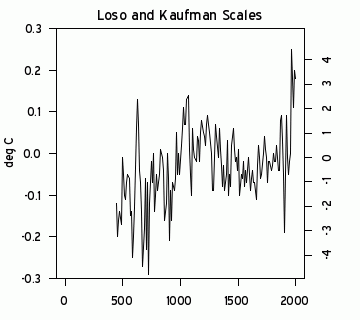
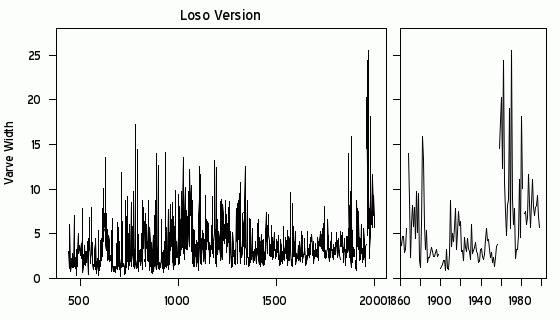
Murray lake varve thickness shows a hockey stick pattern – new data from last decade indicate warmer temps
The third meeting was at AGU in December 2007. By this time, the roster of proxies under discussion had departed fairly considerably from the original NSF30.
At the San Francisco meeting, a special edition of J of Paleolimnology was contemplated for the sites in the NSF program. This edition reported on 14 sites, listed here. Of the 14 sites, only 6 (!) came from the original NSF network of 30 site (one of which was Hallett Lake, substituted for Greyling Lake.)
The standardized program described in the program prospectus (chironomid, O18 and laminations) was completely abandoned. Not a single site has a complete archive according to the program description. Despite all the opening talk of a complete archive, only 10 of 30 sites have any sort of NCDC archive at present – the six J of Paleolimnology sites plus 4 others. In my quick survey, I noticed only one of 30 NSF sites where O18 isotopes are archived (Squanga Lake – a site used neither in Kaufman 2009 nor reported in the JPaleolim edition). Only a couple of the NSF 30 sites has chironomid temperatures and neither of these appears to have been used in Kaufman. Only 5 of the NSF30 sites have archived varve thickness – three of these are used in Kaufman, including the series said by Bradley to have a HS shape. One of these series is Kaufman #1, one of only 4 series that contribute to the final HS shape. Three of the NSF30 sites have archived BSi (biological silica), including Kaufman #2 (Blue Lake), one of the 4 series contributing to a HS shape.
Kaufman uses only 6 of the NSF 30 sites (5 of the 6 are archived. Bradley’s C2 remains unarchived.)
While the original NSF program had objectives that met CA scruples – uniform sampling methodology and archiving of all data prior to publication, Kaufman et al 2009 abandoned these objectives for reasons that are not discussed in the article.
Instead of standardized sampling procedures for all 30 sites, each archived site has an ad hoc pattern of test results – some report varve thicknesses, some BSi, a couple chironomids, one delO18, but none carry out the program set out in the original NSF description. Instead of a complete archive, 20 of 30 sites remain without any archived data whatever.
And Kaufman et al did not calculate some sort of index based on the NSF 30 sites. Instead of compiling and reporting the NSF 30, Kaufman selected only 6 of the NSF 30 sites (including the series said by Bradley to have a HS-shape) and added 17 sites from outside the NSF program – including, of course, Briffa’ Yamal tree ring site, one with a known HS shape and which is the strongest contributor to the Kaufman HS.
Kaufman stated in Iceland that they “need to be extremely careful to document our decisions and be ready to publicly defend them”. It would be nice if they did so.
UPDATE:
Darrell Kaufman responded to my email inviting his participation here and offering him a password to create his own account:
I did log onto the Climateaudit website about a week ago. I have no desire to engage in vicious commentary. If you would like to discuss the study professionally and courteously, then I would be happy to talk with you. I am at: 928-523-xxxx












 Climate Audit