Speaking of which, WBZ-TV in Boston reported on the surface stations issue here .
The image looked familiar to me.
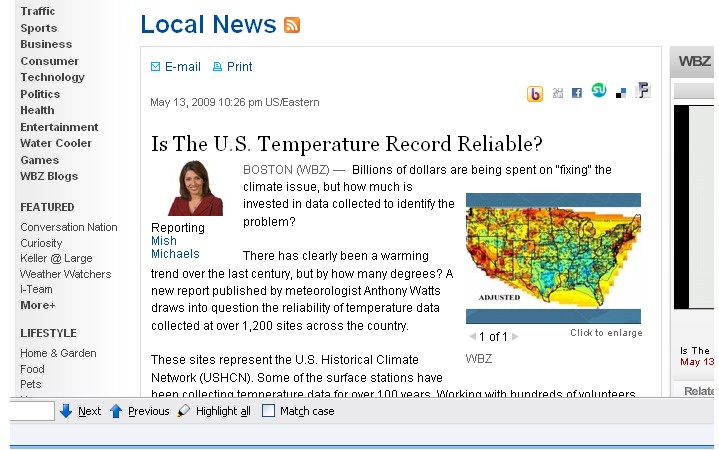
Speaking of which, WBZ-TV in Boston reported on the surface stations issue here .
The image looked familiar to me.
Anthony reports today on a NOAA “Talking Points” document which purports to rebut Anthony’s Is The U.S. Surface Temperature Record Reliable?, without deigning to cite
Watts, A. (2009). Is The U.S. Surface Temperature Record Reliable? Downloaded from http://wattsupwiththat.files.wordpress.com/2009/05/surfacestationsreport_spring09.pdf.
or using Anthony’s name. They seem to have adopted the Team tactic (Hansen in particular) of refusing to even speak the name of critics.
U.S. federal policy on research misconduct defines plagiarism as follows:
Plagiarism is the appropriation of another person’s ideas, processes, results, or words without giving appropriate credit.
I invite readers to review the NOAA “Talking Points” document with that definition in mind.
I have one very serious criticism of Anthony’s post on the issue. He left out an important reference to Knowles et al 2006, who provided a definite comment on the citation issue in a 2006 conference.
A couple of months ago, I posted on the EPA Endangerment Finding. In Canada, the government would just go ahead and pass the regulations without the long U.S. regulatory processes. In practical terms, some odd coalitions can form for specific policies between people who are worried about energy supply or the impact of energy imports on the U.S. economy and people who are worried about climate. I’m not opposed to governments making decisions, even if I don’t agree with the decision.
Contrary to what people on the one hand assume and contrary to urgings of people on the other hand, I don’t actually have an opinion on the merits of this particular policy. But there is an aspect to the process that annoys me – the implicit laundering of past stonewalling and obstruction.
EPA guidelines require that highly influential scientific assessments meet a variety of sensible standards for transparency, data availability and due diligence – policies that CA readers know not to have been implemented by the IPCC. I discussed these issues in my prior post and have amplified these arguments in my submission which is online here EPA submission 3951.1 here
In the submission, I included a consideration of some interesting clauses from the EPA Peer Review Handbook (which appears to be incorporated by reference into EPA Guidelines.)
EPA has to carry out some required processes in order to use a scientific assessment by an external party (mentioning international bodies). One of the requirements is that external party has to submit the assessment to EPA, together with the peer review record, following which EPA officials are obliged to evaluate the material to ensure that if complies with EPA standards (which in this case appear to me to be considerably more rigorous than IPCC standards.)
The IPCC Fourth Assessment Report is obviously a public document, but it doesn’t appear to me that anyone bothered to submit it to EPA (together with the peer review record.) Such a submission would create some interesting issues for ongoing FOI obstruction, e.g. the withholding of Mitchell’s Review Comments and Ammann’s “private” review comments.
Indeed, the various discussions that we’ve had over the past months over IPCC’s amorphous legal status – i.e. IPCC participants having dual status as government employees, with their IPCC affiliation being applied to yield a cone of darkness over activities which would be subject to FOI if they were “merely” government employees.
Evasion of transparency has been a long-running concern of this site and I’ve used this comment opportunity to place this and related concerns on the record.
As CA readers know, Phil Jones keeps his CRU data secret. Embarrassingly, the UK Met Office relies on this secret data and says that it is unable to provide this supporting data for the most relied upon temperature data set in the world. Their statements in response to FOI requests as to what they actually hold seem contradictory, but most recently they state that they do not hold original data, but only the “value added version” provided to them by Phil Jones. Whether they are entitled to keep the “value added version” secret is something that their FOI officer is presently considering.
Recently, Anthony Watts discovered that the Honolulu Observatory data, which NOAA and NASA lost track of in the 1980s, continued to the present day.
Anthony observed the substantial difference between trends at Honolulu airport and at more rural sites.
When I’ve done previous benchmarking of GISS data, I’ve usually tried to use relatively isolated stations so that the effect of data inclusions and exclusions could be simplified. Since Hawaii is relatively isolated, it seemed like it would be an interesting exercise to look at the Hawaiian gridcell, to get a preview of whether the “discovery” of a long data set might have an impact at the gridded level.
As so often, when one goes down a climate science rabbit hole, wonderland awaits. Continue reading
Deepening moats has been a lively topic in UK politics recently. One British MP expensed the public for the cost of deepening the moat at his castle and has been forced to resign. We discussed FOI and the MP expense scandal recently.
We have, of course, followed with some considerable amusement the contortions of the UK Met Office to avoid disclosing data. Last year, we reported how John Mitchell, Chief Scientist at the UK Met Office, obstructed compliance with an FOI request for his IPCC review comments by wrongfully claiming that his IPCC correspondence had been destroyed and then that it was his “personal” property, resiling from these absurd claims only when asked whether the Met Office had paid his salary and expenses for trips to IPCC destinations.
Recently, we’ve followed the amusing contortions at the Hadley Center webpage as they are conflicted between their use of Phil Jones’ land station data (CRUTEM3) and Phil Jones’ absurd campaign to keep CRU station data secret.
The Met Office webpage for downloading CRUTEM3 data http://hadobs.metoffice.com/crutem3/data/download.html presently says:
Station data: Most of the station data was given to us under conditions that don’t allow us to redistribute it; but the CLIMAT reports we use to update the data in near-real time have no such restriction. Summaries of these reports are available on this page.
Although many Met Office pages can be retrieved from the Wayback archive, this particular page has a robots.txt block and is not available at the Wayback archive. I wasn’t able to locate a google cache (though perhaps someone else can.)
The statement here raises an interesting question:
1) who is it that it is attaching conditions to the station data and, by what authority are they doing so?
2) If it’s Phil Jones, who is also subject to the UK Environmental Information Regulations, does he have the authority to attach conditions to the Met Office use of this data?
3) If the Met Office can’t show their underlying data, maybe they should discontinue the use of Phil Jones’ data and use data that they can show
4) Maybe whoever is funding Phil Jones (and I believe that the US Department of Energy is one of his funders) should require him to deliver the data back to them.
Update: The following sent to CRU on June 25, 2009:
Dear Mr Palmer,
Pursuant to the Environmental Information Regulations, I hereby request a copy of any digital version of the CRUTEM station data set that has been sent from CRU to Peter Webster and/or any other person at Georgia Tech between January 1, 2007 and Jun 25, 2009.
Thank you for your attention,
Stephen McIntyre
Prior post here. Next post here
Sea ice threads always seem to be popular. For people interested in handling data themselves, I’ve updated my utility functions for reading sea ice data here. It contains methods for accessing JAXA, monthly NOAA and NSIDC binary. (The latter works but I haven’t verified the turnkey version. Jeff Id has some related tools.)
Here’s a plot for sea ice through May 2009 for the two hemisphere and global using the script below. As you can see, through May 2009, there is virtually no overall trend with an upward trend in SH sea ice offsetting a downward trend in NH sea ice. The MAy 2009 GLB anomaly is relatively elevated, arising from a highish SH anomaly, while even the NH anomaly was (perhaps surprisingly) more or less at the long-term.
source(“http://data.climateaudit.org/scripts/seaice/functions.seaice.txt”)
seaice=get.seaice.monthly() #downloads NOAA monthly
plot.seaice(seaice,case=”extent”,plot_type=”threepanel”)

Figure 1. Sea Ice Extent Anomaly to May 2009
To retrieve and plot daily JAXA data is also easy, yielding the graphic below. I’ll improve the coloring on this some time.)
daily=get.jaxa()
plot.jaxa(daily)
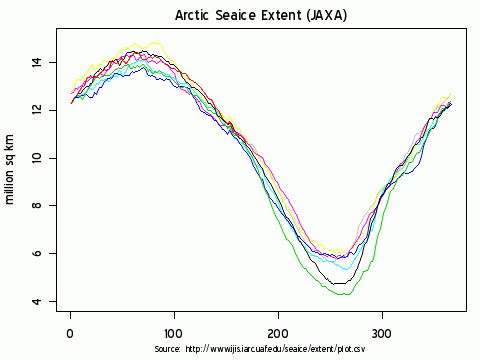
Figure 2. Daily JAXA data
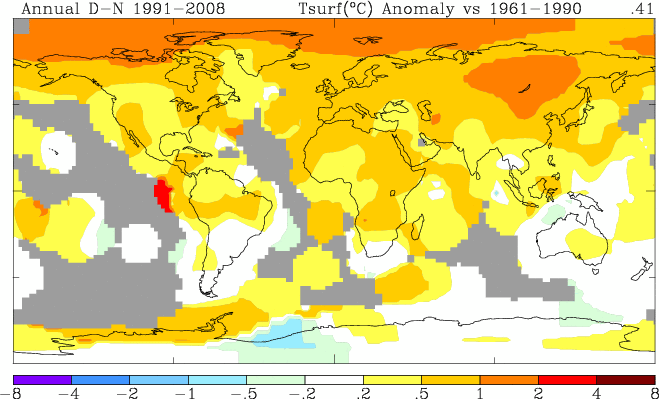
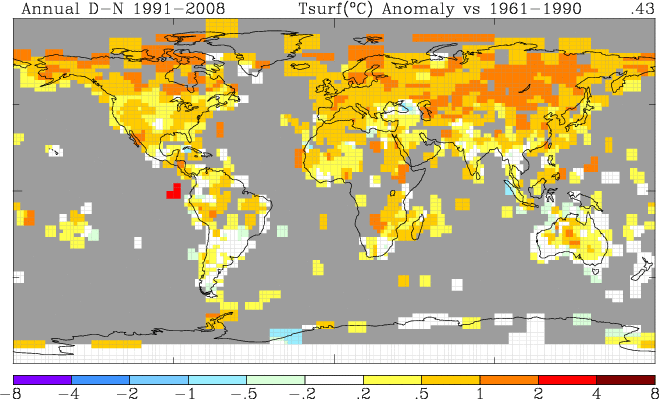
Jean S has written to me with another installment in our ongoing series about GISS conundrums. The puzzle starts with plotting the annual (Dec-Nov) GISS 1200 km anomaly map for the period 1991-2008 (here using 1961-1990 reference.) As you see, there is a Gavinesque red spot offshore Ecuador. Radio buttons generate plots at GISS here.
 |
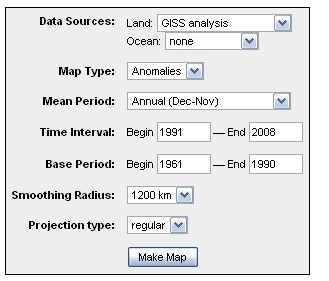 |
Figure 1. 1991-2008 1200 km anomaly
From the 250 km smooth (shown below), Jean S noted that the red spot could be pinned down to the Galapagos (more on this below.)
|
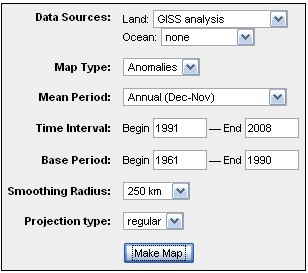 |
Figure 2. 1991-2008 Anomaly (250 km smooth).
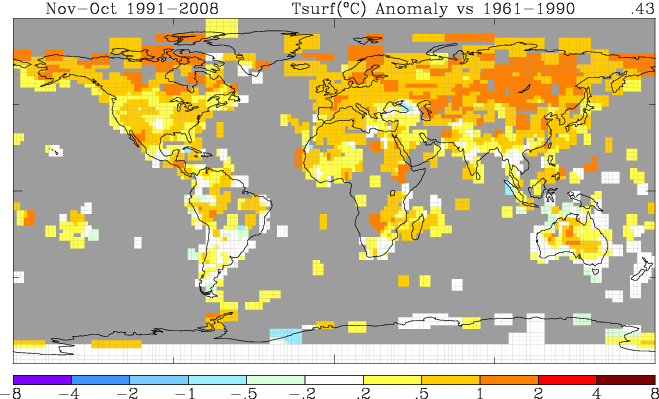
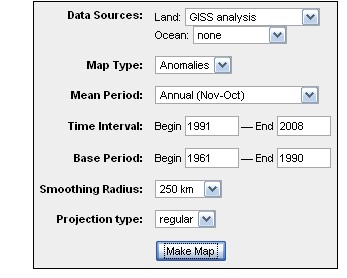
Here’s Jean S’ conundrum. If you do precisely the same graphic – only using the Nov-Oct annual option, the red spot disappears. ???!!???
|
 |
The data is at San Cristobal, Ecuador (Galapagos.)
Hansen et al 1999 stated:
there has been a real reduction since the 1960s in the number of stations making and reporting measurements.
I’ve observed on many occasions that I believe that there has been no “real reduction” in the number of stations “making: measurements – on previous occasions, we’ve offered to help NASA locate data from Wellington NZ and Dawson, Canada (and other locations where NASA has been unable to locate data from stations that report data on the internet.) Galapagos is another such situation. NASA only has measurements for 10% of the months since 1991 – with long and puzzling gaps between measurements. It’s sort of like the intermittent correspondence between Bronze Age emperors in Egypt or Assyria and Hatti, where years might pass between messages. Readers may reasonably differ as to whether Hansen would be more aptly compared to Hattusilis III or Ramesses II, to pick two of the more prominent such correspondents. I presume that the temperature measurements from the Galapagos arrived at NASA in sealed envelopes after a similar perilous journey.
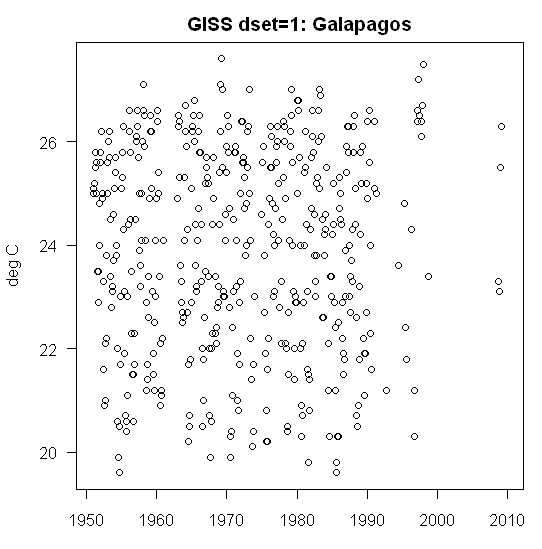
Here is a plot of the anomaly data. You see the sparseness of the data after 1991. However, the royal messengers managed to get data for the big 1998 El Nino through to royal headquarters. Communications have been spotty since then, with only four measurements getting through enemy lines.

Figure 3. San Cristobal, Anomaly.
Here is the underlying data as downloaded from GISS without taking an anomaly. It seems like a pretty thin set of data to justify a Gavinesque red spot.
The National Post in Toronto led off a week of columns on questionable science, leading up to the awarding of the prestigious Rubber Duck Award (named after a Canadian Environmental Defense campaign against homicidal rubber ducks) with a column by Pielke Jr. on models.
RP leads with a discussion of the role of models in the 2008 financial debacle and ends with reflections on hurricanes. He opens with a quote from Keynes.
In 1936, John Maynard Keynes warned that “the ideas of economists and political philosophers, both when they are right and when they are wrong, are more powerful than is commonly understood. Indeed the world is ruled by little else.” Today, almost 75 years later, the power of economics often manifests itself through sophisticated financial and risk models which — when they are right and when they are wrong — exert a powerful influence on many aspects of our daily lives. Understanding the role of these models and how to use them wisely is something that we are still learning how to do.
Here I have a mild criticism. Surely this would have been an ideal opportunity to cite Keynes’ own sharp commentary on econometric modeling (Keynes, Economic Journal, 1940). Keynes’ article is, of course, conveniently accessible online at CA here and is a commentary that still reads freshly today. I placed it online when we discussed (here) Hendry’s Econometrics – Alchemy or Science, in which Hendry also discussed using cumulative UK rainfall as a predictor (“proxy”) for the Consumer Price Index, a correlation so imposing that is puzzling that it was neglected by Steig et al 2009 and Mann et al 2008.
 Suzanne Goldenberg writes today:
The Obama administration is poised for its most forceful confrontation with the American public on the sweeping and life-altering consequences of a failure to act on global warming with the release today of a long-awaited scientific report on climate change.
Figure 1. Photoshopped picture of a flooded house in First Draft of CCSP Report.
This long-awaited report appears is the 4th version of the NOAA report on the US, an earlier version of which was discussed at CA last summer here. This was the report that used the fake photograph of a flooded house, in which the flood waters had been photoshopped onto a picture of house in the northwest U.S. It also used Mann’s HS.
It will be interesting to see compare the new version against last summer’s version. Let’s hope that they at least removed the photoshopped house.
Full Global Climate Change Impacts in the United States available here: Full Government Report
Update: Pielke Jr comments here.





 Climate Audit
The US Synthesis Report and the Search for Climate WMD
White House advisers greeted the new Climate Change Science Program(CCSP) assessment report like Bush advisers would have greeted a favorable report on WMD. Jane Lubchenco, administrator of the National Oceanic and Atmospheric Administration said: “It’s not just a problem for the future. We’re beginning to see the impact on our daily lives.” On the left is a picture of senior White House science adviser John Holdren pointing to a graph showing WMD-like impact of climate change on the U.S. electrical grid system, describing the results as follows:
To be precise for realclimate readers – the picture, of course, does not show John Holdren explaining electrical grid disturbance incidents, but Colin Powell explaining WMD to the UN. (Colin Powell did not actually include a picture of US electrical grid disturbance incidents in his UN speech about WMD; that is stitched into the graphic.) The quote in question comes not from Holdren himself, from the US Synthesis Report page 58, though Holdren described the report as containing the “most up-to-date scientific findings on the impacts of climate change.”
The graphic of electrical grid disturbance incidents to which “Powell” is pointing is shown below in its actual CCSP size. (The size in the final report is considerably larger than in draft reports, presumably reflecting a conscious decision by the authors to emphasize this image. In addition, 2008 data was added on during the editing process, increasing the Hockey-Stick-ness of the image.)
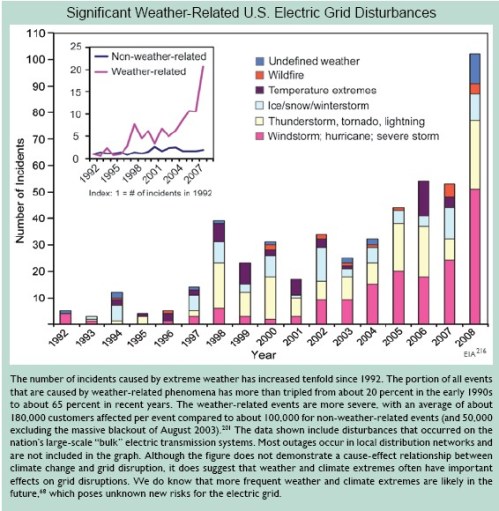
Figure 2. From CCSP, Global Climate Change Impacts in the United States, Final Report, p 58. Actual size.
None of the “blue ribbon” reviewers (IPCC’s Susan Solomon being one of them) saw anything wrong with this graphic. However, on June 17, within a day of publication, blogger Warren Meyer spotted the absurdity of electrical grid disturbance incidents as a supposd climate WMD:
Anthony Watts picked up Meyer’s find later that day here.
If one pauses to look at the graph for even a few minutes, it makes no sense. Climate change in the US in 2008 was not so severe that it could have remotely caused a 10-fold increase in “climate-related” electrical grid disturbances incidents. Meyer followed up his identification of this absurd CCSP claim by contacting John Makens, the holder of the electrical grid disturbance incident data – see follow-up post here. Makens described in the increase in reported incidents as being due to changes from prior “haphazard” data compilation and primarily due to “better reporting”.
The unavoidable conclusion is that the electrical grid disturbance incident hockey stick is not a climate WMD and should never have appeared in the CCSP report.
Warren neatly picked this spitball off the wall, but it raises another interesting question. How did this false claim of climate WMD get into the CCSP report in the first place? And as an answer to this question, I’m interested in something more technical than calling the lead authors of the CCSP report a bunch of names, however richly deserved those names may be.
I’m interested in procedures. These assessment reports typically make quite a fuss about relying on the “peer reviewed literature”. This raises the question: in what “peer reviewed” literature did the electrical hockey stick previously appear? Both the chase and the answer proved interesting.
Let’s start with the most lurid claim (from the caption to the Electrical Hockey Stick):
[201] is the executive summary to a predecessor CCSP report: 201. Wilbanks, T.J., et al., 2007: Executive summary. In: Effects of Climate Change on Energy Production and Use in the United States [Wilbanks, T.J., V. Bhatt, D.E. Bilello, S.R. Bull, J. Ekmann, W.C. Horak, Y.J. Huang, M.D. Levine, M.J. Sale, D.K. Schmalzer and M.J. Scott (eds.)]. Synthesis and Assessment Product 4.5. U.S. Climate Change Science Program, Washington, DC, pp. x-xi.
The final version of this assessment report (4.5) was released in Feb 2008 and is online here. There is nothing in the reference that supports or even mentions a “tenfold increase” in electrical grid disturbance incidents. The language in the Executive Summary referred to in the US Synthesis Report says mildly:
Nothing about a tripling of weather-related incidents.
Let’s try a related reference from the Synthesis Report:
[191] is another chapter in the same CCSP report (online here). 191 Bull, S.R., D.E. Bilello, J. Ekmann, M.J. Sale, and D.K. Schmalzer, 2007: Effects of climate change on energy production and distribution in the United States. In: Effects of Climate Change on Energy Production and Use in the United States [Wilbanks, T.J., V. Bhatt, D.E. Bilello, S.R. Bull, J. Ekmann, W.C. Horak, Y.J. Huang, M.D. Levine, M.J. Sale, D.K. Schmalzer, and M.J. Scott (eds.)]. Synthesis and Assessment Product 4.5. U.S. Climate Change Science Program, Washington, DC, pp. 45-80.
Again, there is nothing in the chapter that remotely supports the claim that there has been a “tenfold increase” in incidents or that the proportion of weather-related incidents has tripled.
The reference for the data in the graphic is “EIA, 216.” This is:
Warren Meyer had already followed the link to http://www.eia.doe.gov/cneaf/electricity/page/disturb_events.html and found John Makens. This website does contain listings of electrical disturbance incidents e.g. here. A browse through the incident reports showed a lot of outages caused, unsurprisingly by winter snow storms – which, I guess, are another global warming WMD. Although the CCSP report refers to the failure of electrical power transformers “due to high temperatures”, problems were mainly associated with storms and winds; the incident in Queens’ appeared to be related to demand exceeding supply. The incident report (see page 137 refers to “voltage reduction” following a “public appeal” and did not directly mention a transformer failure “due to high temperature”.
There’s another clue in the reference:
For Pielke Jr, this is a bit like saying “data assembled by Michael Mann”. Pielke Jr has already criticized CCSP use of a hurricane-damage Hockey Stick from Evan Mills – see here , covered by John Tierney here. Here is Evan Mills’ hurricane damage graphic as rendered by CCSP:
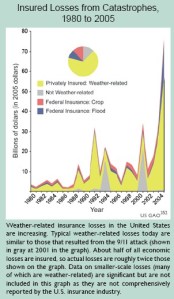
Readers should read Roger’s article before reading the rest of the article. He identifies the provenance of the CCSP figure as Mills, E., 2005: Insurance in a climate of change. Science, 309(5737), 1040-1044, which he had savagely criticized in 2005 here. He observed that Mills, E. (2005) was not peer-reviewed, but was merely a “commentary” and that the provenance of the its data was, in turn, not peer reviewed, but “grey literature” from a workshop. In effect, there is a sequence of so-to-speak academic data laundering, in which non-peer reviewed workshop data (which was heavily criticized elsewhere) was used in a non-peer reviewed commentary in a journal that also published peer reviewed article, which is ratcheted up into a key diagram in an Assessment Report – without ever having been published in peer reviewed journal article. He asked :
In diagnosing the CCSP use of the flawed Evan Mills hurricane damage data, Pielke observed that Mills was a CCSP coauthor. Once again, a climate scientist participating in the author team of an assessment report was advocating and promoting his own work – the sort of problem that we encountered with Michael Mann and the TAR hockey stick.
Here we have a second Evan Mills incident in the Synthesis Report – this time involving electrical grid disturbance incidents. But this one is even worse than the one that Pielke rightly criticized. In the hurricane incident, at least there was something published
in the “Peer Reviewed Literature” as a commentary, however flawed, that the graphic could be traced to. In this case, there seems to be nothing.CSSP policies state:
The US Synthesis Report describes its sources as follows (see page 6)
These policies do not permit the CCSP Author Team to construct their own special-purpose Hockey Sticks for the US Synthesis Report without prior appearance in the “peer reviewed literature”. This slipped by the “blue ribbon” panel, but was picked up within a day by bloggers. We’ve criticized procedures under which authors of assessment reports “assess” their own work (e.g. Mann and IPCC TAR) and this is one more, particularly egregious example.
CA readers will also be interested in review comments on the First (Public) Draft – see John Christy’s comments on the First Draft (and I doubt that subsequent editing has modified his opinion):
When I was asked about the moral, if any, of the Mann hockey stick debacle, I regularly commented that Assessment reports should not rely on authors to assess their own work – that’s an invitation for problems. Unfortunately, that advice – given in a constructive and not adversarial way- has been ignored and the present CCSP report provides a particularly vivid example.