Briffa et al (Phil Trans Roy Soc London 2008) is a relatively new emanation from the Team, not previously discussed here, which is another example of the discrepancy between what the Team professes at its PR challenge and what they actually do.
While AGU journals (for example) have a category for “data” papers in which data sets are published, this cannot be said to be a data paper since no data is archived. It discusses 5 data sets (3 familiar to connoisseurs of Team multiproxy studies – Tornetrask, Yamal and Taimyr; and two not “traditionally” incorporated into Team multiproxy studies – Finnish Lapland (Helama et al 2002) and Bol’shoi Avam (Sidorova et al 2007). None of these 5 data sets are archived at ITRDB (or, to my knowledge, elsewhere), other than a very small subset of Tornetrask archived by Schweingruber some years ago. I’ve expressed my frustration on the unavailability of measurement data used over and over again and have tried to have journals require Briffa to disclose data used in his reports, but so far he’s resolutely refused. (Briffa’s typical excuse is that the data belongs to the Russians or some other excuse; as far as I’m concerned, who cares? The journal needs to ensure that he has permission to archive the data before they permit him to publish.)
The criteria for data selection- as so often in Team publications – are nowhere stated. His section 3 is entitled “Selected Eurasian Tree Ring Chronologies”. and merely notes that the paper is about “selected” long chronologies. Why, example, is the Bol’shoi Avam data set merged in with the Taimyr data set, while the Polar Urals update is not merged with the Yamal data set? (Readers of CA know that the Polar Urals update) had a very elevated medieval period.) It would be one thing if Briffa presented arguments why the Polar Urals data was no good, but he doesn’t. So what were Briffa’s selection criteria?
One only has to think of prior statements by Briffa and his PR challenge coauthors to motivate a little concern. PR Challenge coauthor D’Arrigo told an astonished NAS panel that you have to pick cherries if you want to make cherry pie. PR Challenge coauthor, Esper (in Esper et al 2003):
this does not mean that one could not improve a chronology by reducing the number of series used if the purpose of removing samples is to enhance a desired signal. The ability to pick and choose which samples to use is an advantage unique to dendroclimatology.
Indeed. But I, for one, find these little cherry picking exercises increasingly absurd. So why isn’t the Polar Urals update used? For that matter, why isn’t the Indigirka River chronology used? Could its elevated MWP be a factor?
There are typically frustrating inconsistencies between the information on the data sets in the citations and in Briffa’s compilation. For example, Briffa reports that Bol’shoi Avam, citing the very recent Sidorova et al (Russ J Ecol 2007), had 178 samples yeilding a chronology from 851 to 2003. On the other hand, Sidorova et al 2007 states that “a total of 118 samples” were taken, of which 81 were cross-dated yielding a chronology from 886-2003. Is there a typo in Briffa et al or did they use a version different than the one reported in Sidorova et al 2007? Who knows.
While Briffa does not even archive digital versions of his three regional chronologies, his Figure 3 shows that the only series with a strikingly anomalous 20th century is Yamal – which we’ve discussed over and over at this site.

Original Caption: Briffa et al 2007 Figure 3. Regional curve standardized (RCS) chronologies (thin lines) and smoothed chronologies, the sum of the first three components of singular spectrum analysis of each RCS chronology (thick lines), for the regions: (a) Fennoscandia, (b) Yamal and (c) Avam–Taimyr. The grey shading represents the changing number of samples that go to make up the chronology through time.
While it becomes difficult to make definitive statements in the absence of proper data archiving, Briffa et al 2007 (which includes Grudd as a coauthor) has a different appearance than Grudd’s 2007-2008 update of Tornetrask, previously discussed at CA here, where Grudd contrasted his present chronology to the Grudd et al 2002 version in the figure shown below.

Original Caption Grudd 2008 Figure 11. In the lower panel (b), Reconstruction IV is compared with two previously published temperature reconstructions based on tree-ring data from Tornetrask: The thin curve is from Briffa et al. (1992) and based on TRW and MXD. The hatched curve is from Grudd et al. (2002) and based on TRW. All three reconstructions have been smoothed with a 100-year spline filter and have a common base period: AD 1951- 1970.
The present Briffa version merges Torntrask with Helama’s (unarchived) Lapland data – is it the merging that causes the difference or is it different handling of the Tornetrask measurement data by Briffa as compared to Grudd? Who knows. No data is archived.
It’s also hard to reconcile Briffa’s Taymyr-Avam composite with prior images. Here is a smoothed version of Briffa’s Taymyr series from Briffa (2000). Briffa et al 2007 shows a relatively more elevated 20th century. Sidorova et al doesn’t show an elevated 20th century. Did Briffa re-calculate the results from Sidorova et al 2007 using his own method of adjusting tree rings? Who knows. No data is archived.


Taymyr chronology re-calculated in Briffa 2000 (smoothed).
Briffa et al 2007 introduces methodological variations in its handling data that differ somewhat from prior dendro articles. For example, to supposedly provide an “objective picture” of lone time-scale variations, they filtered the three RCS regional chronologies using singular spectrum analysis (SSA) filtering. Later, “in order to assess the changing nature of large-scale average tree-growth variability”, they analyze trends and means from 101-year time windows. Then “in order to quantify the degree of correspondence in tree-growth trend changes on time scales ranging from multi-decadal to centennial, we have compared
the temporal growth patterns across all RCS chronologies using the Kendall’s (1975) concordance coefficient, applied over different moving time windows” etc. If this is a “correct” way to analyze tree ring data, then shouldn’t they publish some sort of methodological package at http://www.r-project.org or the equivalent or otherwise show that these methodological variations have some validity relative to other plausible choices.
“Unprecedented”
There is an interesting bit of sleight-of-hand on the “unprecedented” front. The article abstract states:
Using Kendall’s concordance, we quantify the time-dependent relationship between growth trends of the long chronologies as a group. This provides strong evidence that the extent of recent widespread warming across northwest Eurasia, with respect to 100- to 200-year trends, is unprecedented in the last 2000 years.
But followed by the next odd sentence in the Abstract:
An equivalent analysis of simulated temperatures using the HadCM3 model fails to show a similar increase in concordance expected as a consequence of anthropogenic forcing.
Here’s what’s going on. Here’s the middle panel of Briffa’s Figure 8 showing the “concordance coefficient” reaching supposedly “unprecedented” levels. Note that this figure, which supposedly motivates the caption, does not show “unprcedented” ring widths, but supposedly “unprecedented” concordance coefficients, not something that we’ve heard about previously as a “fingerprint”. This is described as follows:
In the unsmoothed concordance series, except for the shortest (51 years) window results which clearly show high concordance approximately 900, there is evidence of rising and unprecedented similarity in tree growth across northwest Eurasia in the most recent century. This is accentuated in the smoothed series for 101- and 201-year window lengths.
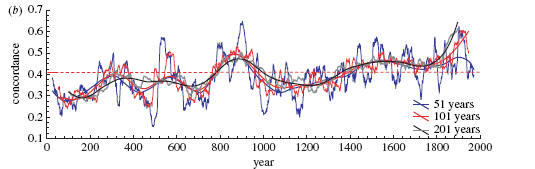
Briffa et al Figure 8. (b) Kendall’s concordance coefficients … for the unfiltered RCS chronologies calculated for moving windows of 51, 101 and 201 years, and the same data smoothed using the negative-exponential weighted least-squares method;
Briffa then discusses whether such concordance results are model “finger prints” reporting that their experiment driven with AGW failed to yield “unprecedented” concordance. Indeed, it barely reached “significant” concordance.
a simple analysis of one such experiment, under natural and GHG forcing for the last 250 years, while showing consistently increasing concordance between simulated temperatures in the regions of our chronologies, failed to produce results that could be distinguished from the results of a similar experiment driven only with natural (i.e. non-anthropogenic) forcings.
The concordance values clearly increase steadily throughout the duration of the all forcings simulation, but the magnitude of the values is low, even by the end of the experiment. Indeed even the maximum concordance values calculated for the series 101-year windows reach only just above 0.3, barely significant, while values approaching 0.4 occur in the naturally forced experiment. These results imply either that an interpretation of strong external forcing of recent widespread high warmth over northern Eurasia, perhaps the consequence of increased atmospheric GHGs, cannot be supported or, alternatively, that this particular GCM simulation of the last 250 years is not consistent with the observational temperature and dendroclimatically implied evidence of unusual warming that has been experienced in the real world.
a simple analysis of one such experiment, under natural and GHG forcing for the last 250 years, while showing consistently increasing concordance between simulated temperatures in the regions of our chronologies, failed to produce results that could be distinguished from the results of a similar experiment driven only with natural (i.e. non-anthropogenic) forcings
How did they go from this statement to the statement in the abstract that:
Kendall’s concordance … provides strong evidence that the extent of recent widespread warming across northwest Eurasia, with respect to 100- to 200-year trends, is unprecedented in the last 2000 years.
Makes no sense whatever. Of course, we’ve already seen Briffa’s Cargo Cult explanation of divergence, so why wouldn’t we expect another cargo cult jump in logic?
Briffa et al. (1998b) discuss various causes for this decline in tree growth parameters, and Vaganov et al. (1999) suggest a role for increasing winter snowfall.” In the absence of a substantiated explanation for the decline, we make the assumption that it is likely to be a response to some kind of recent anthropogenic forcing. On the basis of this assumption, the pre-twentieth century part of the reconstructions can be considered to be free from similar events and thus accurately represent past temperature variability. [Briffa et al. 2002]
As the poets say:
Cherry trees have tasty fruit;
And pickers need dexterity;
But not as much as paleos,
Who claim unprecedentity.
Reference:
Briffa, K.R., T.M. Melvin, E. A. Vaganov, et al. 2008. Trends in recent temperature and radial tree growth spanning 2000 years across northwest Eurasia. Philos Trans Roy Soc Lond B.