One of the issues in play in criticisms of Douglass et al 2007 pertained to their use of RAOBCORE 1.2 rather than RAOBCORE 1.4.
As an editorial comment, since some critics of Climate Audit seem to feel that I bear some personal responsibility for defending this paper, I was not a co-author of Douglass et al nor I did not provide advice on it. I had not posted on it or reviewed it or even read it until a few days ago. Nor did I have any personal familiarity with radiosonde data sets. Nor had I followed the realclimate discussion of this article until a few days ago. I posted up a few days ago on tropical troposphere temperatures because of Ross McKitrick’s T3 concept and I merely did a simple plot of tropical troposphere temperature.
My proximate interest in this paper arose because this post prompted commentary on Douglass et al., including a statistical issue, previously raised by Gavin Schmidt (which I had not followed at the time), which was raised here by Beaker, which caught my interest. The idea of a climate scientist making a gross statistical error is something that would obviously not come as a total surprise to me, though I remain unconvinced that the particular issue advanced by Schmidt and endorsed by Beaker, concerning multi-model means, rises much above a play on words. In fact, my impression is it is more likely that Schmidt has committed the error, by confusing the real world with the output of a model, something that anthropologists have observed as something of an occupational hazard for climate modelers. (See discussion of Truth Machines here.)
The issues concerning radiosonde trends are more substantial, though Schmidt’s commentary is more oriented to proving a gotcha than a careful commentary on real issues pertaining to this data.
RAOBCORE is a re-analysis of radiosonde data by Leopold Haimberger and associates. RAOBCORE 1.2 was published in April 2007, though presumably available in preprint prior to that. Douglass et al 2007 was submitted in May 2007, when the ink was barely dry on the publication of RAOBCORE 1.2. Nonetheless, Schmidt excoriates Douglass et al for using RAOBCORE 1.2.
To date, RAOBCORE 1.4 has not been published in a peer-reviewed journal, though a discussion has been submitted (Haimberger et al 2008) and is currently online at Haimberger’s site. It was announced in Jan 2007 with Haimberger’s website stating that it used the “more conservative ERA-40 bg modification”. “Conservative”. I must say that I dislike the use of such adjectives by climate scientists. Dendros talk about “conservative” standardization, never about “liberal” standardization. Another adjective that sets my teeth on edge is “rigorous” as in a “rigorous statistical procedure”. Inevitably, such procedures are anything but.
RAOBCORE 1.4 data is online in a MSU gridded format at ftp://raobcore:empty@srvx6.img.univie.ac.at/v1_4/grid2.5_invd_1_6, with 24 different data sets covering combinations of 4 layers: tls=Lower Stratosphere (MSU4), tts=Troposphere-Stratosphere (MSU3), tmt=Mid-Troposphere (MSU2), tlt=Lower Troposphere; 3 versions: bg, tm and tmcorr; and two times: midnight (00) and noon (12). I’ve written a short program to extract this data and have made monthly time series for the tropics for all versions.
The underlying concept of the RAOBCORE re-analysis is to apply changepoint algorithms to detect inhomogeneities in the radiosonde record and there seems to be plenty of evidence that inhomogeneities are a real problem. So CA readers that are concerned about inhomogeneities in the surface record should not take the radiosonde record as written in stone, merely because they like the answer. Uncertainties in this record seem just as serious, if not more serious than uncertainties in the surface record.
I’ve done a quick assessment of the data, which has primarily involved figuring out how to download the data (which only goes to end 2006) and plotting the net adjustments in RAOBCORE 1.4 to the original data. (I haven’t located RAOBCORE 1.2 online yet.)
The difficulty that arises is that the recommended adjustments are typically of the same order of magnitude as the underlying trend and, in one case, larger than the underlying trend, such that the sign of the adjusted trend is different from the raw trend. First here is a figure showing the net adjustments for the tropics in deg C for the 4 levels (going high to low). In each case, the adjustments are implemented primarily in the 1985-2000 period, so one is not dealing with the far past. All records end in 2006 are not fully up-to-date.
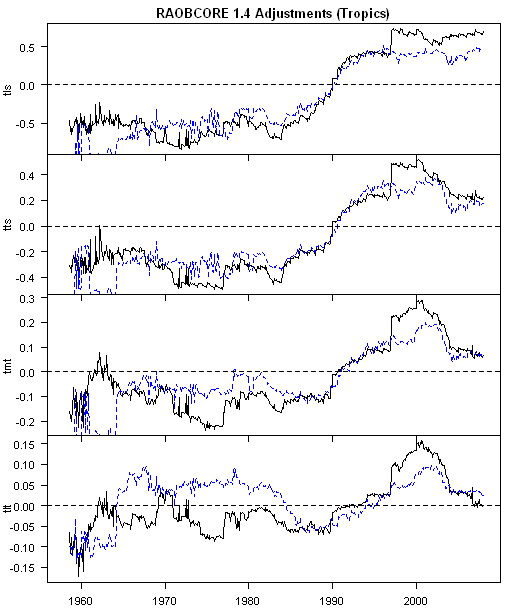
Figure 1. RAOBCORE (tropics) adjustments for 4 levels 1957-2006. Black – midnight; blue- noon.
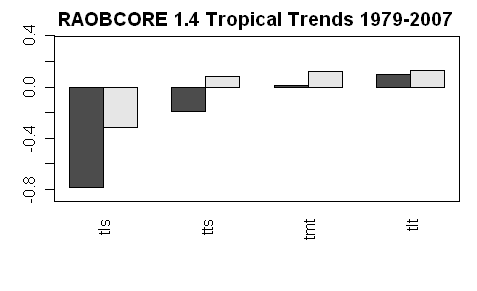
Next here is a figure showing the original and RAOBCORE 1.4 trends for the tropics for the 4 levels (version 1.2 is not shown). The sign in the MSU3 level is reversed by the adjustment process.
For completeness, here are plots showing the original and adjusted versions for the 4 levels.

It is evident from the above plots that the RAOBCORE adjustments are the same order of magnitude as the trend that people are seeking to determine.
Reference:
Haimberger L., 2007: Homogenization of Radiosonde Temperature Time Series Using Innovation Statistics. J. Climate, 20,1377- 1403 (April 2007) url