Anti-Antiscience and Statistical Parlor Tricks

As a result of the Weblog Awards contest, I’ve been introduced to a number of blogs, such as Bad Astronomy and Pharyngula, of which I’d been previously unaware, although they are both popular and have a loyal following. Bad Astronomy has a set of links to what it calls Anti-Antiscience sites, which include their rival Pharyngula and similar sites. “Anti-antiscience” seems to include astrology, mentalism, things like that; Phil Plait on Bad Astronomy mentions James Randi a number of times. I followed one of the links to a site called Memoirs of a SkepChick, one of whose recent posts was a review of Criss Angel’s (pseudo ?-) altercation with a contestant on Phenomenon:

After his pathetic nightclub act, Callahan was praised by the Cosby kid, the host of the show, and Uri Gellar (of course). Criss Angel then whipped out an envelope and offered Callahan and Gellar a million dollars of his own money if they could tell him what was written inside the envelope. Instead of immediately going back into his fake trance, Callahan called Angel an “ideological bigot” and lunged at him in what I suspect was intended to be a threatening manner.

Which gave me the following thought: the focus of Climate Audit is also “anti-antiscience”. The SkepChick is against lame parlor tricks and pathetic nightclub acts; so am I.

MBH98 statistical methodology is essentially a parlor trick – a point that becomes obvious to any statistician that has spent the time to investigate it (a point clear to Jean S and UC as well as myself). It’s not just the principal components methodology – although the principal components methodology was highly relevant to the show in the initial presentation of the parlor trick. When the principal components aspect of the trick was exposed, they re-tooled the trick (in Ammann and Wahl who use prior results from realclimate without attribution) so that the woman still appears to be sawed in half even without using principal components. And all the innocent climate scientists say WOW!

One of the purposes of statistical analysis is to expose parlor tricks, especially where there is self-deception on the part of the scientists.

In our first articles, we criticized several aspects of the parlor trick in MBH98. We did not say that this was the only parlor trick in the world or that this was the only way that the magician’s assistant could be sawed in half. So when the magician’s assistants and serial coauthors, Ammann and Wahl, write that you can still saw the woman in half without using principal components as part of the trick, it doesn’t mean that our criticism of the original parlor trick was wrong – only that they’ve re-tooled the trick a little and you have to watch for the pea under the thimble. I’ve discussed their particular pea under the thimble before – and, in its own way, the overfitting in Ammann and Wahl should be even more embarrassing to the climate science trade than MBH98 ( see posts here , especially here here here .

I’ve tried to tread a careful line in which I’ve been critical of these lame parlor tricks without presuming that the entire AGW theory depended on lame parlor tricks. It seems obvious to me that policy should not depend in any measure on parlor tricks – even if the policy ultimately proves to be the right policy.

In addition, I think that it doesn’t even do people concerned about AGW any good to use things like MBH and its cousins. They should swear off such parlor tricks and focus on their best arguments. They might find that the effort sharpens their own presentations and makes them more convincing. (And, as readers of this blog know, we have thus far been unsuccessful in locating a straightforward engineering-quality exposition of how doubled CO2 leads to 2.5 deg C warming. I’m not saying that such an exposition is impossible; merely that reliance on things like MBH has perhaps diverted scientists from the expositions that they should have been working on.)

After a while, it becomes a bit discouraging that the MBH parlor tricks continue to re-surface under various guises, that climate scientists seem to believe in these tricks and that so many climate scientists apparently don’t understand how the tricks work. It really doesn’t give third party statisticians a very good impression of the acumen of the trade.

In passing, it’s interesting that Phil Plait of Bad Astronomy has also made an issue of data suppression. In a recent post entitled NASA suppressing aeronautic data: Part II, he said:

The bottom line is that Luedtke was 100% in the wrong about not releasing the data, and his reasoning for doing so is garbage. Griffin’s response was fine until he tried to spin this, which was also garbage.

You’d think that someone who thinks like this would support the campaign to make Lonnie Thompson and other climate scientists release their data, especially when, as in Lonnie Thompson’s case, the data is used in Al Gore’s hockey stick, some of it is over 20 years old and inconsistent grey versions have been circulated.

In reading the anti-antiscience comments, I was reminded of a famous comment by Keynes in 1940 in his review of early econometric models – and one that should always be kept in mind when considering complicated models:

But my mind goes back to the days when Mr Yule sprang a mine under the contraptions of optimistic statisticians by his discovery of spurious correlation. In plain terms, it is evidence that if what is really the same factor is appearing in several places under various disguises, a free choice of regression coefficients can lead to strange results. It becomes like those puzzles for children where you write down your age, multiply, add this and that, subtract something else and eventually end up the number of the Beast in Revelation.

Bad Astronomy is against people taking parlor tricks seriously. So are we.

Unthreaded #24

Continuation of Unthreaded #23

More on 2007 Weblog Awards

climateaudit is running strongly in these awards – thanks to voters. When I looked this morning, we were in third place, less than 20 votes behind last years winner, Pharyngula, and within 300 votes of the current leader, Bad Astronomy.

Both Pharyngula and (update: commenters at) Bad Astronomy have bad-mouthed Climate Audit. Pharyngula wrote

I’m in the running with a couple of conservative junk science blogs. Go vote for one of the other people:

This prompted a spirited defence of CA by Spence_UK and John A which seems to have fallen on deaf ears. Bad Astronomy’s attitude was similar.

As noted in comments to the other thread, realclimate and deltoid were both nominated last year, with realclimate receiving 458 votes and deltoid 200 votes, while both Pharyngula and Bad Astronomy received over 9000. So it’s pretty gratifying that CA is competing as closely as it is.

You may vote once a day until Nov 8, 2007 here.

Update: Bad Astronomy took offence at the above post, saying that it was commenters there that had bad-mouthed CA, rather than the head poster. I’ve edited the above to draw the distinction. In particular, one of the commenters called CA “antiscience” as follows:

Is it just me, or is the fact that all climate related nominees are antiscience disturbing?

Another commenter suggested tactical anti-CA voting, a refrain now taken up at Pharyngula:

I’m almost tempted to vote for PZ instead of BA just so that ClimateAudit becomes less likely to win.

In fairness, the comments were made by commenters at Bad Astronomy as opposed to the proprietor and, just as I’m not responsible for and do not agree with all comments, the same goes for him. Plait has posted up on this here suggesting that I’ve “confused his blog with its comments”.

What’s funny is that McIntyre seems to be confusing this blog with its comments, and me with my commenters. To be clear, his problem with this blog “bad-mouthing” him appears to be coming from the comments in this blog, and not from me my own self.

Well, I wouldn’t say that I was “confused” about this distinction as, in my capacity here, I’m careful to state that I do not necessarily agree with all blog comments. So just to clarify, Plait of Bad Astronomy did not accuse CA of being “antiscience”, but one of the commenters there. Plait says that he does not want to start a “cat fight”, but has an odd way of going about it. Notwithstanding that, in the interest of avoiding pointless catfights, I’ve amended the above post to note that the badmouthing was by a commenter at BA, rather than by Plait himself.

Carl Wunsch on Self-Deception

A new and interesting paper by Carl Wunsch is online here (thanks again to Eduardo Zorita for the reference and link). The abstract says:

The human eye and brain are powerful pattern detection instruments. Coupled with the clear human need to perceive the world as deterministic and understandable, and the often counter-intuitive results of probability theory, it is easy to go astray in making inferences. In particular, many examples exist where attention was called to apparent extreme behavior, whether in time or space series, or in the appearance of unusual patterns, that are just happenstance.

Wunsch quotes the following “verse” as his text:

“My eye is better than any statistical test.”
Well-known paleoceanographer, circa 2001.

To which, any person attending the NAS Panel presentations in 2006 cannot help but add:

“I am not a statistician”
Michael Mann to NAS Panel, March 2006

There’s an interesting tie-in in one of the citations in this article to AR4. Wunsch quotes an example from Wunsch (1999). which includes a demolition of the statistics in Trenberth and Hurrell, 1997. Ironically, in response to criticism of the significance testing for trends in chapter 3 of AR4 from Ross McKitrick, IPCC reviewers (also proving that they are not statisticians) invoked an unprecedented use of the Durbin-Watson test – a usage unknown in statistical literature off the Island ( the Durbin-Watson test is fine, it’s just the IPCC usage was nonsensical – see posts last summer on this topic.) As purported justification for this, they cited the Trenberth and Hurrell reply to Wunsch (1999), which Wunsch’s response rebutted.

Ross McKitrick’s criticism was as follows:

3-1132 A 116:55 116:56 The sentence beginning, “Nevertheless, the results depend…” is vague, disputatious and incorrect. It applies more to the REML results, which are presented without such caveat in the chapter. No citation to any literature is given to defend the implication that fractionally-integrated estimators are less physically-realistic than the linear regression models used elsewhere. Persistency models were developed in hydrology precisely to improve physical realism, so as to provide a better match between the stochastic model and the geophysical phenomena. As for transparency, the lack of transparency of GCM’s or other numerical models is never regarded as a deficiency in IPCC documents. And there is no sense in which fractional-integration models lack transparency–the methods are well-known and code is published. They are not trivial, but that doesn’t mean they are not transparent. The sentence is wrong, unnecesary and should be removed. [Ross McKitrick (Reviewer’s comment ID #: 174-13)]

To which the IPCC reviewers replied:

Fractionally-integrated estimators have not been shown to be good models or fits to the data. On the contrary some examples exist where it is demonstrated they are not (e.g. Trenberth, K. E., and J. W. Hurrell, 1999: Comment on “[Wunsch 1999]: The interpretation of short climate records with comments on the North Atlantic and Southern Oscillations”. Bull. Amer. Met. Soc., 80, 2721–2722.

The Trenberth and Hurrell comment was not an exposition of statistics by renowned statisticians, but an exchange sparked by Carl Wunsch’s 1999 criticism, covering somewhat similar ground as the present article. Although AMS publications are mostly online, Trenberth and Hurrelll 1999 is not online (though it is in the paper copies of the journal.)

So when Wunsch (2007) rebuts Trenberth and Hurrell one more time, it is in a debate that has seemingly been going on for a decade without acceptance of Wunsch’s points by rank-and-file IPCC climate scientists who are not statisticians.

2007 Weblog Award Finalists

The Weblog Awards are the world’s largest blog competition, with over 525,000 votes cast in the 2006 edition for finalists in 45 categories. Nominations for 49 categories ended October 17, 2007 and voting is scheduled to begin November 1, 2007. Final results will be announced November 8, 2007 at the BlogWorld & New Media Expo in Las Vegas.

Nominations for Best Science Blog are:

  • SciGuy
  • Junk Science
  • In the Pipeline
  • Journey By Starlight
  • Paryngula
  • Bad Astronomy Blog
  • Invasive Species Weblog
  • Sciencebase
  • Climate Audit
  • Bootstrap Analysis

Vote for best science weblog here; voting is permitted once every 24 hours.

Hughes and the Ababneh Thesis

I’ve had a few requests to comment on Eli Rabett’s recent post, observing that he was unable to observe a Medieval Warm Period in the bristlecone chronology reported in Salzer and Hughes 2006.

Looking at the tree ring index one can clearly see many large eruptions, the little ice age, but no European Warm Period, often called medieval.

I can’t think how many times I’ve said that Graybill bristlecone chronologies have a hockey stick shape – which means obviously that they don’t have a MWP. That’s one of the reasons why the Hockey Team is addicted to bristlecone chronologies. Bristlecone and foxtail chronologies are “active ingredients” in virtually all the Team reconstructions.

So one’s first reaction to a bristlecone chronology showing no MWP is – Well, duh.

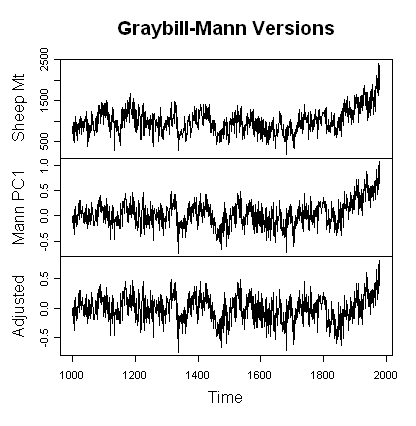
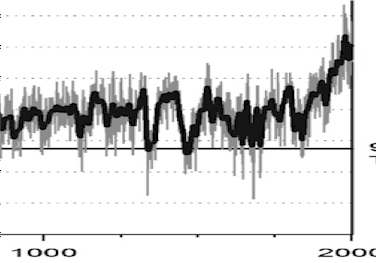
To illustrate this, I’ve shown below three bristlecone versions used in MBH99: on the left, the Sheep Mountain chronology, the Mannian PC1 and the “adjusted” PC1. We compared the Sheep Mountain chronology to the Mannian PC1 in our first submission to Nature in January 2004 observing that the Mannian PC1 was merely an alter ego for Graybill bristlecone chronologies, which were known to be problematic as a temperature proxy. On the right, I’ve shown an excerpt from the new Salzer and Hughes paper. Not much difference.

So to that extent, there’s nothing newsworthy in a bristlecone chronology which doesn’t show a MWP. We already knew that.

hughes61.gif hughes62.gif

Figure 1. Left – Graybill and Mann Versions; right – excerpt from Salzer figure,

The MWP in California

On several previous occasions, I’ve observed that there is very strong paleoclimate evidence for the MWP in California – even, and perhaps, especially in the bristlecone-foxtail areas. Medieval treelines in California were higher than at present, discussed here and here. Post-medieval lakes have even submerged medieval trees. Miller (2006) discussed here and here estimated great warmth in alpine California as follows:

Deadwood tree stems scattered above treeline on tephra-covered slopes of Whitewing Mtn (3051 m) and San Joaquin Ridge (3122 m) show evidence of being killed in an eruption from adjacent Glass Creek Vent, Inyo Craters. Using tree-ring methods, we dated deadwood to 815-1350 CE, and infer from death dates that the eruption occurred in late summer 1350 CE….Using contemporary distributions of the species, we modeled paleoclimate during the time of sympatry [the MWP] to be significantly warmer (+3.2 “C annual minimum temperature) and slightly drier (-24 mm annual precipitation) than present.

Unfortunately, Salzer and Hughes do not discuss and or reconcile any of this literature. Do they disagree with Miller’s analysis? If so, why? And why wouldn’t the reviewers ask them to reconcile their observations with other paleoclimate evidence. But hey, it’s the Team.
Hughes and the Ababneh Thesis

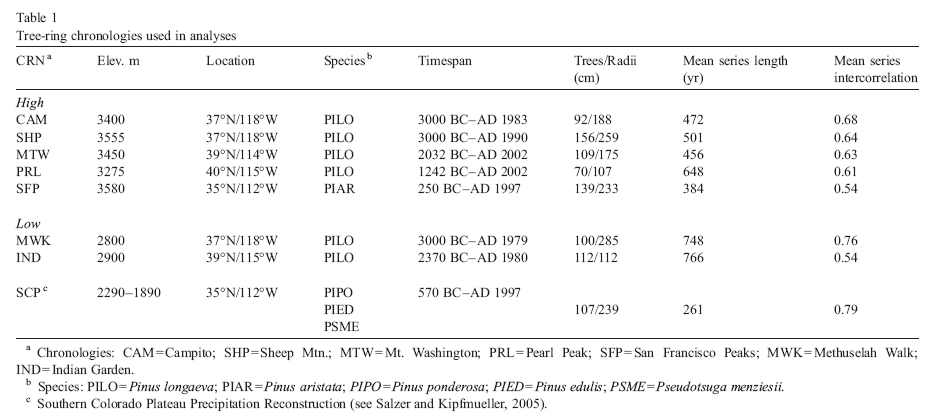
The composite illustrated in Salzer and Hughes is a composite of 5 sites: Sheep Mountain, Campito Mountain, Mt Washington, Pearl Peak and San Francisco Peaks. Methuselah Walk and Indian Garden are also referred to.

hughes60.gif

Take a look at the provenance of the series. There are 3 versions that reflect updates: Mt Washington, Pearl Peak and San Francisco Peaks. None of the updates has been archived, even though at least one of the updates is now 10 years old. But look how old the other versions are: Sheep Mountain ends in 1990, Campito in 1983, Indian Garden in 1980, Methesulah Walk in 1979. These are the Graybill versions – Graybill’s Sheep Mountain version being shown above.

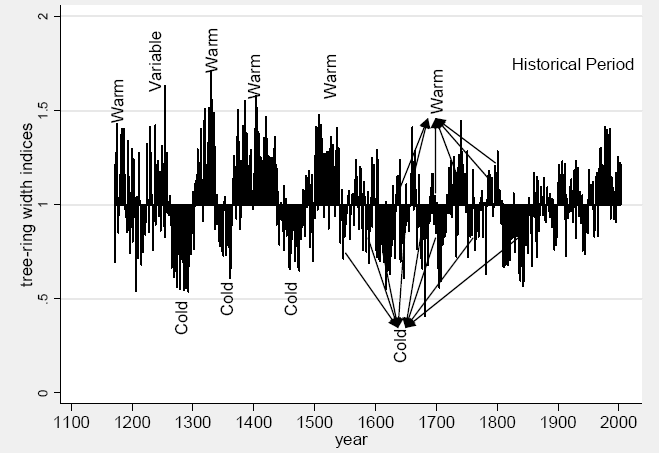
But we know that Linah Ababneh updated the Sheep Mountain data in 2002. We also know that Linah Ababneh’s update, aside from finding a difference between strip bark and whole bark chronologies, did not replicate Graybill’s results and had no HS shape whatever. (Figures for Sheep Mountain for strip bark and whole bark from 1600 on are shown separately in the thesis.) So the Sheep Mountain chronology had been updated – why wouldn’t this update have been used, aside from it not having a HS shape?

ababne32.gif
Ababneh Fig. 5. Cold and warm periods as inferred from tree ring widths chronology (Ababneh, 2006, This study) fluctuations above and below the mean after normalizing, whole-bark and strip-bark chronologies are grouped together from two sites Patriarch Grove and Sheep Mountain.

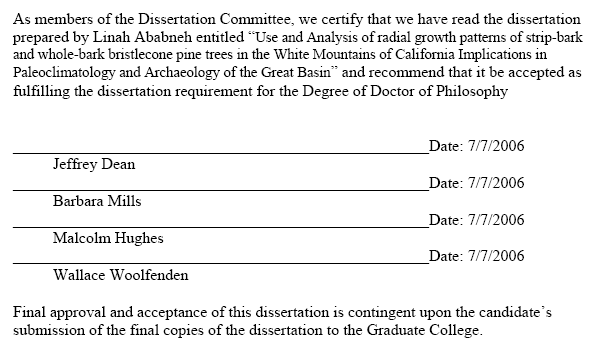
Maybe Rabett would argue that Hughes might have been unaware of the work; or that the work did not meet quality standards. Well, Hughes was not only aware of this work – he (and Jeffrey Dean) was on her Dissertation Committee! Can someone theorize as to a valid reason for not using the Ababneh update? I can’t imagine any.

hughes59.gif

In passing, I also noticed inconsistencies between the data used for the old Graybill data sets and what has been archived. (Recall the Graybill tags at Almagre where we weren’t able to locate matches in the archive.) At Methuselah Walk and Indian Garden, the number of cores shown in the Salzer and Hughes table exactly matches the number of cores archived at ITRDB. But there a lot more Sheep Mt and Campito Mt cores referred to than archived – the difference may be early crossdated cores that precede the existing archive, but one wonders whether, like Almagre, there are Graybill measurements that have never been archived for reasons that no one knows.

The Ababneh Data

I’ve tried to obtain the Ababneh data without success.

I emailed Linah Ababneh at what appears to be her present posting and got no response. I emailed David Meko of the University of Arizona, who has an excellent record of archiving chronologies and measurements, and inquired about a University of Arizona report by Stockton mentioned in the Ababneh thesis (that bender asked about) and about the Ababneh measurements. I reminded Meko that, in her thesis, she had undertaken to archive the measurements and presumably the university was responsible for ensuring that she completed the commitments in her thesis.

Meko wrote back saying that he had checked around the department and had been unable to locate the Stockton report. He also said that they did not have any of Ababneh’s measurement data and that they had lost track of her. He gave me the name of someone who might know where she was. He agreed that she should archive the data and suggested that I write to the funding agency who might take that into consideration in their grant process – (these are the people who put up with Lonnie Thompson and they’re supposed to take it out on Linah Ababneh? C’mon). He didn’t seem to think that the university had any responsibilities in the matter. He was quite pleasant, and , as I mentioned above, Meko himself has an excellent archiving record.

But what a typical climate science circus. Someone goes out and updates the critical Sheep Mountain data. It doesn’t show a Hockey Stick. Instead of using the updated version, Hughes uses the old version with a HS (doesn’t this sound like Jacoby and D’Arrigo at Gasp” where they withheld an update that didn’t have a HS and refused to give me the update when I learned that they were sitting on a non-HS update.) Now the person who got the data has moved and no one at Arizona has the data.

Is the “professional” standard that Eli Rabett and Tamino are holding out for Pete H and myself? We sure plan to do better than this.

What other data series could be plugged in?

I recommend that CA readers visit UC’s blog for some interesting discussion. (BTW UC visited Toronto recently and we had a nice dinner.) UC posted the following interesting figure on Unthreaded as follows:

BTW, got interesting result when I replaced Temperature PCs with solar in MBH98 algorithm. Similar RE values as in the original, and R2 goes down in the verification. I’d try this with 1980-present data, but the proxies are not yet updated.

Sol1

This intrigued Pete H who inquired:

I wonder what other data series could be plugged in to good effect? We could create a nice “quilt” of hockey stick graphs. A great way to demonstrate the extreme confirmative value of today’s influential real climate science.

I can give a pretty complete answer to this, drawing primarily on an early answer to this question, since many, if not most present readers, were not around a couple of years ago. This post discussed the regression phase of MBH98-99, which has its own place in the MBH little shop of horrors.

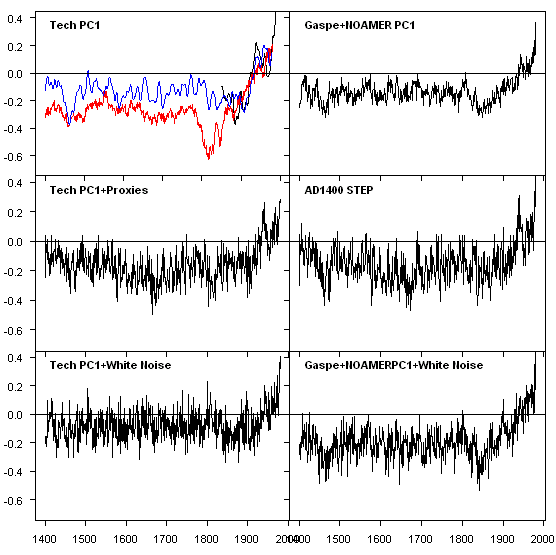
The figure below shows 6 “reconstructions” using different combinations of a Tech Stock PC1 or the MBH98 North American PC1 in combination with the other proxies in the MBH98 AD1400 network or white noise. For the purposes of “getting” a high RE statistic – the sole arbiter of Mannian success, it didn’t “matter” what combination you used. Other than the North American PC1 – essentially the bristlecones, it didn’t matter whether you used the other proxies or white noise. And it didn’t matter whether you used Tech Stocks or bristlecones.

Here’s the figure from the earlier post.

Figure 3. Left – Tech stocks; right – MBH. Top left – Tech PC1 (red), MBH recon (smoothed- blue). Top- Tech PC1 and Gaspé-NOAMER PC1 blend; Middle – plus network of actual proxies; Bottom – plus network of white noise.

I explained the experiments as follows:

To test the difference between MBH98 proxies and white noise, I tried the following experiments, illustrated in Figure 3 below (see explanation below the figure). I discuss RE results – the “preferred” metric for climatological reconstructions for each panel. As a benchmark, the RE statistic for the MBH98 AD1400 reconstruction (second right) is 0.46, said to be exceptionally significant.

Some time ago, I posted up the “Tech PC1”, which I obtained by replacing bristlecones with weekly tech stock prices, as an amusing illustration that Preisendorfer significance in a PC analysis did not prove that the PC was a temperature proxy. I re-cycled the Tech PC1 to compare its performance in climate reconstruction against that of the NOAMER PC1 (actually a blend of the NOAMER PC1 and Gaspé – the two “active ingredients” in the 15th century hockeystick.

In the top panels, I fitted both series against NH temperature in a 1902-1980 calibration period. The top right panel shows the Tech PC1 (red), together with MBH (smoothed- blue) and the CRU temperature (smoothed- black). The “Tech PC1″à actually a higher RE statistic (0.49) than the MBH98 reconstruction (0.46), but it does have a lower variance (in Huybers’ terms). The Tech PC1 has an RE of 0.49, slightly out-performing both the NOAMER PC1-Gaspé blend (RE: 0.46) and the MBH98 step itself (RE: 0.47). In the most simple-minded spurious significance terms, this should by itself evidence the possibility of spurious RE statistics. Both the Tech PC1 and the Gaspé-NOAMER blend have less variance than the target (and the MBH98 reconstruction itself.)

The second panesl show the effect of making up a proxy network with the other MBH98 proxies in the AD1400 network. In both cases, variance is added to the top panel series, in exactly the same way as in the examples with simulated PC1s. The RE for the Tech PC1 is lowered slightly (from 0.49 to 0.46) and remains virtually identical with the RE of the MBH98 reconstruction.

Now for some fun. The third panel shows the effect of using white noise in the network instead of actual MBH proxies. In each case, I did small simulations (100 iterations) to obtain RE distributions. For the “Tech PC1 reconstruction”, the median RE was 0.47 (99% – 0.59), while for the MBH98 case, using the NOAMER-Gaspé blend plus white noise proxies, the median RE was 0.48 (99% – 0.59). Thus, in a majority of runs, the RE statistic improves with the use of white noise instead of actual MBH98 proxies. The addition of variance using white noise is almost exactly identical to the addition of variance using actual MBH98 proxies.

The concluding comment was interesting and worth following up:

These results, which I find remarkable, tell me a lot about what is going on in the underlying structure of MBH98, which was, if you recall, a “novel” statistical methodology. Maybe the “novel” features should have been examined. (Of course, then they’d have had to say what they did.)

When I see the above figures, I am reminded of the following figure from Phillips [1998] , where Phillips observed that you can represent even smooth sine-generated curves by Wiener processes. The representation is not very efficient Phillips’ diagram required 125 Wiener terms to get the representation shown below.


Figure 4. Original Caption: The series f(r)=r^2 on -\pi \le r \le \pi extended periodically.

Phillips’ Figure 2 is calculated using 1000 observations and 125 regressors. In the MBH98 regression-inversion step, the period being modeled is only 79 years, using 22 (!) different time series (a ratio of 4), increasing to use even more “proxies” in later periods. My suspicions right now is that the role of the “white noise proxies” in MBH98 works out as being equivalent to a “representation” of the NH temperature curve more or less like Figure 2 from Phillips. The role of the “active ingredients” is distinct and is more like a “classical” spurious regression. I find the combination to be pretty interesting.

Essentially what Mann did was to create a form of multivariate spurious regression. Traditional spurious regression – the type that you read about in Granger and Newbold 1974, Phillips 1986 – the type that econometricians are used to is univariate. Mannian spurious regression is a generalization of univariate spurious regression. You take one spurious regression (between Tech Stocks and NH temperature) between two unrelated trending series; and then insert this together with a large number of essentially white noise series (low-order red noise also works) in the Mannian multivariate method and bingo what have you got?

1) a high RE statistic
2) a negligible verification r2 statistic;
3) a high calibration r2 (and thus low standard errors in the calibration period)
4) seemingly narrow confidence intervals based on the low residuals in the calibration period.

It is, of course, a complete farce. The “no-PC” reconstruction bruited by Ammann and Wahl completely misunderstood the problems with the technique and carried it to an extreme that is almost a satire. Statistics by Monty Python, so to speak.

David Black, Cariaco and Prompt Archiving

David Black and associates have just (Oct 2007) published a new paper showing a reconstruction of SST from Cariaco sediments using Mg-Ca for the period 1221-1990 (thanks to Eduardo Zorita for alerting me to the study.) In this case, I am happily able to report that the relevant data was archived at WDCP contemporary with publication. Black had already archived data from two other important studies (Black et al 1999, Black et al 2004) in a timely fashion. It’s interesting to contrast Black’s exemplary archiving with the abysmal archiving for another new paper on bristlecones by Hughes and Salzer, noted up recently by Rabett (a paper which I’ll try to comment on some time), which uses information some of which has been unarchived for over 25 years – and where no information collected in the past 17 years has been archived.

Black et al 2007 has particular interest for readers here for several reasons. The Cariaco sediments have a high accumulation for ocean sediments (67 cm/kyr for core PL07-73 BC) and have an annual varve. This has a couple of important benefits: (1) dating precision can be achieved; (2) bioturbation is dramatically reduced (accumulation here being nearly an order of magnitude higher than Arabian Sea RC2730 for example). Secondly, Black has now published and archived near-annual results for four different Cariaco proxies: 1) Mg-Ca in Black et al 2007; 2) G Ruber dO18 and G Bulloides dO18 in Black et al 2004; and 3) weight G Bulloides in Black et al 1999. This latter proxy is not exactly the same as percentage G Bulloides used in the Arabian Sea studies of Anderson, Overpeck and Gupta, but it would presumably be pretty close.

It will also be interesting to compare these results to another high-resolution Mg-Ca seriespublished this year by Richey et al 2007, together with dO18, a study commended by Lloyd Keigwin. Richey presented this study at our AGU session – Mann didn’t like it very much. Tamino has complained about this study as well.

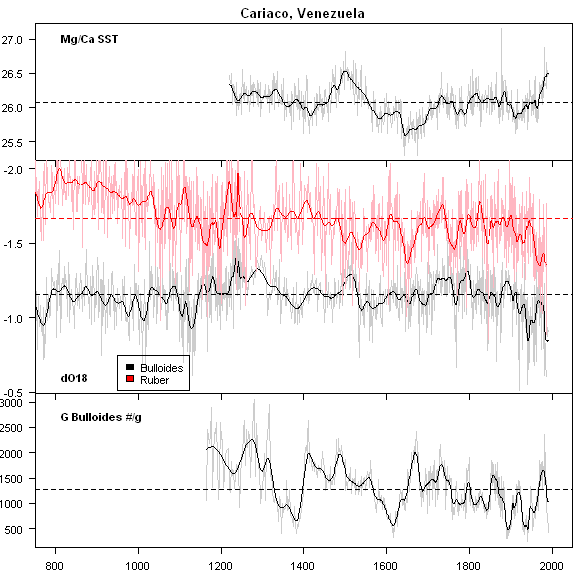
Before presenting Black’s discussion, here is my replot of his Mg-Ca data, also showing the earlier dO18 and G Bulloides data – something that arguably should have been done in Black’s paper (but at least he’s provided materials for others to do so quickly.) The first impression is obviously that the series don’t have much of a common signal over the past 1000 years. Given that Mg-Ca and dO18 give pretty interesting and consistent results on an Ice Age scale over the past million years, it’s a little disappointing to say the least that more of a common signal doesn’t emerge here. It’s not just a high-frequency failure: there’s little commonality in the low frequency either. This is also a disquieting result for results where authors purport to obtain “low frequency” correlations between data which is not nearly as well resolved in time as this data.

One other caveat: the Mg-Ca data (top panel) comes from a different (nearby) box core than the dO18 series. Is it possible that the dating is not all that consistent between the two cores? I don’t know.

cariac33.gif
Figure 1. Cariaco sediments. Top – Mg/Ca reconstruction of SST; middle – G Bulloides and G Ruber dO18; bottom – weight G Bulloides.

The correlations between the series are shown in the table below and are disappointing. Black states of tsuch comparisons: them):

A comparison of the Mg/Ca SST record to G. bulloides abundance, a proxy for upwelling and trade wind variability in the Cariaco Basin [Peterson et al., 1991; Black et al., 1999], reveals very little similarity between the two records. In particular, the large SST changes during the end of the MWP, the beginning of the LIA, and the mid to late twentieth century are not associated with corresponding changes in G. bulloides abundance in either PL07-71BC or PL07-73BC. However, Black et al. [1999] noted a nearzero correlation (r = 0.03) between G. bulloides abundance from a different Cariaco Basin core and local SSTs. A comparison of the G. bulloides abundance record from the core used for this study (PL07-73 BC) to instrumental SSTs over the period of instrumental overlap results in a weak, although statistically significant, correlation (r = 0.18, p <0.1).

Table 1. Correlations between different Cariaco High-Resolution Proxies


Mg-Ca

dO18 Bulloides

dO18 Ruber

Wgt Bulloides

Mg

1

-0.14

0.04

0.16

O18_bull

-0.14

1

0.09

-0.23

O18_ruber

0.04

0.09

1

-0.06

wt_bull

0.16

-0.23

-0.06

1

From the information in the top panel, Black reported:

On average, twentieth-century temperatures are not the warmest in the entire record, but they do show the largest increase in magnitude and fastest rate of SST change over the last 800 a.

This genuflection towards global warming is certainly not the first thing that an unbiased data analyst would take away from this information and in a way, reminds me of the now quaint genuflections towards Chairman Mao in Zhu (1973). Black observes that this record is relatively exceptional in its detail:

Varved, high deposition rate sediments deposited under anoxic conditions and an abundance of well-preserved microfossils result in one of the few marine records capable of preserving evidence of interannual- to decadal-scale climate variability in the tropical Atlantic.

and undertakes a calibration of the record against instrumental SST – something that hadn’t been to date in the ocean sediment community (due to low resolution).

No one to date has directly compared a downcore Mg/Ca record to historical instrumental data because there are very few areas with sufficiently high sedimentation rates where one can recover nonbioturbated sediments and high fossil foraminifera abundances. Long-term sedimentation rates in the Cariaco Basin are as much 1 m/ka, and sediments have been deposited under anoxic, nonbioturbated conditions for the last 12.6 ka, thus allowing one to compare and calibrate a suite of paleoceanographic proxies against historical instrumental data. …the Mg/Ca data were then compared to March–April–May average SSTs over the period of instrumental overlap (Figure 3a).

He then compares the record to other recent publications (but not to his own earlier results discussed in the graphic above or to the Richey et al 2007 Gulf of Mexico Mg-Ca result disliked by Tamino. Comparanda were:

  • a high-resolution sclerosponge Sr/Ca-derived SST study from Jamaica (20 m below sea level) [Haase-Schramm et al., 2005]
  • a planktic foraminiferal Mg/Ca SST records from just south of the Dry Tortugas in the northern Caribbean [Lund and Curry, 2006]
  • Nyberg et al., 2002, noting a temporal offset between the two records that cannot be explained by age model differences alone near Bermuda. (Nyberg et al is one of the studies in Moberg)
  • a shorter but high resolution coral Sr/Ca record [Goodkin et al., 2005]
  • percent titanium data from Cariaco Basin sediments [Haug et al., 2001], said to show a similar pattern to Mg/Ca SSTs during the LIA but are distinctly different during the MWP. A
  • a terrestrial lake record of gastropod d18O from the Yucatan Peninsula [Hodell et al., 2000] said to show a nearly identical LIA pattern, including a large drop in values at the beginning of the Maunder Minimum and a subsequent increase, but not the same trends during the MWP or the twentieth century

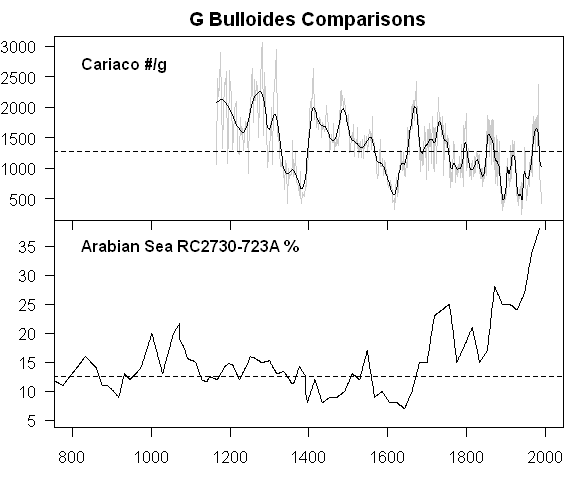
Black also did not take the opportunity to comment on the percentage Arabian Sea G Bulloides series used by Moberg. Below is a plot showing the difference between Black’s series at Cariaco – using well defined varved sediments – and the series by the Overpeck associates in the Arabian Sea. The Arabian Sea version is used in multiproxy reconstructions (Moberg, Juckes), but the Cariaco version is not. Can anyone give me a justification for using one and not the other that would pass even a first-order smell test?

cariac32.gif
Two G Bulloides Versions. Top – Cariaco; bottom – Arabian Sea.

References:

  • David E. Black, Larry C. Peterson, Jonathan T. Overpeck, Alexey Kaplan, Michael N. Evans, Michaele Kashgarian, 1999. Eight Centuries of North Atlantic Ocean Atmosphere Variability, SCIENCE VOL 286 26 NOVEMBER 1999 Data
  • David E. Black, Robert C. Thunell, Alexey Kaplan, Larry C. Peterson, and Eric J. Tappa. 2004. A 2000-year record of Caribbean and tropical North Atlantic hydrographic variability, PALEOCEANOGRAPHY, VOL. 19, PA2022, doi:10.1029/2003PA000982, 2004 Data
  • David E. Black, Matthew A. Abahazi, Robert C. Thunell, Alexey Kaplan, Eric J. Tappa, and Larry C. Peterson, 2007. An 8-century tropical Atlantic SST record from the Cariaco Basin: Baseline variability, twentieth-century warming, and Atlantic hurricane frequency, PALEOCEANOGRAPHY, VOL. 22, PA4204, doi:10.1029/2007PA001427, 2007 Data

Ryan Maue: Bring out the Broom

With October nearly done circling the drain, I figure it is about time to bring out the broom : Northern Hemisphere tropical cyclone activity is at historically low levels .

In fact, September 2007 suffered the lowest ACE since 1977 ! Even scarier, so far 2006 and 2007 have the lowest October ACE since 1976 and 1977. And, unnaturally, Sept-Oct 2007 is the lowest since 1977.

Yet, the tropical cyclone season was not shaping up to be such a ghastly bust. For about a week in June, NH ACE was exceeding climatology but then bit the proverbial dust until mid-August when a noticeable comeback ensued. It has been downhill since.

So, a naysayer over at the Huffington Post or the Daily Green may wonder why we use such metrics such as ACE/PDI or Tropical Cyclone days when we could use better metrics like number of category 5’s making landfall or storms that have intensified the fastest or perhaps number of pumpkins. There are even some spooky hints that the 2007 (Atlantic) Tropical Cyclone season is being “spun” to appear “dead” and inconsistent with the predominant trend. Also, a “storm pundit” would remind that us that the year is not in the grave and we may see hyper-activity (a.k.a. global warming proof) to come.

Here is what needs to happen to reach the 1970-2006 mean:

  • 140 Tropical Cyclone Days — on average, 40 TC days (sigma of 16 days) occur through the end of the year. Slightly more than 70 TC days occurred during 1984, 1992, and 1997. Thus, 140 TC days would be at least a 6 sigma event
  • 50 Hurricane Days — on average, 16 Hurricane days occur through the end of the year. Slightly more than 30 hurricane days occurred during 1984, 1990, 1992, and 1997. Thus, 50 hurricane days is more likely, only a 4 sigma event.
  • Record level ACE exceeding 1997 ENSO enhanced output — just to reach the yearly mean — about a 4 sigma event.

Yet with nature, I wouldn’t bet my last carbon credit against an extreme event. We may need some poleward-moving, late-season tropical cyclones to save us from the winter of 1977-1978. Art Bell will have to warn the “indigenous dog-people” to collect additional firewood…

ace magic

A Coarse Fraction Bias in Arabian Sea G Bulloides?

In our recent discussion of the Arabian Sea G Bulloides series, I noticed a remarkable increase in the coarse fraction percentage in the top 1.3 cm of the critical RC2730 core.

Willis has also commented on this. In core 2730, there is a correlation of 0.91 between the fraction of coarse particles and the percentage of G Bulloides.

This raises a couple of interesting questions:

  • Is there some climatic reason for the increase in the percentage of coarse particles at the top of the core?
  • Or alternatively, are there possible non-climatic reasons for the increase in coarse particle percentage?

In either event, does this have any implications for how one interprets percentage G Bulloides series? This leads, as so often, into many interesting byways and the answers are not entirely the ones that one would expect.

Continue reading