Day Four at AGU didn’t have as much climate stuff as the first three days. Aside from Al Gore, I went to a number of ice core and ocean sediment presentations. Continue reading →
Al Gore was welcomed by a standing ovation from about 4,000 scientists from the AGU convention in the Salon 8 Ballroom at the Marriott San Francisco. He spoke for an hour and was a far more accomplished speaker than one remembers from Presidential debates, glancing only occasionally at notes. It was like a Southern Baptist orator had seamlessly changed texts. His speech was a type of sermon: a few well-practised jokes to start, a commentary on selected verses followed by a call to commit. Gore himself has gotten a little stout over the years (not that I can throw stones on this count) and a little jowly, so his presentation and appearance resulted in a type of secular avatar of Jerry Falwell. Update: the speech is online.
His speech, while fluid and polished, had many strange interludes. At one point, he reflected on how the brain processed signals, ruminating about the neocortex being hard-wired to the amygdala or something like that. Perhaps we were witnessing this phenomenon. Later he quoted Gandhi on the “Truth-force” a word which he said translated poorly. One felt that he wanted to say “my friend and mentor, Mahatma Gandhi”. Continue reading →
Despite ordering and paying for an upgrade to a VPS plan, this wasn’t implemented yet by the server and the site was still on the same server. Once again, traffic led to the server shutting down the site today. We’re back up still on the shared server. The upgrade to VPS is supposed to be done on the weekend and we will be down for 12 hours at some point in the next few days. Hopefully that will be the end of service problems.
Update: CA has been moved to the new server. Blimey what a palaver!
My notes are going to be quick as I’m off in a half hour. Continue reading →
It is impossible to convey the overwhelming number of papers and presentations here. Through the week, my notes have invariably deteriorated. By the time you get home, they are unintelligible. I’ m going to diarize them a little — so I don’t forget totally and to share a bit of the experience. (And since CA readers have in effect paid for the trip, I’ll try to report as well as make my own presentation.)
One comment which should be re-assuring to many readers. There are many younger scientists starting to push their way into positions where they are evaluating the climate of the last 1000 years and I feel quite confident that a reasonable view on the matter will emerge within whatever material is available. Andy Bunn and Andrea Lloyd have a NSF contract to to do a big update of tree ring sites. Rob Wilson is trying to resolve the divergence problem on new sites, without using the same sites. Julie Richey is doing high-resolution analysis of new cores and has no patience for endlessly re-using the same data. Alicia Newton’s high resolution core in the Western Equatorial Pacific is an excellent contribution. Who knows what the results will actually be?
BTW the exchange between Mann and myself was reviewed by a third-party blogger here. The blogger was impressed by Mann’s newest multivariate method – I suspect (in fact I’m sure) that he had no idea what the new method was; if Jean S were impressed, that would mean something. But all the new method is going to be is a new method of making a linear weighting of the proxies. If there’s a “signal”, the precise method of weighting really shouldn’t matter very much.
Continue reading →
While Steve’s away in San Francisco lecturing scientists about statistics, I thought I’d throw in my announcement of a bold, new frontal assault upon the Forces of Obfuscation: Auditblogs.com
Continue reading →
I’m leaving tomorrow for San Francisco and will be presenting at the 8 am Union session 11-B on Monday morning. It takes me a long time to prepare short presentations. When I look at them, I wonder why it took so long.
Al Gore is heading an AGU session on Thursday. If the convention center has wireless connections, I’ll try to post up some comments on sessions while I’m there but no promises.
The Yang version of Guliya goes back to “AD200” and is dated younger than Thompson et al 2004 (although a younger dating may also be in Thompson et al PNAS 2006). I did a quick comparison of the unarchived visual plot in Thompson et al (Science 1997) and compared it to the Yang version, yielding still more problems. Continue reading →
I wrote recently on the bizarre spaghetti graph from Guliya – where three inconsistent versions have been used in 2006 articles. I think that I may have a good first step at decoding this mess, as illustrated in the comparison below of the PNAS 2006, Climatic Change 2004 and Yang 2002 versions (used again in Yang 2006).
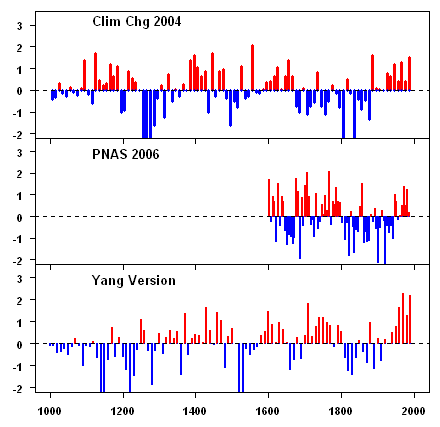
Figure 1. Scaled Guliya dO18 values for versions from Thompson et al 2006 (PNAS), Thompson et al 2004 (Climatic Change) and Yang et al 2002 (GRL).
Squint first at the Clim Chg 2004 version and compare it to the 2nd panel – it looks to me like that dates of the core have been made younger in the 2nd panel – for example, the blue values in the 18th and 19th century in the top panel all seem to be in the 19th century in the PNAS version. It’s a bit of a guess, but I think that the 1604 start date of the PNAS 2006 version corresponds to about 1400 in the Climatic Change version. On that basis, the Climatic Change version would not include any values from the MWP from 1000-1200.
The Yang version also looks to me like it’s dated younger than the Climatic Change 2004 version. The downspike in about 1250 in the Climatic Change version looks like it occurs about 1450 in the Yang 2002 version. The 20th century values in the Yang version are at “anomalous” levels, but are not anomalous in the more recent PNAS version. What accounts for the difference?
And of course, Thompson won’t show the sample data. Now Al Gore has used Thompson’s hockey stick, so I doubt that there’s anyway short of a court order under which Thompson will release the sample data to reconcile this mess.
I’ve written on several occasions about Juckes’ use of cold water G Bulloides as a supposed temperature proxy (following Moberg’s equally indefensible use of this proxy.) It has come to my attention that a leading specialist, David Black of the University of Akron, had already issued a scathing denunciation of Juckes’ use of G Bulloides as a temperature proxy.
Black, an assistant professor of geology at the University of Akron, said that Juckes’ group did not use data on percentage G Bulloides properly in concluding that the 20th century was warm and the MWP ordinary. Black said that the record of G. Bulloides plankton in ocean sediment collected offshore provides a proxy record of the strength of trade winds. But “winds don’t meet any definition of warm, wet, or dry,” he points out.
See the first comment for the rest of the story.





 Climate Audit