London, August 16

I’m speaking in London on August 16:

When: Thursday, 16 August 2012, 3pm
Where: Institute of Materials, Minerals and Mining, 1 Carlton House Terrace, London SW1Y 5DB

The talk is public. It is hosted by the Global Warming Policy Foundation. I’m going to be talking about events over the past year, but will mostly be talking about the increased emphasis by the climate “community” on Climate Extremes, paying particular attention to the IPCC Special Report on Extremes (SREX) published in March, which was the basis of WG2 Co-Chair Christopher Field’s recent testimony to Congress.

These leads into tornados, hurricanes, floods, wildfires, heat waves and droughts, the latter two very topical from this year’s very hot North American summer. (Climate, of course, is not about the weather, except when it’s about the weather.)

UEA Can’t Find Wahl Attachments

The main target of Phil Jones’ notorious email deletion campaign was Eugene Wahl’s surreptitious correspondence with Briffa in summer 2006, in which Wahl changed the IPCC assessment of the Mann controversy from that which had been sent out for external review. Wahl’s changes were contained in attachments to his emails to Briffa. The emails mostly came out in Climategate 1 (with some interesting additions in CG2), but the key attachments were not included in Climategate documents.

As Jones had requested, Mann forwarded Jones’ deletion request to Eugene Wahl, who, according to the report of the NOAA Inspector General in early 2011, then deleted the documents. According to a contemporary (2008) email from Jones to Jean Palutikoff, Briffa removed the emails to thumb drives which he took home.

In 2011, I submitted an FOI request to the UEA for the attachments to the Wahl emails. UEA refused this request, claiming that there were no copies of these attachments on university computers and that they were unable to/not obliged to search the backup server then in the possession of the Norfolk police. I had appealed their refusal on the basis that the UEA was able to request a search of the backup server. The Information Tribunal had accepted the appeal and pleadings had been exchanged up to final replies. In the very latest stages of this proceeding, the server was returned to UEA.

Without withdrawing their previous arguments, the UEA undertook to search the backup server for the Wahl attachments. They reported on this search on August 8, the report being co-authored by FOI officer David Palmer and Chris Collins. Continue reading

IPCC’s Secret Letter

On Feb 26, 2010, as part of their first response to Climategate, Thomas Stocker, a Climategate correspondent of Phil Jones and by then Co-Chair of AR5 WG1, sent a still secret letter to all AR4 Lead Authors, Coordinating Lead Authors and Review Editors under the letterhead of WG1, purporting, it seems, to represent the parent IPCC organization. The existence of this secret email came to light as a result of David Holland’s persistence in trying to cut through IPCC authoritarianism and secrecy. After learning of its existence, David submitted an FOI request, which has been refused, and which is now under appeal at the Tribunal. Continue reading

Gergis and Watts Delayed

According to information from the University of Melbourne, Gergis et al was not re-submitted by the end of July, but has been delayed until the end of September. The university stated:

Please see latest information below

Print publication of scientific study on hold

An issue has been identified in the processing of the data used in the study, “Evidence of unusual late 20th century warming from an Australasian temperature reconstruction spanning the last millennium” by Joelle Gergis, Raphael Neukom, Stephen Phipps, Ailie Gallant and David Karoly, accepted for publication in the Journal of Climate.

The authors are performing detailed reanalysis of the data for the above paper and will submit the revised paper to the journal as soon as possible, likely before the end of September.

I wonder how IPCC will handle this. Will Gergis et al be given the Wahl exemption?

[Update- October 2012.] Without any marking of a change, the above notice has been revised to the following:

Scientific study resubmitted.
An issue has been identified in the processing of the data used in the study, “Evidence of unusual late 20th century warming from an Australasian temperature reconstruction spanning the last millennium” by Joelle Gergis, Raphael Neukom, Ailie Gallant, Steven Phipps and David Karoly, accepted for publication in the Journal of Climate.

The manuscript has been re-submitted to the Journal of Climate and is being reviewed again.

Alert readers will note that Anthony Watts used remarkably similar (TM-climate science) language in his post today

An issue has been identified in the processing of the data used in Watts et al. 2012 that was placed online for review….

The authors are performing detailed reanalysis of the data for the Watts et al. 2012 paper and will submit a revised paper to a journal as soon as possible, and barring any new issues discovered, that will likely happen before the end of September.

Unlike Karoly and Gergis, Anthony acknowledged critics:

We thank critics, including Zeke Hausfather and Steve Mosher for bringing that to attention. Particular thanks go to Zeke who has been helpful with emailed suggestions. Thanks also go to Dr. Leif Svalgaard, who has emailed helpful suggestions.

Hide the Megadroughts

Pielke Jr asserts, using unvarnished words, that WG2 Co-Chair Christopher Field, an ecology professor at Stanford, “misled” Congress. Pielke stated:

This is not a particularly nuanced or complex issue. What Field says the IPCC says is blantantly wrong, often 180 degrees wrong. It is one thing to disagree about scientific questions, but it is altogether different to fundamentally misrepresent an IPCC report to the US Congress.

Pielke noted in connection with droughts:

Field conveniently neglected in his testimony to mention that one place where droughts have gotten less frequent, less intense or shorter is … the United States.

Field was Co-Chair of the recent IPCC SREX report on Extremes, which reported this fact in unambiguous terms as follows: (p182) [added Aug 2]

In North America, there is medium confidence that there has been an overall slight tendency toward less dryness (wetting trend with more soil moisture and runoff; Table 3-2), although analyses for some subregions also indicate tendencies toward increasing dryness. This assessment is based on several lines of evidence, including simulations with different hydrological models as well as PDSI and CDD estimates (Alexander et al., 2006; Andreadis and Lettenmaier, 2006; van der Schrier et al., 2006a; Kunkel et al., 2008; Sheffield and Wood, 2008a; Dai, 2011). The most severe droughts in the 20th century have occurred in the 1930s and 1950s, where the 1930s Dust Bowl was most intense and the 1950s drought most persistent (Andreadis et al., 2005) in the United States, while in Mexico the 1950s and late 1990s were the driest periods. Recent regional trends toward more severe drought conditions were identified over southern and western Canada, Alaska, and Mexico, with subregional exceptions (Dai, 2011).

Field’s SREX report noted paleoclimate evidence for past megadroughts (which occurred in the US as well) – an important piece of evidence that Field did not disclose in his testimony. [added – Aug 2]

From a paleoclimate perspective recent droughts are not unprecedented, with severe ‘megadroughts’ reported in the paleoclimatic record for Europe, North America, and Australia (Jansen et al., 2007). Recent studies extend this observation to African and Indian droughts (Sinha et al., 2007; Shanahan et al., 2009): much more severe and longer droughts occurred in the past centuries with widespread ecological, political, and socioeconomic consequences. Overall, these studies confirm that in the last millennium several extreme droughts have occurred (Breda and Badeau, 2008; Kallis, 2008; Büntgen et al., 2010).

Tailoring of AR5?
The AR5 Zero Order Draft on paleoclimate stated, in language reminiscent of Soon and Baliunas, “multiple studies suggest that current drought and flood regimes are not unusual within the context of last 1000 years”. However, the First Order Draft was substantially changed to language apparently tailored to avoid a direct contradiction of alarmist narrative.

Watch the pea.

The AR5 Zero Order Draft section on droughts and floods stated:

5.5.2.4 Megadroughts and Floods
Drought and floods are recurring extreme climate events. There is ample historical evidence for their past important physical, economic, social and political consequences (Buckley et al., 2010; Buntgen et al., 2011; Graham et al.; Zhang et al., 2008). Evidence from tree rings, historical documents, stalagmites, lake
sediments, peatlands, etc, indicates that severe megadroughts (by modern standards droughts of unusually long duration that typically exceed those observed in the instrumental records; [Woodhouse and Overpeck, 1998; Stahle et al., 2000; Cook et al., 2010]) are a recurrent feature in many regions including North America, east and south Asia, Europe, Africa and India [(Cook, 2007; Herweijer, 2007; Zhang, 2008; Zheng, 2006; Buckley, 2010; Buckley, 2010; Cook, 2010; Helama, 2009; Russell, 2007; Büntgen, 2010; Esper, 2007; Sinha, 2007; Shanahan, 2009; Neukom, 2010; Pfister, 2006; Touchan, 2008; Touchan, 2010; Pauling, 2007; Verschuren, 2000; Christie, 2009; Berkelhammer, 2010; Nicault et al., 2008)].

The occurrence and spatial extent of past megadroughts may be clustered over time following regime changes. There is evidence for more severe droughts during the LIA in South Asia, eastern Northwest China, and Southeast Asia, west Africa and parts of Europe [(Buckley, 2010; Sinha, 2007; Shao, 2010; Zheng, 2006; Zhang, 2008; Sinha, 2007; Sinha, 2007; Helama, 2009; Buntgen, 2011; Pauling, 2007; Cook, 2010 ; Russell, 2007; Shanahan, 2009)] compared to the predating MCA and the last century. In contrast, drought extent in North America, northern and central Europe, and East Africa were significantly greater during 900–1300 than during the LIA and the last century [(Cook, 2007; Cook, 2010; Herweijer, 2007; Helama, 2009; Luoto, 2010; Russell, 2007; Verschuren, 2000; Stager, 2005)]. Proxy information indicate, that intervals of severe drought in western Africa lasting for periods ranging from decades to centuries are characteristic of the monsoon and are linked to natural variations in Atlantic temperatures ([Shanahan et al., 2009]; see also Sections 5.5.2.1 and 5.6.2). Proxy reconstructions and model experiments suggest that variability in the tropical Pacific might partly account for the occurrence of megadroughts in North America with related teleconnections in all continents (Seager et al., 2008). A strengthening of the zonal SST gradient in the tropical Pacific via an enhancement of La Niña state and possibly warming of the Indian Ocean during periods of the MCA may have contributed to arid conditions in North America (Graham et al.; Seager et al., 2008), contrasting with wetter conditions in Asia (Graham et al., 2007). During the MCA, positive NAO conditions (see Section 5.5.5.3) and AMO phases may have favored wetter winter conditions in NW Europe and arid in NW Africa [(Graham, 2007; Esper, 2007; Touchan, 2008; Touchan, 2010)]. El Niño phases seem to have been more prominent during the LIA than the MCA, in coincidence with monsoon weakening Section 5.5.2.1) and drought occurrence in Asia (Buckley et al., 2010; Cook et al., 2010a),


Overall, multiple studies suggest that current drought and flood regimes are not unusual within the context of last 1000 years [(e.g., Cook et al., 2010; Seager et al., 2008; Graham et al., 2010)].

Now here is the corresponding section of the First Order Draft:

5.4.2.2 Megadroughts and Floods
Paleo drought reconstructions provide estimations of the frequency, duration and severity of past dry periods. Megadroughts are comparable in intensity to present drought events but with durations longer than several years to a decade (e.g., Seager et al., 2009).

Figure 5.12 shows regional PDSI (Palmer Drought Severity Index) values reconstructed using tree rings in North America and Monsoon Asia (Cook et al., 2004; Cook et al., 2010), duration of droughts, their severity, and their frequency. Proxy information indicates that intervals lasting from decades to centuries of more frequent severe drought in western Africa are characteristic of the monsoon and appear to be linked to variations in Atlantic temperatures (Shanahan et al., 2009; see also Section 5.6). Proxy reconstructions and model experiments suggest that strengthening of the zonal SST gradient in the tropical Pacific or more severe La Niña conditions, and possibly warming of the Indian Ocean, during periods of the MCA may have contributed to arid conditions in North America (Graham et al., 2011; Graham et al., 2007; Seager et al., 2008), contrasting with wetter conditions in Asia (Buckley et al., 2010; Graham et al., 2011; Graham et al., 2007), although direct evidence of SST variability and ENSO state is more equivocal (Emile-Geay et al., in press). During the MCA, positive NAO conditions (see Section 5.4.3.2) and AMO phases may have favored wetter winter conditions in NW Europe and arid in NW Africa (Esper et al., 2007b; Graham et al., 2007) although Touchan et al (2011) do not find evidence of overall changes in mean drought conditions in northwestern Africa. The transition from the MCA to the LIA appears to coincide with monsoon weakening and megadrought occurrence in Asia (Buckley et al., 2010; Cook et al., 2010), while in North America an apparent shift toward overall wetter conditions occurs in the middle of the 14th century (Cook et al., 2004).

Overall, multiple studies suggest that current flood magnitudes are not unusual within the context of the last 1000 years (e.g., Benito et al., 2011; Brázdil et al., 2012; Enzel et al., 1993; Greenbaum et al., 2000; Herget and Meurs, 2010; Mudelsee et al., 2003)…

Note carefully that the First Order Draft suppressed any explicit mention of historical megadroughts exceeding those in the modern instrumental record (attested in the Zero Draft by a substantial literature. In my opinion, the language in the Zero Order Draft was a better assessment of paleoclimate information.

What was the justification for IPCC authors removing this important information from paleoclimate? It appears to me that the information was deleted because it was inconsistent with alarmist narrative on droughts and not for a valid reason.

To borrow a phrase from Phil Jones, one might say that the evasive language of the First Order Draft was a trick to hide the megadroughts.

Postscript: In Field’s day job, he does statistical analyses of crop yields. His main claim to fame is arguing that increased temperatures have reduced crop yields. Given the astronomical increase in crop yields during the 20th century concurrent with temperature increases and many confounding factors, this is an uphill job. Field’s frequent coauthor, David Lobell, attracted attention with an article in Science last year, expanding on this point. I looked briefly at that article (but did not post on it.) I was amused that it used the CRU-TS data set excoriated by Harry-Readme. (As I recall, the harry readme was explained away on the basis that no one used the CRU-TS data set, a memo that Field and coauthors do not appear to have received.)
Surface Stations

People have quite reasonably asked about my connection with the surface stations article, given my puzzlement at Anthony’s announcement last week. Anthony described my last-minute involvement here.

As readers are probably aware, I haven’t taken much issue with temperature data other than pressing the field to be more transparent. The satellite data seems quite convincing to me over the past 30 years and bounds the potential impact of contamination of surface stations, a point made in a CA post on Berkeley last fall here. Prior to the satellite period, station histories are “proxies” of varying quality. Over the continental US, the UAH satellite record shows a trend of 0.29 deg C/decade (TLT) from 1979-2008, significantly higher than their GLB land trend of 0.173 deg C/decade. Over land, amplification is negligible.

Anthony had asked me long ago to help with the statistical analysis, but I hadn’t followed up. I had looked at the results in 2007, but hadn’t kept up with it subsequently.

When Anthony made his announcement of big news, I volunteered to check the announcement – presuming that it was something to do with FOIA. Mosher and I were chatting that afternoon, each of us assigning probabilities and each assigning about a 20% chance to it being something to do with the surface stations project.

Anthony sent me his draft paper. In his cover email, he said that the people who had offered to do statistical analysis hadn’t done so (each for valid reasons). So I did some analysis very quickly, which Anthony incorporated in the paper and made me a coauthor though my contribution was very last minute and limited. I haven’t parsed the rest of the paper.

I hadn’t been involved in the surface stations paper until after his announcement though I was familiar with the structure of the data from earlier studies.

I support the idea of getting the best quality metadata on stations and working outward from stations with known properties, as opposed to throwing undigested data into a hopper and hoping to get the answer. I think that breakpoints methods, whatever their merits ultimately demonstrate, need to be carefully parsed and verified against actual data with known properties (as opposed to mere simulations where you may not have thought of all the relevant confounding factors). To that extent, Anthony’s project is a real contribution, whatever the eventual results.

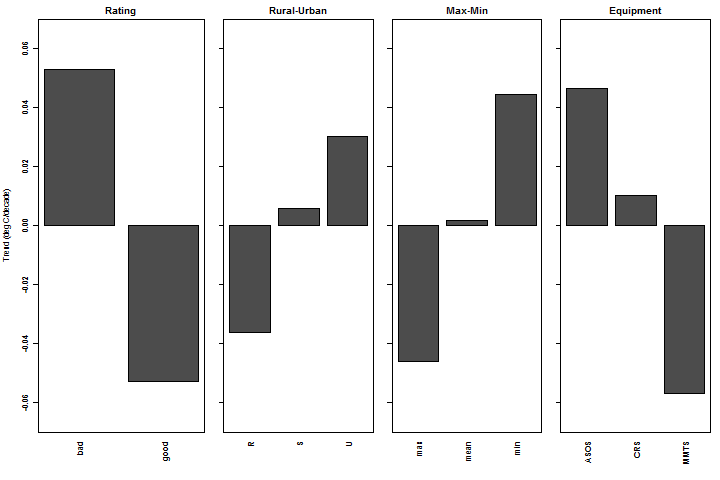
It seemed to me that random effects methodology could be applied to see the impact on trends of the various complicating factors – ratings category, urbanization class, equipment class. (Using the grid region as a separate random effect even provides an elegant way of regional accounting within the algorithm.) This yielded apparent confirmation in expected directions: a distinct effect for urbanization class in the expected direction; of ratings in the expected direction; and of max-min in the expected direction.


Figure 1. Random Effects of Urbanization, Rating, Equipment, Maax-Min.

Whenever I’m working on my own material, I avoid arbitrary deadlines and like to mull things over for a few days. Unfortunately that didn’t happen in this case. There is a confounding interaction with TOBS that needs to be allowed for, as has been quickly and correctly pointed out.

When I had done my own initial assessment of this a few years ago, I had used TOBS versions and am annoyed with myself for not properly considering this factor. I should have noticed it immediately. That will teach me to keep to my practices of not rushing. Anyway, now that I’m drawn into this, I’ll have carry out the TOBS analysis, which I’ll do in the next few days (at the expense of some interesting analysis of Esper et al.)

I have commented from time to time on US data histories in the past – e.g. here, here here, each of which was done less hurriedly than the present analysis.

Anthony’s Announcement

As many of you are aware, Anthony has stopped WUWT for two days, pending an announcement, which he describes as important. I have no idea what it is. However, no one can say that he doesn’t have good instincts for how to attract attention to the announcement. It will have to be pretty good to live up to this hype; Anthony also knows this.

So I’m waiting with as much interest as everyone else.

Update: Anthony’s dialed back expectations. Nothing on FOIA.

“Infestation of Beetle Larvae”

From time to time, we hear from climate scientists that they are limited in their responses by the dignity of their profession. The dignity to which climate scientists aspire is nicely exemplified by the following remarks  archive of a prominent real_climate_scientist:

hey trolls who have been given marching orders to flood the comment threads here like an infestation of beetle larvae: Don’t bother! We’ve seen the mindless talking points before, and coming here to parrot them simply (a) pollutes the otherwise thoughtful discussion in the comment threads here, and (b) exposes the intellectual bankruptcy of your climate change denial zealotry.

Thoughts like the above are surely what the poet Thomas Gray had in mind when he wrote:

Full many a gem of purest ray serene
The dark unfathomed caves of ocean bear:
Full many a flower is born to blush unseen,
And waste its sweetness on the desert air.

From time to time, we here at Climate Audit have had the opportunity to draw attention to these sweet flowers and do so here once again.

Was Gergis et al “Withdrawn”?

On June 12, David Karoly stated of the then recently disappeared Gergis et al:

The paper has been put on hold, while an issue with the data processing and methods that we have identified is checked. The paper has not been withdrawn nor has it been retracted.

In a June 13 email to Gergis et al coauthors and Climate Audit antagonists Schmidt, Mann, Steig, Wahl (see documents obtained by Warwick Hughes here), Gergis admitted that the paper was not merely “on hold” (whatever that means), but that they had decided to “voluntarily withdraw” the paper:

we felt that we needed to voluntarily withdraw the paper in press with the journal, amend the text and add some extra supplementary material justifying our method…

this means we will need to resubmit the manuscript to peer review once again…

We contacted the journal editor on Friday June 8 to let them know…

I guess Karoly has been taking lessons on honesty in climate communications from Phil Jones.

Update- Oct 2012: Journal of Climate now says (h/t WUWT) that the paper has been withdrawn:

The Questions That Were Never Asked

Andrew Montford’s FOI request for emails between the UEA and Outside Organisation ( who were represented by Neil Wallis, charged in the phonehacking scandal) has turned up a remarkable list of questions, the questions that should have been asked by one of the “investigations”, but were never answered.

On February 22, 2010, Alan Preece, an administrator at UEA, completed collation of a list of questions for preparation of Acton and Phil Jones for their March 1 appearance before the Select Committee. See here – more correspondence here.)

Bishop Hill reader TerryS has collated the questions from the pdf. Had these questions been asked and answered, this affair would have been over long ago. Some of the most obvious and important questions have never been asked or answered.

The list of questions also shows that UEA administration clearly understood the sort of questions that needed to be asked. They accordingly know that Muir Russell didn’t ask those questions. Perhaps that was their strategy – sort of like hiring a Inspector Clouseau confident that he would never stumble across the real plot. Or perhaps it was a serendipitous result from administrators wanting to whitewash the situation.

(Dig here: the correspondence was to and from the notorious Neil Wallis of the phone hacking scandal. Wallis had been working as a PR consultant less than a year when retained by UEA. During Wallis’ consultancy for UEA, he was being concurrently paid by the police and by the News of the World. See here.)

Continue reading