Berkeley “Very Rural” Data

Richard Muller sent me the BEST list of “very rural” sites – see http://www.climateaudit.info/data/station/berkeley.

I took a quick look at the “very rural” stations in two tropical countries – Peru and Thailand – in order to groundtruth their classification methodology. These two examples were chosen because several years ago, I looked at Hansen’s “rural” Peru stations, most of which were actually urban; and because one of my sons is in Thailand.

Berkeley classified only two stations in Peru as “very rural” – Huanuco and Quince Mil. However, the population of Huanuco, according to GeoNames, is 147959; it was classified by Hansen as urban. Why the Berkeley algorithm classed it as “very rural” is unclear. Quince Mil is a small town recently featured in Time magazine here. The Berkeley record only has a few sporadic values after the mid-1980s. The BEST urban-rural comparison in Peru looks to me like it has no meaning.

The Berkeley classification in Thailand also looks very suspect. As in Peru, many of the “very rural” sites are small cities. Some locations look suspicious. “Bangkok Pilot” is shown as “very rural”, but when googled is associated with Suvarnabhumi, the name of the very urban Bangkok airport (data is sparse, so it may be something else, but anything associated in any way with Bangkok can hardly be “very rural”)

There are five “very rural” Thailand sites with a minimum of 120 values: PHETCHABURI (population 46,501), KO LANTA (population 20,000), TAKUA PA (population 35,337), KO SAMUI (population 50,000) and MAE HONG SON, a relatively long record in the northwest hill country near the Myanmar border. (We visited Pai which is near there a couple of years ago.) A picture Mae Hong Son airport is shown below:

The Bangkok metropolis data set is the longest series in the area. For reasons that remain obscure, the Berkeley version for Bangkok runs hotter than the CRU version:
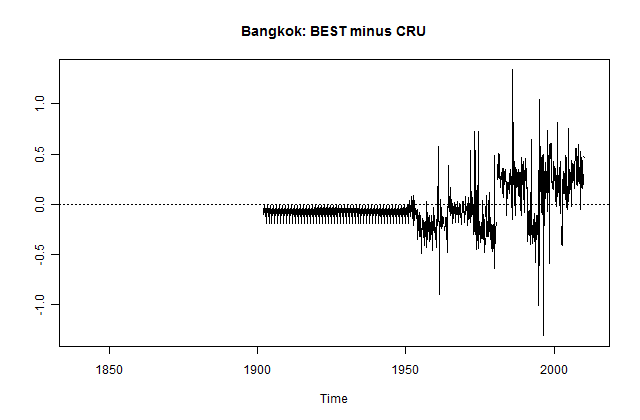
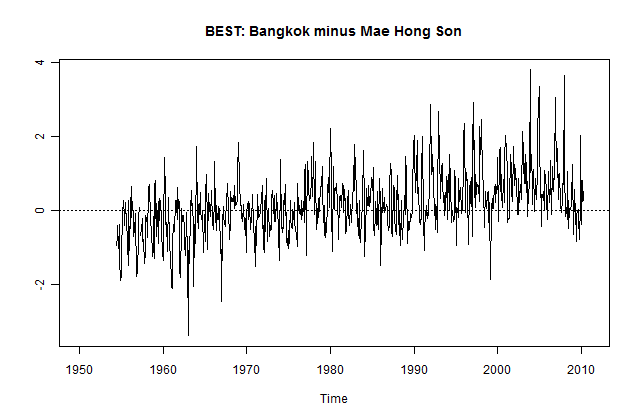
The CRU stations in the CRU gridcell are all highly urban: BANGKOK METROPOLIS (!), ARANYAPRATHET (population 73813), CHANTHABURI (population 488397), SIEMREAP (population 85,000), KAMPOT (poluation 39186), PHNOM-PENH (!). Although we keep hearing of the unimportance of UHI, Bangkok has increased 0.24 deg C/decade relative to Mae Hong Son.
Eudora and the Briffa Attachments

In March 2010, Eugene Wahl admitted to the NOAA Inspector-General that he had destroyed his email correspondence with Keith Briffa about changes to IPCC and falsely stated that “all” the emails were in the public domain. This was untrue. The attachments were not in the public domain. Not only were the attachments not in the public domain, but Wahl had actively opposed disclosure of these emails. Following Wahl’s disinformation about the topic, I submitted an FOI request in April 2010 for the attachments to Wahl’s emails. I provided a review of this and subsequent events earlier this year here – worth re-reading if you wish further context on today’s post.

Briefly, East Anglia refused my request for the attachment to the Wahl-Briffa emails on the grounds: “Information not held”.

Later in the year, after Muir Russell admitted to the Parliamentary Committee that he had not investigated Jones’ email deletion enterprise, Acton told the committee that he had “investigated” the incident – the first public mention of the “Acton investigation” – and, in answer to a direct question from Graham Stringer whether all the emails were available and could be read, told the Committee “Yes”.

Acton’s answer was inconsistent with the excuse used by East Anglia to refuse my request for the attachments to the Wahl-Briffa emails. I accordingly appealed the decision last year. I followed up on several occasions. In July 2011, I was informed that the decision was in the process of being drafted. In early November 2011, I was told that the decision had been drafted and was awaiting sign-off. But still nothing.

Climategate 2.0 brings interesting new information on the attachments – information which may also shed some light on the provenance of the Climategate dossier itself.

On October 12, 2009, about a month before the release of the Climategate dossier, Tom Melvin emailed Mike [Salmon] describing a procedure in which Melvin had copied Briffa’s complete Eudora file together with 3.5 GB of attachments (apparently going back a number of years) to his portable. These arrangements were presumably made to facilitate Briffa’s access to his email history while Briffa was recovering from a serious illness.

3939. 2009-10-12 12:07:03
______________________________________________________
cc: Keith
date: Mon Oct 12 12:07:03 2009
from: Tom Melvin
subject: Keith Email
to: Mike
Mike,
For Keith’s Email :
1. Copied the full C:\Eudora directory to my portable.
2. Deleted the 12000 temporay .gif files from C:\Eudora\Embedded.
3. Copied 3.5 gig of attachments (1 year or older) from C:\Eudora\Attach to C:\OldAttach – this will need to be copied back to his PC
4. He is left with a 1.5 gig C:\Eudora directory on my portable which can be copied back to his PC and readily be moved from PC to portable etc.
5. When using my portable (via yellow cable (in office) or various WiFi networks) Keith logs in to VPN.
Tom
PS. I need to take my portable to a conference w/c 26th Oct.

Bishop Hill, in an article today, refers to another CG2 email that sheds new light on CRU’s handling of emails. In email 0021, Jones informed Manola Brunet:

Hola Manola,
I’ve saved emails at CRU and then deleted them from the server. Now I’m at home I just have some hard copies.

Email 21 was on Sep 12, 2009, only a month prior to Melvin’s email. CA readers will recall that, in August 2009, as a result of the “mole” incident, Jones had ordered the removal of many documents from CRU’s FTP server (many of which were presumably placed on another server not intended for public access.)

Co-Opting the US Department of Energy

Maxim Lott of Fox News has an interesting article drawing attention to the co-opting of US Department of Energy funders by CRU and their associates – co-opting in the sense that the US Department of Energy totally failed to ensure that their grant procedures complied with US federal policy for requiring grantees to archive data.

In the article, Lott quoted extensively from Jones’ emails between 2007 and 2009 in which he assured correspondents that the US Department of Energy had assured him that he didn’t have to archive data:

Making that case in 2009, the then-head of the Research Unit, Dr. Phil Jones, told colleagues repeatedly that the U.S. Department of Energy was funding his data collection — and that officials there agreed that he should not have to release the data.

“Work on the land station data has been funded by the U.S. Dept of Energy, and I have their agreement that the data needn’t be passed on. I got this [agreement] in 2007,” Jones wrote in a May 13, 2009, email to British officials, before listing reasons he did not want them to release data.

Two months later, Jones reiterated that sentiment to colleagues, saying that the data “has to be well hidden. I’ve discussed this with the main funder (U.S. Dept of Energy) in the past and they are happy about not releasing the original station data.”

A third email from Jones written in 2007 echoes the idea: “They are happy with me not passing on the station data,” he wrote.

I was contacted by Lott and drew his attention to correspondence in 2005 between Warwick Hughes and the US Department of Energy, which was reported at CA in October 2005 here. Earlier in February 2005, Jones had famously refused Warwick Hughes as follows:

Even if WMO agrees, I will still not pass on the data. We have 25 or so years invested in the work. Why should I make the data available to you, when your aim is to try and find something wrong with it. There is IPR to consider

In my October 2005 post, I reported Hughes’ email to Tom Boden of the US Department seeking Jones’ data, together with Boden’s response advising Hughes that the terms of Jones’ grant did not require him to provide the funding agency with the data. Curiously, in the early 1990s, under earlier Department of Energy contracts, Jones had provided the US Department of Energy with a complete station data base which was published online by the DOE. (The University of East Anglia has never provided any theory of how alleged confidentiality agreements from the 1980s remained “actionable” given that Jones had either not been prevented by these agreements from providing station data to the US Department of Energy for their online publication or had done so without complaint by the NMSs at the time.)

The October 2005 post is well worth re-reading as it reviews US federal policy which would appear to have required the DOE to ensure that grantee CRU archived data. It also quotes policy from UNFCCC which also clearly required NMSs to have ensured that a system for archiving station data was established. The position of Nature and other defenders of CRU as justified due to elusive confidentiality agreements entails that IPCC participants who rely on these supposed agreements have failed to live up to these UNFCCC obligations. In my opinion, Jones, in his capacity as IPCC AR4 Coordinating Lead Author, ought to have reported such NMS consent refusals to IPCC participants as breaches of UNFCCC commitments. Jones’ failure to do so is hard to separate from his expressed desire as CRUtem proprietor to prevent critics (for reasons that remain unclear) from examining this data.

In my October 2005 post, I wondered at the tactical wisdom (from the Team’s standpoint) at obstructing access to this (and other) data, noting then (as on numerous subsequent occasions) that I did not necessarily anticipate large changes in the temperature history, but equally, given the wide public interest, why the record should not be made available for scrutiny.

New Light on Jones’ Document Deletion Enterprise

David Holland, in a guest post at Bishop Hill, shows that Climategate 2.0 has provided more context on Phil Jones’ efforts to organize the deletion of documents. Continue reading

The Tallbloke Search Warrant

Here is a copy of the search warrant. The name of the detective who swore the information giving rise to the warrant has been whited out at Tall Bloke’s request. (Tall Bloke said that he had “promised anonymity” to the detective. I don’t know why he would do this, but he was the one surrounded by six detectives.) The information (affidavit) supporting the warrant doesn’t seem to have been provided to Tall Bloke so far.

The warrant entitles the police to enter and search the premises for “evidence of an indictable offence” referring to section 15 of the Police and Criminal Evidence Act. In its Climategate series, even the Guardian was unable to conclude that there had been a crime. So I wonder how the Detective Inspector came to the conclusion that the computers at Tall Bloke’s residence would provide “material that is likely to be relevant evidence and be of substantial value to the investigation of the offence”.

The warrant does not include “special purpose material”, which,under section 14, is said to include “(b)journalistic material, other than excluded material.” “Journalistic material” is defined in section 13 as follows:

13 Meaning of “journalistic material”.
(1) Subject to subsection (2) below, in this Act “journalistic material” means material acquired or created for the purposes of journalism.
(2)Material is only journalistic material for the purposes of this Act if it is in the possession of a person who acquired or created it for the purposes of journalism.
(3)A person who receives material from someone who intends that the recipient shall use it for the purposes of journalism is to be taken to have acquired it for those purposes.

In California, bloggers are legally included as journalists. I wonder what the UK situation is.

Police Raid on Tall Bloke

Tall Bloke reports that he was raided by UK police and his computers seized. Read his blog post for further details, including actions in the US involving WordPress. Also see Jeff Id here. It is not a coincidence that this story is reported first on these three blogs.

In an unrelated story, according to Richard Tol, IPCC has told its WG2 scientists that they are above the law on freedom of information.

AR5 (ZOD) and Mike’s “PNAS Trick”

Another episode in the continuing series – Tiljander and Upside Down Mann. Continue reading

Watch the Pea – AR5 (ZOD) Chapter 10

As CA readers are aware, key findings of Santer et al 2008 do not hold using updated data. Ross and I submitted a comment to IJC showing this. The comment was rejected twice, with one of the reviewers (as in the case of the comment on Steig et al) being a Santer coauthor (who was not identified to us as such). Ross eventually managed to get similar results published in another journal.

Jean S points out in a comment on the Steig thread that our findings were completely misrepresented by IPCC AR5 (ZOD) chapter 10 (also the source of disinformation about Steig).

Our article stated that there was a statistically significant difference between models and observations in the tropical troposphere. Instead of citing our articles as rebutting Santer’s assertions, IPCC cites us as endorsing Santer’s false assertions:

The claim by Douglass et al. (2008) that modeled and observed trends in the tropical troposphere for the period from 1979 to 1999 are significantly different is contradicted by Santer et al. (2008) and McKitrick et al. (2010). The findings of Santer et al. (2008) are based on analyzing updated radiosonde and satellite datasets, considering observed and simulated trend uncertainties due to natural variability. Santer et al. (2008) also provide evidence based on synthetic data that the consistency test applied by Douglass et al. (2008) leads to incorrect conclusions.

They go on to make the following absurd statement:

Taking these studies together, we conclude, that apparent differences between tropical free tropospheric temperature trends in models and observations and differential warming in the tropics over the period 1979–1999 are unlikely to be statistically significant after fully accounting for observational uncertainties.

Watch the pea. The issue with Santer was that key results fell apart over the longer period of 1979-2009 (or 2010 or 2011) as opposed to the 1979-1999 period. As noted above, realclimate spoke out strongly against Courtillot’s analysis which didn’t use up-to-date data. Pierrehumbert alleged that such analysis was dishonest. Why should different standards apply when employed by IPCC chapter 10?

AR5 Loves Steig et al 2009

Jeff Id has an excellent post on IPCC AR5 use of the highly flawed Steig et al 2009. Despite Steig’s efforts to block the publication of O’Donnell et al 2010, O2010 shows clearly that whatever is new in Steig et al 2009 is not only incorrect, but an artifact of flawed math and whatever is valid was already known.

As Jeff observes, Steig coauthor Josefino Comiso (who was very uncooperative, to say the least, in providing data underpinning Steig et al 2009) is Coordinating Lead Author of AR5 Chapter 4 on the cryosphere, where Steig et al 2009 is cited, but not O’Donnell et al.

AR5 chapter 10 cites Steig et al 2009 four times, without any citation of O’Donnell et al 2010. Jeff quotes the following from AR5:

It was concluded that the pattern of mean surface temperature trends in both West and East Antarctica are positive for 1957–2006, and this warming trend is difficult to explain without the radiative forcing associated with increasing greenhouse-gas concentrations (Steig et al., 2009).

As readers of CA and tAV are aware, Steig’s methodology smeared warming from the Antarctic Peninsula into other parts of Antarctica. Jeff observes of the IPCC draft (with considerable frustration):

That last sentence is too much for me. The positive trends are very easy to explain – bad math!!

In Chapter 5 (Paleoclimate), Steig et al cited as authority for polar amplification. In this case, they have a placeholder noting O’Donnell et al 2010 as follows:

[Reference needed: O’Donnell et al., ?]).

O’Donnell et al 2010 was the only reference among the 1000 or so citations for this chapter where the authors had not bothered locating volume citation information. It was the only reference returning the term “null” as follows:

O’Donnell, R., N. Lewis, S. McIntyre, and J. Condon: Improved methods for PCA-based reconstructions: case study using the Steig et al. 2009 Antarctic temperature reconstruction. Journal of Climate, 0, null.

One doesn’t get the impression that the IPCC authors had read, let alone assimilated, the findings.

Check out Jeff’s post.

“Not Unusual”: AR5 (ZOD) and Climategate 2.0

In today’s post, I’ll connect an important conclusion in the draft AR5 report to an email exchange that is given extensive treatment in Climategate 2.0. Continue reading