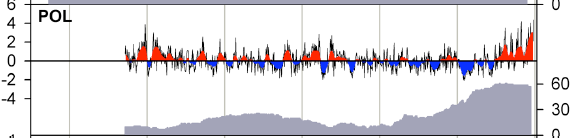
Kinnard Arctic O18 Series

Kinnard et al 2011 report a highly hockey-stick shaped reconstruction of sea ice. (For a different perspective based on Holocene ocean sediments under the Ellesmere Island ice shelf, see the recent Antoniades et al (PNAS 2011).

Kinnard et al use a regression-based statistical methodology that looks at first blush to be a sort of inverse regression: i.e. of sea ice against a large number of proxies and “proxies”. In any such procedure, there is a serious risk of spurious fits. (After all, you can reconstruct a trend with a sufficient number of white noise series simply by brute force.) Kinnard et al attempt to guard against this by considering the RE statistic. Here they head straight into the home territory of Mannian statistics.

This does not mean that their methodology is wrong, let alone “WRONG”. (I haven’t examined it yet, let alone parsed it.) But it is worrying.

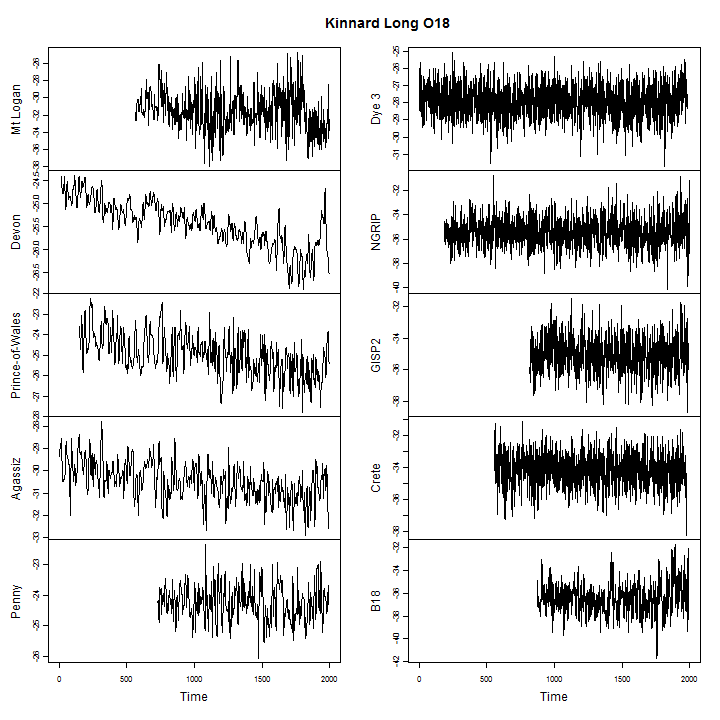
My own preferred technique for examining “multiproxy” data is to first divide the data into subsets of like proxies. The largest subset of Kinnard et al is the 22 O18 series (out of 69 proxies.) This turned out to be a remarkable subset in several ways and I spent much longer examining this data than I had expected or planned. Here is a graphic showing the ten long O18 series in Kinnard et al, arranged from west (Mt Logan, Alaska) to east. The left column shows Mt Logan plus four series in the Canadian archipelago.

The take-home points are that Kinnard et al have provided a huge/unprecedented increase in the number of archived Arctic O18 series – especially long high-resolution series. Whereas Mann et al 2008 had only two Arctic O18 series beginning prior to AD900, Kinnard et al have ten. Most of the ten aren’t new, but, to my knowledge, for the most part, they haven’t been available. And second, that the long Arctic O18 do not give the pronounced HS result of the final Kinnard diagram. Its provenance therefore lies elsewhere: either in other proxies or by sign-flipping and weighting in the regression methodology, resolution of which will require more analysis.

In the meantime, documentation of the new treasure trove of Arctic O18 seems worthwhile in itself.
Continue reading

Moderate Low Weight

(This post is by Jean S.) A few days ago Steve discussed Raymond Bradley’s objection to use of the Yang Chinese composite reconstruction in the Mann et al Eos-response to Soon & Baliunas (2003). Bradley called the series “crap”, and demanded it to be removed from Figure 2 in the Eos article. It is not completely clear if Bradley was fully aware that the Yang composite was also brought in to the Figure 1 in the form of Mann and Jones (2003) (later MJ03) NH composite, which was substituted only 3 days earlier for Briffa’s long series (of the earlier draft) in an agreement made only between Mann and Jones. Nevertheless, Mann defended (#4207) the use of the Yang composite in MJ03 by saying it got “a moderate low weight” in the composite.

In our GRL article, Phil and I weighted the records we used with respect to their decadal correlations with the instrumental gridpoint surface temperature data for the same region (numbers in parentheses in attached figure 1 from the paper), so if a series is truly crap in an objectively determined sense, it got very low weight. The China series has a reasonable (r=0.22), but not great correlation–and it gets a moderate low weight.

Only a day later the weight was further downgraded form a “moderate low weight” to a “low weight” (CG1: 1056477710).

Phil and I have already discussed–we agree that the low weight given to the record in the Mann and Jones composite treats the record appropriately…

At the time it was impossible for Bradley and others to quantify what Mann’s “appropriate low weight” meant. Luckily, as pointed out by UC, the MJ03 code is available in #3499 (also CG1: 1092167224) and we can now calculate the weight of the Yang composite. Before doing that, let’s take a look at other proxies used in MJ03.

As Gavin observed there are “a few typos” in the Eos Figure 1.

I note there a few typos in the Eos figure 1 though (signs of fast turnaround perhaps). It should say 1856–1940 in the key for Briffa et al. for instance (as it is in Jones and Mann, 2004).

Another “typo” was, of course, calling MBH99 plus 0.5 sigma as “Crowley and Lowery” (yellow). I found a third “sign of fast turnaround” in the caption:

an extension back through the past 2000 years based on eight long reconstructions [Mann and Jones,2003].

The long NH reconstruction shown in Figure 1 is actually based only on six series as clearly stated in MJ03 (Figure 2a). There is also another NH series calculated in MJ03 based on eight series, but it only starts in AD553, and AFAIK it is not used anywhere. This shorter NH series has the same six proxies as the main reconstruction plus Jacoby’s Mongolia series (discussed by Steve yesterday) and Fisher’s West Greenland series, both shown in the Eos Figure 2.

A natural member of MJ03 portfolio is Mann’s own western North American PC1 shown on a top of Eos Figure 2 (“Western US”), and discussed by Steve here. This series is a splice of Mannomatic PC1 of six chronologies extending back to AD200 (up to 1700) and the infamous “fixed” Mannomatic PC1 (based on 27 chronologies) from AD1000 network in MBH99 (after 1700). How exactly the splicing was done, as far as I’m aware, remains a mystery today. However, it is interesting that Mann did not “extend” his “fixed” AD1000 PC1 by splicing the new PC1 (based on six chronologies) to the end (i.e., for 200-999 period), which would have been more inline with his stepwise approach in MBH9X. Instead, the cutting point was 1700. We’ll probably never find out the reason for this odd selection, and I only remark that “fixed” AD1000 PC1 has relatively high 11th century values compared to those in the extended AD200 PC1.

As a side note, around time of Steve’s MJ03 post (see comments) we began to understand the effect of this ridiculous “CO2-adjustment” (Mannkovitch Bodge) in MBH99: it adjusted the verification RE statistic and affected the 1000-1850 linear trend (“Milankovitch cooling”) as plotted in the Hockey Stick. It took two more years and ClimateGate files to fully understand what had been done, see Bishop Hill’s treatment for details.

[Update: Dec 5, 2011. Steve wrote me that it is likely that instead of the bodged Torneträsk series some type of mixture of Torneträsk, Taimyr and Yamal was used as the third series, see Fig. 1 in MJ03. However, Taimyr and Yamal are not used in Jones&Mann (2004)  (see Fig. 1), which shares the code with MJ03, so it is hard to tell what exactly went in without actually seeing the file “torny.dat”. Moreover, the decadal correlation value in the code (0.32) does not match either the one given (0.47) in Fig.1 of MJ03 or the one (0.54) in Table I of JM04 …]

Third series in MJ03 is Briffa’s Torneträsk, again shown in the Eos Figure 2. I suppose only few even among regular CA readers know that also this series was “adjusted”, see Steve’s discussion of the topic from the early days of CA. Fourth series to enter the MJ03 portfolio is the Chesapeake Bay Mg/Ca proxy, also present in Figure 2. This series has declining temperatures since late 19th century. Finally, the last two components of MJ03 are rather surprising (not-so-suprisingly these are not plotted in the Eos Figure 2): two Greenland borehole reconstructions from Dahl-Jensen et al (1998) (pdf). Both D-J series have very high MWP values relative to the present (see Figure 4 in the article).

Now that we know the six proxies going in to MJ03 composite, we can return to the weighting issue. Recall that Mann claimed to Bradley (and others) that the weighting in MJ03 was done “objectively” by their decadal correlations to the local temperature, and that the Yang composite had a “reasonable (r=0.22), but not great correlation” and thus it obtained a “moderate low weight”. What Mann “forgot” to tell is that the weight in MJ03 is calculated not only based on correlation but also on the area.

Composite series were formed from weighted combinations of the individual standardized proxy series, employing weights on the individual records that account for the size of the region sampled, and the estimated reliability of the temperature signal as determined by comparison with the instrumental surface temperature record [Jones et al., 1999].

From the code it is seen that this areal weighting is actually cosine(latitude)*dof, where dof is an “estimated number of temperature gridpoints represented by record”. The total weight given to a proxy is then obtained by multiplying this area weight by the correlation. As the Yang composite has the highest dof (4) while both Dahl-Jensen series has 0.667, it is not hard to guess what the final weighting looks like…

…and here are the results of the relative weighting of MJ03 proxies:

extended NA PC1: 33%
Yang composite: 30%
Torneträsk: 17%
Chesapeake: 10%
D-J (DYE-3): 6%
D-J (GRIP): 4%

So in the end of the day, MJ03 composite so prominently presented in Eos Figure 1 is practically just an average of three series, “crappy” Yang composite, “extended” and “fixed” Mannomatic PC1, and Briffa’s “adjusted” Torneträsk. Also the definition of “low” in the Mannian dictionary is likely “anything below 1/3”.
Kinnard and the D’Arrigo-Wilson Chronologies

Two interesting new proxy studies out recently, one with a meticulous archive, one without.

Kinnard et al 2011 (Nature) here is a proxy reconstruction using 69 proxies to reconstruct Arctic sea ice. It contains a comprehensive archive: all proxies as used as archived; all code is archived. Three of the coauthors are Canadians, including David Fisher, who’s had a commendable history of archiving and distributing data even before web-based solutions. (Fisher’s CDs of data were the core of the ice core collections in MBH98 and Mann et al 2008).

Christiansen and Ljungqvist (Clim Past Disc) here is a reconstruction using 91 proxies (all plotted). Although Ljungqvist has recently made two substantial archives collating recent proxies, for some reason, the present study lacks such an archive. Like Kinnard, it uses a procedure said by the authors to be innovative (but without code.) The combination of no archive and no source code detracts from the ability to efficiently analyse the article. I’ve written to Ljungqvist hoping that they will remedy the situation (and I’m hopeful that they will). Unless they do, I don’t plan to consider this article.

Back to Kinnard. The article uses a complicated multivariate method (Partial Least Squares). The authors provide information on their procedures, but overlook one of the most important aspects: at the end of the day, Partial Least Squares, like other methods, results in a vector of weights for the various proxies. While the authors present maps showing loadings for different PCs, unfortunately they didn’t connect the dots to carry out the linear algebra to extract the weights. It will take a while to analyse.

The D’Arrigo Proxies
In 2005, I tried to get the component chronologies (and measurement data) for D’Arrigo et al 2006 (of which Rob Wilson was a co-author, responsible for much if not most of the analysis, but not in control of archiving decisions.) Unfortunately, six years later, the D’Arrigo-Wilson chronologies remained unarchived.

Kinnard used 11 tree ring chronologies, of which 9 were attributed to D’Arrigo et al 2011 (one to Grudd; one to a third party.) The attribution to Grudd is incorrect: this series also comes from D’Arrigo et al. To my knowledge, this is the first time that these chronologies from D’Arrigo et al 2006 have been archived. (Definite progress here – CA readers will recall that Nature required Moberg to archive third party data sets even if the originating author hadn’t archived the data. Nice to see this happening without a complaint being required.)

Unfortunately, the authors seem to have jumbled 7 of the series, so that the wrong location is attached. (The sites are transposed in the style of the incorrect location of the MBH98 instrumental precipitation data used as temperature proxies.) I noticed this when I plotted up their Tornetrask version which looks as follows. This doesn’t look like the Grudd Tornetrask series at all – as any knowledgeable reviewer would have known. It looks like a Yamal version.


Figure 1. Series 68 in the Kinnard file. Site 68 in the information is Tornetrask.

As CA readers are aware, the Polar Urals series of D’Arrigo et al 2006 was actually Yamal (though the core counts illustrated in their figure came from Polar Urals.).

Figure 2. “Polar Urals” series from D’Arrigo et al 2006. (Actually Yamal with Polar Urals core counts.)

Here is Kinnard series 68 plotted in a similar style – showing that the two series are identical.

Figure 3. Kinnard Series 68 in D’Arrigo style.

Here is the complete transposition (as archived. It’s possible that it’s an archiving error rather than a substantive error):

Tornetrask – relocated to Central Northwest Territories;
Forgfjorddalen, Norway – relocated to Yakutia, Siberia
Central Northwest Territories, Canada – relocated to Taymir, Siberia
Yakutia, Siberia – relocated to Polar Urals, west Siberia
Taymir, Siberia – relocated to Yukon, Canada
Yamal, Siberia – relocated to Tornetrask, Sweden
Yukon, Canada – relocated to Forgfjorddalen, Norway

If the error in their archive exists in their data as used, these erroneous locations will obviously affect spatial maps of loadings and weights, to the extent that these proxies are used. This sort of error should have been observable almost immediately to anyone familiar with the proxies.

Over and above the transposition error, Kinnard et al have incorrectly used the Yamal chronology as the “Polar Urals” chronology (with Polar Urals core counts). In fairness to Kinnard et al, D’Arrigo et al incorrectly labeled the Yamal chronology as Polar Urals and then refused to issue a Corrigendum acknowledging the error.

Kinnard et al do not discuss the discrepancy between the divergence problem and the chronologies selected in D’Arrigo et al. Senior author D’Arrigo told the NAS panel that you have to pick cherries if you want to make cherry pie. The large population Briffa et al 1998 showed declining ring widths in a very large population of high-latitude sites (the divergence problem). The tree ring sites selected by Kinnard are also high-latitude sites, but on balance go up. The inconsistency between the decline in the large population and the rise in the small subset suggests biased selection at some point in the process – an issue not addressed by Kinnard. By blending the tree ring results with other proxies, the information from proxy class separately is not shown. I’ll try to extract this on another occasion.

Crowley Tries to Get Data from Jacoby

In 2004, prior to starting Climate Audit, I tried to get data from both Gordon Jacoby and Tom Crowley – neither experience being very pleasant. Climategate-2 emails provide an interest vignette in which Crowley got very frustrated trying to get data from Jacoby in 2008. Continue reading

Climategate 2.0 : The Cause

Another incisive commentary from Minnesotans for Global Warming:

Peer Review of Enhanced Hide-the-Decline

During the counter-attack on Soon et al 2003, Climategate participants made serious allegations about the integrity of its peer review and the editor (Chris de Freitas) who had supervised its publication. (These allegations were investigated by the publisher of Climate Research, Otto Kinne, who cleared de Freitas in unequivocal terms – a finding that did not convince the Climategate scientists. This is a topic that I will discuss on another occasion.)

In today’s post, I’m going to examine information from the Climategate emails on the peer review of Mann et al 2003. Given the serious allegations being leveled against the peer review of Soon et al 2003, one would presume that the Climategate correspondents would ensure that the peer review process for Mann et al (EOS 2003) would be not only meticulous, but antiseptic.

But was it?

For example, we know that the reviewers of Mann et al 2003 did not catch either its enhanced hide-the-decline, its failure to disclose enhanced hide-the-decline or the deceptive captioning in the primary figure used to “discredit” Soon et al. Obviously reviewers cannot be expected to be omniscient, but were they diligent and independent? Continue reading

Hide-the-Decline Plus

A few days ago, we discussed the unresponsive answers provided to climate scientist Jeff Severinghaus in February 2003 when he inquired about the validity of tree ring widths as proxies due to the inconsistency (divergence) between temperature and ring widths, answers characterized by Severinghaus here as not being a “straight answer”.

In first quarter 2003 (almost exactly the same time as Severinghaus’ inquiry), Soon et al raised almost precisely the same question in Soon et al (EE 2003). The answer of Mann and a long list of coauthors (Ammann, Bradley, Hughes, Rutherford, Jones, Briffa, Osborn, Crowley, Oppenheimer, Overpeck, Trenberth and Wigley), which is the topic of today’s post, took hide the decline to new levels. Continue reading

Direct Action at Harvard

Attention has been drawn today to Mann’s request to other Team members for suggestions as to how to take direct action at Harvard against Soon and Baliunas. Not noticed thus far is that Kevin Trenberth reverted almost immediately with suggestions and that Mann followed up on these suggestions. Later, Soon’s supervisor has a small cameo when we (Ross and I) enter on the scene. Continue reading

Severinghaus and “Hide the Decline”

One of the very first contributions to realclimate was an FAQ from Jeff Severighaus on Dec 3, 2004. A year earlier, Severinghaus attempted (unsuccessfully) to get an explanation of the “divergence” problem from Mann and the rest of the Team. Severinghaus had become interested in the question following a presentation by Tom Karl of NOAA in which he had used a figure from Briffa and Osborn 2002, in which he wondered about the “flat” response of the tree ring proxies in the last half of the 20th century.

In nearly all defences of the deletion of the decline in spaghetti graphs that yield a rhetorical effect of coherence between the Briffa and other reconstructions in the last half of the 20th century, it’s been argued that the divergence problem was fully disclosed in a couple of 1998 Briffa articles and that this disclosure in the original technical literature constituted sufficient disclosure – a point that I contested long before Climategate.

The Severinghaus exchange is highly pertinent to this issue. Severinghaus was a climate scientist who was not a specialist in the area who asked specifically about a diagram in which the decline had been hidden (though Severinghaus was unaware that the decline had been hidden.)

Severinghaus was concerned merely by the flattening of proxy response. One can only imagine how the exchange would have read had Severinghaus been aware that the Briffa reconstruction actually declined sharply. Read and see whether Mann, Jones and/or Briffa drew Severinghaus’ attention to the early articles in which the divergence problem was disclose.

Continue reading

IPCC: “Fix It or Fold It”

(Steve: Here is Ross’ excellent op ed on the IPCC from National Post. Ross’ paper is here.)

Continue reading