Crowley’s Apology

Tom Crowley has asked that the following apology be published at Climate Audit for his 2005 EOS article, as well as a similar interview on BBC, both of which contained numerous untrue and damaging allegations against me. See the original EOS article is here , my rejected reply here, the underlying correspondence here with some contemporary commentary. As I noted at the time, Crowley and I subsequently corresponded constructively, but he has continued to sharply criticize me in public e.g. at dotearth in 2009 here and had never apologized for his untrue allegations. His apology today is quite generous though belated (and is one of a kind.)

With respect to Steve’s comment on my Eos article, I would like to make the following statement:

when I wrote that article, and later gave an interview on BBC, I was genuinely under the BELIEF that what I said was true (I had deleted the original emails long ago, so could not verify my belief).

However, a few months ago I had an idea where I might be able to access at least some of those mails. I was shocked when the mails did not reveal what I had totally come to believe Steve had written.

This realization called to mind another, entirely different, situation where I was also convinced about something that I thought I had read. That too later turned out to be unverifiable — I still can’t believe that either, but the evidence (not as strong) seems to suggest so.

The only way I can understand this is that my memory is not NEARLY as good on specifics as I thought it was – it can in fact play gross tricks on a person (I suppose that is why police are always wary of visual descriptions, etc).

Whatever, I know I didn’t intentionally lie, but I also now know that what I said was not true.

I had been meaning to apologize to Steve for that matter but, like many things, I forget about this and many other resolutions when I actually sit down at a computer (I in no way spend all day at it).

Whatever, for the record I now apologize to Stephen for that matter and request him to post it on his climateaudit site. I know some people will not believe my (proposed) explanation, but that’s life – I
for one know I did not lie (intentionally tell a falsehood) because I try quite hard to say what I think is the truth, by all means to not lie, and teach my children likewise.

With regards, and final sign-off on both these matters, I wish you all the best for the new year, Tom Crowley

Crowley didn’t mention where he located the missing correspondence. However, had he consulted the first google in “crowley mcintyre”, the correspondence has been online for the past five years.

The comment referred to in his apology was from email correspondence arising out of Crowley’s statement at dotearth commenting on the 88 pages of review correspondence in connection with O’Donnell and challenging me to produce evidence.

I am concerned about McIntyre’s claim of 88 pages of reviews and responses to the Journal of Climate paper – I have never heard of any paper having that much of a go-around. I think he needs to post this evidence on his blog.

I have seen a few thousand reviews in my life (I used to work at NSF) – if McIntyre is right he may well have a point about fairness – but he HAS to present the evidence or his charge is meaningless.

This led to correspondence among Ryan, myself and Crowley, in which Crowley observed that we had had “run ins” in the past, to which I replied:

..as Tom pointed out, we have had “run-ins” in the past . Tom may not be familiar that one of these incidents contributed strongly to my bad impression of “peer review” as carried out in climate science. In 2005, Tom wrote an article in EOS that contained strong assertions against me – claims that, in my opinion, were both untrue and unsupportable on the record. The article was very damaging to me – for example, it was cited as evidence of poor conduct on my part in a visit to KNMI a year later. I submitted a detailed reply to EOS refuting these claims. EOS took eight months to peer review the article. The reviewer conceded that I had legitimate grievances. However, the editor said that the article was no longer timely and rejected it. At the time (and still), this struck me as a very unfair handling of the matter both in the suppression of the response but in the unequal standard of review between the original commentary (which seems to have had either no peer review or negligible peer review) and the lengthy peer review that my reply was subjected to.

The C.E.T.

December values of the longest instrumental record in the world (CET – Central England) are just in.

December 2010 was the second-coldest December in the entire history dating back to 1659 (including the Little Ice Age.) Only Dec 1890 was colder (by a slim 0.1 deg C). [Update” Paul Hudson

While 2010 worldwide is nudging 1998 for warmest year in the three major land temperature indices, 2010 was the 6th coldest CET year since 1950.

Strange.

Update: Paul Hudson of the BBC made exactly the same observation about December 2010 here.

NASA GISS – Adjusting the Adjustments

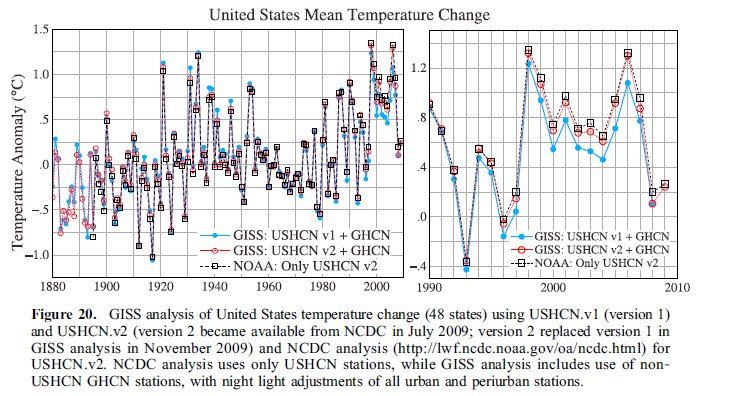
As a simple exercise, I quickly revisited the everchanging Hansen adjustments, a topic commented on acidly by E.M. Smith (Chiefio) in many posts – also see his interesting comments in the thread at a guest post at Anthony‘s, a post which revisited the race between 1934 and 1998 – an issue first raised at Climate Audit in 2007 in connection with Hansen’s Y2K error.

As CA readers recall, Hansen’s Y2K error resulted in a reduction of US temperatures after 2000 relative to earlier values. The change from previous values is shown in red in the graphic below; the figure also shows (black) remarkable re-writing of past history since August 2007 – a rewriting of history that has increased the 2000-6 relative to the 1930s by about 0.3 deg C.

This impacts comparisons made in 2007 between GISS and CRN1-2 stations. At the time, it was noted that GISS adjustments for UHI resulted in the GISS US temperature anomaly having quite a bit in common with a TOBS average from Anthony’s CRN1-2 stations.

Critics of Anthony’s surfacestations.org project commented on this rather smugly – too smugly given the large differences with NOAA and CRU versions in the US and the incoherence of Hansen’s adjustments outside the US. The post-2007 adjustments to GISS adjustments change this.

The increased trend in the GISS US statistic comes at the expense of reconciliation with CRN1-2 stations: the trends no longer cohere.

In the past, Hansen said that he was too busy to joust with jesters – see here. At the time, I observed:

presumably he’s too busy adjusting to have time for jousting. We by contrast have lots of time to jest with adjusters.

Little did we appreciate that Hansen’s new adjustments were not in jest.

Update Dec 26– Hansen’s new article on GISTEMP – Hansen et al 2010 here updates Hansen et al 1999, 2001. Section 4 contains a discussion of US adjustments under different systems, each purporting to show that UHI doesn’t matter. Later in section 9, there is a section on US adjustments, with a brief whining mention of the Y2K adjustment and the following graphic purporting to show that change to USHCN v2 had negligible impact.

It is entirely possible that the change in GISS US since August 2007 is primarily due to the replacement of USHCN v1 methodology (TOBS and that sort of thing that we discussed in the past) with Menne’s changepoint methodology used in USHCN v2.

Menne’s methodology is another homemade statistical method developed by climate scientists introduced without peer review in the statistical literature. As a result, its properties are poorly known.

As I mentioned some time ago, my impression is that it smears stations together so that, if there are bad stations in the network, they influence good stations. Jones used the Menne method in Jones et al 2008, his most recent attempt to show that UHI doesn’t “matter.”

My guess is that it will be very hard to construct circumstances under which UHI will matter after data has been Menne-transformed. And that tests of the various night lights scenario on data after it has been Menne-transformed will not tell you very much. This is just a surmise as I haven’t waded through Menne code. (I requested it a number of years ago, but was unsuccessful until 2009.)

It’s too bad that the Menne adjustment methodology wasn’t published in statistical literature where its properties might have been analysed by now. It’s a worthwhile topic still.

Travel

Away to Thailand to visit one of my sons. Will be away for a couple of weeks but will be online most of the time. 24-hour flight tomorrow. We’ll probably be the only people on the leg to Thailand with a snowboard – presumably not usual inbound luggage. For our daughter who’s visiting there for Christmas as well. She’s planning to go snowboarding in India.

McKitrick and Nierenberg 2010 Rebuts Another Team Article

McKitrick and Nierenberg 2010, rebutting Schmidt 2009 is in press at the Journal of Economic and Social Measurement.

Schmidt (Int J of Climatology) 2009, which commented on McKitrick and Michaels 2007, was peer reviewed by Phil Jones (the puffball review is in the Climategate documents); McKitrick was not given a chance to comment. In contrast, when McKitrick and Nierenberg submitted to IJOC, despite specific requests that Schmidt not be a reviewer, McKitrick and Nierenberg ended up with what was, in effect, a Team peer review, with Gavin Schmidt an important and unreported member of the Team. As in other incidents of Team peer review, the Team managed to stifle the comment at IJOC. In Climategate terminology, the Team ensured that there wasn’t a “leak” at IJOC. Eventually, McKitrick and Nierenberg submitted to the Journal of Economic and Social Measurement, which was not subject to the Team. Continue reading

New Light on UHI

The “inquiries” into CRU, as is well known, did not examine CRU’s “science”. One of CRU’s main “contributions” is the “proof” by Jones et al 1990 that the development of urban heat islands contributed no more than ~0.05 deg C to measured 20th century land temperatures. This proof is an integral component in justifying CRUTEM – which makes no allowance or adjustment for increasing UHI. Jones et al 2008 revisited this theme, estimating the UHI for London at 1 deg and New Yok City at 1.5 deg C, editorializing that much of this would have developed prior to the 20th century. Continue reading

McShane and Wyner Discussion

McShane and Wyner, previewed in August, has now been published by Annals of Applied Statistics as a Discussion Paper here with an accompanying editorial by Michael Stein and discussions by 13 different groups (one of which is a short comment by Mc and Mc, with an excellent Rejoinder.

BTW using Firefox, I wasn’t able to open the papers by clicking, but I was able to download the papers.

CA readers are well aware of my own view that the fundamental problem in paleoclimate is not the need for some novel multivariate method, but better proxies and reconciliation of discordant existing “proxies”. CA readers are also aware that Team reconstructions use highly stereotyped proxies over and over again in different guises – bristlecones, Yamal – sort of an ongoing version of the Dead Parrot skit in Monty Python. McShane and Wyner used the Mann et al 2008 data set, which quixotically introduced the Tiljander sediments, the modern portion of which was contaminated with bridge-building sediments.

Given the central role of these specific proxies in the target data set, I checked the various discussions to see if anyone mentioned either bristlecones or upside-down Tiljander. Given the academic-ness and non-engineering-ness of the discussion, these fundamental issues of data quality are, needless to say, not noticed by the new entrants to the discussion.

Berliner of Hu McCulloch’s Ohio State, in a short comment, says sensible things about the poor quality of the proxies without specifically attending to nuances like bristlecones or upside-down Tiljander. My guess is that he would further roll his eyes if he were aware that this sort of thing is so deeply embedded in the field.

Other than a brief mention by Ross and I, the only discussants to mention bristlecones and Tiljander were Schmidt, Mann and Rutherford.
Schmidt et al analyse a subset of Mann et al 2008 proxies which excluded the Tiljander proxies (which they coyly described only “potentially contaminated” – ignoring both the clear original statements and subsequent clarifications by Mia Tiljander that the modern portion was contaminated.) However, this subset includes multiple Graybill bristlecone series – data sets well known to have selected by Graybill for strip bark. The NAS 2006 panel had recommended that this data be “avoided” in reconstructions; Mann et al 2008 said that they were adhering to the NAS 2006 recommendations, but used bristlecone chronologies anyway. CA readers are well aware of the pea-under-the-thimble character of the Mann et al 2008 sensitivity analyses related to Tiljander and bristlecones – they purported to show that bristlecones didn’t matter – in their highly publicized nodendro reconstruction – using upside-down contaminated Tiljander sediments, and then to show that the upside down sediments didn’t “matter” by using bristlecones. In a grey supplementary information to a different article (Mann et al 2009), key conclusions about the nodendro reconstruction were quietly withdrawn (without placing a notice attached to the original article.)

Schmidt et al further disseminate the disinformation that Mann et al 2008 performed a meaningful sensitivity test on the impact of bristlecones and upside-down Tiljander – remarkably failing to cite the partial withdrawing of results in Mann et al 2009.

The further elimination of 4 potentially contaminated “Tiljander” proxies [as tested in M08; M08 also tested the impact of removing tree-ring
40 data, including controversial long “Bristlecone pine” tree-ring records. Recent work, c.f. Salzer et al 2009, however demonstrates those data to contain a reliable long-term temperature signal], which yields a set of 55 proxies, further reduces the level of peak Medieval warmth (Figure 1a, c.f. Fig 14 in MW; See also Supplementary Figures S1-S2).

Salzer et al 2009, referred to here, notably did not cite Ababneh’s discordant results on Sheep Mountain bristlecones, where she was unable to replicate Graybill’s results. The failure to reconcile Ababneh’s results has been well known to CA readers for a long time and it is bizarre that people attempt to reconstruct past climate using data sets where conflicting results are simply ignored, rather than reconciled.

In a response reminiscent of Wegman’s imperious dismissal of after-the-fact changes to MBH methodology by Wahl and Ammann to “get” the desired result (see Wahl and Ammann, Texas sharpshooters), McShane and Wyner dismiss Schmidt et al’s post hoc ad hoc editing of the data set:

The process by which the complete set of 95/93 proxies is reduced to 59/57/55 is only suggestively described in an online supplement to Mann et al. (2008)3. As statisticians we can only be skeptical of such improvisation, especially since the instrumental calibration period contains very few independent degrees of freedom. Consequently, the application of ad hoc methods to screen and exclude data increases model uncertainty in ways that are unmeasurable and uncorrectable.

Yup.

McShane and Wyner comment that there is an error in Schmidt et al Figure 2, which they were able to diagnose precisely through examination of online code. They archly observe that the error arose through “improper centering”. Plus ca change.

Before proceeding, however, we must note a troubling problem with SMR Figure 2. Visual inspection of the plots reveals an errant feature: OLS methods appear to have non-zero average residual in-sample! Upon examining the code SMR did provide, we confirmed that this is indeed the case and discovered the models were fit incorrectly. The culprit, ironically, is an improper centering of the fitted values.

Remember Gavin’s Taunts about Steig et al 2009?

On January 27, 2009, a few days after Steig et al 2009 was released to fawning international coverage, Gavin Schmidt at RC here claimed that the critical commentary on the paper had been “remarkably weak” and demanding that this “supposed demonstration of intellectual bankruptcy” get some media attention:

All in all, the critical commentary about this paper has been remarkably weak. ..

The poor level of their response is not surprising, but it does exemplify the tactics of the whole ‘bury ones head in the sand” movement – they’d much rather make noise than actually work out what is happening. It would be nice if this demonstration of intellectual bankruptcy got some media attention itself.

Even for realclimatescientists, Gavin’s taunts about being unable to deconstruct Steig in 4 days seem vainglorious. At the time, Steig’s data was mostly unavailable and the method obscure. Gavin’s taunts definitely contributed to interest in Steig et al by the critical blogs and a series of technical posts on Steig et al 2009 soon starting appearing at CA (see tag Steig, The Air Vent and Lucia’s (Ryan O.)

Despite the efforts of Reviewer A, four authors from critical blogs managed to run the gauntlet and publish both an improvement and refutation of Steig et al 2009. An improvement in the sense that the PC retention policy of Steig et al 2009 lacked any foundation and smeared Pensinsula warming into West Antactica. A refutation in the sense that the distinctive claims of Steig et al 2009 ( as compared to predecessor views of Monaghan for example) about West Antarctica are shown to be an artifact of their methodology.

Schmidt’s declaration of “Mission Accomplished” seems, in retrospect, a little premature. In Gavin’s words, it would be “nice” if this got a “little media attention”.

Andrew Weaver Praises O’Donnell et al 2010

Reader David O emailed me:

I thought you might be interested that today at 11:00am Andrew Weaver was on the Bill Good show on am980 in Vancouver. Much to my amazement Dr. Weaver actually had some kind words to say about you regarding your new Antarctic study. The Interview can be heard here. FF to 27:00 minutes for the relevant part.
[relevant excerpt preserved here]

Weaver said that the article was “rather interesting and turn out to be quite an important study…very statistical…a really nice study. His science will be highly cited, it’s an important study.” (Weaver over-credited me relative to coauthors.)

A small mystery – given that the article hasn’t been published yet and none of the coauthors sent Weaver a copy, I wonder how he got the article.

O’Donnell et al 2010 Refutes Steig et al 2009,

Do some of you remember Steig et al 2009, a pre-Climategate Nature cover story? Like so many Team efforts, it applied a little-known statistical method, the properties of which were poorly known, to supposedly derive an important empirical result. In the case of Steig et al 2009, the key empirical claim was that strong Antarctic warming was not localized to the Antarctic Peninsula (a prominent antecedent position), but was also very pronounced in West Antarctic. Their claims are set out firmly in the opening sentences of their abstract as follows:

Assessments of Antarctic temperature change have emphasized the contrast between strong warming of the Antarctic Peninsula and slight cooling of the Antarctic continental interior in recent decades. This pattern of temperature change has been attributed to the increased strength of the circumpolar westerlies, largely in response to changes in stratospheric ozone. This picture, however, is substantially incomplete owing to the sparseness and short duration of the observations. Here we show that significant warming extends well beyond the Antarctic Peninsula to cover most of West Antarctica, an area of warming much larger than previously reported. West Antarctic warming exceeds 0.1 deg C per decade over the past 50 years, and is strongest in winter and spring. Although this is partly offset by autumn cooling in East Antarctica, the continent-wide average near-surface temperature trend is positive.

Their claims were illustrated on the cover of Nature as shown below:

Again, to be very clear about this, the “novelty” of Steig et al 2009 were their results for West Antarctica – the location of the West Antarctic Ice Sheet. Otherwise, there was nothing in their article that warranted an article in Nature, let alone a cover.

There were a variety of problems with their analysis, many of which were documented at CA and tAV at the time. The remarkable episode of Gavin, International Man of Mystery, plagiarizing a small point on a CA thread arose in the context of Steig et al. At an early stage, it seemed that Steig’s rather complicated method was spreading results from the Antarctic Peninsula into other parts of the Antarctic, a surmise that proved correct.

After an abusive peer review process in which the Team were evidently involved, an article has been accepted by Journal of Climate (O’Donnell [Ryan O], Lewis [Nic L], McIntyre and Condon [Jeff Id]) refuting the West Antarctic claims of Steig et al 2009.

Their results proved to be sensitive to the number of retained principal components, with Steig et al selecting only 3 PCs, using arguments that contradicted Wahl and Ammann’s efforts to retain bristlecones in MBH. Steig et al themselves did not appear to realize that Chladni patterns emerge from spatially autocorrelated time series, a peril known for many years (“Castles in the Air”) but apparently forgotten by Steig et al and the Nature reviewers.

Using a more rational (though not magical) policy on retained PCs, a very different picture emerged as illustrated below. The “traditional” picture of very strong warming on the Antarctic peninsula re-emerged, together with large areas of cooling on the continent. Instead of the West Antarctic being a location of anomalous warming, as Steig et al had purported to show, parts of it were actually cooling.

The gauntlet that had to be run shows that practices in climate science journals remain unchanged despite Climategate. Horton’s essay for Muir Russell noted that conflicts of interest were not simply financial. In this case, the Journal of Climate appointed a reviewer – or shall we say a representative of a Team of reviewers – whose energy in attempting to suppress the article went far beyond an unconflicted reviewer. Ultimately, the reviews and responses totalled 88 pages! And Andy Revkin and others blame critical authors for not running such gauntlets. The reviewers for Ross’ and my comment at IJC on Santer et al 2008 were even worse. All too often, in the case of Santer et al, after Team reviewers sabotaged a straightforward and correct comment, Santer and other Team members criticized us for not publishing in the PRL after getting data and continued to put their results forward as unblemished despite knowing of unrebutted criticisms. Getting this article accepted is entirely to the credit of Ryan O’Donnell who did more than the lion’s share of the work.

Climategate documents show the asymmetry between the puffball “pal reviews” that Jones submitted for Mann or Schmidt or Wahl and Ammann, as compared to the Team “going to town” on criticism. Unfortunately, the Muir Russell “inquiry” did not investigate the peer review incidents evidenced in the emails (not even the “going to town” incident) nor did it comment on pal review nor did it make the slightest effort to see if there were other peer review incidents in other CRU documents (part of their terms of reference.)

The gauntlet that was created in this particular incident had nothing to do with additional due diligence occasioned by perhaps overturning a well established result. Steig’s results, showing West Antarctic as a particular locus of warming, were themselves novel and, if anything, contradicted prior views of Peninsula warming. Our results were straightforward – the 88 pages of review and response were nothing more than obstruction, “going to town” on the comment rather than the original article.

Substantively, what is actually left of the signature results about the West Antarctic, which were:

Assessments of Antarctic temperature change have emphasized the contrast between strong warming of the Antarctic Peninsula and slight cooling of the Antarctic continental interior in recent decades… Here we show that significant warming extends well beyond the Antarctic Peninsula to cover most of West Antarctica, an area of warming much larger than previously reported. West Antarctic warming exceeds 0.1 deg C per decade over the past 50 years, and is strongest in winter and spring.

Nothing. Steig’s West Antarctic warming results from a spreading of warming in the Peninsula to the West Antarctic through choices made in their principal components. Different choices – ones more plausible in the circumstances – lead to opposite results.

Also see blog posts at Jeff Id here and WUWT here.

Update Dec 7: Online SI here http://www.climateaudit.info/data/odonnell/