As we’ve discussed before (and is well known), clouds are the greatest source of uncertainty in climate sensitivity. Low-level (“boundary layer”) tropical clouds have been shown to be the largest source of inter-model difference among GCMs. Clouds have been known to be problematic for GCMs since at least the Charney Report in 1979. Given the importance of the topic for GCMs, one would have thought that AR4 would have devoted at least a chapter to the single of issue of clouds, with perhaps one-third of that chapter devoted to the apparently thorny issue of boundary layer tropical clouds.
This is what an engineering study would do – identify the most critical areas of uncertainty and closely examine all the issues related to the critical uncertainty. Unfortunately, that’s not how IPCC does things. Instead, clouds are treated in one subsection of chapter 8 and boundary layer clouds in one paragraph.
Interestingly, the language in IPCC AR4 is (using the terminology of climate science) “remarkably similar” to Bony et al (J Clim 2006) url , with the differences as interesting as the similarities. It seems to me that each language change from Bony to IPCC had the effect of papering over or softening the appearance of problems or contradictions, rather than clearly drawing the issues to the attention of the public. (Note – Bony was a lead author of the chapter – another instance of IPCC authors reviewing their own work.)
AR4
Boundary-layer clouds have a strong impact on the net radiation budget (e.g., Harrison et al., 1990; Hartmann et al., 1992) and cover a large fraction of the global ocean (e.g., Norris, 1998a,b). Understanding how they may change in a perturbed climate is thus a vital part of the cloud feedback problem. The observed relationship between low-level cloud amount and a particular measure of lower tropospheric stability (Klein and Hartmann, 1993), which has been used in some simple climate models and in some GCMs’ parametrizations of boundary layer cloud amount (e.g., CCSM3, FGOALS), led to the suggestion that a global climate warming might be associated with an increased low-level cloud cover, which would produce a negative cloud feedback (e.g., Miller, 1997; Zhang, 2004). However, variants of the lower-tropospheric stability measure, which may predict boundary-layer cloud amount as well as the Klein and Hartmann (1993) measure, would not necessarily predict an increase in low-level clouds in a warmer climate (e.g., Williams et al., 2006). Moreover, observations indicate that in regions covered by low-level clouds, the cloud optical depth decreases and the SW CRF weakens as temperature rises (Tselioudis and Rossow, 1994; Greenwald et al., 1995; Bony et al., 1997; Del Genio and Wolf, 2000; Bony and Dufresne, 2005), but the different factors that may explain these observations are not well established. Therefore, understanding of the physical processes that control the response of boundary-layer clouds and their radiative properties to a change in climate remains very limited.
Bony et al 2006
Boundary layer clouds have a strongly negative CRF (Harrison et al. 1990; Hartmann et al. 1992) and cover a very large fraction of the area of the Tropics (e.g., Norris 1998b). Understanding how they may change in a perturbed climate therefore constitutes a vital part of the cloud feedback problem. Unfortunately, our understanding of the physical processes that control boundary layer clouds and their radiative properties is currently very limited.
It has been argued based on the Clausius–Clapeyron formula that in a warmer climate, water clouds of a given thickness would hold more water and have a higher albedo (Somerville and Remer 1984; Betts and Harshvardhan 1987). But the analysis of satellite observations show evidence of decreasing cloud optical depth and liquid water path with temperature in low latitude boundary layer clouds (Tselioudis and Rossow 1994; Greenwald et al. 1995; Bony et al. 1997). This may be due to the confounding effect of many physical processes, such as increases with temperature in precipitation efficiency or decreases with temperature in cloud physical extent (Tselioudis et al. 1998; Del Genio and Wolf 2000).
Klein and Hartmann (1993) showed an empirical correlation between mean boundary layer cloud cover and lower-tropospheric stability (defined in their study as the difference of 700-hPa and near-surface potential temperature). When imposed in simple two-box models of the tropical climate (Miller 1997; Clement and Seager 1999; Larson et al. 1999) or into some GCMs’ parameterizations of boundary layer cloud amount [e.g., in the National Center for Atmospheric Research (NCAR) Community Climate System Model verion 3 (CCSM3)], this empirical correlation leads to a substantial increase in low cloud cover in a warmer climate driven by the larger stratification of warmer moist adiabats across the Tropics, and produces a strong negative feedback. However variants of lower-tropospheric stability that may predict boundary layer cloud cover just as well as the Klein and Hartmann (1993) parameterization, would not necessarily predict an increase in boundary layer cloud in a warmer climate (e.g., Williams et al. 2006 – Clim Dyn; Wood and Bretherton 2006 – J Clim).
The boundary layer cloud amount is strongly related to the cloud types present, which depend on many synoptic-and planetary-scale factors (Klein 1997; Norris 1998a; Norris and Klein 2000). Factors such as changes in the vigor of shallow convection, possible precipitation processes, and changes in capping inversion height and cloud thickness can outweigh the effect of static stability. These factors depend on local physical processes but also on remote influences, such as the effect of changing deep convective activity on the free tropospheric humidity of subsidence regions (Miller 1997; Larson et al. 1999; Kelly and Randall 2001). Evidence from observations, large-eddy simulation models, or climate models for the role of these different factors in cloud feedbacks is currently very limited.
The similarities are self evident. Now let’s look at the differences.
Bony et al said that boundary layer clouds had “strongly negative CRF” (Cloud Radiative Forcing), which IPCC watered down to “strong impact”. I guess that the idea of “strongly negative” feedback was too salacious for the IPCC audience.
| Boundary layer clouds have a strongly negative CRF (Harrison et al. 1990; Hartmann et al. 1992) and cover a very large fraction of the area of the Tropics (e.g., Norris 1998b). |
Boundary-layer clouds have a strong impact on the net radiation budget (e.g., Harrison et al., 1990; Hartmann et al., 1992) and cover a large fraction of the global ocean (e.g., Norris, 1998a,b). |
The next sentence was identical other than trivial wordsmithing. Bony et al 2006 had stated that the “empirical” Klein and Hartmann (1993) correlation “leads” to a substantial increase in low cloud cover, which resulted in a “strong negative” cloud feedback. Again IPCC watered this down: “leads to” became a “suggestion” that it “might be” associated with a “negative cloud feedback” – the term “strong” being dropped by IPCC.
| Klein and Hartmann (1993) showed an empirical correlation between mean boundary layer cloud cover and lower-tropospheric stability (defined in their study as the difference of 700-hPa and near-surface potential temperature). When imposed in simple two-box models of the tropical climate (Miller 1997; Clement and Seager 1999; Larson et al. 1999) or into some GCMs’ parameterizations of boundary layer cloud amount [e.g., in the National Center for Atmospheric Research (NCAR) Community Climate System Model verion 3 (CCSM3)], this empirical correlation leads to a substantial increase in low cloud cover in a warmer climate driven by the larger stratification of warmer moist adiabats across the Tropics, and produces a strong negative feedback. |
The observed relationship between low-level cloud amount and a particular measure of lower tropospheric stability (Klein and Hartmann, 1993), which has been used in some simple climate models and in some GCMs’ parametrizations of boundary layer cloud amount (e.g., CCSM3, FGOALS), led to the suggestion that a global climate warming might be associated with an increased low-level cloud cover, which would produce a negative cloud feedback (e.g., Miller, 1997; Zhang, 2004). |
The sentence starting “variants of the lower-tropospheric stability measure…” is identical in both versions.
Bony et al raised an argument about increasing albedo in clouds (dating back to the 1980s), noting three articles opposing this argument. IPCC deleted the mention of the arguments in favor of a higher albedo,
| It has been argued based on the Clausius–Clapeyron formula that in a warmer climate, water clouds of a given thickness would hold more water and have a higher albedo (Somerville and Remer 1984; Betts and Harshvardhan 1987), while keeping the three references to the opposing articles.
But the analysis of satellite observations show evidence of decreasing cloud optical depth and liquid water path with temperature in low latitude boundary layer clouds (Tselioudis and Rossow 1994; Greenwald et al. 1995; Bony et al. 1997).
|
–
Moreover, observations indicate that in regions covered by low-level clouds, the cloud optical depth decreases and the SW CRF weakens as temperature rises (Tselioudis and Rossow, 1994; Greenwald et al., 1995; Bony et al., 1997; Del Genio and Wolf, 2000; Bony and Dufresne, 2005), |
Bony et al concluded their paragraphs reporting a very limited understanding of the physical processes controlling boundary layer clouds, a sentence that was substantially repeated by IPCC who qualified the admission of lack of understanding by saying that the understanding was limited in respect to “a change in climate”.
| Unfortunately, our understanding of the physical processes that control boundary layer clouds and their radiative properties is currently very limited. |
Therefore, understanding of the physical processes that control the response of boundary-layer clouds and their radiative properties to a change in climate remains very limited. |
A third party reader might also assume that the section on boundary layer clouds would have benefited from comments from stadiums of IPCC reviewers. In fact, the version as published is almost word for word identical to the version in the First Order Draft. A few comments from reviewers were peremptorily dismissed by the chapter authors.
However, unlike the Hockey Stick section, there were virtually no comments whatever on this section and these were dismissed fairly summarily.
Reviewer Richard Allan observed:
8-586 A 47:54 48:5 It should also be noted that the cooling effect of clouds is primarily felt at the surface during the daytime, while the greenhouse effect of cloud generally heats the atmosphere. [Richard Allan (Reviewer’s comment ID #: 3-83)]
IPCC Authors:
Rejected due to space restrictions (this addition would not be fundamental for the following discussion).
My two cents worth as an interested non-specialist reader: Allan’s comment here seems interesting – it was something that I wasn’t aware of.
Next Allan suggested a seemingly interesting and on point addition to the text.
8-589 A 48:30 48:46 A suggested addition to the discussion of cloud altitude feedbacks: “Cess et al. (2001) [The influence of the 1998 El Nino upon cloud radiative forcing over the Pacific warm pool. J. Climate, 14, 2129–2137] suggested a strong influence of ENSO on cloud altitude and hence the balance between longwave heating and shortwave cooling. It is likely that this is partly a regional effect relating to changes in the vertical motion fields (Allan et al. 2002 [Influence of Dynamics on the Changes in Tropical Cloud Radiative Forcing during the 1998 El Nino J. Climate, 15, 1979-1986]) that may also be linked with decadal fluctuations in cloud properties (Wielicki et al. 2002 [Evidence for large decadal variability in the tropical mean radiative energy budget. Science, 295, 841–844.]) and is unlikely to be related to cloud feedback.” [Richard Allan (Reviewer’s comment ID #: 3-84)]
Again this suggestion was refused by the Chapter Authors.
Rejected. We do not review all the cloud feedback studies published, but assess the main progress that has been done since the TAR in understanding climate change cloud feedbacks. Therefore we do not discuss processes that are unlikely to be involved in climate change cloud feedbacks (e.g. the dynamically-driven change in clouds associated with El-Nino).
This latter excuse raises another interesting aspect of the paragraph on boundary layer clouds. Given the importance of the topic, a third party would assume that AR4 would include many references to a wide variety of studies since AR4 examining every conceivable aspect of marine boundary layer clouds. They rebuff Allan’s suggestion on the basis that they are assessing “progress since the TAR”. However, no fewer than ten of 13 references are pre-TAR (five pre-SAR) – there are only three references to post-TAR literature. Whatever the reason for excluding the Allan comment, it wasn’t because they were already chock-a-block with post-TAR literature.
As noted above, given the importance of clouds in climate sensitivity, and of boundary layer clouds in particular, a third party reader would have expected a comprehensive discussion of all the issues and, in particular, what steps they recommended for the reduction of uncertainties in this area, both of which were conspicuously absent.











RSS June – "Worse Than We Thought"
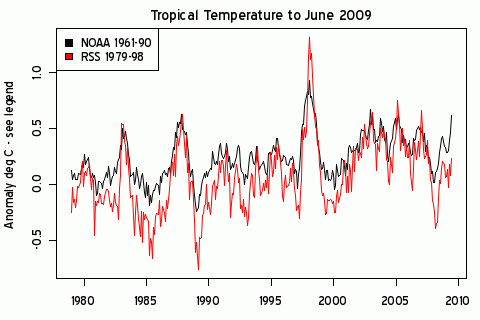
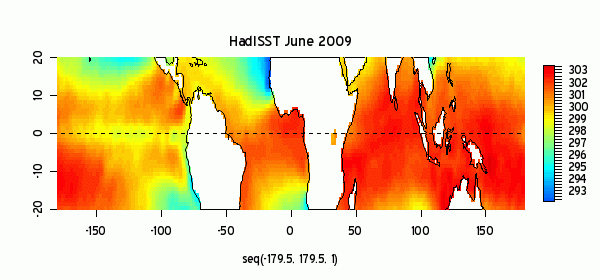
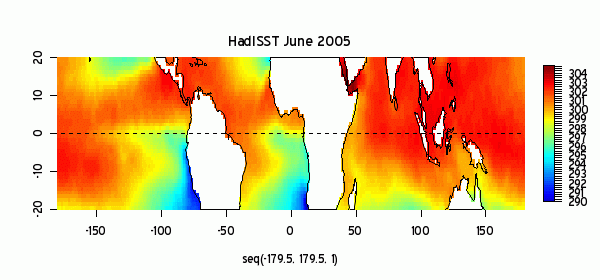
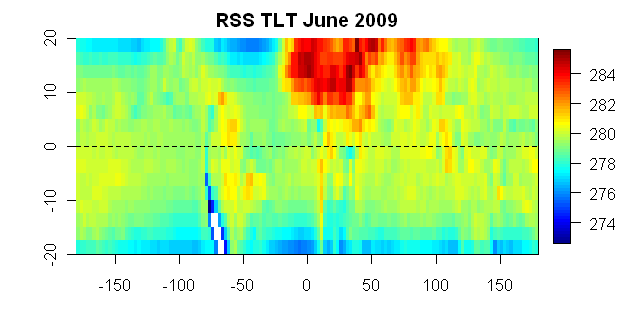
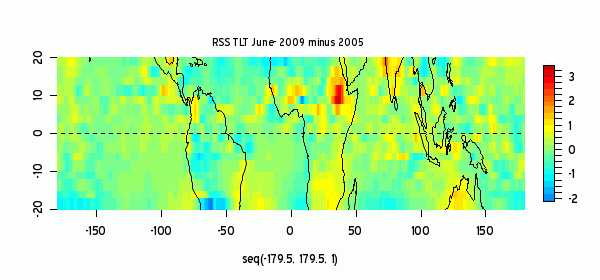
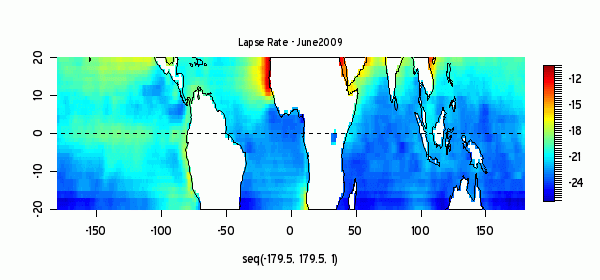
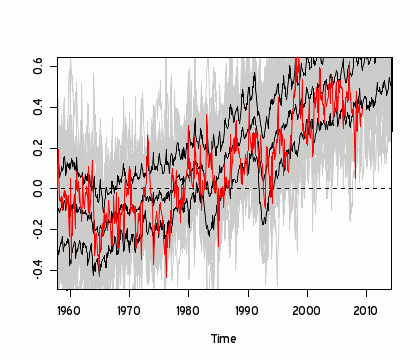
Lucia was quick off the mark with RSS June results. RSS June was 0.075 deg C (reference 1979-1998). The graph shows somewhat of a decline from earlier in the year.
In a joint statement, realclimate authors Gavin Schmidt, Michael Mann, Stefan Rahmstorf and Eric Steig noted their disappointment with market performance. However, Rahmstorf observed that, if these results were embedded in a 15-dimensional manifold, the results were still “worse than we thought”. Michael Mann said that the decline in June RSS values was disinformation from fossil fuel interests and issued a fatwa on those responsible. [Note to realclimate readers – this is a satirical comment; they did not really make the above statements.]