A shout out for Bob Tisdale’s blog here. Bob cross-posts at Anthony’s from time to time. At his own blog, he’s done a number of excellent analyses of SST data sets.
On many occasions, I’ve observed that critical analysis of the temperature record has spent a disproportionate amount of attention on land data sets relative to SST. While the issues there are not necessarily resolved, they are well-known. Over the past few years, many readers, including myself, have built up some familiarity with the alphabet soup of land data. Many of us, like connoisseurs of fine wine, can distinguish between GHCN, CRU, NOAA, GISS and the various vintages of USHCN.
However, speaking for myself, I’m a bit at sea, so to speak, in my connoisseurship of SST data. The differences between SST data sets was recently discussed at Anthony’s and, curiously enough, it also plays a role in Santer et al 2008, which made a curious switch in SST versions from prior articles – a switch that has thus far gone unnoticed and which affects results. I’ll return to this on another occasion.
After Anthony raised a question of a recent divergence between GISS and NOAA/NCDC temperatures, Bob T, pitched in with a careful explanation of differences between the SST data sets used in the different major global indices. Following are quotes from Bob T. In following the nomenclature for data sets, keep in mind that NOAA originates a few different SST versions, with GISS using one version and NOAA (for its own temperature index) using another.
GISS
GISS has used the NCDC OI.v2 SST anomaly data since December 1981, and before that they had used the Hadley Centre’s HADSST data. GISS then splices the two datasets together….
NOAA describes the Optimum Interpolation (OI.v2) SST anomaly data (used by GISS) as, “The optimum interpolation (OI) sea surface temperature (SST) analysis is produced weekly on a one-degree grid. The analysis uses in situ and satellite SST’s plus SST’s simulated by sea-ice cover.” The in situ data is from buoy and ship measurements. The full description of the OI.v2 data is here: http://www.cdc.noaa.gov/data/gridded/data.noaa.oisst.v2.html
The OI.vs SST anomaly is attributed by Bob T to Smith and Reynolds 2002.
NOAA/NCDC
NCDC has their own SST anomaly dataset for their global surface temperature product, and they calculate anomalies against the base years of 1901 to 2000.
The NCDC identifies the “Global Ocean Temperature” dataset as SR05 in its Global Surface Temperature Anomalies webpage:
http://www.ncdc.noaa.gov/oa/climate/research/anomalies/index.php#sr05
Linked to the webpage is a paper by Smith et al (2005) “New surface temperature analyses for climate monitoring” GEOPHYSICAL RESEARCH LETTERS, VOL. 32, L14712, doi:10.1029/2005GL023402, 2005.
Click to access Smith-comparison.pdf
On page 2, Smith et al describe the SR05 data as, “The SR05 SST is based on the International Comprehensive Ocean Atmosphere Data Set (ICOADS [Woodruff et al., 1998]). It uses different, though similar, historical bias adjustments to account for the change from bucket measurements to engine intake SSTs [Smith and Reynolds, 2002]. In addition, SR05 is based on in situ data.”
It appears, from that quote and the rest of the paper, the SR05 SST dataset does NOT use satellite data. This is consistent with NCDC’s other long-term SST datasets. They also abstain from satellite data.
….
I have found no source of SR05 SST anomaly data, other than the Global, Northern Hemisphere, and Southern Hemisphere “Ocean Temperature” datasets linked to the Global Surface Temperature webpage.
ERSST v2 and ERSST v3
Bob T observes that NOAA/NCDC also supports ERSSTv2 (now discontinued) and ERSST v3 SST data sets and in the linked posts, compares these data sets to the other ones. Bob also mentions two vontages of ERSST v3, one of which seems to have disappeared (though Bob mentions that he had saved some of the disappeared data.)
In addition to the SR05 SST data, the NCDC also has two other long-term SST datasets called Extended Reconstructed SST (ERSST) data. The ERSST.v2 (Version 2) data was introduced in 2004 with the Smith and Reynolds (2004) paper Improved Extended Reconstruction of SST (1854-1997), Journal of Climate, 17, 2466-2477. Many of my early Smith and Reynolds SST Posts used ERSST.v2 data through the NOAA NOMADS system. Unfortunately, ERSST.v2 data is no longer available through that NOAA system, so the latest ERSST.v2 global SST anomaly data from NOMADS I have on file runs through October 2008.
The ERSST.v2 data was updated with ERSST.v3 data. In my opinion, it provides the most detailed analysis of high latitude SST in the Southern Hemisphere (the Southern Ocean). The ERSST.v3 data was introduced last year with the Smith et al (2008) paper: Improvements to NOAA’s Historical Merged Land-Ocean Surface Temperature Analysis (1880-2006), Journal of Climate,21, 2283-2296. The NCDC updated it with their ERSST.v3b version later in 2008, but more on that later. A limited number of datasets (based on latitude) for the ERSST.v3b data are available from NCDC (though it is available on a user-selected coordinate basis through the KNMI Climate Explorer website, as is ERSST.v2 data).
From Bob’s comments, I get the impression that ERSST v3 is not used in the three major GLB temperature reports (CRU, GISS, NOAA) and will seek confirmation of this.
HadCRU
I haven’t checked Bob’s posts for HadCRU yet, but I presume that they use HadSST – a newish HadISST version is now in circulation, which I glanced at recently but haven’t studied.
Santer
I was going to do this in another post, but I’ll mention the point here to perhaps motivate readers to ponder the difference between these data sets.
In the CCSP report that prompted Douglass et al 2007 (and thus Santer et al 2008), the surface observations used as comparanda were CRU, NOAA and GISS. These data sets were also used in Douglass et al.
However, in an hitherto unnoticed swap, Santer et al 2008 used ERSST v2, then hot off the press ERSST v3 and HadISSTv2 as surface comparanda. Santer purported to justify the substitution as follows:
The three SST datasets are more appropriate to analyse in order to determine whether observed lower tropospheric temperature changes follow a moist adiabatic lapse rate (Wentz and Schabel, 2000).
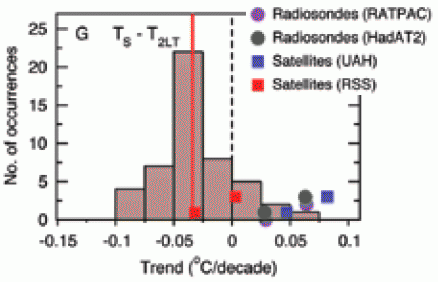
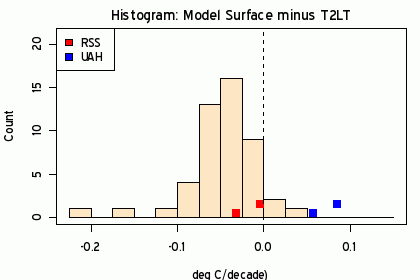
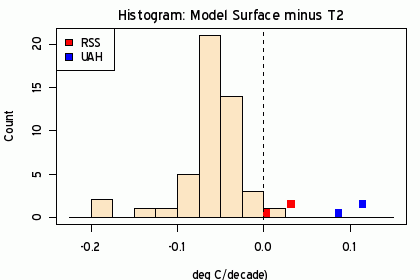
However, the ERSST versions also have a noticeably lower trend than GISS or NOAA (the two “hottest” series). The lower trends in the surface data reduced the mismatch between surface and observations, contributing to Santer’s claim that :
There is no longer a serious and fundamental discrepancy between modelled and observed trends in tropical lapse rates, despite DCPS07’s incorrect claim to the contrary. Progress has been achieved by the development of new T_SST , T_L+O, and T2LT datasets, …
Here the “new T_SST” data set appears to be the ERSST data – which seems to have had a somewhat complicated recent history. It looks like earlier ERSST versions used satellite data in their construction, while the most recent version has got rid of the “satellite bias” by discontinuing use of the satellite data.
Whatever the merits of the ERSST data, it’s hard to see that the comparison of satellite data to ERSST, interesting as it may be, is particularly relevant to the issue of whether there is a statistically significant difference between satellites and the “big” indices (GISS, CRU, NOAA) if it isn’t actually used in the “big” indices.
Again, I provide a caveat that my own personal handling of these SST data sets is very limited and I thus have limited connoiseurship of them at this time.











FOI and the "Unprecedented " Resignation of British Speaker
Readers have sometimes proposed that I try to enlist the support of a British MP for efforts to get information from the various stonewalling UK climate institutions, such as Fortress CRU. In fact, it seems that British MPs have had their own personal reasons for not supporting FOI. For the past 5 years, they have stonewalled FOI requests by journalist Heather Brooke for details of their expenses (2006 comment here). Speaker Michael Martin led the stonewalling campaign. Brooke challenged the MPs in court and, in May 2008, won a notable success. But a year later, even with a court victory, she was still no further ahead.
In the last couple of weeks, the ground suddenly shifted. Using a tried-and-true method (chequebook journalism), the Daily Telegraph purchased a disk with details of MP expenses. The reasons for the stonewalling became pretty clear. MPs expensed the public for things like repairs to the moat at the family castle of one MP to a subscription to Playboy Channel for the husband of another MP. No detail seemed too large or small not to be charged to the public. A climate scientist would have said that the situation was “worse than we thought”.
The worst of the trough-feeding arose over provisions entitling MPs to purchase and improve 2nd and 3rd homes at public expense, under the guise of being nearer Parliament or nearer their constituency, even if the 2nd home was only a few miles closer to Parliament than the original home. MPs as a class seem to have become small-time real estate speculators with the public underwriting the cost of their speculations, but not the capital gains. The public anger is not just about the chiseling, though the anger about the chiseling is real enough, but about the influence of these sorts of perqs and benefits and MPs as a class.
The exposure of the pigs at the trough has angered the British public and amused the rest of the world (e.g. CBC in Canada here.
One of the first casualties of the affair was Speaker Michael Martin, who had been administered the expense program and who had directed the prolonged litigation against revealing the expenses. Martin became the first speaker since the Little Ice Age to resign – in climate science, this is known as an “unprecedented” resignation.
After spending five years trying unsuccessfully to get the expenses, Heather Brooke was understandably a bit sour at being scooped by the Daily Telegraph merely buying the information, but gamely expressed some vindication at this sorry mess being exposed, observing sensibly:
As CA readers, David Holland, Willis Eschenbach and I have been given a variety of fanciful and untrue excuses by climate scientists stonewalling FOI requests. Within this reverse beauty contest, the excuses of Hadley Center executive John Mitchell for refusing to provide his Review Comments on IPCC AR4 chapter 6 are among the most colorful: first, Mitchell said that he had destroyed all his correspondence with IPCC; then he said that they were his personal property. David Holland then submitted FOI requests for Mitchell’s expenses for trips to IPCC destinations and information on whether he had done so on vacation time, while also confronting Hadley Center with their representations to the public on how Hadley Center scientists were doing the British public proud through their participation as Hadley Center employees in IPCC. So Hadley Center foraged around for a new excuse – this time arguing that releasing Mitchell’s review comments would compromise British relations with an international organization (IPCC), IPCC in the meantime having informed Hadley Center that it did not consent to the review comments being made public – ignoring provisions in the IPCC by-laws that require them to make such comments public. In administrative law terms, there is unfortunately no recourse against IPCC – an interesting legal question that we’ve pondered from time to time (also see Global Administrative Law blog here.)
We’ve also tried unsuccessfully to obtain Caspar Ammann’s secret review comments on chapter 6, which IPCC failed to include in their compilation of Review Comments and which Ammann and Fortress CRU have refused to make public.
It’s hard to picture exactly what’s in the Mitchell correspondence (or Ammann correspondence for that matter) that’s caused the parties to be so adamant about not disclosing comments that are properly part of the public record. In Mitchell’s case, I suspect that the reluctance arises not so much from the fact that anything particularly bad was said, but merely that the record would be embarrassingly empty – thereby showing (what I believe to be) an almost complete casualness to discharging any obligations as a Review Editor other than swanning off to IPCC destinations.
As long as we don’t know, it will of course be a mystery. A couple of weeks ago, MP expenses were a mystery as well.