While Steve is a little “under the weather” (it must be all the snow that Al Gore sent him), I thought I’d mention an interesting article in the New York Times which sings the praises of the programming language R.
R is similar to other programming languages, like C, Java and Perl, in that it helps people perform a wide variety of computing tasks by giving them access to various commands. For statisticians, however, R is particularly useful because it contains a number of built-in mechanisms for organizing data, running calculations on the information and creating graphical representations of data sets.
Some people familiar with R describe it as a supercharged version of Microsoft’s Excel spreadsheet software that can help illuminate data trends more clearly than is possible by entering information into rows and columns.
What makes R so useful — and helps explain its quick acceptance — is that statisticians, engineers and scientists can improve the software’s code or write variations for specific tasks. Packages written for R add advanced algorithms, colored and textured graphs and mining techniques to dig deeper into databases.
So there you have it: R is the future.
Give up the Fortran, Mike and the Hockey Team, and join the 21st Century. Uncle Steve does know best.
R can be downloaded at http://www.r-project.org/ and is available for Windows, Linux and Mac OSX. And its free.

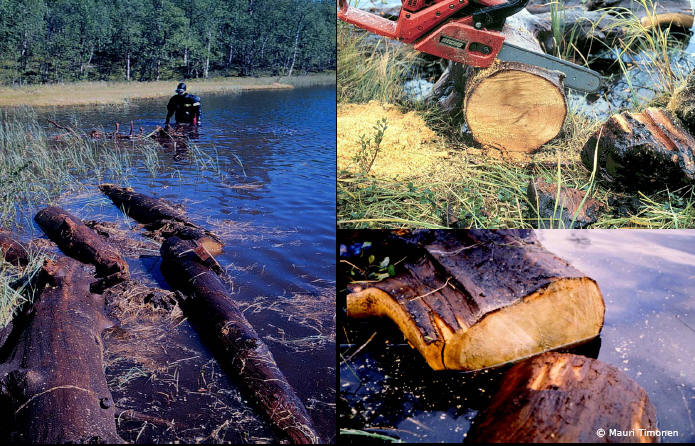
 The old Sodankyla church was built in 1689. Nine cores from beams at this church have been measured and archived. Briffa 2008 used one of 9 cores. Why only one of 9? Your guess is as good as mine.
  A
A