In our examination of the new Mann proxies, there is a notable increase in the prevalence of speleothem proxies in the MWP network.
Craig Loehle used a couple of speleothem proxies in his reconstruction. One was a grey-scale series from Holmgren’s Cold Air Cave, South Africa.
Not to be outdone, Mann et al used two series from Holmgren’s Cold Air Cave, using, however, two other series: C13 and O18.
The second spelothem series used by Loehle was a temperature reconstruction by Mangini on a European speleothem, which had an inverse orientation to the native dO18 series because Mangini ascribed a negative correlation between temperature and speleothem dO18, which Gavin Schmidt excoriated as follows:
As mentioned above, there are a priori reasons to assume d18O records in terrestrial records have a temperature component. In mid-latitudes, the relationship is positive – higher d18O in precipitation in warmer conditions. This is a function of the increase in fractionation as water vapour is continually removed from the air. Most d18O records – in caves stalagmites, lake sediment or ice cores are usually interpreted this way since most of their signal is from the rain water d18O. However, only one terrestrial d18O record is used by Loehle (#9 Spannagel), and this has been given a unique negative correlation to temperature.
However, Mangini’s speleothem record is no longer uniquely oriented, due to recent spelunking by Mann and associates.
The first figure below shows the orientation of the original dO18 data (positive dO18 is up and negative dO18 is down), the orientation advocated above by Gavin Schmidt.

Figure 1. Dongge O18 (in s.d. units) preserving original orientation
Despite Gavin Schmidt’s excoriation of Craig Loehle, the Mann et al algorithm orients speleothem records according to their most opportunistic correlation with gridcell temperature.
In the case of the Dongge dO18 record, this is negative (as shown in the archived rtable) and the orientation of the series is accordingly inverted during the Mannian algorithm. Here is how the Dongge gridcell goes into the Mannomatic – obviously upside down from the original series.
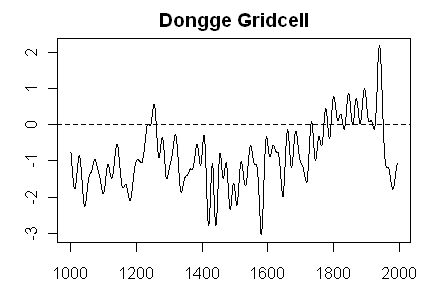
So the orientation of the Mangini dO18 series no longer stands alone, joined now by the Mannian Dongge Cave dO18 series.
Schmidt concluded his discussion of the Loehle reconstruction, citing this and other issues, by aying:
What does this imply for Loehle’s reconstruction? Unfortunately, the number of unsuitable series, errors in dating and transcription, combined with a mis-interpretation of what was being averaged, and a lack of validation, do not leave very much to discuss.
Having examined details of the Mann study, I can confidently say that “the number of unsuitable series, errors in dating and transcription, combined with a mis-interpretation of what was being averaged, and a lack of validation” in the Mann study result in precisely the opposite: there is a great deal to discuss.
The parable urges us to remove the beam from our own eye before worrying about the mote in the other fellow’s eye. One feels that Schmidt and Mann should think about a similar policy: removing the uniquely oriented speloethem from their own reconstruction before worrying about the uniquely oriented speleothem in the other fellow’s reconstruction.
![Reblog this post [with Zemanta]](https://i0.wp.com/img.zemanta.com/reblog_e.png)