I see that the BBC is taking the position that the “evidence” of an MWP-modern differential now is confirmed in so many “independent” studies that the matter is now “incontrovertible”. However these studies are not “independent”; the vast majority of the “independent” studies use the same stale proxy data. In my Erice presentation (which I’ll post up in a day or two), I showed the difference between updated versions of the Tornetrask, Polar Urals and Sheep Mountain data and the older versions used in Team studies, observing that use of the updated versions altered the medieval-modern differential in 9 of 10 canonical studies (the issues in Moberg involve a couple of different proxies, but are similar.)
In regards to the MWP-modern differential, Mann et al 2008 is once again not “independent” of the other studies – the entire suite of Graybill strip bark bristlecones rear up once again. Very few of the “new” proxies covering the MWP contain a relevant HS shape and there are fatal problems with the ones that do (e.g. the Korttajarvi sediments) making one question why these sediments are used in a supposedly serious study.
In a previous post, I made a flash summary of the non-dendro proxies in Mann et al 2008 and I urge interested readers to review that post.
Today I’m providing a flash summary of all the dendro series with SI start dates prior to 1010. While there has been considerable discussion of the use of “tree ring” series in Mann et al 2008, the real issue is the use of Graybill strip bark chronologies, which continue to be used without apology or discussion as to their validity. In the flash image, the HS shaped series labeled as ca534, nv…, co524 etc are invariably Graybill bristlecone strip bark chronologies. The version showed below are non-infilled in the latter portion. Other non-“independent” proxies used over and over are Briffa’s Tornetrask, the Jacoby-d’Arrigo Mongolia series. There is remarkably little that is both new and relevant to a modern-medieval differential, despite the puff.
The continued use of the questionable Graybill strip bark chronologies is highly objectionable, especially in view of Abaneh’s inability to replicate the most important Graybill chronology (ca 534.) It is also objectionable in view of the following puff by Mann et al:
We were guided in this work by the suggestions of a recent National Research Council report (35) concerning an expanded dataset, updated data, complementary strategies for analysis, and the use of thoroughly tested statistical methods.
As has been widely observed, the NRC panel recommended that “strip bark” chronologies be “avoided” in temperature reconstructions – a suggestion obviously not adhered to by the Mann group. This is doubly disappointing as the chairman of the NAS panel, Gerry North, is said to have been a reviewer of the Mann et al 2008 paper, but he seems to have taken no steps whatever to ensure that strip bark chronologies were avoided, though this issue should have been on his mind.
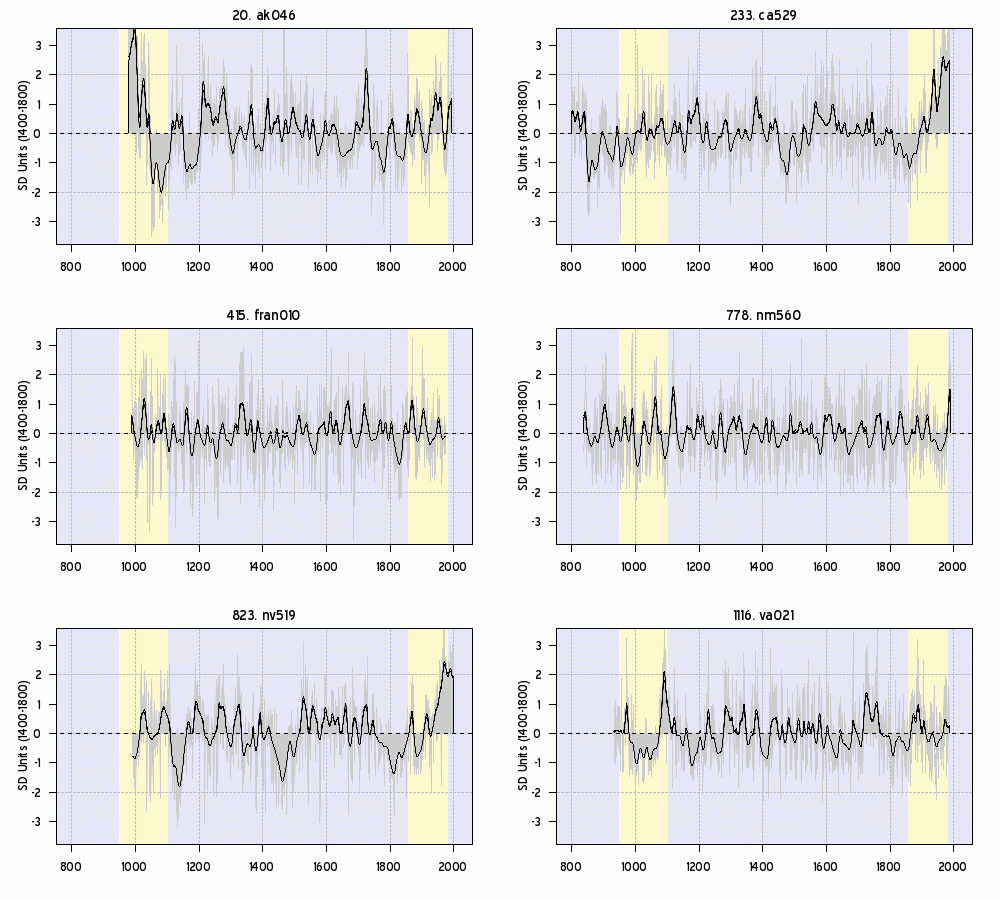
Figure 1. Mann 2008 Dendro proxies standardized to 1400-1980 with 21 year smooth illustrated. Non-infilled. There is one series in the list that doesn’t go back to 1010, but this appears to be an error in the underlying SI and has been left in.
The Pea under the Thimble
The Mann study claims that they can “get” a HS shape without dendro (i.e. without Graybilll bristlecones):
When tree-ring data are eliminated from the proxy data network, a skillful reconstruction is possible only back to A.D. 1500 by using the CPS approach but is possible considerably further back, to A.D. 1000, by using the EIV approach. We interpret this result as a limitation of the CPS method in requiring local proxy temperature information, which becomes quite sparse in earlier centuries. This situation poses less of a challenge to the EIV approach, which makes use of nonlocal statistical relationships, allowing temperature changes over distant regions to be effectively represented through their covariance with climatic changes recorded by the network.
A skillful EIV reconstruction without tree-ring data is possible even further back, over at least the past 1,300 years, for NH combined land plus ocean temperature (see SI Text). This achievement represents a significant development relative to earlier studies with sparser proxy networks (4) where it was not possible to obtain skillful long-term reconstructions without tree-ring data.
But watch the pea under the thimble: the completely defective Korttajarvi sediment chronologies are used in the comparandum series. Yes, the anthropogenically disturbed sediments have a HS pattern, but so what? Surely no one can seriously argue that this presents valid evidence on the modern-medieval differential (whichever way it goes.)
As noted before, in the SI to Mann et al 2008, they purported to account for the defective Korttajarvi sediments by doing a sensitivity analysis without them. But once again, watch the pea under the thimble: the Graybill strip bark chronologies are used in this comparison. Mann et al:
We therefore performed additional analyses as in Fig. S7, but instead compaired the reconstructions both with and without the above seven potentially problematic series [including the four Korttajarvi series], as shown in Fig. S8.
As far as I can tell, this is not a comparison of non-dendro proxies with and without the defective Kortaajarvi series, but before and after of a network which has multiple Graybill bristlecones in the network.
This is what passes as “incontrovertible” evidence in climate science.






BBC "Climate Wars"
A placeholder thread.