As I mentioned before, Hans Erren’s digitization of the Ababneh Sheep Mountain data has prompted me to pick up the MBH files to re-examine the vexed matter of Mann’s CO2 “adjustment”. Each step is fraught with problems. I’m going to try to pull something together listing the steps in the adjustment and the issues involved – but it makes a very long post. Today I’m going to post on one of the later steps in the process, which will also nicely illustrate a point that bender emphasized: that superimposing HS shapes involves only a a couple of degrees of freedom. The superpositions may or may not be “right”, but they have negligible statistical significance – a point that has completely escaped Wahl and Ammann (for example).
Here’s Figure 1b from MBH99, together with its original caption. It purports to show the difference (grey) between the 75-year smooth of an average of Jacoby chronologies in northern North America and a 75-year smooth of the Mannian PC1 (rescaled somehow). I’ll re-visit this calculation on another occasion. The dashed line purports to show the “secular trend” from the difference of the smooths. Again, I’ll revisit this calculation on another occasion.
Here’s what I want you to pay attention to here: the graphic purports to show “relative variations in atmospheric CO2 …for comparison”. The y-axis is labeled only “Relative Amplitude” – an imprecise term that we see often in the Mannian canon. CO2 values are estimated in ppm – so this graph has required a re-scaling and re-fitting of CO2 measurements to fit onto the graphic. But what were the steps? A point that I’d like readers to bear in mind whenever they see one of these re-centering and re-scaling is that re-centering and re-scaling involve the estimation of 2 coefficients. Univariate linear regression also involves the estimation of 2 coefficients: so the types of concerns and caveats involved in estimation of linear regression coefficients carry forward into the estimation of rescaling and recentering values, even if the proponents don’t discuss it.

MBH99 Figure 1b. Residual between the smoothed NT [Jacoby] and ITRDB [MBH PC1] series, and its secular trend (retaining timescales longer than 150 years). Relative variations in atmospheric CO2 since AD 1700 are shown for comparison.
From inspection of MBH98 data at the FTP site of Virginia Mann (no longer online but which I have), I have digital versions of the series used in these plots. The CO2 “version” here starts with CO2 from 1610-1995 measured in ppm (I haven’t verified the provenance of this data yet).. Mann sets a “reference” value of 278.5 ppm, which appears to be drawn from minimum values in his data in the 18th century. He then divides the observed values by the reference and takes the log.. Thus x= log (CO2/278.5)
If these values were plotted up, one gets the following graphic.

Figure 1. Without Rescaling
For the above graphic, there was no effort to rescale the CO2 series to visually match the “residuals”. The most obvious way to re-scale the CO2 to the residual scale is to regress the “target” against the CO2 and then “predict” the target. I do this all the time in experiments and it’s an efficient method. In this case, I didn’t want to change the zero point and so I did the fit without an intercept, just to get a re-scaling coefficient. The code for this type of operation is as follows:
fm=lm(target~logco2-1,data=Z);
predict0=predict(fm,newdata=Z)
These “predicted” values then rescale the log Co2 series to plot in a visually more convenient manner. Good practitioners will typically put a 2nd scale on the other (right) vertical axis so people can tell what’s going on. In this case, a fit based on the period 1700-1980 (and 1700-1995 would be similar) yields the following graphic. This doesn’t look much like the Mannian graphic.
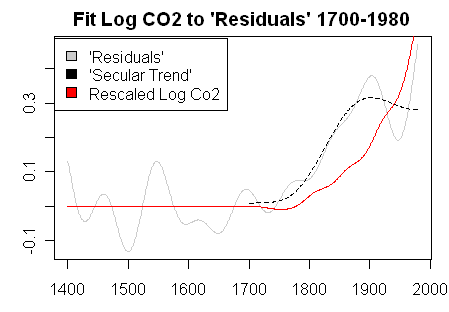
Figure 2. Rescaling based on 1700-1980
The only way that you can re-scale the CO2 series to match the “residuals” as shown in MBH99 Figure 1b is to coerce the fit by limiting the fit to the period 1700-1900. So applying the same re-scaling method, I calculated a re-scaling factor by limiting the regression to the period before 1900 as follows:
fm=lm(target~logco2-1,data=Z[301:501,]);
predict0=predict(fm,newdata=Z)
This yielded the following graphic which is a very close match for the MBH99 Figure 1b (this is not saying that this is “Correct” or that the target “residuals” have any meaning.) I’m just looking at this step.
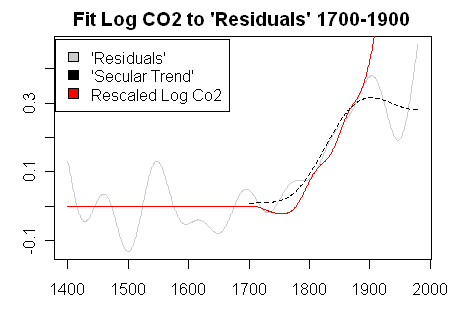
Figure 3. Re-scaling based on 1700-1900
Does this fit have any meaning or significance relative to the fit on the 1700-1980? I don’t think so. From this exercise, Mann concluded in MBH99 the following:
The residual is indeed coherent with rising atmospheric CO2 (Figure 1b), until it levels off in the 20th century, which we speculate may represent a saturation effect whereby a new limiting factor is established at high CO2 levels. For our purposes, however, it suffices that we consider the residual to be non-climatic in nature, and consider the ITRDB PC #1 series “corrected” by removing from it this residual, forcing it to align with the NT series at low frequencies throughout their mutual interval of overlap.
How many issues can one count? If one looks at the “residuals” (whatever they are) there is no leveling off in the 20th century. The “leveling off” occurs only when Mann does a second-stage smoothing. Is the “secular trend” in the residuals something that has any meaning? I ‘d be surprised. And is the residual “coherent” with rising CO2? If you coerce the fit so that the trends match, then it looks coherent. If you don’t coerce the fit, is it coherent? Doesn’t look that way to me. It looks like the residuals increase before the increase in CO2 if one doesn’t coerce the fit to the 19th century.
Does this sort of coerced fit have any statistical meaning? I can’t think of any.
 levels. And in sufficient detail to test my prediction. How do you think that I did on my prediction?









 Climate Audit