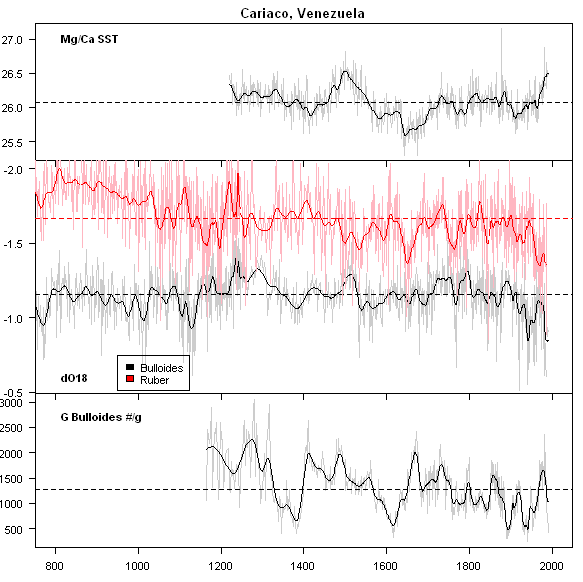
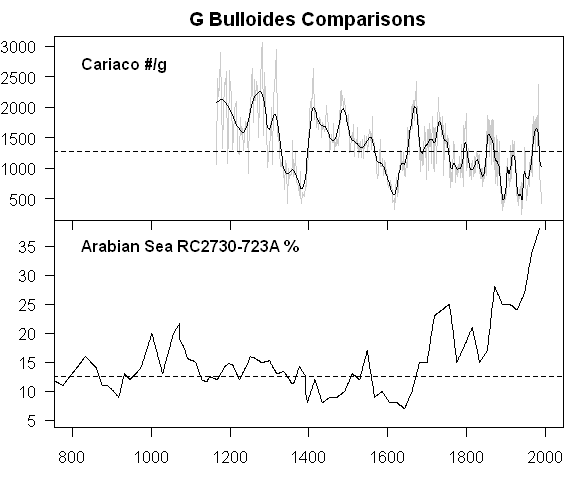
I’ve had a few requests to comment on Eli Rabett’s recent post, observing that he was unable to observe a Medieval Warm Period in the bristlecone chronology reported in Salzer and Hughes 2006.
Looking at the tree ring index one can clearly see many large eruptions, the little ice age, but no European Warm Period, often called medieval.
I can’t think how many times I’ve said that Graybill bristlecone chronologies have a hockey stick shape – which means obviously that they don’t have a MWP. That’s one of the reasons why the Hockey Team is addicted to bristlecone chronologies. Bristlecone and foxtail chronologies are “active ingredients” in virtually all the Team reconstructions.
So one’s first reaction to a bristlecone chronology showing no MWP is – Well, duh.
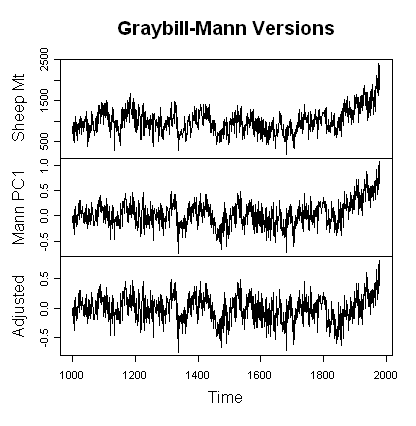
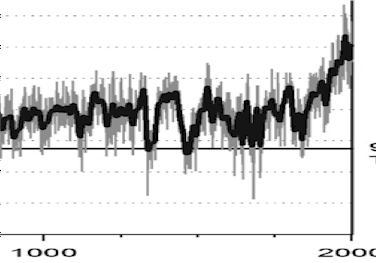
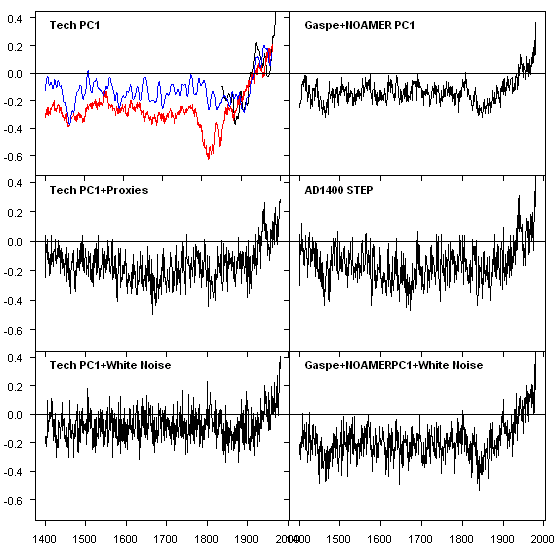
To illustrate this, I’ve shown below three bristlecone versions used in MBH99: on the left, the Sheep Mountain chronology, the Mannian PC1 and the “adjusted” PC1. We compared the Sheep Mountain chronology to the Mannian PC1 in our first submission to Nature in January 2004 observing that the Mannian PC1 was merely an alter ego for Graybill bristlecone chronologies, which were known to be problematic as a temperature proxy. On the right, I’ve shown an excerpt from the new Salzer and Hughes paper. Not much difference.
So to that extent, there’s nothing newsworthy in a bristlecone chronology which doesn’t show a MWP. We already knew that.
Figure 1. Left – Graybill and Mann Versions; right – excerpt from Salzer figure,
The MWP in California
On several previous occasions, I’ve observed that there is very strong paleoclimate evidence for the MWP in California – even, and perhaps, especially in the bristlecone-foxtail areas. Medieval treelines in California were higher than at present, discussed here and here. Post-medieval lakes have even submerged medieval trees. Miller (2006) discussed here and here estimated great warmth in alpine California as follows:
Deadwood tree stems scattered above treeline on tephra-covered slopes of Whitewing Mtn (3051 m) and San Joaquin Ridge (3122 m) show evidence of being killed in an eruption from adjacent Glass Creek Vent, Inyo Craters. Using tree-ring methods, we dated deadwood to 815-1350 CE, and infer from death dates that the eruption occurred in late summer 1350 CE….Using contemporary distributions of the species, we modeled paleoclimate during the time of sympatry [the MWP] to be significantly warmer (+3.2 “C annual minimum temperature) and slightly drier (-24 mm annual precipitation) than present.
Unfortunately, Salzer and Hughes do not discuss and or reconcile any of this literature. Do they disagree with Miller’s analysis? If so, why? And why wouldn’t the reviewers ask them to reconcile their observations with other paleoclimate evidence. But hey, it’s the Team.
Hughes and the Ababneh Thesis
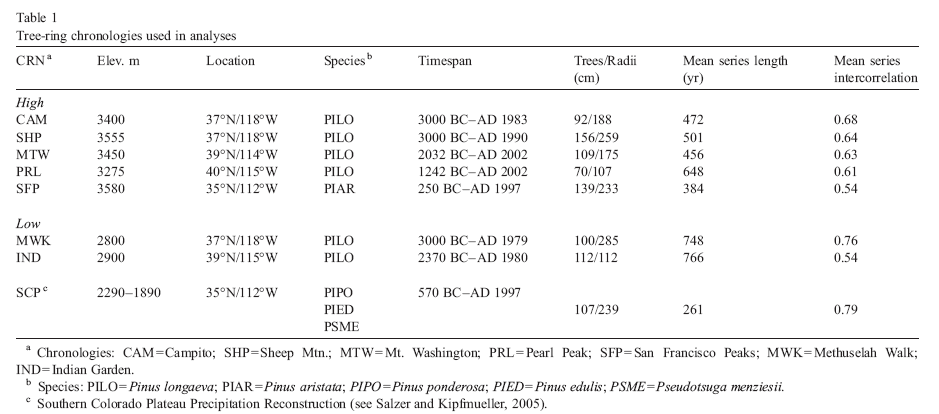
The composite illustrated in Salzer and Hughes is a composite of 5 sites: Sheep Mountain, Campito Mountain, Mt Washington, Pearl Peak and San Francisco Peaks. Methuselah Walk and Indian Garden are also referred to.
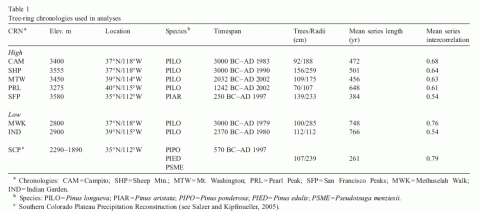
Take a look at the provenance of the series. There are 3 versions that reflect updates: Mt Washington, Pearl Peak and San Francisco Peaks. None of the updates has been archived, even though at least one of the updates is now 10 years old. But look how old the other versions are: Sheep Mountain ends in 1990, Campito in 1983, Indian Garden in 1980, Methesulah Walk in 1979. These are the Graybill versions – Graybill’s Sheep Mountain version being shown above.
But we know that Linah Ababneh updated the Sheep Mountain data in 2002. We also know that Linah Ababneh’s update, aside from finding a difference between strip bark and whole bark chronologies, did not replicate Graybill’s results and had no HS shape whatever. (Figures for Sheep Mountain for strip bark and whole bark from 1600 on are shown separately in the thesis.) So the Sheep Mountain chronology had been updated – why wouldn’t this update have been used, aside from it not having a HS shape?
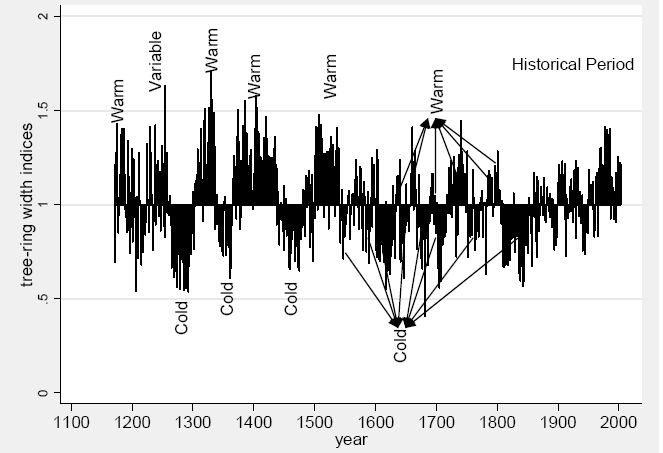
Ababneh Fig. 5. Cold and warm periods as inferred from tree ring widths chronology (Ababneh, 2006, This study) fluctuations above and below the mean after normalizing, whole-bark and strip-bark chronologies are grouped together from two sites Patriarch Grove and Sheep Mountain.
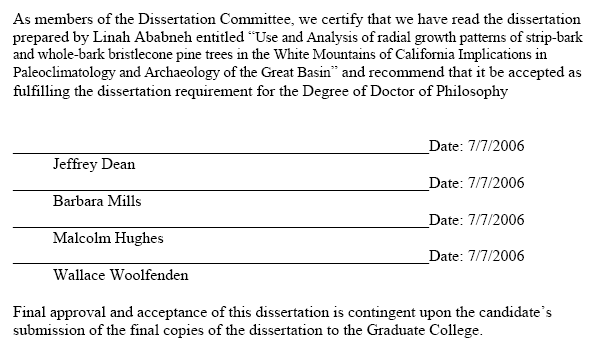
Maybe Rabett would argue that Hughes might have been unaware of the work; or that the work did not meet quality standards. Well, Hughes was not only aware of this work – he (and Jeffrey Dean) was on her Dissertation Committee! Can someone theorize as to a valid reason for not using the Ababneh update? I can’t imagine any.
In passing, I also noticed inconsistencies between the data used for the old Graybill data sets and what has been archived. (Recall the Graybill tags at Almagre where we weren’t able to locate matches in the archive.) At Methuselah Walk and Indian Garden, the number of cores shown in the Salzer and Hughes table exactly matches the number of cores archived at ITRDB. But there a lot more Sheep Mt and Campito Mt cores referred to than archived – the difference may be early crossdated cores that precede the existing archive, but one wonders whether, like Almagre, there are Graybill measurements that have never been archived for reasons that no one knows.
The Ababneh Data
I’ve tried to obtain the Ababneh data without success.
I emailed Linah Ababneh at what appears to be her present posting and got no response. I emailed David Meko of the University of Arizona, who has an excellent record of archiving chronologies and measurements, and inquired about a University of Arizona report by Stockton mentioned in the Ababneh thesis (that bender asked about) and about the Ababneh measurements. I reminded Meko that, in her thesis, she had undertaken to archive the measurements and presumably the university was responsible for ensuring that she completed the commitments in her thesis.
Meko wrote back saying that he had checked around the department and had been unable to locate the Stockton report. He also said that they did not have any of Ababneh’s measurement data and that they had lost track of her. He gave me the name of someone who might know where she was. He agreed that she should archive the data and suggested that I write to the funding agency who might take that into consideration in their grant process – (these are the people who put up with Lonnie Thompson and they’re supposed to take it out on Linah Ababneh? C’mon). He didn’t seem to think that the university had any responsibilities in the matter. He was quite pleasant, and , as I mentioned above, Meko himself has an excellent archiving record.
But what a typical climate science circus. Someone goes out and updates the critical Sheep Mountain data. It doesn’t show a Hockey Stick. Instead of using the updated version, Hughes uses the old version with a HS (doesn’t this sound like Jacoby and D’Arrigo at Gasp” where they withheld an update that didn’t have a HS and refused to give me the update when I learned that they were sitting on a non-HS update.) Now the person who got the data has moved and no one at Arizona has the data.
Is the “professional” standard that Eli Rabett and Tamino are holding out for Pete H and myself? We sure plan to do better than this.



 on
on  extended periodically.